Cam giydirme cepheler ve cephe camlama sistemleri çarpıcı mimari ifadeler yaratır, ancak performansları tamamen aşırı hareketlere uyum sağlaması, hava koşullarına dayanması ve on yıllarca yapısal bütünlüğünü koruması gereken sızdırmazlık sistemlerine bağlıdır. Yetersiz yalıtım, su sızıntısından hava kaçağına ve bina sakinlerini ve yoldan geçenleri tehdit eden cam kırıklarına kadar felaketlere yol açar.
Camlama sistemi gereksinimlerini anlamak ve uygun yapısal ve hava koşullarına dayanıklı yalıtım malzemelerini seçmek, bu çarpıcı cephelerin kullanım ömrü boyunca güvenli ve güvenilir bir şekilde çalışmasını sağlar. İster çöl sıcağında yüksek binalarda, ister tuzlu havaya maruz kalan kıyı yapılarında, isterse de mutlak güvenilirlik gerektiren prestijli projelerde çalışıyor olun, doğru yalıtım, başarı ile pahalı başarısızlık arasındaki farkı yaratır.
Perde Duvar Sistemlerini ve Yalıtım Gereksinimlerini Anlamak
Modern cephe sistemleri, basit pencere duvarlarından karmaşık yapısal camlama sistemlerine kadar uzanır ve her birinin kendine özgü yalıtım ihtiyaçları vardır. Sistem tipinin yanlış anlaşılması, performansı olumsuz etkileyen yanlış dolgu malzemesi seçimi ve uygulama yöntemlerine yol açar.

Perde Duvar Sistemlerinin Çeşitleri
Ahşap iskeletli perde duvarlar Çerçeve elemanlarını ve cam panelleri şantiyede parça parça birleştirin. Bu sistemler, sızdırmazlık gerektiren çok sayıda saha bağlantısı oluşturur. – hem camı çerçevelere bağlayan yapısal bağlantılar hem de çerçeve bölümleri arasındaki hava koşullarına dayanıklı bağlantılar. Şantiye koşulları, kurulum kalitesini doğrudan etkiler., Bu nedenle, uygun dolgu malzemesi seçimi ve uygulama tekniği son derece önemlidir.
Ünitelendirilmiş perde duvarlar Bina cephesine birbirine kenetlenen, önceden monte edilmiş paneller halinde gelirler. Fabrika montajı, panel sızdırmazlığı için daha iyi kalite kontrolü sağlar., Ancak Paneller arası derzlerin sahada sızdırmaz hale getirilmesi gerekmektedir. Yapı toleranslarını ve panel hareketini dikkate alması gereken bir durum. Bu bağlantı noktaları, ahşap iskeletli sistemlerle aynı hava koşullarına maruz kalır. Genel olarak daha az sayıda saha sızdırmazlığı yapılmış bağlantıya sahip olmasına rağmen.
Yapısal camlama sistemleri Yapısal silikon kullanarak, harici baskı plakaları veya kapaklar olmadan camı doğrudan metal çerçevelere yapıştırın. Silikon, birincil yapısal eleman haline gelir. Rüzgar yüklerini, ölü yükleri ve termal gerilimleri camdan çerçeveye aktarmak. Bu durum, katı yapısal gereksinimleri karşılayan sızdırmazlık malzemelerine ihtiyaç duyulmasını gerektirir. Basit hava koşullarına karşı koruyucu ürünlerin çok ötesinde.
Noktasal destekli cam sistemleri Minimum çerçeveleme ile belirli noktalarda mekanik sabitleme elemanları kullanın. Bu sistemlerdeki derz dolgu malzemeleri öncelikle hava koşullarına karşı koruma sağlar. Mekanik bağlantılar ise yapısal yükleri karşılar. Ancak hareket uyumu kritik hale gelir. Çünkü bu sistemler genellikle önemli miktarda ısı hareketine neden olan büyük cam panellere sahiptir.
Kemer altı panelleri ve opak bölümler Perde duvarlarda farklı malzemeler (metal, taş, kompozit paneller) kullanılabilir. Birbirine uyumlu sızdırmazlık malzemeleri gerektiren, farklı malzemelerin bir arada kullanıldığı derzler oluşturulması. Cam ve opak bölümler arasındaki bu geçişler genellikle gerilimi yoğunlaştırır ve zorlu sızdırma koşulları yaratır.
Yapısal ve Su Geçirmezlik Sızdırmazlık Malzemeleri Arasındaki Fark
Perde duvar yalıtımında en önemli ayrım, yük taşıyan yapısal yalıtım malzemeleri ile sadece hava ve su sızmasını önleyen hava koşullarına dayanıklı yalıtım malzemeleri arasında yatmaktadır.

Yapısal sızdırmazlık malzemeleri mutlak:
- Rüzgar yüklerini aktarın camdan destek çerçevesine kadar arızasız
- Camın ölü ağırlığını destekleyin belirli konfigürasyonlarda
- Bağ gücünü koruyun dinamik yükleme ve yorgunluğa rağmen
- Harekete uyum sağlamak termal genleşme ve bina deformasyonundan
- Hava koşullarına dayanıklıdır. 20-30+ yıl hizmet ömrü boyunca mukavemet kaybı olmadan
- Titiz test standartlarını karşılayın yapışma, kohezyon ve dayanıklılık gereksinimleri dahil
Bu zorlu gereksinimleri yalnızca özel olarak formüle edilmiş yapısal silikonlar karşılayabilir. Standart hava koşullarına karşı koruyucu sızdırmazlık malzemeleri, gerekli mukavemete, dayanıklılığa ve test doğrulamasına sahip değildir. yapısal uygulamalar için. Yapısal uygulamalarda yapısal olmayan ürünlerin kullanılması, can güvenliği açısından tehlike oluşturur.
Su geçirmezlik malzemeleri mutlak:
- Su sızıntısını önleyin Sağanak yağmura rağmen cephe derzlerinden içeri girebiliyor.
- Hava bariyerlerini koruyun. enerji kaybını ve yoğuşmayı azaltmak
- Harekete uyum sağlamak sızıntı oluşmadan
- UV ışınlarına ve hava koşullarına dayanıklıdır. on yıllar boyunca esnekliği korumak
- Uyumluluğu koruyun bitişik malzemeler ve sızdırmazlık malzemeleri ile
Kaliteli hava koşullarına karşı koruyucu dolgu malzemeleri, yapısal ürünlere göre daha düşük maliyetle güvenilir performans sağlar., Doğru ayrımı yapmak hem güvenlik hem de ekonomi açısından önemlidir.
Hareket ve Stresle İlgili Hususlar
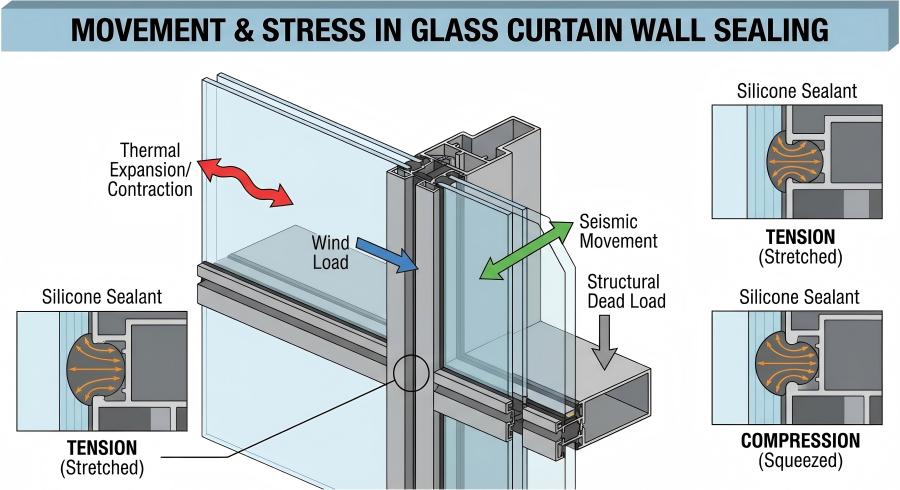
Cam cepheler, birden fazla kaynaktan gelen olağanüstü hareketlere maruz kalır ve sızdırmazlık malzemeleri bu hareketlere uyum sağlamalıdır.
Cephe derz tasarımında termal genleşme belirleyici faktördür. Çöl güneşinde koyu renkli camın dış sıcaklığı 80°C'ye ulaşabilirken, iç yüzeylerin sıcaklığı 20°C veya daha düşük kalır., 60°C veya daha fazla sıcaklık farkı yaratmak. Alüminyum çerçeveler, °C başına yaklaşık 23 × 10⁻⁶ oranında genleşir. – 10 metrelik bir çerçeve bölümü, 50°C'lik sıcaklık değişimine maruz kaldığında 11,5 mm genleşir. Cam, alüminyumdan daha az genleşir (°C başına 9 × 10⁻⁶)., Aynı düzenek içinde farklı hareketler yaratmak.
Rüzgar yükünden kaynaklanan bina deformasyonu Eklem hareketine ek katkı sağlar. Yüksek binalar, şiddetli rüzgarlarda belirgin şekilde esner., Üst katlarda alt katlara göre daha fazla yer değiştirme yaşanmaktadır. Katlar arası perde duvar derzleri bu kat kaymasını dikkate almalıdır. Bu kalınlık, uzun ve ince binalarda 10-15 mm veya daha fazla olabilir.
Canlı yüklerden kaynaklanan hikaye kayması ve bina yerleşimi Rüzgarın neden olduğu sapmanın ötesinde uzun vadeli hareketler yaratır. Binalar yerleştikçe ve canlı yükler yeniden dağıldıkça, Katlar arası ölçülerde hafif değişiklikler olur. Birden fazla katı kapsayan perde duvarlar bu hareketleri karşılamalıdır. Aksi takdirde conta arızası ve cam kırılması riskiyle karşı karşıya kalırsınız.
Deprem bölgelerindeki sismik hareket Hızlı ve büyük yer değiştirmeleri karşılayabilecek bağlantı noktaları gerektirir. Yapı yönetmelikleri deprem kaynaklı yer değiştirme gereksinimlerini belirtir. Bu durum, önemli eklem hareket taleplerine dönüşmektedir. Deprem bölgelerindeki sızdırmazlık malzemeleri, yer değiştirme döngüleri boyunca bütünlüklerini korumalıdır. Statik hareket kabiliyetinin önerdiğinin ötesinde.
Birleşik hareketler, geniş güvenlik önlemleri gerektirir. Eklem tasarımı, beklenen tüm hareketlerin toplamını karşılayacak şekilde olmalıdır. Beklenmedik durumlar için ek bir güvenlik payı. Muhafazakar tasarım, contanın aşırı gerilmesini önler. Bu durum, erken arızaya neden olur.
Yapısal Silikon Seçimi ve Gereksinimleri
Yapısal camlama sistemleri, hava koşullarına karşı koruma ürünlerinin çok ötesinde, titiz performans standartlarını karşılayan sızdırmazlık malzemeleri gerektirir. Bu gereksinimleri anlamak, tehlikeli şartname hatalarını önler.
Yapısal Silikon Performans Standartları
ASTM C1184 Cam yapıştırma uygulamaları için yapısal silikon mastik gereksinimlerini tanımlar. Ürünler şu özellikleri göstermelidir:
- Cam, metal ve diğer yüzeylere yapışma titiz test protokolleri aracılığıyla
- Minimum çekme dayanımı ve uzama Yeterli yük kapasitesini sağlayan gereksinimler
- Hava koşullarına dayanıklılık Hızlandırılmış yaşlandırma yoluyla uzun vadeli dayanıklılık sergiliyor.
- Uyumluluk cam türleri, çerçeve kaplamaları ve diğer yapı malzemeleriyle birlikte
- Kalite kontrol standartları üretim tutarlılığı için
Avrupa standartları EN 15434 Bölgesel farklılıklarla benzer gereksinimler sağlayın. Farklı pazarlardaki projeler farklı standartlara atıfta bulunabilir., Ancak temel performans gereksinimleri benzer kalmaktadır: yapısal kapasite, dayanıklılık ve uyumluluk.
Yapısal uygulamalar için test gereksinimleri şunlardır:
Yapışma testi to all substrates in the actual assembly. Testing must use the specific glass type, metal coating, gaskets, and other materials present in the project rather than generic substrates. This testing accounts for coating systems, primers, and surface treatments that may affect bond strength.
H-shaped tensile specimens test structural sealant under stress geometries mimicking actual use. These tests quantify sealant strength and elongation under controlled conditions. Minimum performance thresholds must be met or exceeded for structural qualification.
Cyclic fatigue testing subjects sealant to repeated loading simulating years of service. Wind loading isn’t static – it cycles constantly. Sealants must maintain strength through hundreds of thousands of cycles without degradation. This testing reveals fatigue issues that static testing might miss.
Weathering chambers expose test specimens to accelerated UV, heat, humidity, and thermal cycling. Post-weathering testing verifies the sealant maintains required properties after simulated long-term exposure. Products showing significant property loss fail qualification regardless of initial performance.
Structural Silicone Bite and Joint Design
“Bite” refers to the width of structural silicone bonding glass to frame. Adequate bite ensures sufficient bond area to safely transfer loads without overstressing the sealant.
Minimum bite requirements typically range from 6-12mm depending on:
- Glass panel size and weight – larger, heavier panels need more bite
- Wind loading – higher wind zones require greater bite for wind resistance
- Sealant properties – higher strength sealants may allow reduced bite
- Safety factors – conservative designs use greater bite for margin
However, maximum bite also exists. Very thick sealant sections (over 25mm) may not cure completely in reasonable time frames, and thick sections concentrate thermal stress. Typical structural applications use 8-15mm bite, balancing strength needs against practical limitations.
Structural joint depth should equal joint width (1:1 ratio) for optimal stress distribution. Deeper joints don’t improve performance meaningfully and complicate application, while shallow joints concentrate stress reducing effective strength.
Edge clearance between glass edge and back of frame affects structural performance. This dimension must accommodate glass manufacturing tolerance, thermal expansion, and installation alignment while maintaining minimum structural bite. Insufficient clearance causes glass edge loading that may lead to breakage.
Load Calculations and Safety Factors
Structural glazing design requires engineering calculations verifying sealant adequacy for actual loading conditions. These calculations aren’t optional – building codes require them.
Dead load from glass weight acts constantly on horizontal structural joints. Sealant must support this load indefinitely without creep or failure. Even vertical joints experience some dead load component from wind suction effects that create horizontal loads on glass.
Wind load creates the primary structural demand in most facades. Design wind pressures vary by location, building height, and exposure. High-rise buildings in exposed locations may experience wind pressures exceeding 3-5 kPa. Sealant joint design must handle these pressures with adequate safety factors.
Safety factors typically range from 4:1 to 6:1 for structural glazing. This means design strength should be 4-6 times calculated loads. These conservative factors account for:
- Material property variations in production
- Installation quality variations in field conditions
- Unexpected loading beyond design assumptions
- Long-term property changes despite weathering testing
- Consequences of failure justifying conservative design
Professional structural engineers should perform and stamp these calculations. Contractors or installers shouldn’t attempt structural design without appropriate engineering expertise and professional liability coverage.
Weatherproofing Sealant Selection
While structural silicones carry loads in structural glazing, all curtain wall systems require weatherproofing sealants preventing water and air infiltration. These products face demanding conditions without the structural loads.
Requirements for Curtain Wall Weathersealing
Movement capability determines weatherseal success. Quality curtain wall sealants provide ±50% movement capability to accommodate the substantial thermal movement and building deflection these systems experience. Products rated for only ±25% movement prove inadequate for many curtain wall applications.
UV resistance separates premium from standard products. Facade sealants receive intense, direct UV exposure throughout their service life. Products without adequate UV stabilizers chalk, crack, and lose elasticity within 5-10 years. Premium products maintain performance for 20-30+ years despite continuous UV bombardment.
Water resistance under pressure goes beyond simple water immersion testing. Driving rain creates hydrostatic pressure forcing water into joints. Sealants must maintain watertight barriers despite sustained pressure from wind-driven rain. Standard test methods specify pressure resistance requirements that quality products must meet.
Compatibility with substrates and adjacent materials prevents the problems that incompatible products create. Neutral-cure silicones provide the broadest compatibility with aluminum, glass, coatings, and gaskets common in curtain walls. Acetic-cure products risk corrosion on sensitive metals and shouldn’t be used in curtain wall applications.
Silicone Weatherseals: Premium Performance
High-quality neutral-cure silicone sealants dominate curtain wall weatherproofing for excellent reasons. Their combination of movement capability, UV resistance, and longevity makes them ideal despite higher initial cost.
Gibi ürünler BoPin 770 Hava Koşullarına Dayanıklı Nötr Silikon provide weatherseal performance curtain walls demand – ±50% movement capability, service temperatures from -40°C to +150°C, and excellent UV resistance for decades of exposure. For critical facade applications, quality silicones represent the best value through their extended service life.
Key silicone advantages for curtain walls:
- Aşırı sıcaklık aralığı handles desert heat, arctic cold, and everything between
- Superior UV resistance prevents premature aging from intense sun exposure
- Excellent movement capability accommodates thermal expansion and building deflection
- Uzun hizmet ömrü – 20-30+ years reduces lifecycle costs despite higher initial price
- Broad compatibility with aluminum, glass, and coatings
- Proven track record in thousands of successful curtain wall projects globally
Silicone considerations:
- Not paintable – color selection at installation is permanent
- Higher material cost – though lower lifecycle cost
- May attract dirt in pollution-prone environments
- Requires proper primers on some substrates for optimal adhesion
MS Polymer Alternative Solutions
MS polymer sealants provide alternative solutions where silicone’s limitations create problems or specific MS advantages matter.
MS polymer benefits for curtain walls:
- Kürlendikten sonra boyanabilir – allows color matching or changes
- Lower dirt pickup – cleaner appearance in polluted urban environments
- Good movement capability – ±50% in quality products like BoPin MS-220
- Mükemmel yapışma without primers in many applications
- Daha düşük maliyet than premium silicones
MS polymer considerations:
- Temperature range – typically -40°C to +90°C, narrower than silicones
- UV direnci – good but generally not quite matching premium silicones
- Newer technology – less long-term field data than silicones
- Not suitable for structural applications
MS polymers work well for curtain wall weathersealing in moderate climates and where paintability or cost considerations make silicones less attractive. For extreme exposure or critical applications, silicones generally prove more reliable long-term.
Climate-Specific Curtain Wall Considerations
Environmental conditions dramatically affect curtain wall sealant performance. Understanding regional challenges ensures appropriate product selection and application methods.
Desert Climate Facades
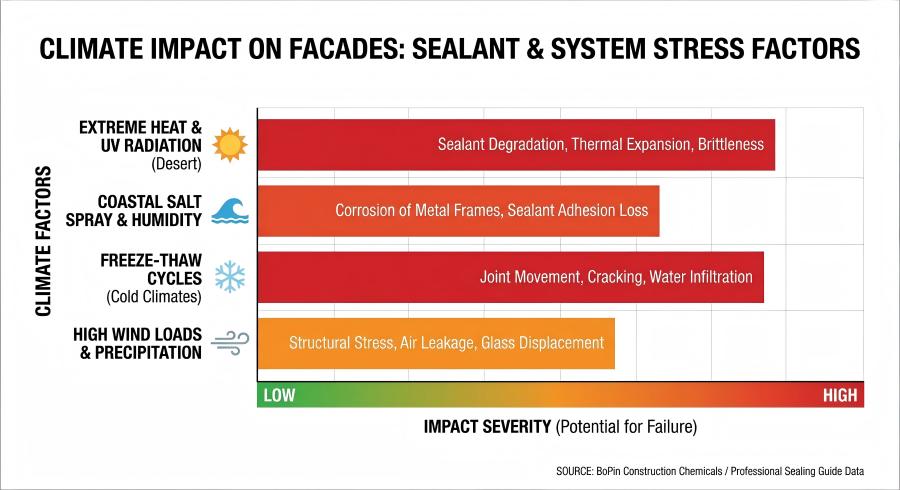
Extreme heat and intense UV challenge glass facades in Middle Eastern and North African climates. Surface temperatures on dark glass and aluminum frames routinely exceed 70-80°C in peak summer sun.
Critical desert climate factors:
Temperature extremes demand sealants with maximum temperature resistance. Standard products rated to +100°C may approach their limits on dark-colored facades in extreme heat. Premium silicones rated to +150°C provide necessary margin for reliable performance.
Intense UV exposure at near-equatorial latitudes accelerates sealant aging. Without exceptional UV stabilizers, sealants degrade rapidly – chalking and cracking within 5-10 years instead of lasting 20-30+ years. This makes UV resistance non-negotiable for desert facade applications.
Extreme thermal cycling from 70°C+ afternoon to 20-30°C overnight creates constant movement. Daily temperature swings of 40-50°C drive joint movement every single day throughout the building’s life. Sealants must handle this cycling without fatigue or adhesion loss.
Dust and sand contaminate surfaces and interfere with adhesion if not properly removed. Surface preparation becomes more challenging in dusty desert conditions. Work timing to avoid windy periods and thorough cleaning before application prove essential.
Application timing becomes critical in desert heat. Work during morning hours before extreme heat builds. Attempting to seal surfaces at 60-70°C creates application problems and risks adhesion failure. Morning applications allow cure before afternoon heat arrives.
Tropical Climate Facades
High humidity, driving rain, and biological growth create different challenges in tropical regions like Southeast Asia.
Tropical climate considerations:
Driving rain from monsoons creates severe water infiltration pressures. Curtain wall joints must resist sustained, high-pressure water exposure during storm events that may last hours or days. Premium weatherseals with proven pressure resistance become essential, not optional.
High humidity affects moisture-cure sealants positively by accelerating cure but also creates higher mold and algae growth potential on sealant surfaces. Anti-fungal additives in sealants help prevent unsightly biological growth, especially on shaded facade areas.
Coastal proximity in many tropical locations adds salt exposure to humidity and rain. Salt spray accelerates corrosion of aluminum frames and may affect some sealant types. Neutral-cure silicones generally handle salt exposure well, but verify compatibility for critical coastal projects.
Constant moisture complicates surface preparation. Substrates may never feel completely dry despite appearing clean. Use of moisture meters to verify dryness and primers on damp surfaces ensures proper adhesion despite challenging conditions.
Year-round UV exposure at high intensity demands excellent UV resistance. Unlike seasonal climates where UV intensity varies, tropical locations maintain intense sun throughout the year. Sealant UV protection must handle this constant exposure.
High-Altitude and Temperature-Cycling Environments
Mountain and high-altitude buildings face unique combinations of cold, intense UV, and rapid temperature changes.
High-altitude challenges:
Intense UV despite cold temperatures creates unusual stress combinations. Thin atmosphere provides less UV filtration, increasing radiation intensity significantly. Sealants must excel in both cold performance and UV resistance – a combination some products handle better than others.
Rapid temperature swings from freezing mornings to warm afternoons create daily thermal cycling. Movement from these swings accumulates throughout the year stressing sealant joints through countless cycles. Premium products with proven cycling resistance prove essential.
Lower atmospheric pressure may affect some sealant cure mechanisms slightly. Test products at project altitude if possible to verify expected performance rather than assuming sea-level behavior translates directly.
Installation and Quality Control
Even the best products fail without proper installation. Curtain wall sealing demands rigorous quality control throughout the process.
Surface Preparation Standards
Curtain wall sealant substrates must meet higher cleanliness standards than most applications. The long-term loads and exposure curtain walls face don’t forgive poor preparation.
Aluminum frame cleaning requires complete removal of mill oils, cutting fluids, and handling contaminants. Two-solvent cleaning method – first solvent removes oils, second solvent removes residue from first – ensures truly clean surfaces. Isopropyl alcohol followed by clean cloth wipes works for most situations.
Glass edge preparation for structural glazing demands especially rigorous attention. Any contamination between glass and structural silicone risks bond failure. Factory edge treatment provides best results, but field-applied glass must be cleaned to the same standards regardless of difficulty.
Primers when specified must be applied correctly. Proper coverage, adequate dry time, and working within primer’s open time all affect final bond strength. Don’t skip primers on substrates where specified – they’re specified for good reasons based on testing.
Environmental conditions during preparation matter significantly. Temperature, humidity, and precipitation all affect preparation quality. Work during optimal conditions when possible, and use environmental controls (temporary enclosures, heaters, dehumidifiers) when conditions aren’t naturally ideal.
Application Technique for Curtain Wall Sealing
Proper application technique ensures sealants perform as designed throughout their service life.
Joint preparation includes installing backer rod or bond breakers preventing three-sided adhesion. Closed-cell backer rod sized appropriately (25% larger than joint width) provides correct sealant depth and geometry. Don’t omit backer rod to save time or cost – improper joint geometry causes premature failure.
Sealant application should create consistent, void-free beads completely filling joints. Apply slightly overfilled, then tool to final profile ensuring no voids or gaps remain. Work methodically without rushing – voids created during application can’t be fixed after curing.
Tooling creates proper sealant profile and ensures intimate substrate contact. Tool while sealant remains workable – after skinning begins, tooling becomes difficult and may damage the forming seal. In hot weather, complete tooling within 10-15 minutes of application before surface cure interferes.
Structural silicone cure time before glass loading varies by product and conditions. Typical requirements range from 7-21 days depending on sealant thickness, temperature, and humidity. Don’t rush structural cure – premature loading may damage developing bonds.
Weather protection during cure prevents contamination or water damage to fresh sealant. Protect work areas from rain, dust, and construction debris during the critical first 24-48 hours minimum. For structural applications, protection may be needed for the entire cure period.
Quality Assurance and Testing
Curtain wall projects warrant rigorous quality assurance beyond typical construction. The life-safety implications justify extra attention.
Mock-up testing before full production provides confidence that design works in practice. Full-scale mock-ups subjected to air, water, and structural testing verify that details perform as intended. Problems discovered in mock-ups cost far less to fix than the same problems in installed facades.
Yapışma testi during production verifies proper installation. Pull tests on sacrificial samples confirm adhesion to actual project materials prepared and applied under actual conditions. Testing should occur at regular intervals throughout the project, not just initially.
Air and water testing of completed facade sections confirms weatherproofing effectiveness. Positive and negative pressure testing simulates wind conditions while water spray replicates driving rain. Testing reveals installation problems before they cause interior damage or expensive remediation.
Görsel inceleme catches obvious problems before they worsen. Regular inspection during installation allows corrections while work progresses. Final inspection before closeout documents project completion and establishes baseline for future maintenance.
Maintenance and Lifecycle Management
Proper maintenance extends curtain wall sealant life significantly and prevents minor issues from becoming major problems. The accessibility challenges facades present make proactive maintenance especially important.
Inspection Frequency and Procedures
Annual visual inspections from ground level catch obvious problems. Use binoculars or telephoto photography to inspect higher facades without requiring expensive access equipment. Look for visible gaps, staining indicating water infiltration, or obvious deterioration.
Close-up inspections every 5 years using swing stages or other access equipment allow detailed examination. Check sealant adhesion, flexibility, and surface condition up close. These detailed inspections reveal problems developing before they become obvious from ground level.
Post-storm inspections after severe weather events identify acute damage. High winds may damage sealant joints or dislodge panels requiring immediate repair. Don’t wait for scheduled inspections if severe weather suggests possible damage.
Common Failure Modes
Understanding typical failure patterns helps diagnose problems and select appropriate repairs.
Adhesion loss – sealant separating from substrate – usually stems from contaminated surfaces during installation or incompatible products. Proper repair requires complete removal and surface re-preparation before new sealant application.
Bütünleşik başarısızlık – sealant tearing internally – indicates movement exceeding capability or material degradation. Joints may need redesigning to wider dimensions accommodating actual movement, using higher-movement sealants, or both.
UV degradation appears as surface chalking, hardening, or cracking. Once advanced UV damage occurs, complete replacement is necessary. Prevention through proper product selection proves far more economical than premature replacement.
Structural silicone failure demands immediate engineering assessment. Glass panels supported by structural silicone showing bond degradation create life-safety hazards. Professional evaluation and emergency stabilization must precede permanent repairs.
Sıkça Sorulan Sorular
What’s the difference between structural and non-structural glazing sealants?
Structural sealants carry actual loads from glass to frames and must meet rigorous testing standards (ASTM C1184, EN 15434) for strength, durability, and adhesion under stress. Non-structural weatherproofing sealants simply prevent air and water infiltration without carrying loads. Using non-structural products in structural applications creates dangerous situations where glass may fall from facades. Only specially formulated and tested structural silicones should be used for load-bearing applications, while weatherproofing can use a broader range of sealant types.
How long do curtain wall sealants last?
Quality silicone sealants properly selected and applied typically last 20-30+ years in curtain wall applications. Actual lifespan varies dramatically based on climate, exposure, and application quality. Desert climates with extreme UV and heat may reduce life 20-30%, while protected applications may exceed typical lifespans. Regular inspection every 5 years allows assessment of actual condition rather than assuming predetermined replacement schedules. However, plan for eventual replacement – no sealant lasts forever regardless of quality.
Can I use MS polymer instead of silicone for curtain walls?
MS polymer sealants work well for curtain wall weathersealing in moderate climates and applications where paintability matters. However, MS polymers should NOT be used for structural glazing applications – only structural silicones meet the required performance standards for load-bearing glass bonding. For weathersealing in extreme climates (desert heat, arctic cold), silicones generally prove more reliable than MS polymers due to wider temperature range and superior UV resistance. In moderate climates for weathersealing only, MS polymers provide excellent value.
How do I calculate if my structural silicone joint is adequate?
Structural glazing design requires professional engineering calculations accounting for glass weight, wind loads, safety factors, sealant properties, and joint geometry. These calculations verify that sealant bite (width), depth, and overall joint design provide adequate strength with appropriate safety factors (typically 4:1 to 6:1). Contractors or installers should not attempt these calculations without appropriate engineering expertise. Hire qualified structural engineers who will perform calculations, stamp drawings, and take professional liability for the design.
What maintenance do glass facades require?
Annual visual inspections from ground level identify obvious problems, with detailed close-up inspections every 5 years using access equipment to examine sealant condition, adhesion, and flexibility. Clean facades regularly to remove pollutants that may attack sealants and check drainage to prevent water ponding near sealed joints. Address minor problems immediately – small gaps or adhesion loss are inexpensive to repair when caught early but become major issues if ignored. Plan for eventual complete re-sealing typically 20-30 years after initial construction as part of long-term building maintenance budgets.
Çözüm
Glass curtain walls and facade glazing systems create striking architecture but demand professional-grade sealing systems far beyond typical construction applications. The combination of structural loads, extreme movement, harsh weathering, and life-safety implications makes proper sealant selection and installation absolutely critical.
Understanding the distinction between structural and weatherproofing applications prevents dangerous specification errors. Only rigorously tested structural silicones belong in load-bearing applications, while weathersealing can use a broader range of products based on movement requirements, climate exposure, and compatibility needs.
Climate conditions dramatically affect product selection and expected service life. Desert heat, tropical humidity, and high-altitude UV exposure each demand specific product characteristics and application adjustments. Products succeeding in temperate climates may fail rapidly in extreme conditions without proper specification.
Proper installation proves as important as correct product selection. Rigorous surface preparation, proper joint geometry, correct application technique, and adequate cure time all contribute to long-term success. Shortcuts during installation cause premature failures regardless of product quality.
Quality assurance through mock-up testing, production adhesion testing, and performance testing verifies that designs work in practice. The investment in proper QA proves minuscule compared to costs of repairing improperly installed curtain walls.
Regular maintenance and inspection extend sealant life and catch developing problems before they escalate. Annual visual inspections supplemented by detailed examinations every 5 years allow proactive repairs maintaining performance throughout the facade’s service life.
Glass facades represent major architectural and financial investments demanding proper sealing systems that match the quality and performance of the glazing itself. Using premium products, following rigorous installation standards, and maintaining properly ensures these dramatic systems perform reliably for decades.
Working on curtain wall or glazing projects and need expert guidance on structural or weatherproofing sealants? Contact our technical team for professional support on product selection, testing requirements, and application specifications suited to your specific project.
İlgili Makaleler: