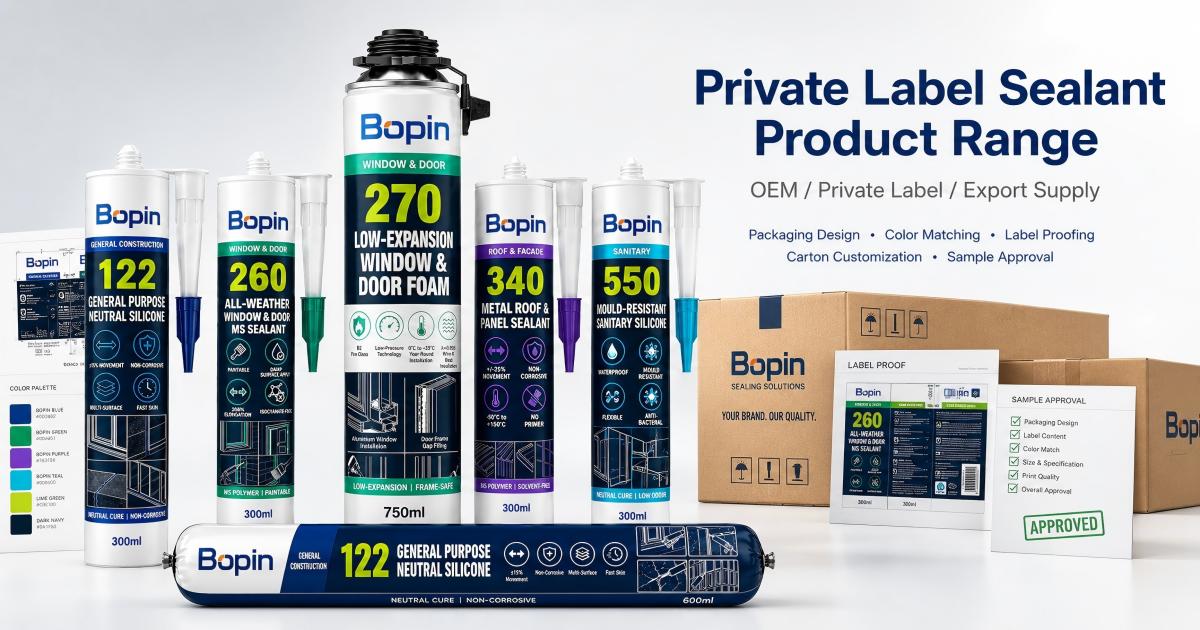
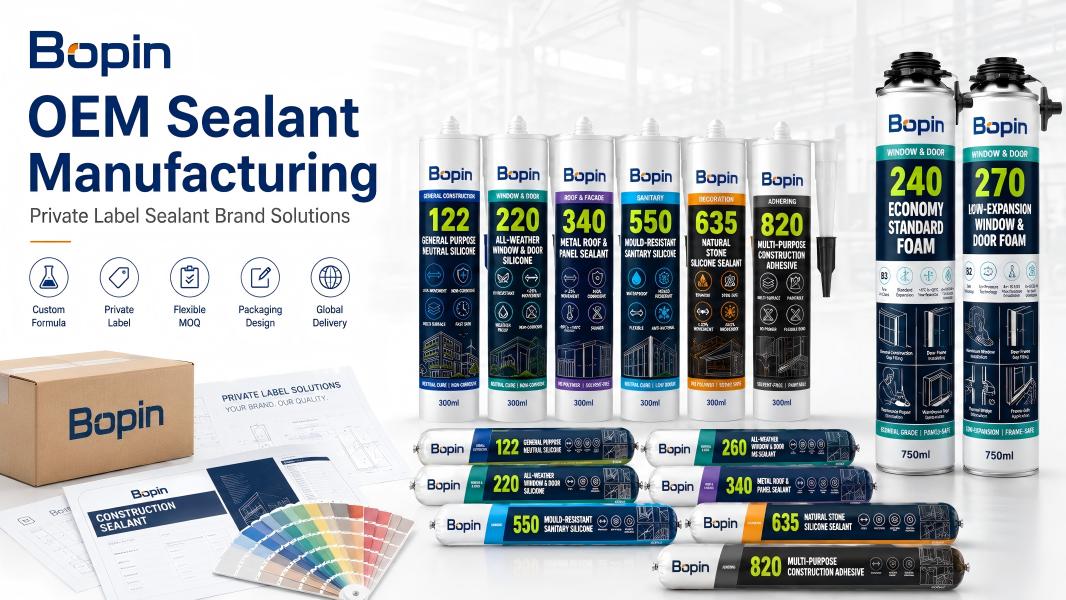
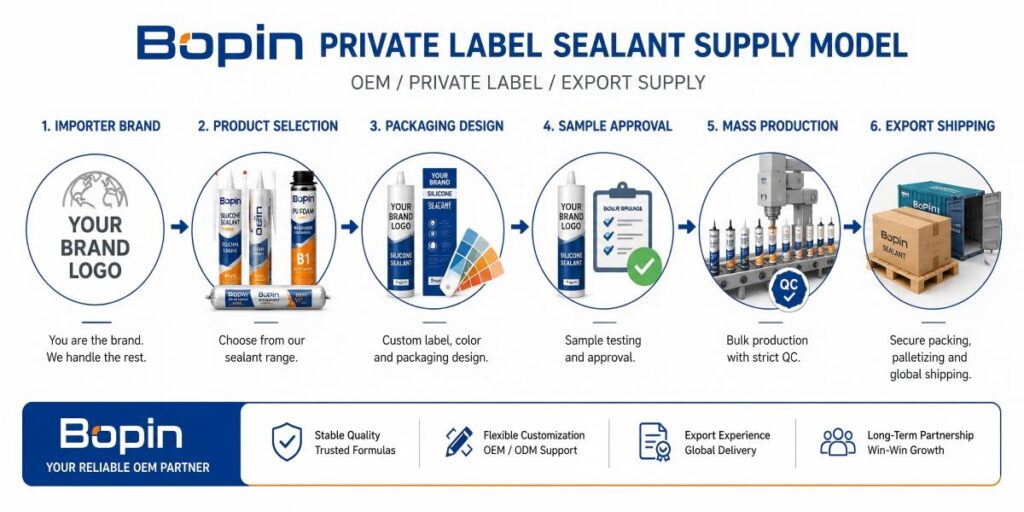
Private label sealant can be a smart way for importers, distributors and building material wholesalers to build their own product range without investing in a factory.
Instead of selling only generic products, you can create a sealant brand with your own logo, packaging design, product names, color system and market positioning. This gives you better control over your sales channel, pricing structure and customer recognition.
However, a private label sealant order is not only about printing your brand name on a cartridge. Before placing an OEM order, importers need to prepare product requirements, packaging details, technical expectations, sample testing plans and shipping information.
This guide explains what importers should prepare before ordering private label sealants from a manufacturer or export supplier.
What Is Private Label Sealant?
Private label sealant means sealant products manufactured by a supplier but sold under your own brand name.
The supplier provides the product formula, production capacity, filling, packaging and export support. The importer provides the brand identity, local market requirements and sales direction.
Private label sealants may include:
- Selantes de silicone
- Neutral cure sealants
- Sanitary silicone
- Acrylic sealants
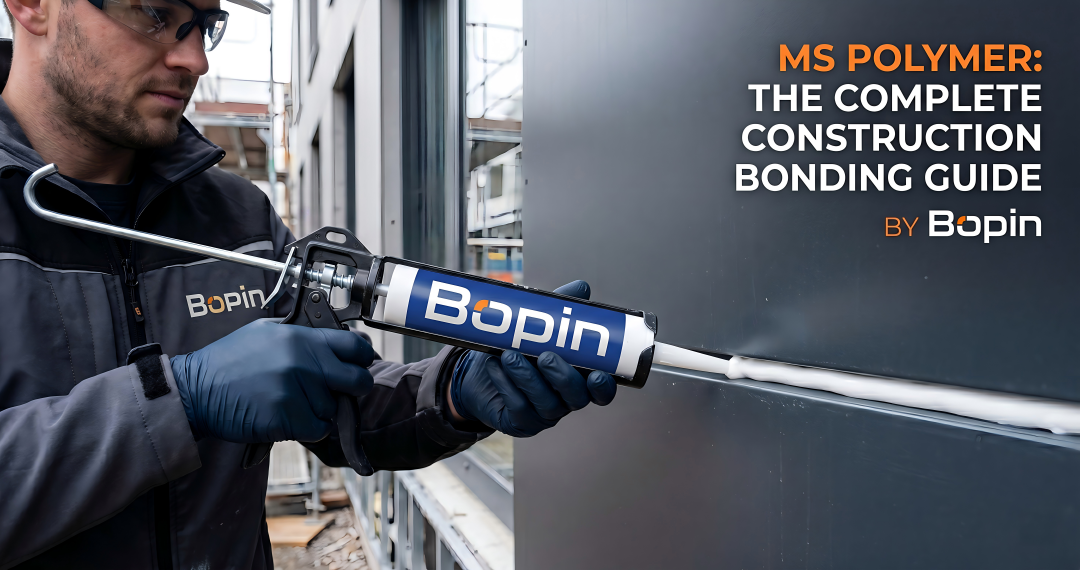
- Selantes de polímero MS
- PU expanding foam
- Construction adhesives
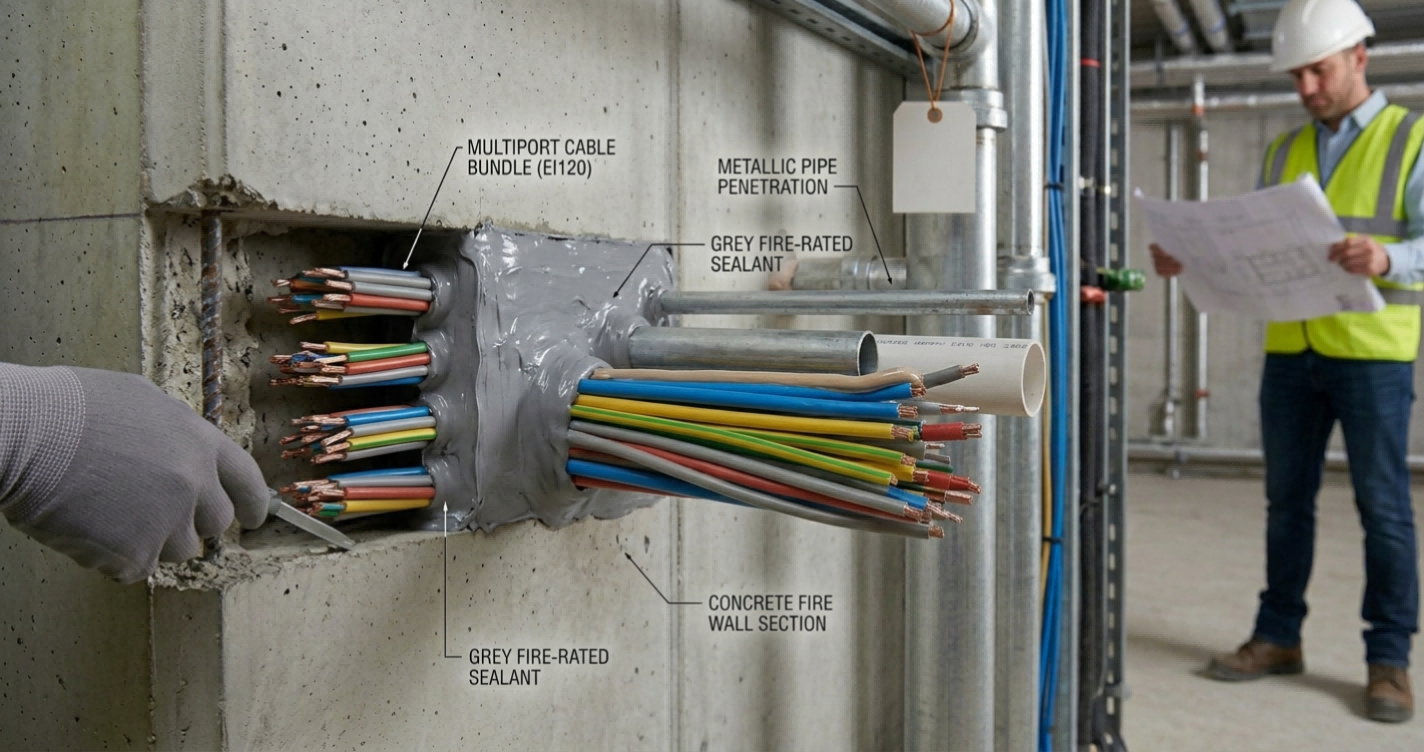
- Fire-rated sealants
- Facade and roofing sealants
For importers, private label sealant is useful because it allows you to build a product line that matches your local market instead of only reselling another supplier’s brand.
Why Importers Choose Private Label Sealants
Many importers choose private label sealants because the market for construction materials is highly competitive. If you sell the same product as many other distributors, it is difficult to build long-term customer loyalty.
A private label range helps you create your own identity in the market.
Main benefits include:
- Stronger brand recognition
Your customers remember your product name and packaging. - Better profit control
You can build your own pricing structure instead of competing only on supplier brand prices. - More suitable product positioning
You can select economy, standard, professional or premium products for different channels. - Flexible packaging design
Your packaging can match local languages, contractor habits and retail shelf requirements. - Long-term customer loyalty
If the quality is stable, contractors and retailers are more likely to repeat purchase from your brand.
Private label is especially suitable for building material distributors, hardware wholesalers, construction chemical importers and project supply companies.
1. Define Your Target Market First
Before ordering private label sealants, you should first define your target market.
Different markets need different products. A market focused on residential decoration may need selantes acrílicos and sanitary silicone. A market focused on window installation may need neutral silicone, MS polymer sealant and PU foam. A market focused on facade or roofing projects may need weather-resistant facade sealant, metal roof sealant and high-performance construction adhesive.
You should answer these questions before selecting products:
- Who are your main customers?
- Are you selling to retailers, wholesalers, contractors or project buyers?
- What are the most common applications in your market?
- Is your market price-sensitive or quality-focused?
- Do customers prefer 300ml cartridges, 600ml sausage packs or aerosol cans?
- Are local projects mainly residential, commercial or industrial?
- Is your market hot, humid, coastal, cold or high-UV?
- Do customers need local language labels or bilingual packaging?
A clear target market helps you avoid choosing too many random products.
2. Prepare a Product List
A private label project should start with a clear product list.
Some importers already know exactly what they need. Others only know they want to start a sealant brand but are not sure which products should be included.
For a new private label sealant brand, it is better to start with a focused product range rather than too many SKUs.
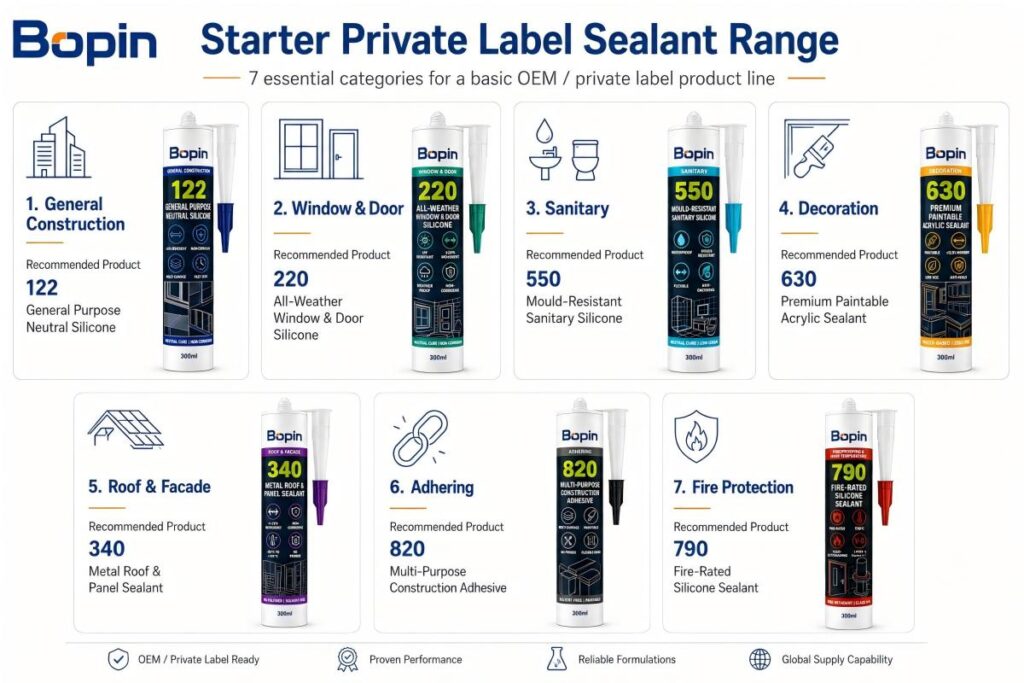
Suggested starter product range:
| Category | Suggested Product Type | Typical Use |
|---|---|---|
| Construção geral | All-purpose silicone / neutral silicone | Daily gap filling and general sealing |
| Janelas e portas | Neutral silicone / MS polymer / PU foam | Frame sealing and insulation |
| Sanitário | Anti-mould sanitary silicone | Vedação de banheiros e cozinhas |
| Decoração | Acrylic sealant / decorative trim sealant | Interior cracks, skirting boards and finishing |
| Telhado e fachada | Metal roof sealant / facade silicone | Exterior joints, panels and roofing |
| Aderente | Construction adhesive / high-strength MS adhesive | Panel bonding and fixing |
| Fire Protection | Fire-rated silicone sealant | Fire-resistant joints and public buildings |
This structure gives your brand good coverage for both retail and project sales.
If your budget is limited, start with 5–7 products first. After receiving market feedback, you can expand to more specialized products.
3. Confirm Product Positioning
Private label products should not only have different names. They should have clear positioning.
For example, you may need:
- Economy grade for price-sensitive retail channels
- Standard grade for daily construction use
- Professional grade for contractors
- Premium grade for facade, roofing, stone or panel applications
If several products look similar, customers may not understand the difference. That can make your product range difficult to sell.
A better approach is to define each product by application and performance level.
For example:
- General purpose silicone for daily sealing
- Neutral silicone for metal frames and masonry
- Sanitary silicone for bathroom and kitchen sealing
- MS polymer sealant for paintable and solvent-free applications
- Facade sealant for high-movement exterior joints
- Construction adhesive for panel bonding
Clear positioning makes your catalog, packaging and sales communication much easier.
4. Prepare Your Packaging Requirements
Packaging is one of the most important parts of a private label sealant order.
A good package should not only look attractive. It should also help customers understand the product quickly.
Before ordering, prepare the following packaging details:
- Brand logo
- Product name
- Product number
- Product category
- Main color system
- Main selling points
- Application icons
- Volume, such as 300ml, 590ml, 600ml or 750ml
- Product color, such as white, clear, grey or black
- Curing type
- Usage instructions
- Limitações
- Safety information
- Barcode
- Production date area
- Shelf life
- Carton design
- Label language
If you do not have a complete packaging design, you can first prepare a simple direction. The supplier can then help you adjust the layout based on product type and packaging size.
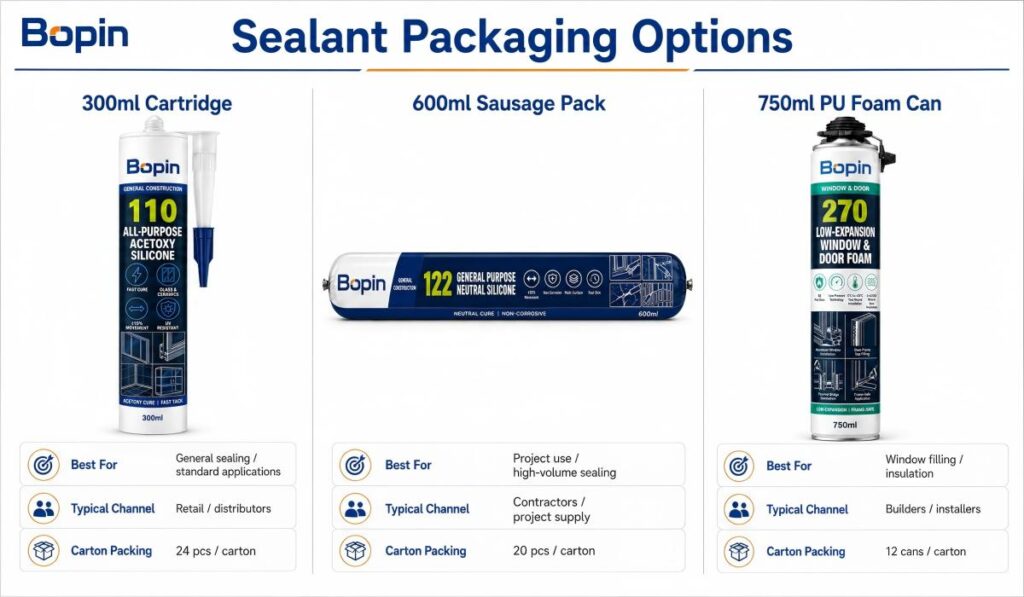
Common packaging formats:
| Packaging Format | Common Use |
|---|---|
| 300ml cartridge | Retail, hardware stores and general construction |
| 590ml / 600ml sausage pack | Contractors and project use |
| 750ml aerosol can | PU expanding foam |
For a professional private label range, it is helpful to use different colors for different application series. For example, one color for General Construction, another color for Window & Door, another for Roof & Facade, and another for Sanitary or Decoration.
5. Prepare Label and Carton Information
Private label buyers should prepare both product label and carton information.
The cartridge label is important for retail display and user understanding. The carton is important for warehouse management, shipping and distributor sales.
Product label information may include:
- Brand name
- Product name
- Product model
- Application category
- Product features
- Net volume
- Cor
- Curing system
- Application temperature
- Storage conditions
- Shelf life
- Instructions
- Safety warnings
- Manufacturer or importer information
Carton information may include:
- Product model
- Product name
- Cor
- Quantity per carton
- Gross weight
- Net weight
- Carton size
- Batch number
- Production date
- Shelf life
- Handling marks
- Destination language requirements
For importers, carton information should be clear and easy to identify. This helps reduce warehouse mistakes and makes distribution more efficient.
6. Confirm Technical Requirements
Sealant is a functional construction material. Before placing a private label order, importers should confirm the key technical requirements.
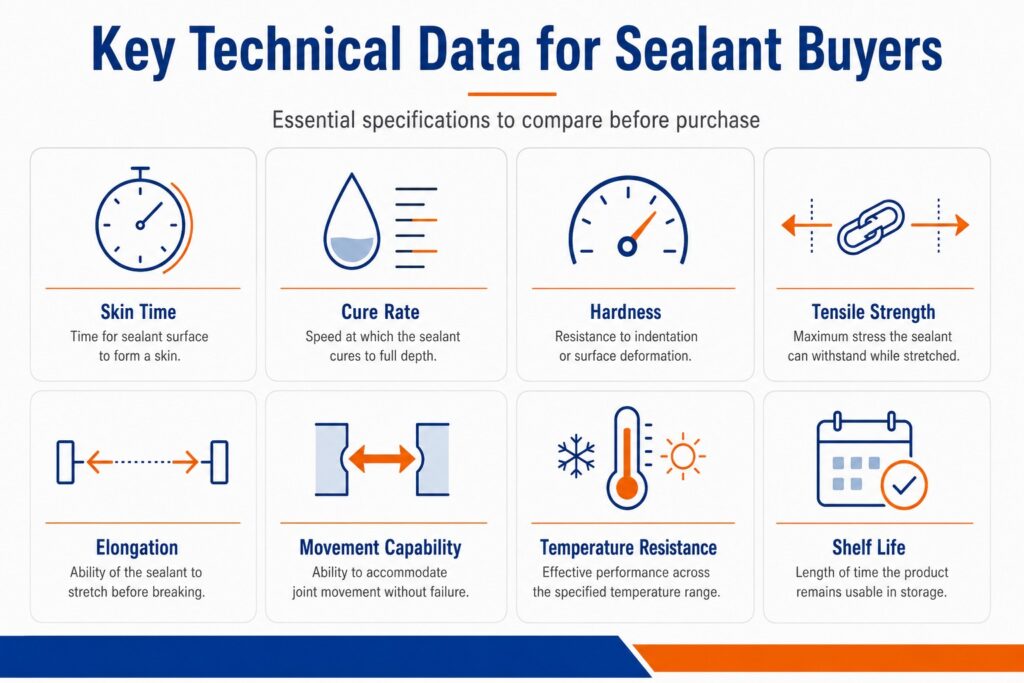
Important technical items may include:
- Curing system
- Skin formation time
- Cure rate
- Hardness
- Tensile strength
- Alongamento na ruptura
- Capacidade de movimento
- Sag resistance
- Temperature resistance
- Application temperature
- Adhesion to target substrates
- Shelf life
- Applicable standards
For example, a window sealant should bond well to aluminium, glass and masonry. A facade sealant should have good movement capability and UV resistance. A natural stone sealant should be non-staining. A PU foam should match the expansion level required for the application.
Do not choose products only by price. A lower-cost sealant may create problems if it does not match the application.
7. Request Samples Before Bulk Ordering
Samples are very important for private label sealant orders.
Before confirming mass production, importers should test the product with real local materials and real application conditions.
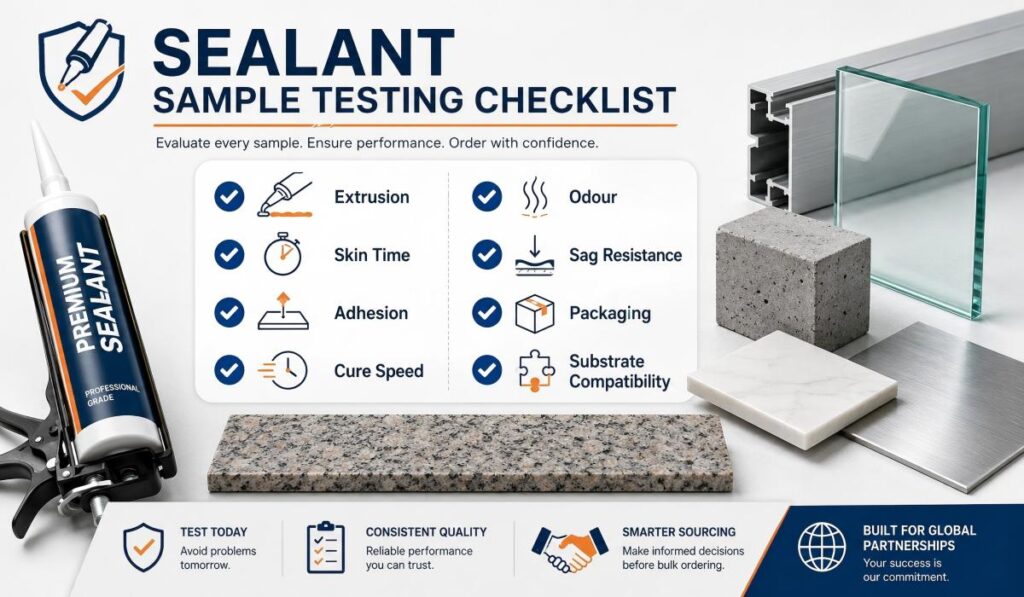
Sample testing should include:
- Packaging appearance
- Cartridge or sausage pack quality
- Extrusion smoothness
- Odour
- Skin formation time
- Curing speed
- Sag resistance
- Adhesion to target substrates
- Tooling performance
- Paintability if required
- Staining test for natural stone
- Expansion control for PU foam
For window and door products, test on aluminium, PVC, glass, concrete and masonry. For metal roof sealants, test on coated metal sheets. For natural stone sealants, always test on real stone samples before full use. For construction adhesives, test bonding strength and initial grab on actual panels.
A sample test does not need to be complicated, but it should be practical. The goal is to confirm whether the product works for your market before you invest in bulk packaging and inventory.
8. Confirm MOQ, Lead Time and Production Details
Private label orders usually require more preparation than standard stock orders.
Before placing an order, confirm:
- Minimum order quantity
- Product models
- Product colors
- Packaging format
- Label design timeline
- Sample approval timeline
- Production lead time
- Carton quantity
- Pallet requirements
- Condições de pagamento
- Inspection requirements
- Shipping schedule
MOQ may vary depending on product type, packaging design, label printing and carton customization.
If you are launching a new brand, it may be better to start with several core products first. After the first batch sells well, you can expand your range with more specialized products.
This approach reduces inventory pressure and helps you test your market more safely.
9. Prepare Import and Shipping Information
Importers should prepare basic shipping information before requesting a formal quotation.
Useful information includes:
- Destination country
- Destination port
- Preferred shipping method
- Required documents
- Local import requirements
- Whether MSDS is needed
- Whether TDS is needed
- Whether certificate of analysis is needed
- Whether product registration is required
- Whether pallet packing is required
- Whether special carton marks are required
PU foam aerosol cans may require more attention during shipping because aerosol products are often handled under dangerous goods transport requirements. Importers should confirm shipping rules with their freight forwarder before ordering.
Para aerosol products and chemical goods, buyers should confirm dangerous goods shipping requirements with their forwarder before shipment.
10. Prepare Marketing Materials for Your Brand
After product and packaging confirmation, importers should also prepare sales and marketing materials.
Useful materials include:
- Product catalog
- Technical datasheets
- Product photos
- Application photos
- Short videos
- Product comparison chart
- Sales sheets
- FAQ document
- Website product pages
- Social media content
- Contractor training materials
Many private label brands fail not because the product is bad, but because customers do not understand the product clearly.
Good marketing materials should answer simple questions:
- What is this product?
- Where can it be used?
- What materials does it bond to?
- What are the main benefits?
- What are the limitations?
- Why should customers choose this product?
For B2B customers, clear technical documents and application guidance can make your brand look more professional.
Common Mistakes Importers Should Avoid
Private label sealant projects are not difficult, but some common mistakes can create problems.
1. Choosing only by the lowest price
Low price is important, but sealant quality must match the application. If the product fails, your brand reputation may be damaged.
2. Ordering too many products at the beginning
Too many SKUs can increase inventory pressure. Start with a focused product range and expand later.
3. Ignoring local climate
Hot, humid, coastal or cold markets may need different sealant performance.
4. Using unclear packaging
If the product name, application and benefits are not clear, customers may choose the wrong product.
5. Not testing samples
Samples should be tested on actual local materials before bulk ordering.
6. Forgetting technical documents
Importers should prepare TDS, MSDS and clear application instructions for professional buyers.
7. Not confirming shipping requirements
Chemical products and aerosol cans may require special handling, documents or shipping arrangements.
Final Checklist Before Ordering Private Label Sealants
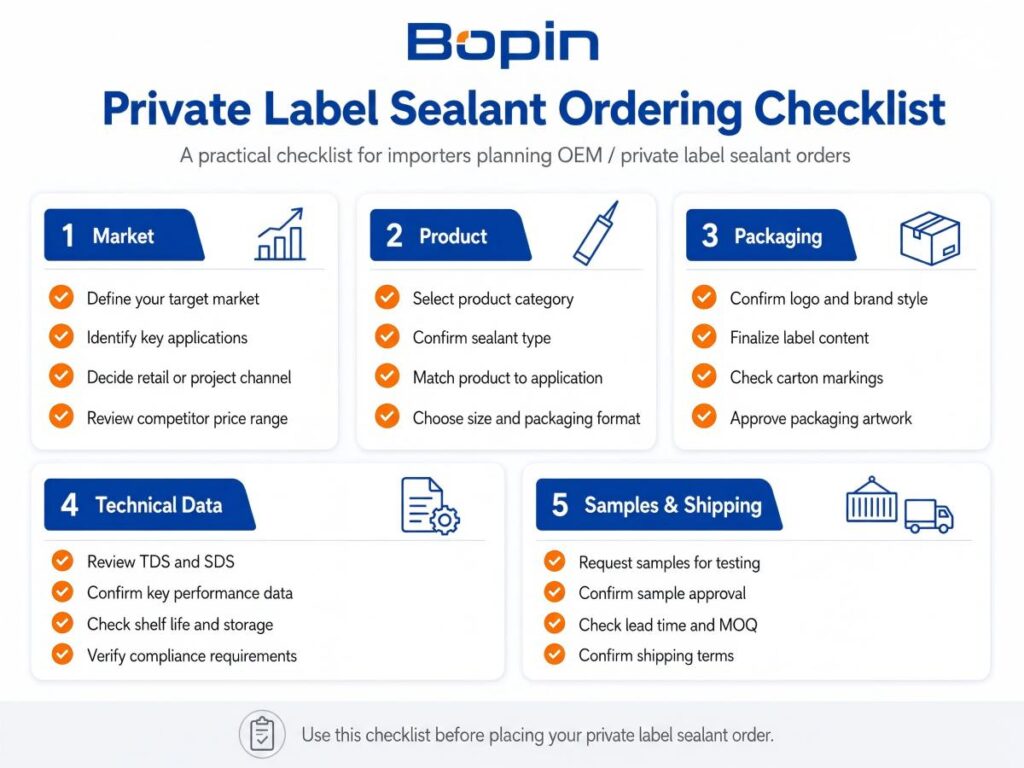
Before placing your order, use this checklist:
| Item | Prepared? |
|---|---|
| Target market confirmed | |
| Main customer type confirmed | |
| Product list prepared | |
| Product grades confirmed | |
| Packaging format confirmed | |
| Logo and brand colors prepared | |
| Label language confirmed | |
| Carton information prepared | |
| Technical requirements confirmed | |
| Samples requested and tested | |
| MOQ confirmed | |
| Production lead time confirmed | |
| Shipping method confirmed | |
| Required documents confirmed | |
| Marketing materials planned |
This checklist can help importers communicate more efficiently with suppliers and reduce mistakes before production.
Final Thoughts
Private label sealant can help importers build a stronger product range and create long-term brand value in their local market.
But before ordering, it is important to prepare the right information. You should confirm your target market, product list, packaging requirements, technical specifications, sample testing plan, MOQ, lead time and shipping details.
A successful private label project depends on more than packaging. It requires stable product quality, clear product positioning, professional documents and reliable export support.
If you are planning to develop your own private label sealant range, BoPin can help you select suitable products, prepare packaging options, arrange samples and build a practical product line for your market.