Walk past any modern facade, prefabricated apartment block, or commercial fit-out and you are almost certainly looking at a building held together — in part — by an MS polymer adhesive sealant. Yet most procurement managers and contractors still default to mechanical fasteners, cement-based adhesives, or silicone when a superior option has been available for years.
MS polymer, also called modified silane polymer or hybrid sealant-adhesive, combines the flexibility of silicone with the paintability and adhesion strength of polyurethane — without the isocyanates or solvents that make PU adhesives hazardous and difficult to work with on construction sites. The result is a one-component product that bonds to almost any construction substrate, remains permanently elastic, and can be safely applied without special ventilation equipment or complex mixing procedures.
This guide is written for construction professionals, facade contractors, specification engineers, and distributors who need to understand not just what MS polymer does, but when to specify it, which grade to choose for a given application, and how to apply it correctly for a bond that lasts the life of the building.
1. What Is an MS Polymer Adhesive?
MS polymer is a hybrid polymer chemistry first commercialized in Japan in the 1970s and now the specification-grade bonding technology across demanding construction markets in Europe, the Middle East, Southeast Asia, and increasingly across Central Asia and Africa.
The chemistry starts from a polyether backbone — which delivers flexibility and low-temperature performance — and terminates with silane groups. These silane groups cross-link on contact with atmospheric moisture to form a strong, permanently elastic rubber-like body. The curing process requires no mixing, no special equipment, and no separate primer on most substrates. Apply from a standard sealant gun, expose to air, and full cure is achieved in 24–72 hours depending on joint depth, ambient temperature, and relative humidity. In practice, MS polymer cures at approximately 2.0–2.5 mm per 24 hours at 23°C and 50% relative humidity — a rate contractors can use directly when planning subsequent work steps, such as paint application or mechanical loading of the joint.
MS polymer is defined and tested under standards including ISO 11600 for building construction sealants. Understanding which performance class applies to your specific application is the correct starting point for product selection.
Why the Name “MS Polymer”?
The “MS” stands for Modified Silicone — reflecting the silane-terminated chemistry — though the backbone is polyether, not polysiloxane. In different markets you may encounter this chemistry under alternative names: hybrid polymer sealant, silyl-terminated polyether (STPE), silane-modified polymer, or SMP adhesive. All refer to the same fundamental chemistry with minor formulation variations by manufacturer.
2. How MS Polymer Compares to Silicone and PU Adhesives
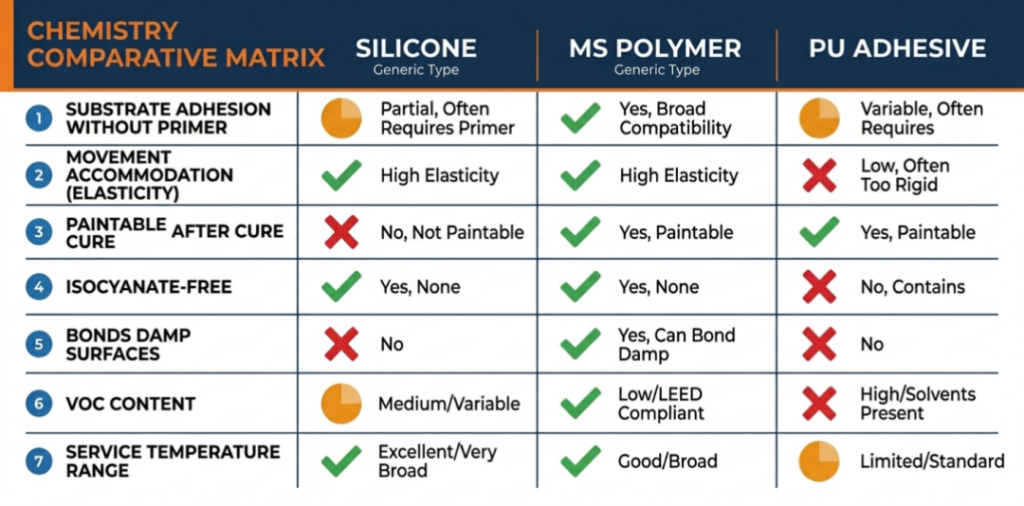
Understanding each chemistry’s profile helps when specifying the right product — or explaining a specification choice to a design team or client.
Silicone Adhesive Sealants
Silicone excels as a weatherproof sealant and provides outstanding UV and temperature resistance. For sanitary sealing, glazing perimeter beads, and exterior weatherproofing joints, silicone remains the dominant technology. Its limitations become clear in bonding applications: adhesion requires primer on many substrates, the cured surface cannot be overpainted, and tensile strength for structural bonding is moderate. On many construction sites, silicone contamination also permanently disables future adhesion from any other sealant chemistry applied to the same surface.
Polyurethane (PU) Adhesives
PU adhesives deliver high final bond strength and good performance in low-movement structural joints. However, isocyanate content requires careful handling under site health and safety regulations — particularly under frameworks in the Middle East and EU-aligned markets, where ECHA’s REACH regulation increasingly restricts isocyanate exposure. Moisture sensitivity during application creates a recurring site quality problem, and the cured body is often too rigid for joints subject to sustained thermal movement.
MS Polymer: The Balanced Option
MS polymer sits between both chemistries where it matters most. It provides better substrate adhesion than silicone without primer, significantly safer handling than isocyanate-containing PU, and far greater movement accommodation than rigid PU adhesives. It bonds damp surfaces — a meaningful site advantage in tropical climates. It accepts paint after curing. And it performs across a service temperature range of −40°C to +90°C — critical for projects in Central Asia, the Gulf, and Southeast Asia where surface temperatures can vary by 40°C or more within a single day.
A Note on Total Cost of Ownership
MS polymer cartridges typically carry a higher unit price than standard silicone or acrylic. For procurement teams comparing line items, this is a genuine difference. In total project cost, however, the picture shifts. No primer purchase, no primer application labor, no primer cure waiting time. No isocyanate PPE or specialist handling procedures. And significantly lower rework rates: the flexibility of a cured MS polymer joint means it continues to perform under thermal movement that would cause a rigid adhesive to crack and require resealing. Across a facade project or large flooring installation, the labor savings and extended service life typically more than offset the higher product unit cost.
3. Key Bonding Applications in Construction
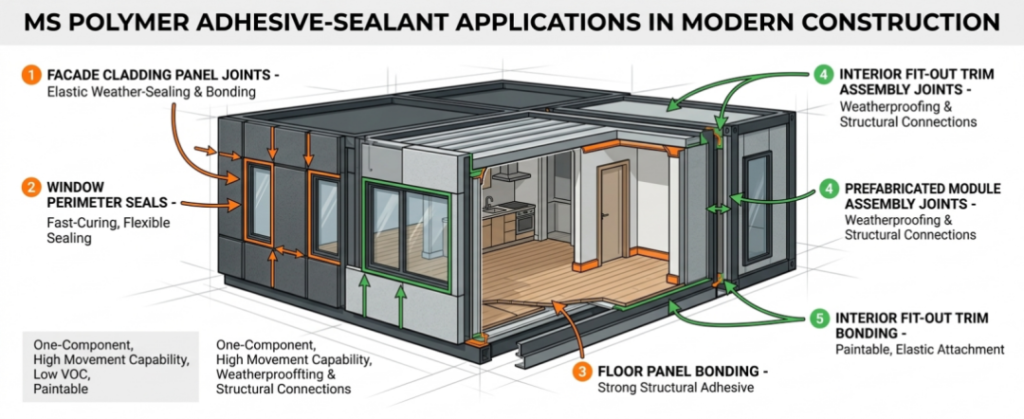
MS polymer appears across multiple construction stages. The following are the highest-volume application categories.
Prefabricated and Modular Building Assembly
The global shift toward off-site construction — prefabricated concrete panels, steel-framed modules, cross-laminated timber structures — has created a large and growing demand for flexible structural adhesives. MS polymer is the preferred bonding technology for joints between prefabricated building elements, where large-scale thermal movement, transport vibration, and site assembly tolerances make rigid adhesives impractical.
High-elongation, low-modulus grades with elongation above 400% are specified here. They provide a soft, durable bond that accommodates differential movement between adjacent panels without initiating stress cracking in the substrate or adhesive body.
Exterior Cladding and Facade Panel Bonding
Fiber cement panels, aluminum composite material (ACM), natural stone, sintered stone (thin porcelain slabs), and phenolic panels are used widely as rainscreen cladding on commercial and residential buildings. MS polymer adhesive applied in a continuous or serpentine bead pattern to the panel rear provides distributed load transfer across the full panel area. This eliminates the stress concentration points created by point mechanical fixings, which are a common initiation site for panel delamination and substrate cracking.
High-strength grades with tensile strength above 3.0 MPa and fast initial grab are used in vertical panel bonding, reducing or eliminating the need for temporary mechanical support while the adhesive develops handling strength.
Window and Door Perimeter Sealing
The joint between a window or door frame and the surrounding masonry is a critical air and water infiltration point in any building envelope. MS polymer provides both the sealing function and an adhesive bond to both the frame and the masonry, significantly outperforming silicone or acrylic in joints subject to frame deflection and thermal movement. ASTM C920 specifies movement capability classifications for sealants used in window perimeter applications — MS polymer grades typically achieve Class 25 or higher, making them appropriate for high-performance fenestration systems.
Interior Decoration and Fit-Out Bonding
Skirting boards, architraves, wall panels, mirror tiles, display cases, and sanitary furniture are all applications where a flexible, paintable adhesive-sealant eliminates the need for nails, screws, or clamping. MS polymer bonds dissimilar materials — MDF to plaster, glass to tile, ceramic to concrete — in a single product, without primer. The ability to paint over the cured joint with standard water-based or solvent-based coatings is a key advantage for interior finish quality that silicone cannot provide.
Wood Flooring Installation
Specialized MS polymer flooring grades bond engineered timber, laminate, and LVT panels to concrete substrates. The flexible cured body accommodates the dimensional movement of timber under humidity changes without causing delamination or audible creaking — the primary failure mode of rigid floor adhesives. EN 14293 covers adhesives for bonding parquet to subfloors and provides the performance documentation framework for specifying on commercial flooring projects.
Sintered Stone and Large-Format Panel Bonding
Sintered stone slabs — thin porcelain panels of 3–6mm thickness — have very low porosity and create adhesion challenges for cement-based tile adhesives on their non-absorbent surface. High-strength MS polymer grades with fast initial grab and long open time handle this application well. They allow precise repositioning during installation followed by a firm, vibration-resistant final bond that cement-based systems cannot provide on this substrate.
4. Substrate Compatibility Guide
One of MS polymer’s principal commercial advantages is broad substrate compatibility without priming. The table below summarizes typical adhesion performance:
| Substrate | Adhesion Quality | Notes |
|---|---|---|
| Concrete / masonry | Excelente | Bonds to damp (not wet) surfaces |
| Vidro | Excelente | Interior glazing; not primary structural glazing |
| Aluminum (anodized / powder coated) | Very good | Wipe with IPA before application |
| PVC / uPVC | Bom | Surface activation wipe improves results |
| Galvanized / stainless steel | Very good | Degrease thoroughly with IPA |
| Ceramic tile | Very good | — |
| Sintered stone / porcelain | Bom | High-strength grade recommended |
| Natural stone (non-calcareous) | Very good | Test porous stone for staining risk before full application |
| Engineered wood / MDF | Excelente | — |
| Solid timber | Excelente | Accommodates dimensional movement |
| EPS polystyrene | Very good | Solvent-free formulation is essential |
Surfaces that MS polymer does not bond: Polyethylene (PE), polypropylene (PP), PTFE/Teflon, and silicone-contaminated surfaces. Run a small adhesion test on the actual substrate before committing to full application if any uncertainty exists.
5. How to Choose the Right MS Polymer Grade
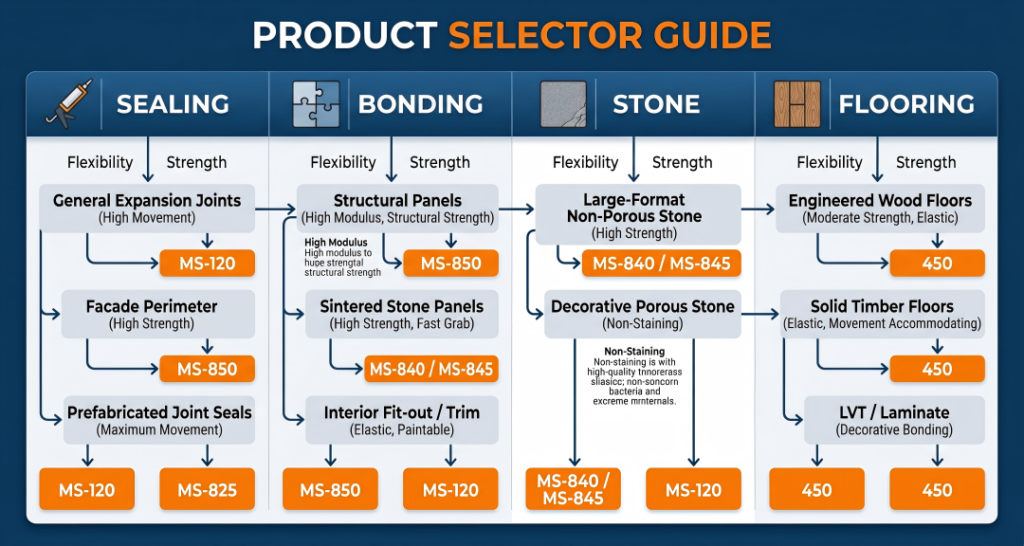
Different applications require different balances of flexibility, strength, open time, and initial grab. Grade selection is technical, not commercial — choosing by price rather than specification profile is the leading cause of bonding failures in the field. When selecting a product for your project, BoPin offers a complete range of specialized grades tailored to specific structural, substrate, and environmental requirements:
For General Sealing and Multi-Surface Bonding
BoPin MS-120 is a medium-modulus product with movement capability of ±25% and elongation above 600%. This grade suits expansion joints, perimeter sealing around windows and service penetrations, and general bonding and sealing where high flexibility is the primary requirement. VOC content below 40 g/L makes it compliant with LEED v4 low-emitting materials credits and equivalent regional green building standards.
For Structural Panel and Facade Cladding Bonding
BoPin MS-850 is a high-modulus, high-strength grade with tensile strength up to 3.0 MPa and fast skin formation of 10–15 minutes. This grade is designed for facade panel bonding, heavy material installation, and structural element assembly where high initial grab reduces the need for temporary mechanical support. Shore A hardness of 55 in the cured state resists creep under sustained vertical panel load.
For Prefabricated Building Joints
BoPin MS-825 provides Shore A hardness of 22 and elongation of 515% — the correct performance profile for large panel-to-panel joints in modular construction, where structural movement accommodation is more critical than tensile strength. The very soft cured body absorbs differential movement between prefabricated elements without initiating interfacial stress at the bond line.
For Wood Flooring
BoPin 450 targets engineered and solid wood floor installation with elongation of 469% and tensile strength of 2.13 MPa. Controlled consistency and extended open time allow efficient work across large floor areas before board placement.
For Sintered Stone and Premium Wall Panels
BoPin MS-840 e BoPin MS-845 are high-strength grades reaching tensile strength of 3.3 MPa and 3.2 MPa respectively. Both are developed for sintered stone and large-format panel bonding. The MS-845 provides immediate anti-slip resistance on vertical applications — critical for large thin stone panel installations where the standard adhesive development time creates site workflow problems.
6. Surface Preparation and Application Best Practices
Correct surface preparation is the dominant variable in bond performance. MS polymer will not compensate for contamination. Most bonding failures in the field trace back to inadequate surface cleaning rather than product failure.
Step 1: Surface Cleaning
Remove dust, oil, grease, release agents, and loose particles from both bonding surfaces. On non-porous surfaces — glass, metals, smooth plastics — clean with a lint-free cloth dampened with isopropyl alcohol (IPA) and allow to evaporate fully before applying adhesive. On concrete and masonry, remove loose surface laitance mechanically and clear dust by sweeping or compressed air.
MS polymer bonds to damp concrete — a meaningful advantage in tropical climates and on ground-level slabs — but not to wet or puddled surfaces. The practical distinction between damp and wet matters in the field.
Step 2: Apply the Adhesive
Load the cartridge into a standard sealant gun. Cut the nozzle at 45° to the appropriate bead diameter. Apply a continuous bead to one surface only — either the panel or the substrate. For facade panel bonding, a serpentine or parallel bead pattern at 150–200mm spacing distributes load evenly. For perimeter sealing, apply a single continuous bead centered in the joint depth.
Do not apply in ambient temperatures above 40°C or to surface temperatures above 50°C. In warm, humid climates — Southeast Asia, sub-Saharan Africa, Gulf coastal zones — plan facade bonding for early morning or shaded conditions.
Step 3: Assembly and Adjustment
Open time — the window in which the substrate can be placed and adjusted after adhesive application — ranges from approximately 10 minutes on fast-grab grades to 30–45 minutes on slow-cure, high-elongation grades. In warm, humid conditions, open time shortens significantly. Know the open time for the product and ambient conditions before beginning work.
After placing the substrate, apply light, even pressure. Excessive clamping pressure squeezes adhesive from the joint area and reduces effective bond area — the opposite of the intended result.
Step 4: Cleanup and Finishing
Uncured MS polymer cleans up with IPA or a dedicated foam cleaner. After curing, removal is mechanical only. Smooth joints and squeeze-out with a wetted spatula or gloved finger before skin formation — within the first 10 minutes of application. Before overpainting, allow full through-cure: 24–72 hours depending on joint depth and site temperature, based on the approximately 2.0–2.5 mm/24h cure rate. Painting over insufficiently cured MS polymer causes blistering and paint adhesion failure.
7. Common Mistakes and How to Avoid Them
Applying to a contaminated surface. Invisible oil residue, mold release agent, or silicone contamination causes complete adhesion failure. Clean every surface every time, regardless of visual appearance. Where mold release agents are used on prefabricated panel forms, treat every panel surface as potentially contaminated.
Selecting grade by price rather than performance profile. A soft high-elongation grade will not support a vertically bonded heavy stone panel. A hard high-strength grade will crack in a prefabricated panel joint subject to large thermal movement. The specification decision is technical.
Applying to hot dark surfaces in direct sun. Surface temperatures on dark facade panels in Gulf or Central Asian summers can reach 70–80°C. MS polymer skins in seconds at those temperatures and bond area is compromised before the panel is placed. Schedule bonding operations in shaded or early-morning conditions.
Applying over existing silicone. MS polymer does not bond to cured silicone. Where silicone previously occupied a joint area, abrasively remove it back to clean substrate. Any remaining silicone film creates a bond-free zone. Where full removal is impractical, continue with a compatible silicone rather than switching chemistries.
Painting too early. Applying topcoat over insufficiently cured MS polymer traps moisture under the paint film and causes blistering. Allow full cure before the first paint coat.
8. FAQs
Can MS polymer adhesive be used in continuously wet or submerged conditions?
MS polymer is water-resistant and performs well in intermittent wet exposure — shower enclosures, wet rooms, exterior perimeter joints — but is not rated for continuous submersion. For pools, aquariums, or below-waterline structural bonding, products specifically tested for permanent water immersion are required. Standard MS polymer does not qualify.
Is MS polymer suitable for structural glazing applications?
No. Primary structural glazing — where glass is bonded to the building structure without mechanical backup retention — requires tested structural silicone meeting ETAG 002 or equivalent. MS polymer is suitable for secondary sealing in curtain wall systems, interior decorative glazing, and mirror bonding, but not for primary structural glass retention.
How does MS polymer perform in extreme heat — Gulf facade projects, metal roof surfaces?
The cured body of standard MS polymer is rated to +90°C continuous service temperature. This is adequate for most construction facade and perimeter applications in the Gulf and Southeast Asia. For joints on dark metal roof surfaces, which can exceed 90°C surface temperature in peak summer, confirm the specific product’s rated service temperature in the technical data sheet before specifying.
What is the shelf life and how should it be stored in a tropical warehouse?
Unopened MS polymer cartridges have a shelf life of 9–12 months (grade dependent) stored below 27°C in a dry location away from direct sunlight and heat sources. In tropical warehouse conditions at 30–35°C ambient, use within 9 months and check the nozzle area for pre-cure skinning before use. Partially used cartridges should be resealed immediately and used within a few days.
Can MS polymer fully replace mechanical fasteners on facade panels?
In many applications, yes — full adhesive bonding without mechanical backup is standard practice for smaller panels and interior applications. For external facade panels on buildings subject to high wind-load zones or above certain heights, the structural engineer’s load analysis and specification governs. Many contemporary facade systems use MS polymer as the primary load transfer mechanism with mechanical fixings retained for edge restraint and safety backup only.
If you are specifying bonding adhesives for a facade, flooring, or modular construction project and need product recommendations, technical data sheets, or grade selection guidance for a specific substrate combination, contact BoPin directly. We work with installation contractors, facade engineers, and procurement teams — direct supply, no intermediary layers.
Sourcing MS polymer adhesives for a construction project? Contact BoPin for direct technical support, product documentation, and pricing on professional volumes.
Artigos relacionados: