As estruturas dos edifícios estão em constante movimento devido à expansão e contração térmica, forças sísmicas, cargas de vento, assentamento e fluência – movimentos que geram tensões internas capazes de fissurar o concreto, deformar o revestimento e falhar os sistemas de envoltório do edifício. Juntas de dilatação estrategicamente posicionadas em toda a estrutura acomodam esses movimentos, prevenindo danos ao criar separações intencionais que permitem que os elementos adjacentes da construção se movam independentemente.
Compreender os princípios de projeto de juntas de dilatação, calcular os movimentos esperados e implementar sistemas de vedação adequados garante que os edifícios suportem as forças dinâmicas de forma eficiente ao longo de sua vida útil. Seja no projeto de grandes complexos comerciais, na especificação de sistemas de fachada ou na manutenção de instalações existentes, o tratamento adequado das juntas de dilatação é essencial para a integridade estrutural e a longevidade do edifício.

Entendendo a movimentação de edifícios e as juntas de dilatação
Todos os materiais de construção se expandem quando aquecidos e se contraem quando resfriados – uma realidade física que gera forças e movimentos substanciais nas estruturas. Sem o devido ajuste, esses movimentos induzidos termicamente causam rachaduras em materiais rígidos, deformações em elementos restringidos e falhas em sistemas de revestimento.
Por que as juntas de dilatação são necessárias
A expansão térmica cria forças que excedem em muito a capacidade estrutural se forem restringidas. Considere uma parede de concreto de 50 metros exposta a uma variação de temperatura de 40°C – Sem juntas de dilatação, a expansão térmica gera uma tensão de compressão superior a 3.000 kPa., Esmagando alvenaria e rachando concreto com facilidade. As juntas de dilatação eliminam essa tensão, permitindo a livre movimentação.
Materiais diferentes se expandem em taxas diferentes. criando desafios adicionais. Um painel metálico que se expande duas vezes mais que o concreto adjacente cria movimento diferencial. que rompe conexões ou deforma painéis. Juntas bem projetadas acomodam essas diferenças de material. prevenindo danos.
Edifícios de vários andares apresentam padrões de movimento complexos. Os andares superiores sofrem maior deflexão do que os andares inferiores sob a ação do vento, eventos sísmicos criam deslocamentos relativos entre os andares e o assentamento a longo prazo ocorre de forma desigual. As juntas de expansão abordam essas diversas fontes de movimento de forma sistemática.
Fontes de Movimento em Edifícios
A compreensão das fontes de movimento orienta o projeto e o posicionamento das juntas de expansão.
Expansão e contração térmica Representa a principal fonte de movimento na maioria dos edifícios. Os materiais se expandem quando a temperatura sobe e se contraem quando a temperatura cai. – a magnitude depende do coeficiente de expansão térmica (CTE) do material e da faixa de temperatura.
Coeficientes de expansão térmica comuns dos materiais:
- Concreto: 10-14 × 10⁻⁶ por °C
- Aço: 12 × 10⁻⁶ por °C
- Alumínio: 23 × 10⁻⁶ por °C (quase o dobro do concreto/aço)
- Vidro: 8-9 × 10⁻⁶ por °C
- Pedra natural: 5-12 × 10⁻⁶ por °C (varia conforme o tipo)
- Plásticos/compósitos: 30-150 × 10⁻⁶ por °C
Essas diferenças explicam por que as juntas entre materiais distintos exigem atenção especial. – O revestimento de alumínio expande-se duas vezes mais do que a estrutura de concreto subjacente.
Movimento sísmico Os terremotos provocam deslocamentos rápidos e substanciais. Os códigos de construção sísmica modernos exigem uma capacidade de deriva entre andares tipicamente de 1 a 2% de altura do andar. – Para um andar com 4 metros de altura, isso representa uma movimentação potencial de 40 a 80 mm. As juntas de dilatação devem suportar isso sem falhar.
Carga de vento A flexibilidade dos edifícios cria deslocamentos entre os andares. Edifícios altos balançam sob a ação do vento., com os andares superiores deslocando mais do que os andares inferiores. Os sistemas de revestimento devem acomodar esse movimento diferencial. Sem danos.
Assentamento e expansão causar movimentos de longo prazo. Assentamento diferencial devido a diferentes condições do solo, tipos de fundação ou padrões de carregamento. Cria distorção angular que exige acomodação articular. Fluência do concreto – deformação dependente do tempo sob carga sustentada – também contribui para o movimento gradual.
Movimento relacionado à umidade afeta alguns materiais. O concreto e a alvenaria sofrem retração por secagem após a construção., Enquanto alguns materiais se expandem com a absorção de umidade. Essas alterações dimensionais combinam-se com movimentos térmicos. exigindo consideração no projeto conjunto.
Tipos e aplicações de juntas de dilatação
As juntas de dilatação são classificadas de acordo com sua localização e função.
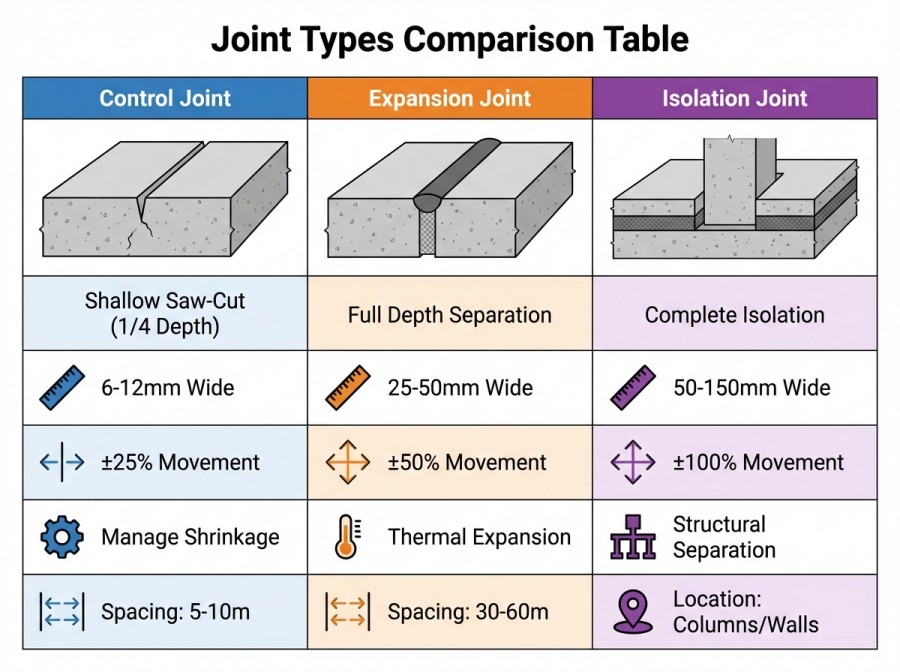
Juntas de dilatação de edifícios Seções inteiras do edifício podem ser separadas, permitindo movimentação independente. Essas separações de altura total, da fundação ao telhado, são feitas no próprio eixo. Normalmente ocorrem a cada 30-60 metros em edifícios longos, em junções de plantas em forma de L ou T e entre sistemas estruturais diferentes.
Juntas de fachada e revestimento Acomodar a movimentação em sistemas de revestimento externo. Essas juntas permitem movimento diferencial entre o revestimento e a estrutura. mantendo a impermeabilização. Sistemas de fachada cortina, painéis metálicos e revestimentos de pedra exigem juntas de dilatação cuidadosamente projetadas.
Juntas de piso e pavimento Lidar com o movimento em superfícies horizontais. Lajes de concreto, terraços e pavimentos exigem juntas de controle para gerenciar a retração e a movimentação térmica. Os pisos industriais enfrentam desafios adicionais devido ao carregamento de equipamentos pesados.
juntas de dilatação do telhado Acomodar grandes movimentos térmicos em sistemas de telhado. As membranas de cobertura escuras podem atingir temperaturas de 70 a 80 °C sob luz solar direta. gerando uma expansão substancial em comparação com as temperaturas noturnas frias. Essas faixas de temperatura extremas exigem sistemas de juntas robustos.
Calculando o movimento esperado
A previsão precisa dos movimentos determina o dimensionamento correto das juntas e a seleção do selante adequado. Subestimar o movimento leva à falha articular, enquanto o conservadorismo excessivo desperdiça recursos.
Cálculo do Movimento Térmico
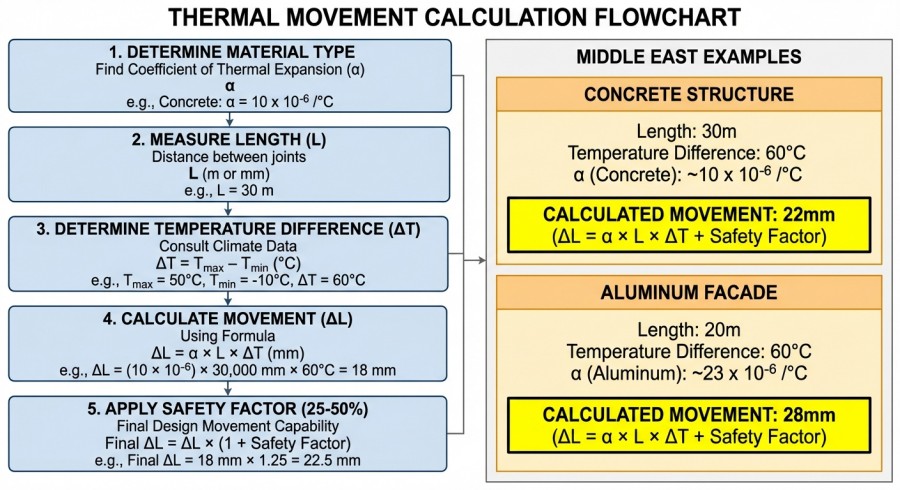
O cálculo do movimento térmico segue uma fórmula simples:
ΔL = α × L × ΔT
Onde:
- ΔL = variação no comprimento (mm)
- α = coeficiente de expansão térmica (por °C)
- L = comprimento do elemento (mm)
- ΔT = variação de temperatura (°C)
Exemplo: Parede externa de concreto
- Material: Concreto, α = 12 × 10⁻⁶ por °C
- Comprimento: L = 30.000 mm (30 metros)
- Faixa de temperatura: ΔT = 50°C (de 5°C a 55°C)
ΔL = 12 × 10⁻⁶ × 30.000 × 50 = 18 mm
Esta parede de 30 metros expande/contrai um total de 18 mm. – exigindo juntas que permitam um movimento de ±9 mm quando centradas.
Exemplo do Oriente Médio: fachada cortina de alumínio
- Material: Alumínio, α = 23 × 10⁻⁶ por °C
- Comprimento: L = 20.000 mm (20 metros entre juntas de dilatação)
- Faixa de temperatura: ΔT = 60°C (de 15°C a 75°C – painéis de alumínio sob luz solar direta)
ΔL = 23 × 10⁻⁶ × 20.000 × 60 = 27,6 mm
Isso demonstra por que os climas desérticos com amplitudes térmicas extremas criam condições tão exigentes. – movimento quase 50% maior do que o exemplo de clima temperado.
Determinação da faixa de temperatura
Determinar com precisão a faixa de temperatura é fundamental para o cálculo do movimento.
Faixa de temperatura de serviço difere da temperatura do ar. A temperatura da superfície dos materiais sob luz solar direta pode exceder a temperatura do ar em 20 a 40 °C ou mais. Superfícies escuras atingem temperaturas ainda mais elevadas.
Faixas típicas de temperatura dos materiais por clima:
Deserto/Oriente Médio (exemplo: Dubai, Riade):
- Concreto/alvenaria: 5°C a 60°C (ΔT = 55°C)
- Painéis metálicos (escuros): 10°C to 75°C (ΔT = 65°C)
- Roofing membrane (black): 15°C to 85°C (ΔT = 70°C)
- Glass curtain wall: 10°C to 65°C (ΔT = 55°C)
Temperate climate (example: Northern Europe, Northern US):
- Concreto/alvenaria: -10°C to 40°C (ΔT = 50°C)
- Metal panels: -15°C to 50°C (ΔT = 65°C)
- Roofing membrane: -10°C to 70°C (ΔT = 80°C)
Tropical humid (example: Southeast Asia):
- Concreto/alvenaria: 20°C to 50°C (ΔT = 30°C)
- Metal panels: 20°C to 60°C (ΔT = 40°C)
Note that roofing membranes experience largest temperature ranges regardless of climate due to solar heating.

Combined Movement Calculations
Real-world joints experience multiple movement sources simultaneously.
Total movement = Thermal movement + Seismic displacement + Settlement + Construction tolerances
For critical joints, add 25-50% safety factor accounting for uncertainties and aging effects reducing sealant capability.
Example: Facade expansion joint calculation
Thermal movement: 20mm (calculated above) Seismic displacement: 15mm (1.5% story drift × 1,000mm between joints) Construction tolerance: ±3mm Safety factor: 30%
Total design movement = (20 + 15 + 3) × 1.3 = 49mm
This joint must accommodate ±25mm movement (half total) requiring high-performance sealant rated ±50% movement in properly sized joint.
Expansion Joint Design Principles
Proper expansion joint design balances movement accommodation with structural requirements, weatherproofing needs, and constructability.
Joint Width Sizing
Joint width must accommodate expected movement while maintaining proper sealant geometry.
Design joint width = Expected total movement ÷ Sealant movement capability
For sealant rated ±25% movement:
- Total movement = 20mm
- Required width = 20 ÷ 0.25 = 80mm minimum
- Design width = 80 + 25% = 100mm (adding safety margin)
For sealant rated ±50% movement:
- Same 20mm total movement
- Required width = 20 ÷ 0.50 = 40mm minimum
- Design width = 40 + 25% = 50mm
This demonstrates how higher-capability sealants allow narrower joints – important where wide joints create architectural or practical problems.
Practical joint width ranges:
- Minimum practical width: 12-15mm (smaller joints difficult to seal properly)
- Typical building expansion joints: 25-50mm
- Seismic joints: 50-150mm depending on expected displacement
- Bridge/infrastructure joints: 50-300mm
Joint Depth and Geometry
Proper joint depth ensures optimal sealant performance.
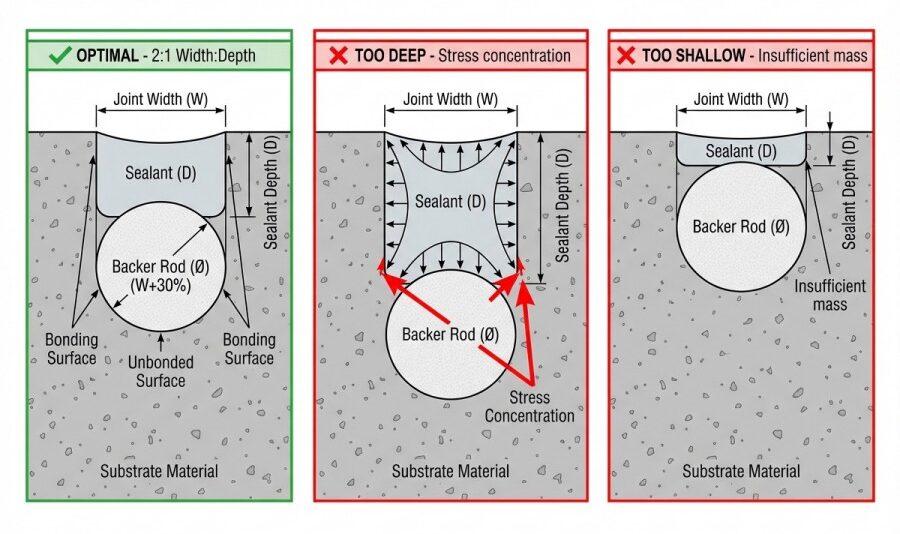
Width-to-depth ratio critically affects sealant behavior. Optimal ratio typically 2:1 (width:depth) allows sealant to stretch and compress properly without excessive stress concentration.
Sealant depth guidelines:
- Joints 6-12mm wide: depth = width (1:1 ratio)
- Joints 12-25mm wide: depth = width or width/2 (1:1 to 2:1)
- Joints >25mm wide: depth = width/2 (2:1 ratio), maximum 12-15mm depth
Excessive depth (too narrow ratio) creates high stress concentration as sealant deforms. Too shallow (too wide ratio) provides inadequate mass for movement accommodation.
Seleção de haste de apoio controls sealant depth. Use closed-cell polyethylene backer rod sized 25-30% larger than joint width for proper compression fit. Backer rod prevents three-sided adhesion – sealant bonding to joint bottom restricts movement causing premature failure.
Joint Spacing Guidelines
Joint spacing depends on material type, temperature range, and structural system.
Concrete structures:
- Standard practice: 30-60 meter spacing
- High temperature range: 20-40 meter spacing
- Reinforcement level: heavily reinforced structures tolerate longer spacing
Masonry walls:
- Typical spacing: 20-40 meters
- Varies by: mortar type, reinforcement, support conditions
Metal cladding:
- Panel-to-panel joints: every panel (600-1500mm typically)
- Juntas de dilatação: 15-30 meters
Stone cladding:
- Panel-to-panel joints: every panel
- Juntas de dilatação: 10-20 meters (stone’s low thermal expansion allows longer spacing)
Floor slabs:
- Control joint spacing: 24-30 times slab thickness (in feet)
- Isolation joints: at columns, walls, penetrations
- juntas de construção: at pour boundaries
Sealant Selection for Expansion Joints
Expansion joint sealants must accommodate substantial movement while maintaining weatherproofing and durability. Movement capability, durability, and adhesion determine suitability.
Movement Capability Requirements
Sealant movement capability expressed as ±percentage of joint width determines ability to handle expansion and contraction.
Movement capability classes:
±25% movement – Standard capability adequate for moderate applications:
- Protected interior joints
- Small temperature ranges
- Supplementary joints with primary structural system
±50% movement – High performance suitable for most exterior applications:
- Exterior facade joints in temperate climates
- Typical expansion joints in most structures
- Produtos como BoPin 770 Silicone Neutro Resistente às Intempéries rated ±50% movement
±100% movement – Maximum performance for extreme demands:
- Desert climate applications with extreme temperature ranges
- Seismic joints requiring large displacement capacity
- Joints with combined thermal and structural movement
- Specialty applications requiring maximum flexibility
Calculating required movement capability:
Joint width: 40mm Expected total movement: 30mm Required capability: 30 ÷ 40 = 75% (requires ±100% rated product with safety margin)
Recommended Sealant Types
Different sealant chemistries offer varying movement capabilities and characteristics.
Selantes de silicone provide excellent movement capability, weather resistance, and durability. Neutral-cure silicones like BoPin 770 Silicone à prova de intempéries handle demanding exterior applications through:
- ±50% movement capability standard (some products ±100%)
- Temperature resistance -40°C to +150°C
- Superior UV and weather resistance
- Decades of service life in exposed conditions
- Excellent adhesion to diverse substrates
Selantes de polímero MS offer good performance with paintability. Produtos como Polímero MS multiuso BoPin MS-220 suit applications where:
- ±50% movement capability sufficient
- Paintability required for aesthetic reasons
- Excellent adhesion needed
- Temperature range -40°C to +90°C adequate
Selantes de poliuretano provide good performance at moderate cost:
- ±25% to ±50% movement capability (product dependent)
- Good adhesion and abrasion resistance
- Temperature range typically -25°C to +80°C
- UV sensitivity limits exposed roof applications
Polysulfide sealants offer maximum movement capability:
- ±100% movement capability
- Excelente resistência química
- Good long-term flexibility
- Poor UV resistance (interior or buried applications only)
- Slow cure and strong odor during application
Climate-Specific Considerations
Climate dramatically affects sealant selection and performance expectations.
Desert/Middle East applications:
Extreme temperature ranges (60-70°C) and intense UV demand:
- Maximum UV resistance – premium silicones or specialized products
- Alta capacidade de movimento – ±50% minimum, ±100% preferred for large joints
- Heat resistance – maintain properties at 70-80°C surface temperatures
- Thermal stability – withstand daily cycling without fatigue
- Low dirt pickup – clean appearance in dusty environments
Produtos como BoPin 770 Silicone à prova de intempéries specifically formulated for demanding conditions handle these requirements effectively.
Tropical/coastal applications:
High humidity and biological growth risk require:
- Moisture resistance – maintain adhesion in constant humidity
- Anti-fungal properties – prevent mold/algae growth
- Salt resistance – withstand salt spray in coastal locations
- Rapid cure – moisture-cure products cure quickly in high humidity
Cold climate applications:
Freeze-thaw cycling and low temperatures demand:
- Low-temperature flexibility – maintain flexibility to -40°C
- Resistência ao congelamento e descongelamento – withstand hundreds of freeze-thaw cycles
- Cold application capability – some products apply to 0°C or -5°C
- Ice adhesion resistance – prevent ice bonding damaging sealant
Expansion Joints in Different Building Systems
Expansion joint requirements vary by building system and location. Understanding system-specific needs ensures appropriate solutions.
Facade and Curtain Wall Expansion Joints
Exterior envelope systems require joints accommodating thermal movement while maintaining weatherproofing.
Curtain wall expansion joints typically occur every 15-25 meters depending on panel material and climate. These joints must accommodate:
- Thermal expansion of aluminum framing (23 × 10⁻⁶ per °C)
- Building structure movement
- Inter-story drift from wind/seismic loads
- Installation tolerances
Joint design considerations:
- Primary weatherproofing from joint system (gaskets, covers)
- Vedação secundária from sealant backup
- Drainage provisions for any water penetrating primary seal
- Visibility – architectural appearance requirements
Materials: High-performance silicones provide optimal combination of movement capability, weather resistance, and longevity for exposed facade applications.
Concrete Floor and Slab Expansion Joints
Floor slabs require control joints managing shrinkage and thermal movement while maintaining flatness and load transfer.
Control joint spacing typically 24-30 times slab thickness (in feet). A 150mm (6-inch) slab requires joints every 36-45 meters maximum.
Joint types:
- Control joints – shallow sawcuts inducing cracking at planned locations
- juntas de construção – between pours, may include dowels for load transfer
- Isolation joints – full-depth separations at columns, walls, equipment
Sealant requirements:
- Trafficability – resist abrasion from foot and equipment traffic
- Flush surface – self-leveling products create smooth transitions
- Resistência química – handle cleaning chemicals and spills
- Load transfer – some joints use specialized systems maintaining structural connection
For industrial applications: Refer to comprehensive guidance in our Industrial Floor and Warehouse Joint Sealing Guide.
Roof Expansion Joints
Roof systems experience extreme temperature ranges requiring robust expansion joint systems.
Temperature extremes on roofs exceed those elsewhere. Black membrane roofs can reach 85°C in peak sun then cool to 15°C overnight – 70°C daily temperature swing creates substantial movement.
Roof expansion joint systems typically use:
- Raised curbs elevating joints above roof surface
- Metal covers protecting sealant from direct exposure
- Flexible bellows or compression systems accommodating movement
- Backup sealant providing secondary weatherproofing
For metal roof applications: See detailed guidance in our Metal Roof and Panel Sealing Guide.
Plaza Deck and Parking Structure Joints
Traffic-bearing surfaces face additional challenges from vehicle loading and waterproofing requirements.
Trafficked expansion joints must:
- Support wheel loads without damage
- Remain waterproof preventing infiltration to structure below
- Accommodate movement under traffic and temperature changes
- Provide smooth transitions preventing tripping hazards or vehicle impacts
Specialized joint systems for these applications include:
- Armored joints with metal edge protection
- Modular systems with replaceable components
- Drainage provisions directing water away from joint
- Flexible yet durable materials surviving traffic abuse
Installation Best Practices
Proper installation techniques ensure expansion joints perform as designed. Even premium products fail if installed incorrectly.
Preparação da superfície
Thorough surface preparation proves critical to sealant adhesion and long-term performance.
Concrete substrates:
- Remove laitance from sawcut or formed surfaces
- Limpe completamente removing dust, dirt, curing compounds
- Verifique a secura – concrete moisture typically <4% for most sealants
- Prime if required per manufacturer specifications
Metal substrates:
- Clean with solvents removing oils, greases, protective coatings
- Abrade glossy surfaces improving mechanical adhesion
- Prime as specified – many metals require primers for reliable bonding
- Verifique a compatibilidade – some metals (copper, lead) may require special products
Cleaning products like BoPin CL-900 Professional Cleaning Solution effectively clean substrates without leaving residue.
Backer Rod Installation
Proper backer rod installation controls sealant depth and prevents bond breaker failure.
Backer rod selection:
- Polietileno de células fechadas para a maioria das aplicações
- Tamanho 25-30% maior que a largura da junta for compression fit
- Appropriate firmness – too soft compresses excessively, too firm difficult to install
Installation technique:
- Install at proper depth achieving 2:1 width:depth ratio
- Evite alongar – O cordão de enchimento esticado pode sofrer recuo, deformando a junta.
- Use insertion tools for narrow or deep joints
- Verify position before sealant application
Sealant Application
Proper application technique affects both performance and appearance.
Application conditions:
- Faixa de temperatura per product specifications (typically +5°C to +35°C)
- Dry substrates – no surface moisture
- Protected from precipitation during cure period (24-48 hours minimum)
- Proper ventilation for solvent-based products
Técnica de aplicação:
- Continuous beads without gaps or voids
- Complete joint filling from backer rod to surface
- Proper gunning speed creating consistent bead size
- Immediate tooling while sealant workable
Tooling:
- Appropriate tools matching joint size and geometry
- Perfil côncavo optimal for most joints
- Smooth finish ensuring complete substrate contact
- Remove masking tape shortly after tooling while sealant still soft
Controle de Qualidade e Testes
Verification procedures ensure installations meet specifications.
Visual inspection:
- Continuous beads without gaps
- Proper profile achieved through tooling
- Good adhesion – no gaps at edges
- Consistent appearance throughout project
Adhesion testing:
- Teste de tração sample joints verifying adhesion
- Wait appropriate cure time before destructive testing
- Evaluate failure mode – cohesive (good), adhesive (problem)
Movement testing:
- Mock-up panels demonstrating performance
- Cycle test – opening and closing joint verifying sealant recovery
- Long-term observation of test panels
Common Failure Modes and Prevention
Understanding typical expansion joint failures guides prevention strategies.
Undersized Joints
Joints too narrow for expected movement represent the most common design error.
Sintomas:
- Falha coesiva – sealant tears internally
- Adhesive failure at maximum extension
- Substrate damage from excessive stress
Prevenção:
- Accurate movement calculation including all sources
- Adequate safety factors (25-50% typical)
- Select appropriate movement capability sealants
Correction:
- Alargar as juntas existentes if possible
- Install higher movement capability sealants
- Adicione juntas intermediárias reduzir o movimento articular individual
Adesão em três lados
Sealant bonding to joint bottom prevents proper movement creating premature failure.
Causes:
- Missing or inadequate backer rod
- Backer rod installed too deep
- Joint too shallow for proper backer rod placement
Prevenção:
- Utilize sempre o cordão de apoio adequado.
- Instale na profundidade correta. achieving 2:1 width:depth ratio
- Verify backer rod position before sealant application
Sintomas:
- Sealant tears at substrate interface rather than stretching
- Early failure despite adequate joint width
Inadequate Surface Preparation
Poor adhesion from contaminated substrates causes widespread failures.
Common contaminants:
- Form release agents on concrete
- Oils and greases on metals
- Dirt and dust on any substrate
- Previous sealant residue not completely removed
Prevenção:
- Thorough cleaning with appropriate methods
- Verify cleanliness before sealant application
- Use specified primers when required
- Deixe secar completamente. after cleaning
Excessive Movement or Unforeseen Loading
Actual movement exceeding design assumptions overloads joints causing failure.
Causes:
- Inaccurate movement calculations
- Unanticipated load conditions (seismic events, settlement)
- Material changes altering thermal properties
- Sealant aging reducing movement capability
Response:
- Document failure conditions understanding causes
- Revise calculations based on actual performance
- Upgrade to higher performance produtos
- Modify joint geometry if needed
Inspection and Maintenance
Regular inspection identifies developing problems before catastrophic failure, while proactive maintenance extends joint service life.
Inspection Procedures
Systematic inspection schedules depend on exposure and criticality.
Inspection frequency:
- Exterior exposed joints: Annual minimum, preferably semi-annual
- Protected interior joints: Every 2-3 years
- Critical structural joints: Annual with detailed documentation
- Articulações de alta mobilidade: More frequent based on performance
Inspection checklist:
- Sealant adhesion – probe gently checking bond integrity
- Cohesion – look for cracks, tears, splits
- Largura da junta – measure verifying adequate width maintained
- Substrate condition – check for spalling, cracking, corrosion
- Movement evidence – sealant deformation indicating active movement
- Weather protection – verify covers, flashings remain effective
Documentation:
- Photographs showing joint condition
- Measurements of joint widths and visible defects
- Notes on performance trends
- Recommendations for maintenance or repair
Maintenance and Repair
Proactive maintenance extends joint life and prevents failures.
Cleaning:
- Annual cleaning removes dirt and biological growth
- Gentle methods – avoid abrasives damaging sealant
- Verify no damage after cleaning
Minor repairs:
- Small cracks or tears – can sometimes be oversealed
- Local adhesion loss – remove affected section, clean, reseal
- Surface damage – may not require complete replacement
Complete replacement:
- Remove old sealant completamente
- Clean and prepare substrates per original specifications
- Install new sealant following proper procedures
- Allow adequate cure before returning to service
Replacement timing:
- Plan proactive replacement at 15-20 years for premium products
- Earlier replacement in severe exposure (desert, coastal, industrial)
- Replace when: 30% of length shows deterioration, adhesion loss >20%, or hardening/brittleness evident
Perguntas mais frequentes
How wide should expansion joints be for buildings in hot climates?
Building expansion joints in hot desert climates like the Middle East require 50-100% wider spacing than temperate climates due to extreme temperature ranges. A 30-meter building section experiencing 60°C temperature swing creates approximately 22mm thermal movement in concrete – requiring minimum 40-50mm joint width with ±50% movement capability sealant, or 80-100mm with ±25% product. The extreme daily temperature cycling (40-50°C) in desert climates also accelerates sealant fatigue, favoring premium silicone products rated for extreme conditions. Calculate specific requirements using material thermal expansion coefficient, length between joints, and actual temperature range.
What’s the difference between control joints and expansion joints?
Control joints create intentional weak points in concrete inducing cracking at planned locations, while expansion joints provide complete structural separation allowing independent movement. Control joints typically use shallow sawcuts (1/4 to 1/3 depth) and remain 6-12mm wide, accommodating only concrete shrinkage and modest thermal movement. Expansion joints provide full-depth separation (25-50mm or wider) accommodating substantial thermal expansion, seismic displacement, and differential settlement between building sections. Expansion joints require high-movement sealants (±50% to ±100%) while control joints may use standard products (±25%). Think of control joints as “guided cracks” and expansion joints as “intentional separations.”
Can I use regular caulk in expansion joints?
No – regular acrylic or latex caulk lacks the movement capability, durability, and weather resistance required for expansion joints. Expansion joints demand sealants rated for ±25% to ±100% movement capability, while standard caulks typically handle only ±10% or less before failure. Quality expansion joint sealants – silicone, MS polymer, or polyurethane – maintain flexibility through decades of cycling, resist UV degradation, and adhere reliably to diverse substrates. Using inadequate products leads to premature failure typically within 1-3 years versus 15-25 years for proper materials. The cost difference between appropriate and inadequate products proves trivial compared to re-work expenses.
How often should expansion joint sealants be replaced?
High-quality silicone sealants in moderate conditions typically last 20-25 years before requiring replacement, while challenging exposures may reduce life to 10-15 years. Factors affecting longevity include: climate severity (desert/coastal accelerates aging), UV exposure intensity, daily temperature cycling magnitude, actual vs. designed movement, and sealant quality. Desert climates with 60-70°C temperature ranges and intense UV may require replacement every 10-15 years even with premium products. Plan proactive replacement when 20-30% of joint length shows deterioration rather than waiting for widespread failure. Annual inspection identifies approaching end-of-life conditions allowing planned maintenance versus emergency repairs.
What causes expansion joint sealants to fail prematurely?
The most common causes of premature expansion joint sealant failure are: undersized joints unable to accommodate actual movement (40% of failures), inadequate surface preparation preventing adhesion (30%), three-sided adhesion from missing backer rod (15%), and using inappropriate products for exposure conditions (15%). Undersized joints tear when movement exceeds capability – always include 25-50% safety factor beyond calculated movement. Poor surface prep leaves oils, dust, or old sealant preventing bonding – invest time in thorough cleaning and priming. Missing backer rod causes stress concentration and premature failure – never skip this critical step. Using economy products in severe exposure guarantees failure – match product capabilities to actual conditions.
Conclusão
Expansion joints represent critical building components preventing damage from thermal movement, seismic forces, settlement, and other dynamic loading – proper design, material selection, and installation ensure structures accommodate these movements gracefully throughout their service life. Without adequate expansion joints, buildings crack, cladding buckles, and envelope systems fail from forces that properly designed joints dissipate harmlessly.
Understanding movement sources and accurately calculating expected displacement forms the foundation of effective expansion joint design. Thermal expansion dominates most applications, with movement magnitude depending on material thermal expansion coefficient, length between joints, and temperature range. Desert climates with 60-70°C temperature ranges create movements 50-100% larger than temperate regions, demanding wider joints or higher-capability sealants.
Proper joint sizing balances movement accommodation with practical constraints. Joint width must provide adequate capacity for expected movement while maintaining sealant geometry for optimal performance – typically 2:1 width-to-depth ratio works best. Spacing guidelines vary by material and climate, with concrete structures typically requiring joints every 30-60 meters in temperate climates or 20-40 meters in extreme conditions.
Sealant selection should match movement capability to application demands. Standard ±25% movement products suit protected interior applications, while exterior envelope systems require ±50% capability minimum. Extreme applications – desert climates, seismic zones, or joints with combined movement sources – demand ±100% rated products. Silicone sealants deliver optimal performance for exposed applications through weather resistance, UV stability, and long-term flexibility.
System-specific requirements affect expansion joint design. Curtain walls combine thermal movement with inter-story drift requiring careful analysis. Floor slabs need joints managing both shrinkage and thermal effects while maintaining load transfer. Roofs face most extreme temperature ranges demanding robust systems with backup weatherproofing.
Installation quality determines real-world performance regardless of design excellence. Thorough surface preparation ensures adhesion, proper backer rod prevents three-sided adhesion failure, and correct application technique creates joints functioning as designed. Quality control through inspection and testing verifies specifications are met.
Regular inspection and proactive maintenance extend joint life while preventing small problems from becoming expensive failures. Annual inspection of critical joints identifies developing issues, while planned replacement after 15-25 years (depending on exposure) prevents catastrophic failures disrupting operations.
Whether designing new construction, specifying building systems, or maintaining existing facilities, expansion joint design and sealing demands systematic attention ensuring buildings handle dynamic forces effectively while protecting interior spaces and maintaining architectural integrity throughout decades of service.
Planning large-scale construction projects or need expert guidance on expansion joint design and material specifications? Entre em contato com nossa equipe técnica. for professional support on movement calculations, product selection, and installation specifications suited to your specific climate, structural system, and performance requirements.
Artigos relacionados: