Los profesionales de la construcción y los aficionados al bricolaje suelen confundir adhesivos y selladores, utilizándolos indistintamente a pesar de tener propósitos fundamentalmente diferentes. Elegir el producto equivocado supone un derroche de dinero, compromete la integridad estructural y crea problemas de mantenimiento que podrían haberse evitado fácilmente.
Comprender las distintas funciones de los adhesivos frente a los selladores, y saber exactamente cuándo usar cada uno, garantiza que sus proyectos de construcción funcionen según lo previsto durante toda su vida útil. Ya sea que trabaje en proyectos residenciales, edificios comerciales o instalaciones industriales, elegir correctamente entre adhesivos y selladores determina el éxito a largo plazo.
Comprender la diferencia fundamental
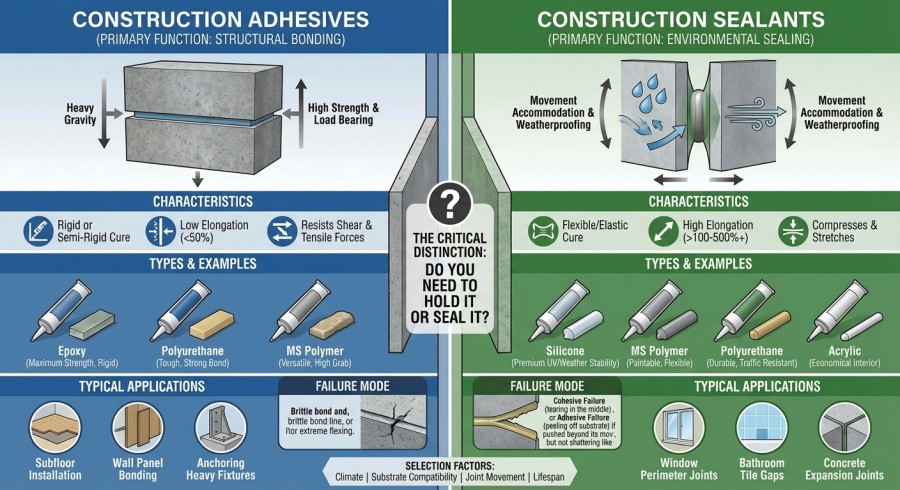
La principal diferencia entre adhesivos y selladores radica en su función primaria: los adhesivos unen materiales entre sí, mientras que los selladores rellenan huecos e impiden el paso de materiales. Esta diferencia fundamental determina todo lo demás en estos productos: su química, sus propiedades físicas y sus aplicaciones adecuadas.
¿Qué hacen los adhesivos de construcción?
Los adhesivos crean uniones permanentes entre sustratos, transfiriendo cargas y manteniendo unidos los conjuntos. Piensa en los adhesivos como elementos de fijación invisibles que distribuyen la tensión por las zonas de unión, en lugar de concentrarla en puntos específicos como hacen los elementos de fijación mecánicos.
La transferencia de carga define la función adhesiva. Cuando se aplican correctamente, los adhesivos estructurales pueden reemplazar o complementar los elementos de fijación mecánicos, creando uniones que pueden superar la resistencia de los materiales que se unen. El adhesivo se convierte en un elemento estructural integral, en lugar de ser simplemente un método de unión.
Los adhesivos funcionan mediante uno o más mecanismos de unión:
- Enclavamiento mecánico donde el adhesivo penetra las irregularidades de la superficie
- Enlace químico donde las moléculas forman enlaces químicos reales con las superficies del sustrato.
- Atracción física a través de fuerzas de van der Waals a nivel molecular
Los mejores adhesivos de construcción combinan múltiples mecanismos de unión. Para obtener la máxima resistencia y fiabilidad en diferentes sustratos y condiciones.
¿Qué hacen los selladores?
Los selladores rellenan huecos, permiten el movimiento e impiden el paso de aire, agua, polvo u otros materiales. En lugar de mantener las cosas unidas, los selladores impiden que entren cosas, o a veces las mantienen dentro, como en el caso de los tanques de combustible o los contenedores de productos químicos.
La capacidad de adaptación al movimiento distingue a los selladores de calidad. Los edificios se mueven constantemente debido a la dilatación térmica, la deformación estructural, el asentamiento y la carga del viento. Los selladores deben estirarse y comprimirse repetidamente sin perder adherencia ni desarrollar huecos.
Los selladores cumplen principalmente estas funciones:
- Impermeabilización – Previene la infiltración de agua, aire y polvo.
- Relleno articular – acomodar el movimiento en las juntas de dilatación
- Fines estéticos – crear transiciones suaves entre materiales
- Creación de barreras – que contenga líquidos, gases o que prevenga la contaminación
El sellador ideal permanece flexible indefinidamente. manteniendo una adhesión perfecta a las superficies articulares a pesar de los continuos ciclos de movimiento.
La distinción crítica en la práctica
La confusión entre adhesivos y selladores suele deberse a la superposición de sus características. Ambos se adhieren a los sustratos, ambos rellenan los espacios entre los materiales, y algunos productos afirman realizar ambas funciones.
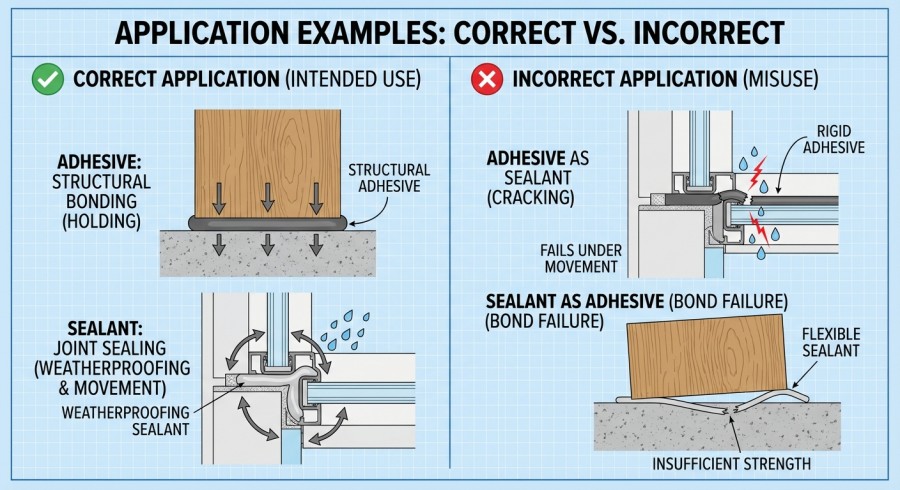
Sin embargo, intentar utilizar un sellador como adhesivo suele provocar fallos bajo carga. Los selladores carecen de la cohesión y la capacidad de transferencia de carga que exigen las aplicaciones estructurales. Un sellador puede parecer inicialmente que une los materiales, pero el movimiento o la tensión revelan rápidamente sus limitaciones.
Por el contrario, el uso de adhesivos como selladores genera problemas diferentes. La mayoría de los adhesivos permanecen relativamente rígidos después del curado, incapaces de adaptarse al movimiento que experimentan las articulaciones. Esta rigidez provoca fallos en la adhesión, agrietamiento o transferencia de tensión a los materiales adyacentes, causando daños.
Comprender esta diferencia fundamental ayuda a seleccionar el producto adecuado. – Elija adhesivos cuando necesite mantener las cosas unidas, y selladores cuando necesite evitar que entren cosas.
Tipos de adhesivos para la construcción y sus aplicaciones
El mercado de adhesivos para la construcción ofrece numerosas formulaciones químicas, cada una optimizada para diferentes aplicaciones y requisitos de rendimiento. Saber qué tipo de adhesivo se adapta mejor a sus necesidades evita errores costosos.
Adhesivos de polímero MS: Versátiles y de alto rendimiento
Los adhesivos poliméricos de silano modificado (MS) combinan las ventajas de múltiples composiciones químicas en un solo producto. Ofrecen una resistencia estructural similar a la de las resinas epoxi, una flexibilidad comparable a la de los poliuretanos y una resistencia a la intemperie similar a la de las siliconas.
Las ventajas del adhesivo de polímero MS incluyen:
- Fuerte acogida inicial – a menudo soportando peso durante el curado sin fijaciones temporales
- Excelente capacidad para rellenar huecos – Las uniones se mantienen fuertes incluso en juntas imperfectas.
- Adhesión a múltiples sustratos – Une materiales diferentes sin necesidad de imprimación en la mayoría de los casos.
- Resistencia a la intemperie – apto para aplicaciones interiores y exteriores
- Pintabilidad – Admite pintura después del curado, a diferencia de las siliconas.
Para aplicaciones de unión estructural exigentes, productos como Adhesivo de construcción de alta resistencia BoPin MS-850 Proporcionan una excepcional fuerza de unión, con una fuerza de agarre inicial superior a 75 kg/m² y una fuerza de unión final de hasta 3,0 MPa. Estos adhesivos de alto rendimiento permiten trabajar con materiales pesados como paneles de piedra, revestimientos metálicos y estructuras metálicas.
Aplicaciones típicas de adhesivos de polímero MS:
- Instalación de paneles y revestimientos sin fijaciones visibles.
- Montaje de espejos y accesorios pesados
- Unión de peldaños de escalera y encimeras
- Unión de elementos estructurales en la prefabricación
- Conexiones de metal con hormigón
Adhesivos de poliuretano: resistencia y flexibilidad
Los adhesivos de poliuretano (PU) ofrecen una excelente resistencia combinada con cierta flexibilidad. Los adhesivos de poliuretano monocomponente curan mediante reacción con la humedad, lo que los hace convenientes para aplicaciones en campo.
Características del adhesivo de poliuretano:
- Alta fuerza de unión Adecuado para aplicaciones estructurales
- Cierta flexibilidad acomodando movimientos menores
- Buen relleno de huecos en juntas de hasta 10 mm
- Opción de expansión de espuma – Los adhesivos de poliuretano expansivos rellenan grandes huecos a la vez que unen.
- Resistencia a la temperatura Adecuado para la mayoría de las aplicaciones de construcción.
Los adhesivos de poliuretano destacan en aplicaciones que requieren tanto resistencia como una ligera flexibilidad. – Fijación al subsuelo, unión de los paneles aislantes y adhesión de la membrana de cubierta.
Sensibilidad a la humedad durante el curado Esto significa que los adhesivos de poliuretano se benefician de condiciones de alta humedad, pero se ven afectados negativamente si los sustratos están excesivamente húmedos. Almacene los envases con cuidado y úselos antes de su fecha de caducidad para mantener su rendimiento.
Adhesivos epoxi: Máxima resistencia
Los adhesivos epoxi proporcionan las uniones más resistentes disponibles en aplicaciones de construcción. Los sistemas de dos componentes mezclan resina y endurecedor, lo que inicia reacciones químicas que crean enlaces extremadamente fuertes y rígidos.
Características del adhesivo epoxi:
- Fuerza de unión excepcional – a menudo más resistentes que los materiales que se unen
- Excelente resistencia química – Resiste aceites, disolventes y muchos productos químicos.
- Contracción mínima – Mantiene la precisión dimensional durante el curado.
- Capacidad de rellenar huecos – con la formulación y el refuerzo adecuados
- Resistencia a la temperatura – algunas formulaciones resisten el calor extremo
Sin embargo, las limitaciones de la resina epoxi incluyen:
- Se requiere mezclar – introduce la posibilidad de errores de ratio
- Flexibilidad limitada – Las uniones rígidas pueden agrietarse bajo movimiento o impacto.
- limitaciones de tiempo de trabajo – El tiempo de vida útil limita el tiempo de aplicación después de la mezcla.
- La preparación de la superficie es crítica – exige superficies extremadamente limpias y preparadas.
Los adhesivos epoxi funcionan mejor para aplicaciones que requieren máxima resistencia sin movimiento. – Adhesión de hormigón, reparaciones estructurales, sistemas de anclaje y montaje de equipos industriales.
Adhesivos acrílicos y de contacto: Usos especializados
Los adhesivos acrílicos y de contacto cumplen funciones específicas en la construcción. Si bien son menos comunes que los polímeros MS, PU o epoxi, ofrecen ventajas específicas en ciertas aplicaciones.
Los adhesivos acrílicos proporcionan:
- Rápido inicio – montaje rápido sin necesidad de abrazaderas
- Resistencia a los rayos UV – Aplicaciones en exteriores sin degradación
- bonos transparentes – Adecuado para lugares donde el adhesivo pueda ser visible
- Resistencia a la temperatura – algunas formulaciones soportan calor extremo
Los adhesivos de contacto funcionan mediante:
- Bono instantáneo cuando las superficies recubiertas se encuentran
- Alta resistencia inicial – no clamping or drying time needed
- Flexible bonds – suitable for materials that flex
- Relleno de huecos limitado – requires tight joint fits
These adhesive types suit specialized applications like laminate bonding, panel veneering, and situations requiring immediate grab without repositioning capability.
Types of Sealants and Their Applications
Construction sealants span multiple chemistries, each offering distinct advantages for specific sealing challenges. Matching sealant chemistry to application ensures lasting weatherproofing and joint performance.
Selladores de silicona: rendimiento superior
Silicone sealants dominate high-performance applications through exceptional durability and movement capability. Their inorganic polymer structure resists UV degradation, extreme temperatures, and weathering that destroys organic polymer sealants.
Silicone sealant advantages:
- Rango de temperatura extremo – typically -40°C to +150°C or higher
- Resistencia superior a los rayos UV – décadas de exposición sin degradación
- Excelente capacidad de movimiento – ±25% to ±50% depending on formulation
- Larga vida útil – 20-30+ years in demanding conditions
- Estabilidad química – resists most building chemicals and pollutants
Different silicone cure systems suit different applications:
Siliconas de curado neutro como BoPin 122 Silicona neutra de uso general offer safe compatibility with metals and sensitive materials. These sealants don’t release corrosive acetic acid during curing, making them suitable for aluminum, copper, natural stone, and mirror backing.
Specialized silicones address specific needs:
- Sanitary silicones with anti-fungal additives for wet areas
- Siliconas de alta temperatura for extreme heat exposure
- Structural glazing silicones for glass facade systems
- Fire-rated silicones maintaining seals through fire exposure
The main silicone limitation is paintability – most paints don’t adhere to cured silicone. For applications requiring painting, consider MS polymer or acrylic sealants instead.
MS Polymer Sealants: Paintable Flexibility
MS polymer technology extends beyond adhesives into high-performance sealants. These hybrid products combine silicone-like performance with paintability and ease of use.
MS polymer sealant advantages:
- Pintable después del curado – accepts most paint types
- Excelente flexibilidad – ±50% movement in quality formulations
- Adhesión a múltiples sustratos – usually no primer required
- Bajo olor – more pleasant for occupied spaces
- Good UV resistance – suitable for exterior applications
Productos como Polímero MS multiusos BoPin MS-220 serve dual roles – structural enough for light bonding yet flexible enough for joint sealing. This versatility makes MS polymers particularly valuable in applications where both bonding and sealing may be needed.
MS polymer sealants excel in:
- Window and door perimeter sealing
- Painted joint applications
- Multi-material joints requiring primers
- Interior applications where odor matters
- Renovation work matching existing painted finishes
Polyurethane Sealants: Flexible Durability
Polyurethane sealants offer good flexibility and strong adhesion at moderate cost. Single-component moisture-cure PU sealants provide convenient one-part systems for field applications.
PU sealant characteristics:
- Buena capacidad de movimiento – típicamente ±25% en productos de calidad
- Fuerte adhesión to concrete, metal, wood, and most substrates
- Abrasion resistance – better than silicone for traffic areas
- Pintable – acepta recubrimientos después del curado completo
- Rentable – often less expensive than silicones
However, PU limitations include:
- Sensibilidad a los rayos UV – yellowing and degradation in sunlight without stabilizers
- Sensibilidad a la humedad durante el curado – requires proper humidity
- Rango de temperatura limitado – typically -25°C to +80°C
PU sealants work well for:
- Concrete joint sealing
- Below-grade applications
- Industrial floor joints
- Applications where abrasion resistance matters
- Interior joints not requiring extreme durability
Acrylic Sealants: Economical Interior Solutions
Acrylic latex sealants serve light-duty interior applications economically. While lacking the performance of silicones or MS polymers, acrylics handle many basic sealing needs.
Acrylic sealant advantages:
- A base de agua – easy cleanup, low VOC
- Paintable immediately – even before full cure
- Bajo costo – most economical sealant option
- Fácil aplicación – forgiving working properties
- Safe for most substrates – no compatibility concerns
Acrylic limitations:
- Limited movement capability – typically ±10% or less
- No es impermeable – water-resistant at best
- Poor durability – 3-5 year service life in good conditions
- Rango de temperatura limitado – unsuitable for extreme conditions
- Substrate sensitive – adhesion problems on some materials
Acrylics suit applications like:
- Interior trim gaps and cracks
- Drywall joints and gaps
- Non-moving interior joints
- Temporary or low-stress sealing
- Paint-grade applications on forgiving substrates
When to Use Adhesives vs Sealants
The key to proper product selection lies in understanding your primary need: holding things together or keeping things out. Let’s examine specific scenarios that guide this choice.
Situations Requiring Adhesives
Choose construction adhesives when the primary goal is creating permanent bonds that transfer loads or hold assemblies together.
Panel installation demands adhesive strength. Mounting wall panels, ceiling tiles, or cladding requires bonds that support weight and resist pull-off forces. While mechanical fasteners might supplement adhesive bonds, the adhesive carries primary loads. Sealants lack the structural capacity for these applications and will creep or fail under constant load.
Heavy fixture mounting needs adhesive grab and strength. Mirrors, cabinets, countertops, and equipment require initial grab during installation plus long-term bond strength resisting gravitational and usage forces. Quality construction adhesives like MS polymer formulations provide both immediate positioning capability and eventual structural strength.
Structural bonding applications absolutely require adhesives. Joining structural elements, reinforcing existing structures, or creating composite assemblies demands the load-transfer capability only true adhesives provide. Sealants attempting these roles will fail, potentially creating dangerous situations.
Stair treads, thresholds, and similar applications where bonding must resist shear forces, impact loading, and wear require adhesive performance. Sealant flexibility becomes a liability in these applications rather than an asset.
Situations Requiring Sealants
Choose sealants when the primary goal is weatherproofing, gap filling, or accommodating movement in joints.
Expansion joints must use sealants, never adhesives. These joints exist specifically to accommodate building movement from thermal expansion, structural deflection, or settlement. Adhering joint faces together defeats the expansion joint’s purpose and concentrates stress at bond points, likely damaging adjacent materials.
Window and door perimeters require sealant flexibility. The junction between frames and walls experiences constant movement from temperature changes, wind loading, and frame operation. Quality weatherproof sealants accommodate this movement while maintaining watertight and airtight seals. Adhesives in these joints crack and leak rapidly.
Curtain wall and facade joints demand sealant performance. Large glazed facades move significantly through thermal cycling and wind forces. Specialized high-movement sealants maintain weather barriers through these conditions. Attempting to bond facade panels rigidly creates enormous stress and likely failure.
Wet area applications need flexible, anti-fungal sealants. Bathroom and kitchen joints around fixtures must flex with substrate movement while resisting water and mold growth. Productos como Silicona sanitaria BoPin 550 provide this combination. Adhesives in these locations would crack and allow water infiltration.
Any application primarily focused on weatherproofing – preventing water, air, or dust passage – requires sealant rather than adhesive, even if some incidental bonding occurs.
Applications Using Both
Many construction details benefit from using both adhesives and sealants strategically. Understanding how to combine them maximizes performance.
Window installation typically employs both. Low-expansion polyurethane foam adhesive provides structural support and insulation around the frame perimeter. After foam installation, weatherproof sealant at the exterior joint provides the water and air barrier. Each product serves its distinct purpose – foam for bonding and insulation, sealant for weatherproofing.
Panel installation often combines products. Construction adhesive bonds panels to substrates, transferring loads and providing primary attachment. Sealant then fills joints between panels, preventing water infiltration and accommodating differential movement. Neither product alone achieves both objectives adequately.
Countertop installation uses both strategically. Adhesive bonds countertop to cabinets, supporting weight and preventing movement. Sealant fills the backsplash joint and sink rim, keeping water out of vulnerable areas. Using only adhesive leaves gaps, using only sealant provides insufficient support.
The key is understanding each product’s role – adhesive for structural bonding, sealant for gap filling and movement accommodation. Attempting to make one product do both jobs compromises performance.
Common Mistakes and Misconceptions
Understanding what not to do prevents expensive failures. These common errors appear repeatedly in construction, usually from misunderstanding adhesive and sealant capabilities.
Using Sealants as Adhesives
The most common mistake involves using sealants to bond materials together permanently. Sealants may initially appear to hold, but time and stress reveal their inadequacy for structural applications.
Sealant creep under constant load causes progressive failure. Unlike adhesives that maintain dimensional stability under load, sealants continue slowly deforming. A mirror “bonded” with sealant gradually slides downward. Panels attached with sealant sag and eventually detach.
Temperature effects accelerate sealant-as-adhesive failure. Heat softens sealants, reducing their already-limited load capacity. In hot climates or sun-exposed locations, sealants attempting to hold weight fail faster.
The appropriate solution uses proper adhesive for bonding supplemented by sealant where weatherproofing is needed. Don’t ask sealants to perform structural roles they weren’t designed for.
Using Adhesives as Sealants
The inverse mistake – using adhesives in applications requiring movement accommodation – also causes problems. Adhesives’ strength becomes a liability when joints need flexibility.
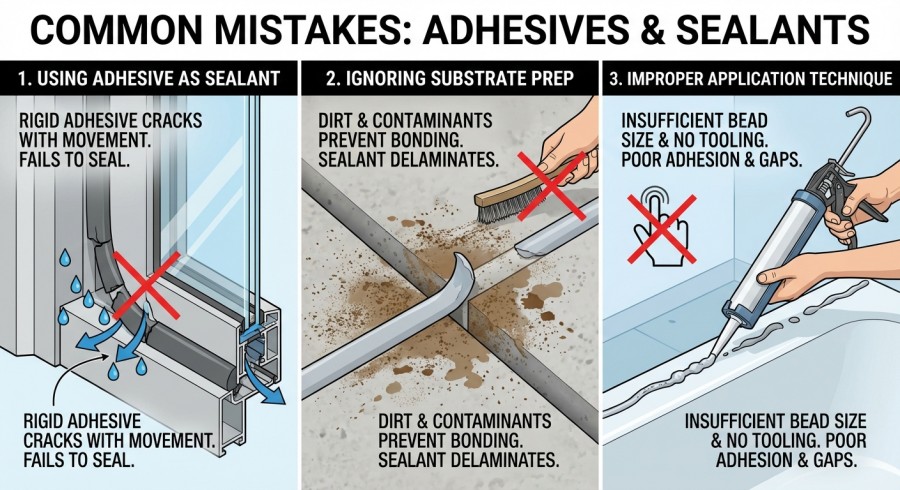
Rigid adhesives in expansion joints crack. The joint movement that expansion joints accommodate breaks adhesive bonds or cracks the adhesive itself. This creates exactly the water and air infiltration paths the joint was meant to prevent.
Adhesives at window perimeters fail from movement. Daily and seasonal thermal cycling moves window frames relative to walls. Adhesive attempting to seal these joints cracks, pulls away from substrates, or transfers stress causing damage to adjacent materials.
The solution uses flexible sealants in joints where movement occurs, regardless of how small that movement might seem. Let adhesives bond, let sealants seal.
Ignoring Substrate Preparation
Both adhesives and sealants demand proper surface preparation, though requirements differ. Skipping preparation steps causes adhesion failure regardless of product quality.
Contaminated surfaces prevent proper bonding. Oil, grease, dust, dirt, form release agents, and other contaminants interfere with adhesive and sealant adhesion. Cleaning is non-negotiable for lasting results – no premium product overcomes poor surface preparation.
Moisture content affects performance differently for adhesives and sealants. Some moisture-cure products benefit from slight dampness, while others require completely dry surfaces. Check technical data sheets for specific requirements rather than guessing.
Porous substrates may need primers para una adhesión óptima. While many modern MS polymer adhesives and sealants claim “no primer needed,” extremely porous or powdery surfaces still benefit from primer application. Don’t skip primers on challenging substrates to save minimal time and cost.
Improper Application Technique
Even correct product selection fails without proper application methods. Understanding and following manufacturer guidelines prevents easily-avoided problems.
Insufficient adhesive quantity reduces bond strength. Trying to stretch adhesives too thin saves little cost while dramatically reducing effectiveness. Follow recommended coverage rates and bead sizes for the intended application.
Inadequate sealant depth compromises flexibility. Too-shallow sealant in joints cannot stretch adequately, causing premature failure. The standard recommendation suggests joint depth approximately equal to width, typically achieved using backer rod.
Three-sided adhesion restricts sealant movement. When sealant bonds to joint bottom as well as sides, it cannot stretch freely. Backer rod or bond-breaker tape prevents bottom adhesion, allowing proper joint movement.
Working outside temperature or humidity ranges affects cure. Most products specify application conditions for proper curing. Extreme heat, cold, or humidity outside these ranges causes cure problems regardless of proper technique otherwise.
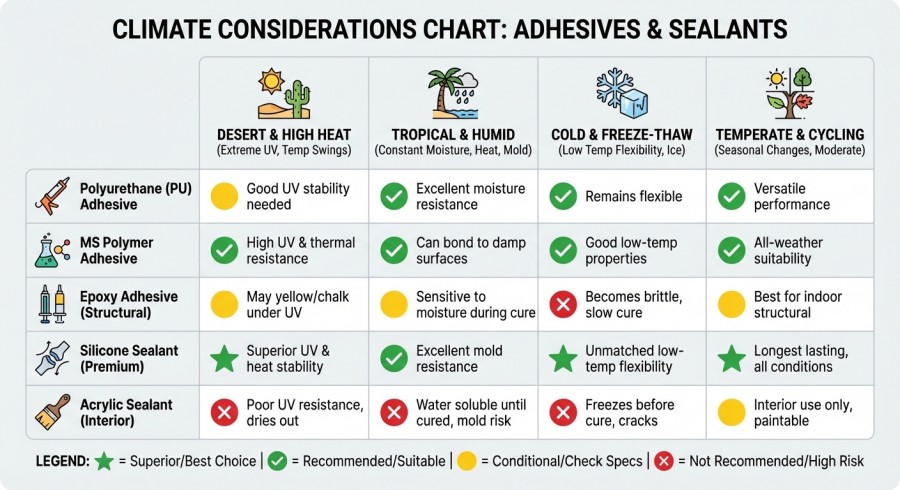
Selection Guide: Climate and Application Considerations
Environmental conditions significantly impact which adhesives and sealants perform reliably. Products successful in one climate may fail rapidly in another without adjustment.
Desert Climate Selections
Extreme heat, intense UV, and wide temperature swings challenge both adhesives and sealants in desert regions. Products must maintain performance through surface temperatures exceeding 70°C and nightly drops to moderate or even cold temperatures.
For adhesive applications in desert climates:
- MS polymer adhesives handle heat better than many PU formulations
- Avoid water-based products that may not cure properly in very low humidity
- Temperature-stabilized formulations prevent heat-related failure
- UV-resistant adhesives maintain strength despite intense sun exposure
For sealant applications:
- Premium silicones como BoPin 770 Silicona neutra resistente a la intemperie excel in extreme heat and UV
- High-temperature service ratings ensure performance on sun-exposed joints
- Movement capability ±50% Se adapta a ciclos térmicos severos
- UV stabilizers prevent premature aging from intense desert sun
Application timing matters critically in deserts. Work during morning hours when temperatures are moderate and surfaces haven’t reached extreme highs. Late afternoon or evening work risks applying to overheated substrates that compromise adhesion.
Tropical Climate Selections
High humidity, frequent rainfall, and biological growth create different challenges in tropical regions. Moisture resistance and anti-fungal protection become priorities.
For adhesive applications in tropical climates:
- Moisture-cure adhesives benefit from high humidity, curing faster and more completely
- Anti-microbial formulations resist mold growth on adhesive surfaces
- Rapid cure products minimize exposure time before reaching service strength
- Water-resistant formulations handle inevitable moisture exposure
For sealant applications:
- Anti-fungal sealants essential for preventing mold growth
- Moisture-cure chemistries like silicones cure reliably in high humidity
- Quick skin-over times reduce contamination risk from dust or rain
- Weather-resistant formulations handle constant exposure
Surface preparation challenges intensify in tropical humidity. Substrates rarely feel completely dry, and mold establishes rapidly on prepared surfaces. Use moisture meters to verify actual dryness rather than relying on feel, and proceed promptly after preparation to minimize contamination.
Temperature-Cycling Environments
Locations experiencing wide daily or seasonal temperature ranges – whether hot days and cold nights in highlands or seasonal extremes in continental climates – stress both adhesives and sealants through repeated expansion and compression.
For adhesive applications in cycling conditions:
- Flexible adhesives accommodate substrate movement better than rigid types
- Thermal expansion matching between adhesive and substrates reduces stress
- Quality gap-filling capability maintains bonds despite substrate movement
- Proven fatigue resistance through cycling testing
For sealant applications:
- Capacidad máxima de movimiento – ±50% provides safety margin
- Temperature range covering actual extremes experienced by the joint
- Proven cycle testing demonstrating performance through repeated movement
- Recuperación elástica maintaining seal integrity after compression and extension
Joint design becomes more critical where temperature cycling is severe. Adequate joint width and depth ensure sealants can accommodate movement without overstressing. Conservative sizing provides reliability margin.
Product Selection Decision Tree
Making the right choice between adhesive and sealant – and selecting the appropriate type within each category – follows logical decision paths. Answer these key questions to guide selection:
Question 1: What is the Primary Function?
If the primary need is holding materials together and transferring loads: You need an adhesive. If the primary need is weatherproofing, gap filling, or accommodating movement: You need a sealant. If both functions are required: Plan to use both products appropriately.
Question 2: Will the Joint Experience Movement?
Minimal to no movement expected: Adhesives (rigid or flexible), rigid sealants possible Moderate movement (thermal cycling, minor deflection): Flexible adhesives or flexible sealants Significant movement (expansion joints, large thermal swings): Sealants only, ±25-50% movement capability
Question 3: What Environmental Conditions Exist?
Extreme heat or UV exposure: Silicones, MS polymers, or temperature-stabilized adhesives High humidity or wet conditions: Moisture-cure products (silicone, PU, MS polymer) Wide temperature cycling: Products with appropriate temperature range and movement capability Exposición química: Epoxies, specialized chemical-resistant formulations
Question 4: What Substrates are Being Joined or Sealed?
Similar materials (concrete to concrete, metal to metal): Most adhesives and sealants work Dissimilar materials (metal to concrete, glass to aluminum): MS polymers, neutral-cure silicones Sensitive materials (natural stone, mirrors, certain metals): Neutral-cure products avoiding corrosive compounds Porous substrates: May require primers, or select products with excellent porous material adhesion
Question 5: What Performance Lifespan is Required?
Temporary or short-term (1-5 years): Economy products acceptable Standard service (5-15 years): Quality standard-grade products Long-term durability (15-30+ years): Premium products with proven long-term performance
Following this decision process systematically leads to appropriate product selection for virtually any application.
Preguntas frecuentes
Can I use construction adhesive as a sealant?
No, construction adhesives generally lack the flexibility and movement accommodation that sealing applications require. While adhesives fill gaps during bonding, they remain relatively rigid after curing and cannot stretch and compress through repeated cycles like proper sealants. In joints experiencing movement, adhesives will crack or lose adhesion, allowing water and air infiltration. For applications needing both bonding and sealing, use adhesive for the structural bond and proper sealant for weatherproofing.
Can sealant hold heavy objects like mirrors or panels?
Sealants should not be used for permanent load-bearing applications. While sealants may initially appear to support weight, they creep under constant load, causing progressive failure over time. Temperature increases accelerate this creep, especially problematic in warm climates. For mounting mirrors, panels, or other heavy objects, use proper construction adhesive formulated for structural bonding. Sealant may be used around perimeters for weatherproofing after adhesive provides structural support.
How do I know if I need primer?
Check manufacturer recommendations for your specific substrate combination. Modern MS polymer adhesives and neutral-cure silicones often bond without primers on common clean substrates like concrete, metal, and glass. However, primers significantly improve adhesion on porous, powdery, or difficult substrates like aged concrete, certain plastics, or oily woods. When in doubt, primer application provides insurance against adhesion failure at minimal additional cost and effort.
Can I paint over construction adhesive or sealant?
Paintability depends on product chemistry. MS polymer products and most polyurethanes accept paint after curing – check specific product data for recommended cure time before painting. Los selladores de silicona generalmente no se pueden pintar. as most paints don’t adhere properly to cured silicone surfaces. Acrylic sealants accept paint readily, often even before full cure. If paintability matters for your application, verify this capability before product selection rather than discovering problems after installation.
How long should I wait before exposing adhesive or sealant to water or stress?
Timing varies significantly by product chemistry and environmental conditions. Moisture-cure products (silicones, PU, MS polymers) typically skin over in 10-30 minutes but require 24-48 hours for adequate cure depth for normal service. Full cure may take 7 days or more depending on thickness and humidity. Check technical data sheets for specific timing, and note that cold temperatures or low humidity extend cure times while heat and humidity accelerate them. For critical applications, err on the conservative side by allowing extra cure time.
Conclusión
Understanding the fundamental difference between construction adhesives and sealants – bonding versus sealing – guides proper product selection and prevents expensive failures. Adhesives create permanent structural bonds that transfer loads, while sealants fill gaps and accommodate movement.
Attempting to use sealants as adhesives leads to creep, failure under load, and eventual detachment. Conversely, using adhesives in applications requiring flexibility results in cracking, adhesion loss, and compromised weatherproofing. The key to success lies in matching product capabilities to application requirements.
Both product categories include multiple chemistries offering different advantages. MS polymer products provide versatility for both adhesive and sealant applications, silicones excel in extreme conditions, polyurethanes offer cost-effective performance, and epoxies deliver maximum structural strength. Understanding these differences enables informed selection.
Climate conditions significantly affect performance. Desert heat, tropical humidity, and temperature cycling each demand specific product characteristics for reliable long-term results. Products succeeding in temperate climates may fail rapidly in extreme conditions without proper selection.
Many applications benefit from using both adhesives and sealants strategically. Window installation, panel mounting, and countertop installation typically employ adhesives for structural bonding and sealants for weatherproofing. Trying to make one product do both jobs compromises performance in both roles.
Proper surface preparation and application technique remain essential regardless of product quality. Clean substrates, appropriate environmental conditions during application, and following manufacturer guidelines ensure products perform as intended throughout their service life.
When in doubt about which product to use, return to the fundamental question: Do I need to hold materials together or keep things out? This simple distinction guides you toward adhesive or sealant, then specific chemistry selection refines the choice based on movement, environment, substrates, and service life requirements.
Need help selecting the right products for your specific application? Contacte con nuestro equipo técnico for personalized recommendations on adhesives and sealants suited to your project requirements and climate conditions.
Artículos relacionados: