Construction professionals and DIY builders often confuse adhesives and sealants, using them interchangeably despite fundamentally different purposes. Choosing the wrong product wastes money, compromises structural integrity, and creates maintenance problems that could have been easily avoided.
Understanding the distinct roles of adhesives versus sealants – and knowing exactly when to use each – ensures your construction projects perform as intended for their entire service life. Whether you’re working on residential projects, commercial buildings, or industrial facilities, making the right choice between bonding and sealing determines long-term success.
Understanding the Fundamental Difference
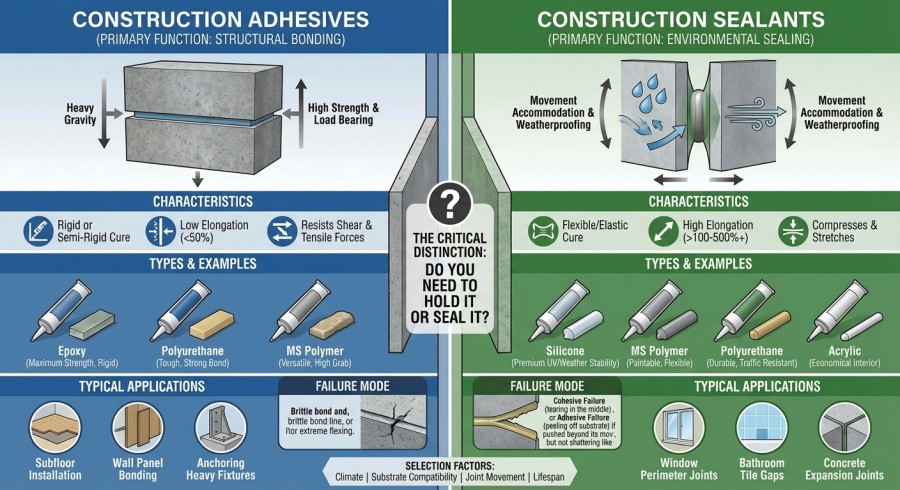
The core distinction between adhesives and sealants centers on their primary function: adhesives bond materials together while sealants fill gaps and prevent passage. This fundamental difference drives everything else about these products – their chemistry, physical properties, and appropriate applications.
What Construction Adhesives Do
Adhesives create permanent bonds between substrates, transferring loads and holding assemblies together. Think of adhesives as invisible fasteners that distribute stress across bond areas rather than concentrating it at discrete points like mechanical fasteners do.
Load transfer defines adhesive function. When properly applied, structural adhesives can replace or supplement mechanical fasteners, creating bonds that may exceed the strength of the materials being joined. The adhesive becomes an integral structural element rather than just a joining method.
Adhesives work through one or more bonding mechanisms:
- Mechanical interlocking where adhesive penetrates surface irregularities
- Chemical bonding where molecules form actual chemical bonds with substrate surfaces
- Physical attraction through van der Waals forces at molecular level
The best construction adhesives combine multiple bonding mechanisms for maximum strength and reliability across different substrates and conditions.
What Sealants Do
Sealants fill gaps, accommodate movement, and prevent passage of air, water, dust, or other materials. Rather than holding things together, sealants keep things out – or sometimes in, as with fuel tanks or chemical containment.
Movement accommodation distinguishes quality sealants. Buildings move constantly through thermal expansion, structural deflection, settlement, and wind loading. Sealants must stretch and compress repeatedly without losing adhesion or developing gaps.
Sealants primarily serve these functions:
- Weatherproofing – preventing water, air, and dust infiltration
- Joint filling – accommodating movement in expansion joints
- Aesthetic purposes – creating smooth transitions between materials
- Barrier creation – containing liquids, gases, or preventing contamination
The ideal sealant remains flexible indefinitely while maintaining perfect adhesion to joint faces despite continuous movement cycles.
The Critical Distinction in Practice
The confusion between adhesives and sealants often stems from overlapping characteristics. Both stick to substrates, both fill spaces between materials, and some products claim to do both jobs.
However, trying to use a sealant as an adhesive typically fails under load. Sealants lack the cohesive strength and load-transfer capability that structural applications demand. A sealant might initially appear to bond materials, but movement or stress quickly reveals its limitations.
Conversely, using adhesives as sealants creates different problems. Most adhesives remain relatively rigid after cure, unable to accommodate the movement that joints experience. This rigidity leads to adhesive failure, cracking, or stress transfer to adjacent materials causing damage.
Understanding this fundamental difference guides proper product selection – choose adhesives when you need to hold things together, sealants when you need to keep things out.
Types of Construction Adhesives and Their Applications
The construction adhesive market offers numerous chemistries, each optimized for different applications and performance requirements. Knowing which adhesive type suits your needs prevents expensive mistakes.
MS Polymer Adhesives: Versatile High-Performance
Modified Silane (MS) polymer adhesives combine advantages of multiple chemistries in single products. They offer structural strength approaching epoxies, flexibility rivaling polyurethanes, and weather resistance matching silicones.
MS polymer adhesive advantages include:
- Strong initial grab – often supporting weight during cure without temporary fasteners
- Excellent gap-filling capability – bonds remain strong even in less-than-perfect joints
- Multi-substrate adhesion – bonds dissimilar materials without primers in most cases
- Устойчивость к погодным условиям – suitable for interior and exterior applications
- Возможность покраски – accepts paint after curing, unlike silicones
For demanding structural bonding applications, products like Высокопрочный строительный клей BoPin MS-850 provide exceptional bonding strength with initial grab exceeding 75kg/m² and final bond strength up to 3.0 MPa. These high-performance adhesives handle heavy materials like stone panels, metal cladding, and structural assemblies.
Typical MS polymer adhesive applications:
- Panel and cladding installation without visible fasteners
- Mirror and heavy fixture mounting
- Stair tread and countertop bonding
- Structural element joining in prefabrication
- Metal to concrete connections
Polyurethane Adhesives: Strength and Flexibility
Polyurethane (PU) adhesives offer excellent strength combined with some flexibility. Single-component PU adhesives cure through moisture reaction, making them convenient for field applications.
PU adhesive characteristics:
- High bond strength suitable for structural applications
- Some flexibility accommodating minor movement
- Good gap-filling in joints up to 10mm
- Foam expansion option – expanding PU adhesives fill large voids while bonding
- Temperature resistance adequate for most building applications
PU adhesives excel in applications requiring both strength and slight flexibility – subfloor attachment, insulation panel bonding, and roofing membrane adhesion.
Moisture sensitivity during cure means PU adhesives benefit from high-humidity conditions but suffer if substrates are excessively wet. Store cans carefully and use within shelf life to maintain performance.
Epoxy Adhesives: Maximum Strength
Epoxy adhesives provide the strongest bonds available in construction applications. Two-component systems mix resin and hardener, initiating chemical reactions that create extremely strong, rigid bonds.
Epoxy adhesive characteristics:
- Exceptional bond strength – often stronger than materials being joined
- Отличная химическая стойкость – resists oils, solvents, and many chemicals
- Minimal shrinkage – maintains dimensional accuracy during cure
- Gap-filling capability – with proper formulation and reinforcement
- Temperature resistance – some formulations withstand extreme heat
However, epoxy limitations include:
- Mixing required – introduces potential for ratio errors
- Limited flexibility – rigid bonds may crack under movement or impact
- Working time constraints – pot life limits application time after mixing
- Surface preparation critical – demands extremely clean, prepared surfaces
Epoxy adhesives work best for applications requiring maximum strength without movement – concrete bonding, structural repairs, anchoring systems, and industrial equipment mounting.
Acrylic and Contact Adhesives: Specialized Uses
Acrylic and contact adhesives fill niche roles in construction. While less common than MS polymer, PU, or epoxy, they offer specific advantages in certain applications.
Acrylic adhesives provide:
- Fast initial tack – quick assembly without clamping
- Устойчивость к ультрафиолетовому излучению – outdoor applications without degradation
- Transparent bonds – suitable where adhesive might be visible
- Temperature resistance – some formulations handle extreme heat
Contact adhesives work through:
- Instant bond when coated surfaces meet
- High initial strength – no clamping or drying time needed
- Flexible bonds – suitable for materials that flex
- Limited gap-filling – requires tight joint fits
These adhesive types suit specialized applications like laminate bonding, panel veneering, and situations requiring immediate grab without repositioning capability.
Types of Sealants and Their Applications
Construction sealants span multiple chemistries, each offering distinct advantages for specific sealing challenges. Matching sealant chemistry to application ensures lasting weatherproofing and joint performance.
Silicone Sealants: Premium Performance
Silicone sealants dominate high-performance applications through exceptional durability and movement capability. Their inorganic polymer structure resists UV degradation, extreme temperatures, and weathering that destroys organic polymer sealants.
Silicone sealant advantages:
- Extreme temperature range – typically -40°C to +150°C or higher
- Превосходная стойкость к ультрафиолетовому излучению – десятилетия воздействия без ухудшения качества
- Excellent movement capability – ±25% to ±50% depending on formulation
- Длительный срок службы – 20-30+ years in demanding conditions
- Химическая стабильность – resists most building chemicals and pollutants
Different silicone cure systems suit different applications:
Neutral-cure silicones нравиться BoPin 122 Универсальный нейтральный силикон offer safe compatibility with metals and sensitive materials. These sealants don’t release corrosive acetic acid during curing, making them suitable for aluminum, copper, natural stone, and mirror backing.
Specialized silicones address specific needs:
- Sanitary silicones with anti-fungal additives for wet areas
- High-temperature silicones for extreme heat exposure
- Structural glazing silicones for glass facade systems
- Fire-rated silicones maintaining seals through fire exposure
The main silicone limitation is paintability – most paints don’t adhere to cured silicone. For applications requiring painting, consider MS polymer or acrylic sealants instead.
MS Polymer Sealants: Paintable Flexibility
MS polymer technology extends beyond adhesives into high-performance sealants. These hybrid products combine silicone-like performance with paintability and ease of use.
MS polymer sealant advantages:
- Можно красить после отверждения – accepts most paint types
- Excellent flexibility – ±50% movement in quality formulations
- Multi-substrate adhesion – usually no primer required
- Слабый запах – more pleasant for occupied spaces
- Good UV resistance – suitable for exterior applications
Такие продукты, как Многоцелевой полимер MS BoPin MS-220 serve dual roles – structural enough for light bonding yet flexible enough for joint sealing. This versatility makes MS polymers particularly valuable in applications where both bonding and sealing may be needed.
MS polymer sealants excel in:
- Window and door perimeter sealing
- Painted joint applications
- Multi-material joints requiring primers
- Interior applications where odor matters
- Renovation work matching existing painted finishes
Polyurethane Sealants: Flexible Durability
Polyurethane sealants offer good flexibility and strong adhesion at moderate cost. Single-component moisture-cure PU sealants provide convenient one-part systems for field applications.
PU sealant characteristics:
- Хорошая способность передвижения – typically ±25% in quality products
- Сильная адгезия to concrete, metal, wood, and most substrates
- Abrasion resistance – better than silicone for traffic areas
- Можно красить – accepts coatings after full cure
- Cost-effective – often less expensive than silicones
However, PU limitations include:
- Чувствительность к УФ-излучению – yellowing and degradation in sunlight without stabilizers
- Moisture sensitivity during cure – requires proper humidity
- Limited temperature range – typically -25°C to +80°C
PU sealants work well for:
- Герметизация бетонных швов
- Below-grade applications
- Industrial floor joints
- Applications where abrasion resistance matters
- Interior joints not requiring extreme durability
Acrylic Sealants: Economical Interior Solutions
Acrylic latex sealants serve light-duty interior applications economically. While lacking the performance of silicones or MS polymers, acrylics handle many basic sealing needs.
Acrylic sealant advantages:
- Water-based – easy cleanup, low VOC
- Paintable immediately – even before full cure
- Low cost – most economical sealant option
- Easy application – forgiving working properties
- Safe for most substrates – no compatibility concerns
Acrylic limitations:
- Limited movement capability – typically ±10% or less
- Not waterproof – water-resistant at best
- Poor durability – 3-5 year service life in good conditions
- Limited temperature range – unsuitable for extreme conditions
- Substrate sensitive – adhesion problems on some materials
Acrylics suit applications like:
- Interior trim gaps and cracks
- Drywall joints and gaps
- Non-moving interior joints
- Temporary or low-stress sealing
- Paint-grade applications on forgiving substrates
When to Use Adhesives vs Sealants
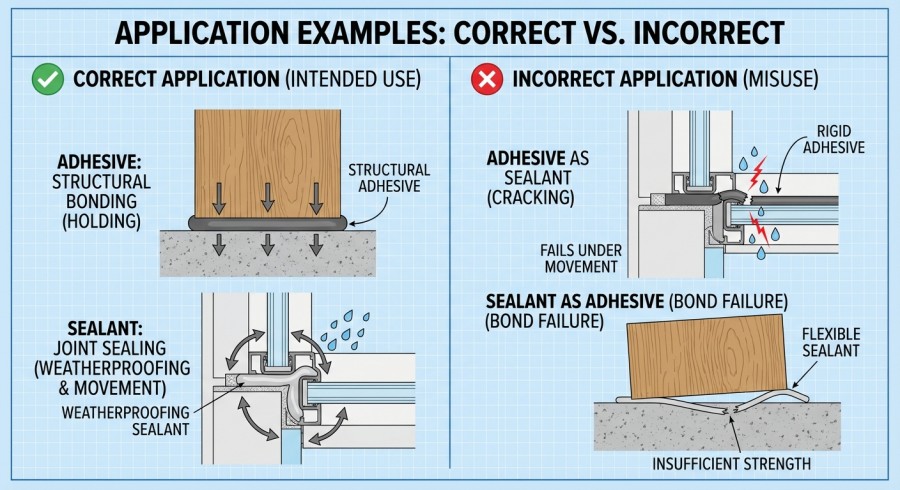
The key to proper product selection lies in understanding your primary need: holding things together or keeping things out. Let’s examine specific scenarios that guide this choice.
Situations Requiring Adhesives
Choose construction adhesives when the primary goal is creating permanent bonds that transfer loads or hold assemblies together.
Panel installation demands adhesive strength. Mounting wall panels, ceiling tiles, or cladding requires bonds that support weight and resist pull-off forces. While mechanical fasteners might supplement adhesive bonds, the adhesive carries primary loads. Sealants lack the structural capacity for these applications and will creep or fail under constant load.
Heavy fixture mounting needs adhesive grab and strength. Mirrors, cabinets, countertops, and equipment require initial grab during installation plus long-term bond strength resisting gravitational and usage forces. Quality construction adhesives like MS polymer formulations provide both immediate positioning capability and eventual structural strength.
Structural bonding applications absolutely require adhesives. Joining structural elements, reinforcing existing structures, or creating composite assemblies demands the load-transfer capability only true adhesives provide. Sealants attempting these roles will fail, potentially creating dangerous situations.
Stair treads, thresholds, and similar applications where bonding must resist shear forces, impact loading, and wear require adhesive performance. Sealant flexibility becomes a liability in these applications rather than an asset.
Situations Requiring Sealants
Choose sealants when the primary goal is weatherproofing, gap filling, or accommodating movement in joints.
Expansion joints must use sealants, never adhesives. These joints exist specifically to accommodate building movement from thermal expansion, structural deflection, or settlement. Adhering joint faces together defeats the expansion joint’s purpose and concentrates stress at bond points, likely damaging adjacent materials.
Window and door perimeters require sealant flexibility. The junction between frames and walls experiences constant movement from temperature changes, wind loading, and frame operation. Quality weatherproof sealants accommodate this movement while maintaining watertight and airtight seals. Adhesives in these joints crack and leak rapidly.
Curtain wall and facade joints demand sealant performance. Large glazed facades move significantly through thermal cycling and wind forces. Specialized high-movement sealants maintain weather barriers through these conditions. Attempting to bond facade panels rigidly creates enormous stress and likely failure.
Wet area applications need flexible, anti-fungal sealants. Bathroom and kitchen joints around fixtures must flex with substrate movement while resisting water and mold growth. Такие продукты, как BoPin 550 Санитарный силикон provide this combination. Adhesives in these locations would crack and allow water infiltration.
Any application primarily focused on weatherproofing – preventing water, air, or dust passage – requires sealant rather than adhesive, even if some incidental bonding occurs.
Applications Using Both
Many construction details benefit from using both adhesives and sealants strategically. Understanding how to combine them maximizes performance.
Window installation typically employs both. Low-expansion polyurethane foam adhesive provides structural support and insulation around the frame perimeter. After foam installation, weatherproof sealant at the exterior joint provides the water and air barrier. Each product serves its distinct purpose – foam for bonding and insulation, sealant for weatherproofing.
Panel installation often combines products. Construction adhesive bonds panels to substrates, transferring loads and providing primary attachment. Sealant then fills joints between panels, preventing water infiltration and accommodating differential movement. Neither product alone achieves both objectives adequately.
Countertop installation uses both strategically. Adhesive bonds countertop to cabinets, supporting weight and preventing movement. Sealant fills the backsplash joint and sink rim, keeping water out of vulnerable areas. Using only adhesive leaves gaps, using only sealant provides insufficient support.
The key is understanding each product’s role – adhesive for structural bonding, sealant for gap filling and movement accommodation. Attempting to make one product do both jobs compromises performance.
Common Mistakes and Misconceptions
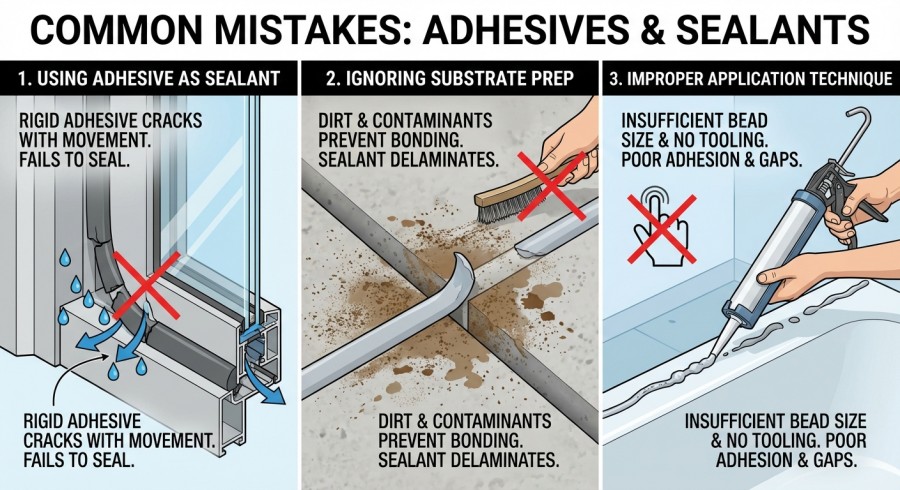
Understanding what not to do prevents expensive failures. These common errors appear repeatedly in construction, usually from misunderstanding adhesive and sealant capabilities.
Using Sealants as Adhesives
The most common mistake involves using sealants to bond materials together permanently. Sealants may initially appear to hold, but time and stress reveal their inadequacy for structural applications.
Sealant creep under constant load causes progressive failure. Unlike adhesives that maintain dimensional stability under load, sealants continue slowly deforming. A mirror “bonded” with sealant gradually slides downward. Panels attached with sealant sag and eventually detach.
Temperature effects accelerate sealant-as-adhesive failure. Heat softens sealants, reducing their already-limited load capacity. In hot climates or sun-exposed locations, sealants attempting to hold weight fail faster.
The appropriate solution uses proper adhesive for bonding supplemented by sealant where weatherproofing is needed. Don’t ask sealants to perform structural roles they weren’t designed for.
Using Adhesives as Sealants
The inverse mistake – using adhesives in applications requiring movement accommodation – also causes problems. Adhesives’ strength becomes a liability when joints need flexibility.
Rigid adhesives in expansion joints crack. The joint movement that expansion joints accommodate breaks adhesive bonds or cracks the adhesive itself. This creates exactly the water and air infiltration paths the joint was meant to prevent.
Adhesives at window perimeters fail from movement. Daily and seasonal thermal cycling moves window frames relative to walls. Adhesive attempting to seal these joints cracks, pulls away from substrates, or transfers stress causing damage to adjacent materials.
The solution uses flexible sealants in joints where movement occurs, regardless of how small that movement might seem. Let adhesives bond, let sealants seal.
Ignoring Substrate Preparation
Both adhesives and sealants demand proper surface preparation, though requirements differ. Skipping preparation steps causes adhesion failure regardless of product quality.
Contaminated surfaces prevent proper bonding. Oil, grease, dust, dirt, form release agents, and other contaminants interfere with adhesive and sealant adhesion. Cleaning is non-negotiable for lasting results – no premium product overcomes poor surface preparation.
Moisture content affects performance differently for adhesives and sealants. Some moisture-cure products benefit from slight dampness, while others require completely dry surfaces. Check technical data sheets for specific requirements rather than guessing.
Porous substrates may need primers для оптимальной адгезии. While many modern MS polymer adhesives and sealants claim “no primer needed,” extremely porous or powdery surfaces still benefit from primer application. Don’t skip primers on challenging substrates to save minimal time and cost.
Improper Application Technique
Even correct product selection fails without proper application methods. Understanding and following manufacturer guidelines prevents easily-avoided problems.
Insufficient adhesive quantity reduces bond strength. Trying to stretch adhesives too thin saves little cost while dramatically reducing effectiveness. Follow recommended coverage rates and bead sizes for the intended application.
Inadequate sealant depth compromises flexibility. Too-shallow sealant in joints cannot stretch adequately, causing premature failure. The standard recommendation suggests joint depth approximately equal to width, typically achieved using backer rod.
Three-sided adhesion restricts sealant movement. When sealant bonds to joint bottom as well as sides, it cannot stretch freely. Backer rod or bond-breaker tape prevents bottom adhesion, allowing proper joint movement.
Working outside temperature or humidity ranges affects cure. Most products specify application conditions for proper curing. Extreme heat, cold, or humidity outside these ranges causes cure problems regardless of proper technique otherwise.
Selection Guide: Climate and Application Considerations
Environmental conditions significantly impact which adhesives and sealants perform reliably. Products successful in one climate may fail rapidly in another without adjustment.
Desert Climate Selections
Extreme heat, intense UV, and wide temperature swings challenge both adhesives and sealants in desert regions. Products must maintain performance through surface temperatures exceeding 70°C and nightly drops to moderate or even cold temperatures.
For adhesive applications in desert climates:
- MS polymer adhesives handle heat better than many PU formulations
- Avoid water-based products that may not cure properly in very low humidity
- Temperature-stabilized formulations prevent heat-related failure
- UV-resistant adhesives maintain strength despite intense sun exposure
For sealant applications:
- Силиконы премиум-класса нравиться BoPin 770 — влагостойкий нейтральный силикон excel in extreme heat and UV
- High-temperature service ratings ensure performance on sun-exposed joints
- Movement capability ±50% accommodates severe thermal cycling
- UV stabilizers prevent premature aging from intense desert sun
Application timing matters critically in deserts. Work during morning hours when temperatures are moderate and surfaces haven’t reached extreme highs. Late afternoon or evening work risks applying to overheated substrates that compromise adhesion.
Tropical Climate Selections
High humidity, frequent rainfall, and biological growth create different challenges in tropical regions. Moisture resistance and anti-fungal protection become priorities.
For adhesive applications in tropical climates:
- Moisture-cure adhesives benefit from high humidity, curing faster and more completely
- Anti-microbial formulations resist mold growth on adhesive surfaces
- Rapid cure products minimize exposure time before reaching service strength
- Water-resistant formulations handle inevitable moisture exposure
For sealant applications:
- Anti-fungal sealants essential for preventing mold growth
- Moisture-cure chemistries like silicones cure reliably in high humidity
- Quick skin-over times reduce contamination risk from dust or rain
- Weather-resistant formulations handle constant exposure
Surface preparation challenges intensify in tropical humidity. Substrates rarely feel completely dry, and mold establishes rapidly on prepared surfaces. Use moisture meters to verify actual dryness rather than relying on feel, and proceed promptly after preparation to minimize contamination.
Temperature-Cycling Environments
Locations experiencing wide daily or seasonal temperature ranges – whether hot days and cold nights in highlands or seasonal extremes in continental climates – stress both adhesives and sealants through repeated expansion and compression.
For adhesive applications in cycling conditions:
- Flexible adhesives accommodate substrate movement better than rigid types
- Thermal expansion matching between adhesive and substrates reduces stress
- Quality gap-filling capability maintains bonds despite substrate movement
- Proven fatigue resistance through cycling testing
For sealant applications:
- Maximum movement capability – ±50% provides safety margin
- Temperature range covering actual extremes experienced by the joint
- Proven cycle testing demonstrating performance through repeated movement
- Elastic recovery maintaining seal integrity after compression and extension
Joint design becomes more critical where temperature cycling is severe. Adequate joint width and depth ensure sealants can accommodate movement without overstressing. Conservative sizing provides reliability margin.
Product Selection Decision Tree
Making the right choice between adhesive and sealant – and selecting the appropriate type within each category – follows logical decision paths. Answer these key questions to guide selection:
Question 1: What is the Primary Function?
If the primary need is holding materials together and transferring loads: You need an adhesive. If the primary need is weatherproofing, gap filling, or accommodating movement: You need a sealant. If both functions are required: Plan to use both products appropriately.
Question 2: Will the Joint Experience Movement?
Minimal to no movement expected: Adhesives (rigid or flexible), rigid sealants possible Moderate movement (thermal cycling, minor deflection): Flexible adhesives or flexible sealants Significant movement (expansion joints, large thermal swings): Sealants only, ±25-50% movement capability
Question 3: What Environmental Conditions Exist?
Extreme heat or UV exposure: Silicones, MS polymers, or temperature-stabilized adhesives High humidity or wet conditions: Moisture-cure products (silicone, PU, MS polymer) Wide temperature cycling: Products with appropriate temperature range and movement capability Воздействие химических веществ: Epoxies, specialized chemical-resistant formulations
Question 4: What Substrates are Being Joined or Sealed?
Similar materials (concrete to concrete, metal to metal): Most adhesives and sealants work Dissimilar materials (metal to concrete, glass to aluminum): MS polymers, neutral-cure silicones Sensitive materials (natural stone, mirrors, certain metals): Neutral-cure products avoiding corrosive compounds Porous substrates: May require primers, or select products with excellent porous material adhesion
Question 5: What Performance Lifespan is Required?
Temporary or short-term (1-5 years): Economy products acceptable Standard service (5-15 years): Quality standard-grade products Long-term durability (15-30+ years): Premium products with proven long-term performance
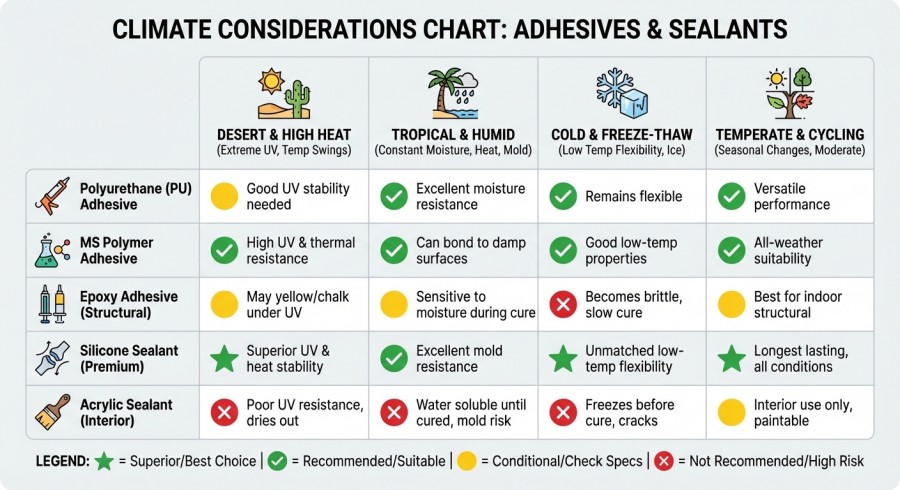
Following this decision process systematically leads to appropriate product selection for virtually any application.
Часто задаваемые вопросы
Can I use construction adhesive as a sealant?
No, construction adhesives generally lack the flexibility and movement accommodation that sealing applications require. While adhesives fill gaps during bonding, they remain relatively rigid after curing and cannot stretch and compress through repeated cycles like proper sealants. In joints experiencing movement, adhesives will crack or lose adhesion, allowing water and air infiltration. For applications needing both bonding and sealing, use adhesive for the structural bond and proper sealant for weatherproofing.
Can sealant hold heavy objects like mirrors or panels?
Sealants should not be used for permanent load-bearing applications. While sealants may initially appear to support weight, they creep under constant load, causing progressive failure over time. Temperature increases accelerate this creep, especially problematic in warm climates. For mounting mirrors, panels, or other heavy objects, use proper construction adhesive formulated for structural bonding. Sealant may be used around perimeters for weatherproofing after adhesive provides structural support.
How do I know if I need primer?
Check manufacturer recommendations for your specific substrate combination. Modern MS polymer adhesives and neutral-cure silicones often bond without primers on common clean substrates like concrete, metal, and glass. However, primers significantly improve adhesion on porous, powdery, or difficult substrates like aged concrete, certain plastics, or oily woods. When in doubt, primer application provides insurance against adhesion failure at minimal additional cost and effort.
Can I paint over construction adhesive or sealant?
Paintability depends on product chemistry. MS polymer products and most polyurethanes accept paint after curing – check specific product data for recommended cure time before painting. Silicone sealants generally cannot be painted as most paints don’t adhere properly to cured silicone surfaces. Acrylic sealants accept paint readily, often even before full cure. If paintability matters for your application, verify this capability before product selection rather than discovering problems after installation.
How long should I wait before exposing adhesive or sealant to water or stress?
Timing varies significantly by product chemistry and environmental conditions. Moisture-cure products (silicones, PU, MS polymers) typically skin over in 10-30 minutes but require 24-48 hours for adequate cure depth for normal service. Full cure may take 7 days or more depending on thickness and humidity. Check technical data sheets for specific timing, and note that cold temperatures or low humidity extend cure times while heat and humidity accelerate them. For critical applications, err on the conservative side by allowing extra cure time.
Заключение
Understanding the fundamental difference between construction adhesives and sealants – bonding versus sealing – guides proper product selection and prevents expensive failures. Adhesives create permanent structural bonds that transfer loads, while sealants fill gaps and accommodate movement.
Attempting to use sealants as adhesives leads to creep, failure under load, and eventual detachment. Conversely, using adhesives in applications requiring flexibility results in cracking, adhesion loss, and compromised weatherproofing. The key to success lies in matching product capabilities to application requirements.
Both product categories include multiple chemistries offering different advantages. MS polymer products provide versatility for both adhesive and sealant applications, silicones excel in extreme conditions, polyurethanes offer cost-effective performance, and epoxies deliver maximum structural strength. Understanding these differences enables informed selection.
Climate conditions significantly affect performance. Desert heat, tropical humidity, and temperature cycling each demand specific product characteristics for reliable long-term results. Products succeeding in temperate climates may fail rapidly in extreme conditions without proper selection.
Many applications benefit from using both adhesives and sealants strategically. Window installation, panel mounting, and countertop installation typically employ adhesives for structural bonding and sealants for weatherproofing. Trying to make one product do both jobs compromises performance in both roles.
Proper surface preparation and application technique remain essential regardless of product quality. Clean substrates, appropriate environmental conditions during application, and following manufacturer guidelines ensure products perform as intended throughout their service life.
When in doubt about which product to use, return to the fundamental question: Do I need to hold materials together or keep things out? This simple distinction guides you toward adhesive or sealant, then specific chemistry selection refines the choice based on movement, environment, substrates, and service life requirements.
Need help selecting the right products for your specific application? Свяжитесь с нашей технической командой for personalized recommendations on adhesives and sealants suited to your project requirements and climate conditions.
Статьи по теме: