Fire-rated sealing systems represent critical life safety components preventing fire and smoke spread through building penetrations and joints – yet improper installation, non-compliant products, or inadequate maintenance creates vulnerabilities that can prove fatal during fire events. Building codes worldwide mandate fire-rated sealing at specific locations, with strict requirements for product certification, installation procedures, and documentation.
Understanding fire-rated sealing requirements, selecting properly certified products, and implementing compliant installation procedures ensures buildings meet code requirements while providing occupants the protection fire ratings promise. Whether you’re a fire protection engineer designing systems, a contractor installing fire-rated assemblies, or a facility manager maintaining code compliance, proper fire-rated sealing proves essential to building safety and regulatory compliance.
Understanding Fire-Rated Sealing Requirements
Fire-rated building assemblies – walls, floors, and roofs designed to resist fire spread for specified time periods – lose their fire resistance when penetrations or joints compromise their integrity. Every pipe, cable, or duct passing through rated assemblies creates a potential path for fire and smoke unless properly sealed with fire-rated systems.

The Life Safety Purpose
Fire-rated assemblies serve two critical life safety functions: containing fire to its area of origin and maintaining safe egress paths for occupant evacuation. Fire-rated sealing preserves these protective functions at vulnerable penetration and joint locations.
Compartmentation divides buildings into fire-resistant compartments limiting fire spread. Rated walls and floors create boundaries that contain fire for rated periods (typically 1-4 hours). However, a single unsealed penetration through a 2-hour rated wall destroys the wall’s effectiveness allowing fire and smoke spread.
Egress path protection maintains safe evacuation routes during fires. Stairwells, corridors, and exit passages require fire-rated enclosures protecting occupants during evacuation. Fire-rated sealing at penetrations and joints ensures these protected paths remain safe for expected egress duration.
Property protection represents a secondary benefit. While life safety drives code requirements, limiting fire damage through effective compartmentation reduces property loss and business interruption.
Code and Standard Requirements
Multiple codes and standards govern fire-rated sealing creating overlapping regulatory requirements.
International Building Code (IBC) provides model building code adopted by most jurisdictions. IBC Chapter 7 (Fire and Smoke Protection Features) specifies where fire-rated sealing is required and references test standards for product approval.
NFPA standards (National Fire Protection Association) establish fire safety requirements. NFPA 101 (Life Safety Code) addresses existing buildings, while other NFPA standards cover specific building types or systems.
Local building codes may modify IBC requirements. Always verify local amendments as jurisdictions often impose stricter requirements than model codes. Middle Eastern countries increasingly adopt international standards while adding local requirements.
Insurance requirements may exceed minimum code. Property insurers often mandate specific protection levels to reduce loss exposure, particularly for high-value properties or critical facilities.
Fire Resistance Ratings
Fire resistance ratings indicate how long assemblies withstand standard fire exposure.
Common ratings include:
- 1-hour rating: Light construction, smaller buildings, non-critical separations
- 2-hour rating: Most common for major separations, stairwells, corridor walls
- 3-hour rating: High-rise buildings, hazardous occupancies, critical separations
- 4-hour rating: Most demanding applications, high-rise exit enclosures, severe hazards
Rating requirements depend on: building height, occupancy type, construction type, and specific location within building. High-rise buildings demand higher ratings than low-rise structures. Healthcare and assembly occupancies require more stringent protection than warehouses.
Fire-rated penetration and joint sealing systems must match or exceed the rating of assemblies they protect. A penetration through a 2-hour wall requires a 2-hour rated firestop system.
Fire-Rated Penetration Sealing Systems
Penetrations through fire-rated assemblies for mechanical, electrical, and plumbing services require listed and labeled fire-rated sealing systems. These engineered systems undergo rigorous testing verifying they maintain fire resistance ratings.
Penetration Types and Challenges
Mechanical penetrations include pipes, ducts, and conduits serving building systems. These create substantial openings – HVAC ducts may reach 600mm or larger – requiring robust sealing systems.
Electrical penetrations range from single cables to large cable trays. Numerous small cables collectively create significant openings if not properly sealed. High-voltage electrical systems add complexity requiring both fire protection and electrical safety.
tesisat geçişleri include water, waste, and gas piping in various materials and sizes. Plastic pipes present particular challenges as they melt during fires potentially creating unprotected openings.
Through-penetrations pass completely through assemblies emerging on both sides. These require sealing on both sides (or alternate approved methods) to prevent fire spread in either direction.
Membrane penetrations penetrate only the membrane (such as suspended ceiling) without breaching the structural floor above. While less critical than through-penetrations, codes still require proper sealing in many circumstances.
UL Firestop Systems
UL (Underwriters Laboratories) maintains the most widely recognized fire-rated system certifications in North America and increasingly globally. UL’s Fire Resistance Directory documents thousands of tested and listed firestop systems.
UL system numbers uniquely identify specific tested configurations. A complete UL system includes: specific assembly construction, penetrating item specifications, firestop product details, and installation instructions. Systems must be installed exactly as tested – deviations void the rating.
Key UL firestop standards include:
UL 1479 (Fire Tests of Through-Penetration Firestops): Tests systems with penetrating items (pipes, cables) passing completely through assemblies. This standard evaluates:
- T-Rating (temperature rise) – limits temperature increase on unexposed side
- F-Rating (flame and hot gas passage) – prevents fire spread through penetration
- L-Rating (air leakage) – controls smoke spread (when tested)
UL 2079 (Tests for Fire Resistance of Building Joint Systems): Tests joint systems accommodating building movement. Evaluates movement capability while maintaining fire resistance.
System components must be approved: UL systems specify particular products by manufacturer and model. Substituting “equivalent” products without engineering judgment voids certification.

ASTM Test Standards
ASTM International develops consensus test methods used globally for product evaluation.
ASTM E814 (Standard Test Method for Fire Tests of Through-Penetration Fire Stops): Provides test method similar to UL 1479. Many international jurisdictions reference ASTM standards rather than proprietary UL methods.
ASTM E1966 (Standard Test Method for Fire Resistive Joint Systems): Tests joint systems comparable to UL 2079 methods.
ASTM E119 (Standard Test Methods for Fire Tests of Building Construction and Materials): Establishes standard fire exposure (time-temperature curve) used in most fire resistance testing.
F-Rating and T-Rating: ASTM testing evaluates same criteria as UL methods. F-rating indicates time (in hours) system prevents flame passage. T-rating indicates time before unexposed side temperature rises 181°C above ambient or any single point rises 221°C above ambient.
Engineering Judgment and Alternative Methods
When no listed system exactly matches field conditions, engineering judgment provides alternative approval methods.
Qualified professionals (typically licensed fire protection engineers) may approve variations from listed systems through documented analysis. Engineering judgment considers: materials similarity, dimensions comparison to tested systems, fire severity, and technical principles.
Through-penetration firestop devices offer alternative to listed systems for certain applications. These tested devices accommodate multiple cable sizes allowing field flexibility while maintaining certification.
However, engineering judgment has limits. Major deviations from tested systems, changes to critical dimensions, or material substitutions may require new testing. Always document engineering judgments for authority having jurisdiction (AHJ) review.

Fire-Rated Joint Systems
Joints between fire-rated assemblies – where walls meet floors, exterior curtain walls connect to floor edges, or where building movement requires designed gaps – require fire-rated systems maintaining both fire resistance and movement capability.

Static vs. Dynamic Joints
Static joints in non-movement locations use conventional fire-rated sealants. These include: head-of-wall joints (where interior walls meet floor/roof above), perimeter joints around door and window frames in rated walls, and joints between precast concrete panels.
Static joint products typically use:
- Intumescent sealants that expand when heated creating insulating char
- Endothermic sealants releasing water vapor absorbing heat
- Mineral fiber systems with fire-rated sealants
Dynamic joints must accommodate building movement while maintaining fire resistance. These include: seismic joints, expansion joints in exterior walls, and curtain wall perimeter joints where facades attach to floor slabs.
Dynamic joint systems require:
- Hareket kabiliyeti (typically ±25% to ±50% of joint width)
- Yangına dayanıklılık matching assembly rating
- Compression resistance preventing squeeze-out during joint closure
- Restoration capability returning to original position after movement
For detailed expansion joint information see our Genleşme Derz Tasarımı ve Sızdırmazlık Kılavuzu.
Head-of-Wall Joints
Head-of-wall joints where non-load-bearing interior walls terminate at floor or roof structures above require fire-rated sealing preventing smoke and fire spread into concealed spaces.
Why head-of-wall sealing matters: Modern construction often uses metal stud walls that don’t reach structural floor above. The gap between wall top and floor/ceiling creates fire spread path into plenum spaces if not sealed.
UL 2079 systems specifically test head-of-wall configurations. Systems typically include:
- Mineral fiber insulation filling annular space
- Spray-applied or trowel-applied fire-rated materials on both sides
- Compatible with wall movement from deflection or thermal effects
Installation considerations:
- Install before ceiling if possible for easier access
- Maintain required thickness of fire-rated materials
- Support mineral fiber preventing compression
- Document system used for inspection
Curtain Wall Perimeter Joints
Curtain wall perimeter joints where exterior wall systems connect to floor edges represent particularly challenging applications requiring both fire protection and weather resistance.
These joints must:
- Resist fire spread between floors (typically 1-2 hour rating)
- Accommodate substantial movement termal genleşme ve bina deformasyonundan
- Provide weatherproofing rüzgarla savrulan yağmura karşı
- Maintain insulation continuity for energy efficiency
Typical system components:
- Fire-rated mineral wool insulation compressed behind curtain wall
- Fire-rated sealant (often intumescent) at interior
- Weather seal (often silicone) at exterior
- Safing (mineral fiber blanket) filling cavity
For comprehensive curtain wall guidance see Glass Curtain Wall and Facade Glazing Systems.
Fire-Rated Products and Materials
Various product types provide fire resistance through different mechanisms. Understanding product characteristics guides appropriate selection.
Intumescent Sealants
Intumescent products expand dramatically when exposed to fire, creating insulating char that blocks openings and protects substrates.
Expansion mechanism: Heat causes chemical reaction producing carbon foam expanding 10-40 times original volume. This expansion fills gaps, crushes combustible penetrating items (like plastic pipes), and creates insulating barrier.
Avantajları:
- Accommodate joint movement before fire exposure
- Self-sealing – expansion fills gaps automatically
- Effective on plastics – crushes melting materials closing openings
- Clean appearance – typically smooth paintable finish
Sınırlamalar:
- May not suit very large penetrations – expansion limits exist
- Requires proper depth – insufficient material may not expand adequately
- Some products sensitive to water – verify exterior suitability
Uygulamalar: Through-penetrations with plastic pipes, dynamic joints, head-of-wall applications, general penetration sealing.
Endothermic Sealants
Endothermic materials release water vapor when heated, cooling the fire exposure and creating steam barrier.
Cooling mechanism: Products contain hydrated minerals releasing bound water at elevated temperatures. Water vapor absorbs substantial heat while steam creates protective atmosphere.
Avantajları:
- Cooling effect protects substrates
- Stable dimensions – doesn’t expand like intumescents
- Good gap-filling – viscous consistency fills irregularities
- Water resistant – suitable for exterior locations
Sınırlamalar:
- Heavier than intumescents – requires structural support in some applications
- Less movement capability – primarily for static applications
- May require mechanical support – can sag before curing
Uygulamalar: Large penetrations, exterior locations requiring water resistance, static joints, supporting intumescent systems.
Fire-Rated Mortars and Putties
Cementitious mortars create rigid fire barriers through mineral content and thermal stability.
Özellikler:
- Very hard when cured – essentially concrete-like
- Excellent fire resistance – minerals don’t burn
- No movement capability – completely rigid
- Heavy – requires substantial support
Uygulamalar: Large static penetrations, heavy mechanical systems, below-grade applications, severe fire hazard areas.
Fire-rated putty provides hand-moldable alternative for certain applications. Non-hardening putty seals irregular spaces around cables and pipes. However, putty alone rarely constitutes complete system – typically used with other materials.
Firestop Devices and Accessories
Through-penetration firestop devices provide factory-assembled solutions for certain penetration types.
Mechanical devices using intumescent materials in metal housings accommodate cables or pipes. Benefits include:
- Tested and listed as complete devices
- Field adjustable – cables added/removed without re-sealing
- Consistent installation – reduces field variables
- Faster than field-assembled systems in some applications
Firestop collars clamp around plastic pipes expanding to crush pipe during fire. These simple devices effectively seal combustible penetrations.
Cable and pipe sleeves provide complete penetration systems combining metal sleeve, fire-rated packing, and intumescent components. Particularly useful for complex multiple-penetration situations.
Installation Requirements and Quality Control
Proper installation following listed system requirements proves critical to fire-rated sealing effectiveness. Deviations from tested configurations void ratings regardless of product quality.
Following UL System Specifications
Each UL system includes detailed installation instructions that must be followed exactly.
Critical specifications include:
- Assembly construction – substrate materials and thickness
- Penetrating item specifications – materials, dimensions, spacing
- Product quantities – minimum thickness, coverage, depth
- Installation sequence – material application order
- Curing requirements – time before exposure or loading
Common installation errors:
Wrong substrate: System tested in concrete block but installed in gypsum wallboard. Substrate affects heat transfer and material adhesion – systems aren’t interchangeable between assemblies.
Oversized penetrations: System tested with 100mm pipe in 150mm opening but installed with 100mm pipe in 250mm opening. Larger gaps require different systems or additional materials.
Insufficient material thickness: System requires 25mm depth but only 15mm installed. Reduced thickness cannot provide rated protection.
Mixing system components: Using Product A (tested in System X) with Product B (tested in System Y). Components from different systems may not work together properly.
Documentation and Submittal Requirements
Code compliance requires documentation verifying proper products and installation.
Before installation:
- Submit UL system numbers or equivalent for approval
- Provide product data sheets including fire rating certifications
- Detail installation locations on drawings
- Document engineering judgments for non-standard conditions
During installation:
- Photograph completed work before concealment
- Maintain installation logs recording locations, systems used, dates
- Document any field changes requiring approval
- Preserve material packaging showing batch numbers and certifications
After completion:
- Provide as-built documentation to owner
- Include maintenance requirements for future reference
- Certify compliance with code requirements
- Maintain records for building life
Inspection requirements vary by jurisdiction. Some require third-party special inspection, others accept contractor self-certification. Always verify local requirements.
Quality Control During Installation
Systematic quality control catches problems before concealment.
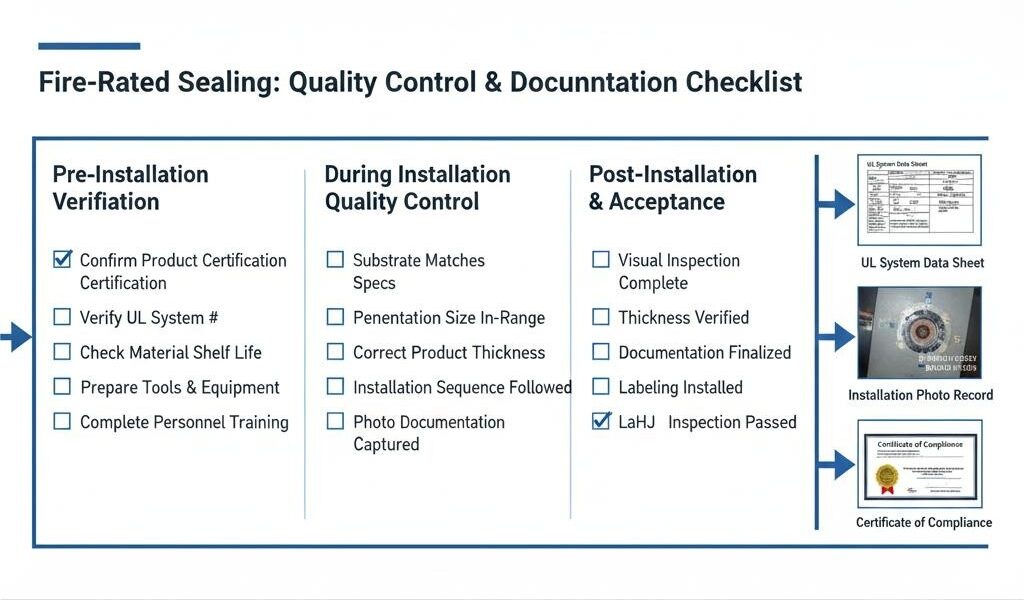
Pre-installation verification:
- ☐ Correct products delivered
- ☐ Materials within shelf life
- ☐ UL system number confirmed
- ☐ Tools and equipment ready
- ☐ Workers trained on system requirements
During installation:
- ☐ Assembly matches system specifications
- ☐ Penetration sizes within approved ranges
- ☐ Proper surface preparation
- ☐ Correct product thickness/depth
- ☐ Required accessories included
- ☐ Installation sequence followed
Post-installation:
- ☐ Visual inspection for completeness
- ☐ Thickness verification
- ☐ Photo documentation
- ☐ Labeling installed
- ☐ Records completed
Inspection and Maintenance
Fire-rated sealing requires periodic inspection and maintenance ensuring continued code compliance. Alterations, additions, or deterioration may compromise original protection.
Initial Inspection and Acceptance
Authority Having Jurisdiction (AHJ) inspections verify compliance before occupancy.
Inspectors verify:
- Products match approved submittals
- Installation follows system requirements
- All required locations sealed
- Documentation complete
- Labeling present where required
Prepare for inspection by:
- Reviewing all work before calling inspection
- Having documentation readily available
- Providing access to all locations
- Addressing any punch-list items promptly
- Maintaining photographs of concealed work
If installations fail inspection, correct deficiencies and re-inspect. Never conceal failed work hoping to avoid correction – discovered later, remediation costs escalate dramatically.
Ongoing Maintenance Inspection
Periodic inspection identifies problems before they compromise fire safety.
Inspection frequency recommendations:
- Annual inspection minimum for critical facilities (healthcare, high-rise)
- Biennial inspection adequate for most commercial buildings
- After alterations affecting fire-rated assemblies
- Following any fire event even if minor
Inspection focus areas:
Penetrations:
- Look for gaps, cracks, or damage
- Verify sealing materials intact
- Check for unauthorized penetrations
- Examine large mechanical penetrations closely
- Test adhesion if deterioration suspected
Joints:
- Inspect head-of-wall sealing
- Examine curtain wall perimeter joints
- Check expansion joints for damage
- Verify safing material in place
- Look for compression or displacement
Alterations:
- Every new penetration requires fire-rated sealing – verify nothing added without proper sealing
- Removed penetrations may need re-sealing
- Modified systems may need upgrading
Documentation:
- Photograph conditions
- Note any deficiencies
- Prioritize repairs by severity
- Track trends over time
Common Maintenance Issues
Unauthorized penetrations represent the most common compliance problem. Building staff may drill holes or add cables without understanding fire-rating requirements. Educate facility personnel about prohibitions against unsealed penetrations.
Deteriorating sealants particularly in demanding locations (exterior exposure, mechanical rooms) eventually require replacement. Plan proactive replacement before complete failure.
Modified systems during renovations may not receive proper attention. Any work affecting fire-rated assemblies must include fire-rated sealing – coordinate with contractors ensuring this happens.
Missing documentation makes future work difficult. Maintain comprehensive records of systems installed, locations, and dates for future reference during alterations.
Common Compliance Errors and How to Avoid Them
Understanding typical mistakes helps prevent code violations and failed inspections.
Using Non-Rated Products
The most serious error involves using standard sealants or materials instead of fire-rated products in rated assemblies.
Why it happens:
- Lack of awareness of requirements
- Attempting to save costs
- Substituting “equivalent” products without verification
- Confusion about what requires rating
Consequences:
- Life safety hazard – no fire protection
- Code violation – failing inspection
- Liability – potential legal consequences if fire occurs
- Expensive correction – removal and proper installation
Önleme:
- Train all personnel on fire-rating requirements
- Specify rated products clearly in plans
- Verify products before installation – check labels and certifications
- Never substitute without approval from engineer and AHJ
Installation Deviations from Listed Systems
Installing fire-rated products differently than listed system specifications voids the rating.
Common deviations:
- Insufficient material thickness
- Wrong substrate type
- Oversized penetrations
- Missing system components
- Incorrect installation sequence
Önleme:
- Keep system sheets on site during installation
- Review requirements before starting each location
- Question anything unclear – don’t guess
- Document any necessary deviations and obtain engineering approval
- Inspect work against system specifications
Inadequate Documentation
Missing or incomplete documentation creates compliance issues during inspections and future alterations.
Documentation failures:
- No record of UL system numbers used
- Missing product certifications
- No as-built documentation
- Lack of photographic evidence
- Lost maintenance records
Önleme:
- Establish documentation procedures before starting work
- Assign responsibility for record keeping
- Create standardized forms ensuring consistency
- Photograph work systematically before concealment
- Maintain centralized files accessible for future needs
Compromising Systems During Later Work
Future alterations may damage or bypass existing fire-rated sealing without proper restoration.
How it happens:
- Adding cables to existing penetration without proper sealing
- Drilling new penetrations without fire-rated sealing
- Removing safing to access mechanical systems
- Disturbing joint systems during renovations
Önleme:
- Educate building staff about fire-rating importance
- Include fire-rating requirements in all work scopes
- Require contractor submittals for fire-rated work
- Inspect alterations verifying proper sealing
- Maintain as-built drawings showing fire-rated locations
Sıkça Sorulan Sorular
What’s the difference between fire-rated and regular sealants?
Fire-rated sealants undergo testing to ASTM E814 or UL 1479 standards verifying they maintain fire resistance ratings when installed per listed systems, while regular sealants receive no such testing and provide no fire protection. Fire-rated products use specialized formulations – intumescent materials that expand in fire, or endothermic compounds releasing water vapor – specifically designed to prevent fire and smoke spread. Using standard silicone or polyurethane sealants in fire-rated assemblies violates codes and creates life-safety hazards regardless of the sealant’s quality for normal sealing purposes. Only products tested and listed as components of fire-rated systems provide code-compliant fire protection – there is no acceptable substitute or “equivalent” unless specifically approved through engineering judgment.
Do I need fire-rated sealing for every penetration in my building?
Fire-rated sealing is legally required only for penetrations through fire-rated assemblies – walls, floors, or ceilings designed with specific fire resistance ratings. Not every wall or floor in buildings has fire ratings; code determines which assemblies must be rated based on building height, occupancy, construction type, and location. Check building drawings or consult your architect/engineer to identify which assemblies have fire ratings – these are typically labeled on drawings. Common rated locations include: stairwell enclosures, corridor walls in certain occupancies, floor assemblies in multi-story buildings, and walls separating different tenants or occupancies. Once you identify rated assemblies, every penetration through them requires properly installed, listed fire-rated sealing systems – no exceptions without formal engineered variance.
Can I add cables to existing penetrations with fire-rated sealing?
Adding cables, pipes, or other penetrating items to existing fire-rated penetrations requires careful evaluation – in most cases, you cannot simply add items without re-sealing. Listed UL systems specify maximum fill percentages and specific configurations. Adding items may exceed these limits or change the configuration beyond what was tested, voiding the fire rating. Options for adding items include: (1) verify existing system allows additional penetrations within tested parameters and re-seal per system requirements, (2) install adjacent new penetration with proper fire-rated sealing, or (3) use through-penetration firestop devices designed for reconfigurable installations. Never simply push new cables through existing sealant – this compromises fire protection. Document any changes and maintain records for future reference and compliance verification.
How often should fire-rated sealing be inspected?
Fire-rated sealing should receive initial inspection before concealment during construction, annual inspections minimum for critical occupancies (healthcare, high-rise), and biennial inspections for most commercial buildings, with additional inspection required after any alterations affecting fire-rated assemblies. Initial inspection by authorities having jurisdiction (AHJ) occurs during construction before finishes conceal work – this verifies code compliance. Ongoing maintenance inspections identify unauthorized penetrations (the most common problem), deteriorating sealants, or damaged systems requiring repair. Critical facilities with high life-safety stakes warrant more frequent inspection. After any renovation, remodeling, or tenant improvement work, inspect all fire-rated sealing ensuring contractors properly sealed new penetrations and didn’t compromise existing systems. Document all inspections photographically creating records of conditions and any deficiencies requiring attention.
What happens if fire-rated sealing is found to be non-compliant?
Non-compliant fire-rated sealing creates serious legal, safety, and financial consequences requiring immediate correction. Discovered during inspections, authorities may issue stop-work orders, deny occupancy permits, or require complete removal and re-installation of non-compliant work – correction costs typically far exceed proper initial installation. For occupied buildings, non-compliance may trigger: violation notices, mandatory correction timelines, increased insurance premiums, potential building closure for egregious violations, and legal liability if fire occurs causing injury or death. Property owners bear ultimate responsibility for code compliance regardless of contractor errors. If you discover or suspect non-compliant fire-rated sealing, immediately: engage qualified fire protection professional for assessment, develop correction plan, obtain required permits/approvals, complete repairs with proper products and documentation, and verify compliance through re-inspection. Never attempt to conceal non-compliant work – penalties escalate if discovered later, and moral responsibility for life safety demands proper correction.
Çözüm
Fire-rated sealing systems serve critical life safety functions preventing fire and smoke spread through building penetrations and joints – yet effectiveness depends entirely on proper product selection, compliant installation, and adequate maintenance throughout building life. These systems protect building occupants during fires and facilitate safe evacuation, making proper implementation a moral and legal obligation transcending simple code compliance.
Code requirements mandate fire-rated sealing at specific locations based on building characteristics and occupancy risks. International Building Code and NFPA standards establish baseline requirements, though local jurisdictions often impose additional stipulations. Understanding which assemblies require protection – typically stairwells, corridor walls, floor assemblies, and occupancy separations – guides where fire-rated sealing proves necessary. Not every wall or penetration requires fire-rating, but those that do demand absolute compliance.
Listed and labeled systems from recognized testing agencies like UL provide the only code-compliant path for most applications. These systems undergo rigorous testing verifying they maintain fire resistance ratings under standard fire exposure. UL system numbers specify exact configurations – assembly construction, penetrating item specifications, product details, and installation procedures – that must be followed precisely. Deviations void ratings regardless of good intentions or apparent equivalence.
Different product types serve different applications. Intumescent sealants expand dramatically when heated crushing combustible penetrating items and filling gaps. Endothermic materials release water vapor absorbing heat and creating protective steam. Cementitious products provide rigid fire barriers for static applications. Understanding product mechanisms helps select appropriate materials for specific conditions.
Installation quality determines real-world performance. Workers must follow system specifications exactly, using correct products in specified configurations at proper thicknesses. Documentation requirements include submittals, installation records, and photographic evidence supporting code compliance during inspections and providing reference for future work.
Ongoing inspection and maintenance ensure continued protection. Annual inspections minimum for critical facilities identify unauthorized penetrations, deteriorating sealants, or compromised systems requiring attention. Any building alteration affecting fire-rated assemblies must include proper fire-rated sealing – educating building staff and contractors about this requirement prevents the most common compliance problem.
Common errors include using non-rated products, deviating from listed systems, inadequate documentation, and compromising systems during later work. Understanding these pitfalls enables prevention through proper training, quality control, and systematic procedures.
Fire-rated sealing represents insurance against worst-case scenarios – we install these systems hoping they’re never tested by actual fires, but knowing lives depend on their proper function if fires occur. This life safety mission demands nothing less than complete compliance with requirements, attention to detail during installation, and diligent maintenance throughout building life. Whether you’re designing systems, installing products, or maintaining facilities, your professional obligation to occupant safety requires taking fire-rated sealing seriously as the critical life safety component it represents.
Need expert guidance on fire-rated sealing system selection, installation specifications, or compliance verification for your projects? Contact our technical team for professional support on fire protection requirements, product recommendations, and installation procedures for code-compliant fire-rated sealing.
İlgili Makaleler:
- Waterproofing Penetrations: Pipes, Cables, and Equipment
- İnşaatta Genleşme Derzlerinin Tasarımı ve Sızdırmazlığı
- Glass Curtain Wall and Facade Glazing Systems
- Industrial Floor and Warehouse Joint Sealing
- Sızdırmazlık Malzemesi Sorun Giderme: Sık Karşılaşılan Problemler ve Çözümler
Standards and Resources: