Private-label sealant packaging is more than a branding exercise.
Once a cartridge, sausage pack or PU foam can is printed, the information on the package becomes part of the product that customers, distributors, contractors and sometimes regulators will rely on.
A packaging mistake can therefore create more than a design problem.
It can lead to:
- Customers using the wrong product
- Unsupported technical claims
- Incorrect safety information
- Conflicts between the label and SDS
- Incorrect net-content declarations
- Problems with distributors or customs
- Expensive packaging reprints
- Product complaints
- Regulatory questions in the destination market
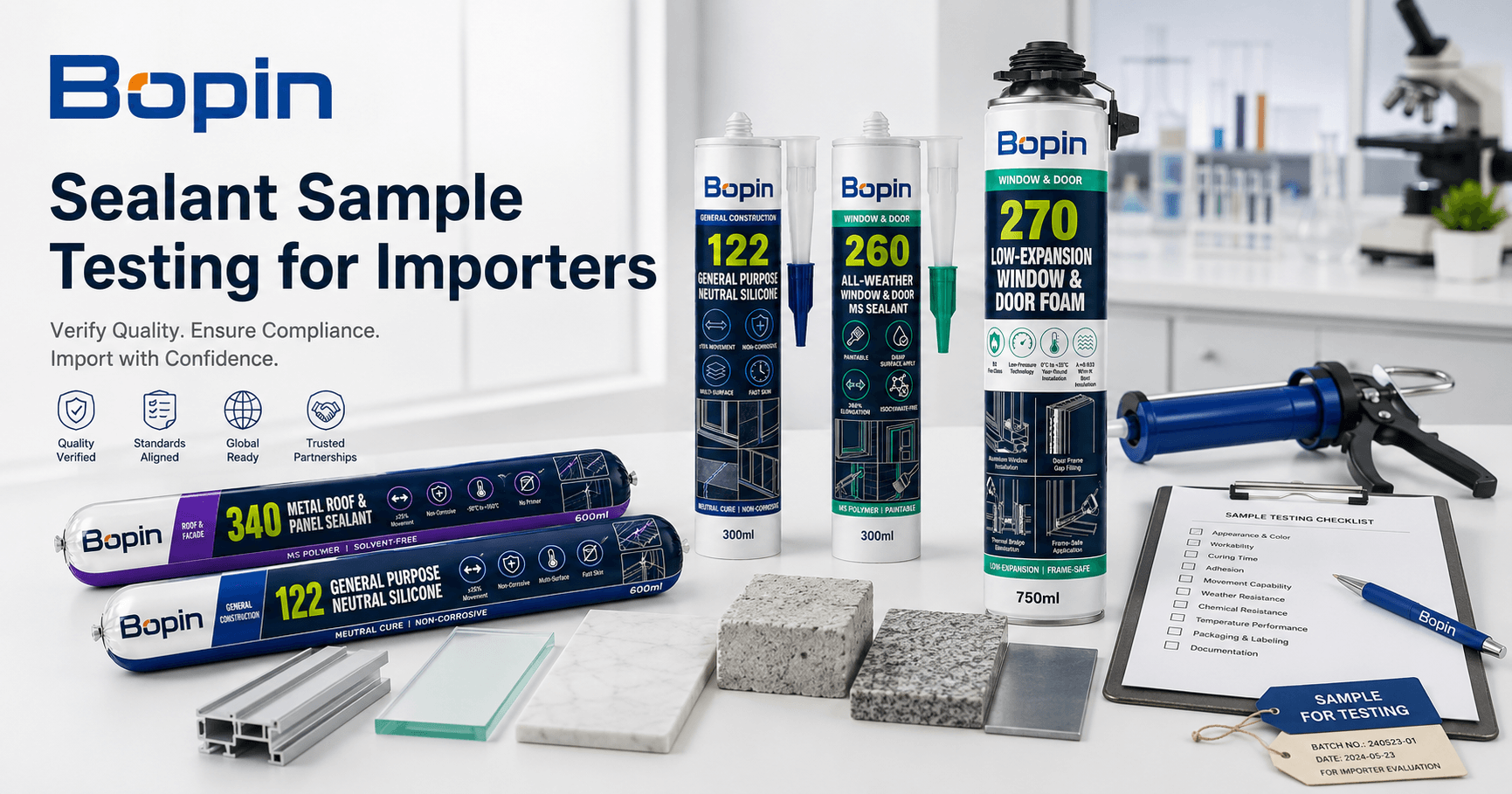
For importers developing an OEM sealant brand, the safest approach is to approve packaging only after the product positioning, formulation and supporting documents are sufficiently clear.
This guide explains what importers should verify before printing private-label packaging for silicone sealants, MS polymer sealants, acrylic sealants, PU foam and construction adhesives.
The Most Important Rule: Packaging Must Follow the Product
A common mistake in OEM projects is to design the package first and decide the exact product later.
The process should normally work in the opposite direction:
Market Requirement → Product Selection → Sample Approval → Formula Confirmation → Document Review → Packaging Claims → Artwork Approval → Printing
Why?
Because the package may contain claims about:
- Cure chemistry
- Substrate compatibility
- Khả năng sơn
- Khả năng vận động
- Mould resistance
- Temperature performance
- Fire performance
- Environmental characteristics
- Standards or certifications
If the final formulation changes, some of these claims may no longer be correct.
For example, changing from one neutral silicone formulation to another could affect movement capability, skin time, adhesion, standard references or available colours.
Changing the manufacturing partner may also require updated TDS, SDS or test evidence.
A professional private-label project should therefore treat artwork approval as one of the final product-confirmation steps—not the first.

1. Confirm the Exact Product Name
The product name is one of the most important elements on the front label.
It should help customers understand what the product actually is.
Good examples include:
- All-Purpose Acetoxy Silicone
- General Purpose Neutral Silicone
- Window & Door Silicone
- Mould-Resistant Sanitary Silicone
- Natural Stone Silicone
- MS Construction Adhesive
- Keo Acrylic
- Low-Expansion PU Foam
Avoid names that make the product sound more technically capable than the confirmed formulation.
Examples requiring caution include:
- Structural Adhesive
- Structural Silicone
- Fire-Rated Sealant
- Firestop Sealant
- Green Building Certified Sealant
- 50% Movement Sealant
- Permanent Waterproof Sealant
- Professional Stone-Safe System
These terms can imply specific performance or certification.
If the evidence supports only a narrower claim, use narrower wording.
For example:
Safer:
Fire-Retardant Silicone Sealant
instead of:
4-Hour Fire-Rated Firestop Sealant
unless the appropriate system test actually supports the stronger wording.
Likewise:
Safer:
Keo silicone trám đá tự nhiên
instead of:
Guaranteed Non-Staining Stone Silicone
unless suitable staining-test evidence applies to the offered formulation.
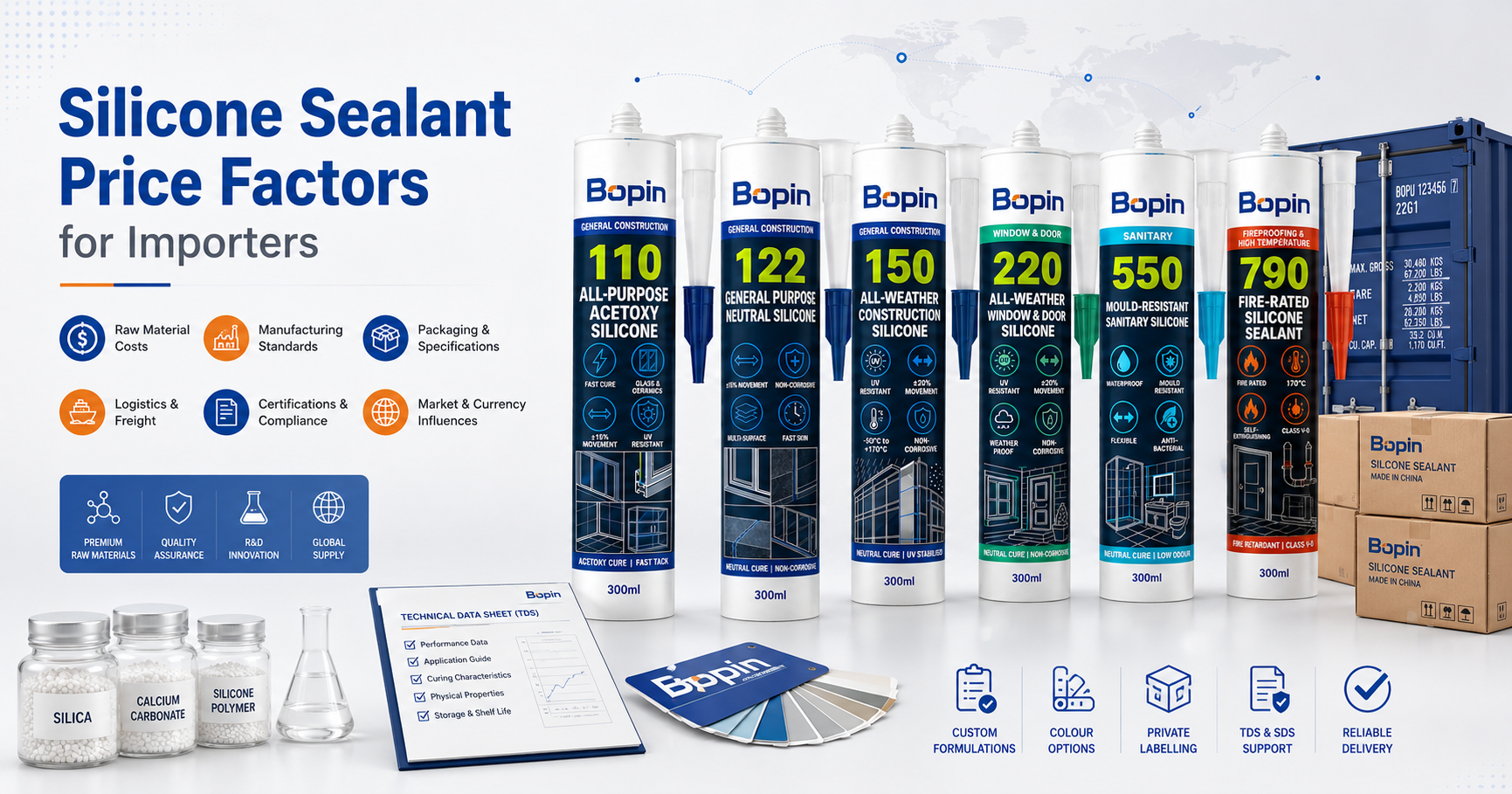
BoPin’s own packaging matrix uses this approach—for example, changing stronger fire-rating language to a narrower fire-retardant positioning and holding unsupported high-temperature products until the technical source is confirmed.
2. Verify the Cure System
For silicone sealants, the curing system can affect product selection and substrate compatibility.
Common front-label descriptions include:
- Acetoxy Cure
- Neutral Cure
- Oxime Cure
- Alkoxy Cure
- Moisture Cure
- MS Polymer
- Water-Based Acrylic
Do not print a chemistry description simply because it sounds more marketable.
The chemistry shown on the packaging should match:
- The selected formulation
- The TDS
- The SDS
- The actual supplier product
For example, a silane-modified or MS polymer product should not automatically be labelled as conventional silicone simply because the market commonly calls all cartridge sealants “silicone.”
Likewise, an acetoxy product should not be packaged as a neutral sealant.
Why cure chemistry matters to customers
Customers may use chemistry information to decide whether a product is suitable for:
- Metals
- Mirrors
- Natural stone
- Glass
- Sanitary applications
- Exterior joints
- Bề mặt sơn
Incorrect chemistry information can therefore result in incorrect product use.
3. Separate Application Claims from Performance Claims
Not every statement on a sealant package carries the same technical risk.
A useful method is to divide claims into three levels.
Level 1: Application and Product-Category Claims
Usually easier to support:
- Cửa sổ & Cửa ra vào
- Xây dựng chung
- Interior Decoration
- Vệ sinh
- Roof & Panel
- Glass & Ceramic
- Gap Filling
- Interior Crack Repair
These describe intended use rather than guaranteeing a numerical result.
Level 2: Functional Benefit Claims
These require stronger support:
- Có thể sơn
- Flexible
- Weather Resistant
- Non-Corrosive
- Anti-Mould
- High Tack
- Low Expansion
- Stone Safe
- Low Odour
- Damp-Surface Application
Before printing them, verify that they correspond to the selected formulation and available technical information.
Level 3: Hard Technical or Compliance Claims
These require the most careful review:
- ±25% / ±50% movement
- 3.0 MPa strength
- B2 fire classification
- EI 240
- 4-hour fire resistance
- λ = 0.033 W/m·K
- 60 dB acoustic insulation
- UL approved
- TÜV certified
- SGS certified
- REACH approved
- Green building certified
- 20+ year durability
These should not be placed on the packaging simply because a similar supplier product or catalog mentions them.
The final evidence must apply to the product being sold.
BoPin’s internal publishing framework follows essentially this three-level logic: basic application and packaging information are treated as relatively safe; movement, VOC, fire class, mould resistance and similar functional claims require caution; certification, EI/firestop, code-compliance and other strong statements are held back without supporting documents.

4. Be Careful with Certification Logos
Certification marks are among the highest-risk elements on private-label packaging.
Examples include:
- UL
- TÜV
- SGS
- CE
- ISO
- REACH
- RoHS
- Green building logos
- Third-party laboratory logos
A supplier having worked with an organisation does not automatically mean the logo can be printed on every private-label product.
Before printing a certification or approval mark, confirm:
- What organisation issued the document?
- What exact product was assessed?
- What product model appears on the document?
- Which manufacturing site is covered?
- Is the private-label brand covered?
- Is use of the logo permitted?
- Does the certificate remain valid?
- Does it apply to the final formulation?
- Is the claim company-level or product-level?
- Is the mark actually a certification mark?
ISO certificates need special care
ISO 9001 or ISO 14001 usually relates to a company management system.
It should not be used to suggest that the sealant itself is “ISO certified” for technical performance unless a relevant product requirement actually supports the claim.
Laboratory logos are not decorative icons
If a product has been tested by a laboratory, that does not automatically permit the laboratory’s logo to be used prominently on retail packaging.
When uncertain, the safer approach is:
Technical data and test documentation available upon request.
rather than printing an unsupported certification badge.
5. Make Sure Safety Information Matches the SDS
Marketing copy and safety information must not contradict each other.
For hazardous chemicals covered by OSHA’s U.S. Hazard Communication requirements, shipped-container labels use defined elements such as the product identifier, supplier identification and, where applicable, signal words, hazard statements, pictograms and precautionary statements.
Các United Nations GHS provides the broader harmonised framework on which many national and regional chemical hazard-communication systems are based.
For the European Union, the CLP Regulation requires chemical suppliers to classify, label and package relevant substances and mixtures before placing them on the market.
What importers should check
Compare the package against the final SDS:
- Product identifier
- Responsible supplier information
- Hazard classification
- Pictograms where applicable
- Signal word
- Hazard statements
- Precautionary statements
- Storage wording
- Emergency information
- Transport classification where relevant
Do not copy safety wording from another product
Two neutral silicones may have different composition or classification.
A PU foam aerosol and a silicone cartridge can have very different safety requirements.
The final safety label must therefore follow the actual product and destination market.
Destination-market rules matter
A package prepared for one country may not automatically be suitable for:
- Hoa Kỳ
- European Union
- Vương quốc Anh
- Trung Đông
- Latin America
- Đông Nam Á
The importer should verify mandatory local labelling requirements before printing.
6. Confirm Net Content Carefully
One of the simplest packaging details can also create major commercial problems:
How much product is actually inside the cartridge?
Common programmes may use:
- 260ml
- 280ml
- 300ml
- 590ml
- 600ml
- 750ml aerosol
A standard 300ml cartridge body does not automatically mean that it contains 300ml of sealant.
For example, an OEM programme may intentionally use:
280ml net content in a standard cartridge format.
That can be a valid commercial configuration—but it should be declared clearly.
Verify:
- Declared net volume
- Cartridge capacity
- Filling tolerance
- Product density
- Approximate net weight
- Carton quantity
- Carton gross weight
Do not use misleading design elements that visually imply a larger volume than the declared amount.
Net Volume vs Net Weight
Sealants are often sold by volume.
Because Tỉ trọng varies between formulas, two 300ml cartridges may have different weights.
Do not change a volume claim into a weight claim without confirming the actual density.
7. Verify Product Colour and Colour Identification
Colour is important for:
- Retail selection
- Warehouse control
- Contractor use
- Batch identification
Common colours include:
- Thông thoáng
- Trắng
- Đen
- Xám
- Màu nâu
- Custom colours
The package should make colour identification easy.
Possible methods include:
- Printed colour name
- Colour sticker
- End-cap colour
- Label colour block
- Batch label
- Carton colour marking
Avoid relying only on packaging colour
A blue cartridge does not mean the sealant itself is blue.
The actual sealant colour should be clearly identified.
Custom colour requires approval
For custom-colour orders, confirm:
- Colour sample
- Reference code if used
- Approved physical sample
- Production tolerance
- Minimum order quantity
- Packaging colour description
The buyer should approve the actual sealant colour—not only the artwork colour displayed on a computer monitor.
8. Check Application Icons Carefully
Icons are useful because contractors can understand them quickly.
Examples include:
- Window
- Bathroom
- Roof
- Glass
- Stone
- Paintbrush
- Interior wall
- Panel bonding
However, icons are also claims.
A stone icon may imply stone compatibility.
A flame icon may imply fire performance.
A food icon may imply food-contact suitability.
A green-leaf icon may imply environmental certification.
A structural-building icon may imply structural use.
Therefore:
Never add an icon only because it makes the package look more professional.
Every icon should have a clear interpretation.
Safer icon strategy
Use icons for:
- Ứng dụng
- Chemistry
- General product benefits
Ví dụ:
- Neutral Cure
- Flexible
- Cửa sổ & Cửa ra vào
- Có thể sơn
- Glass & Ceramic
- Interior Use
Avoid icons that imply:
- Certification
- Code approval
- Guaranteed service life
- Khả năng chống cháy
- Structural performance
unless the evidence supports them.
Your packaging matrix already uses this logic by preferring safe benefit icons and removing unconfirmed numeric or certification-style icons before printing.
9. Include the Important Product Limitations
Good packaging does not only explain what a product can do.
It should also help prevent obvious misuse.
Depending on the product, important limitations may include:
- Not for structural glazing
- Not for continuous immersion
- Not suitable for natural stone
- Not suitable for mirror backing
- Not suitable for copper or acid-sensitive metals
- Not suitable for PE, PP or PTFE
- Not for joints above the specified movement range
- Not for exterior exposure
- Interior dry-area use only
- Compatibility testing recommended
The full list does not always need to appear on the front label.
A practical structure is:
Front
Main positioning and safe benefits.
Back / Side
- Applications
- Instructions
- Limitations
- Storage
- Safety
- Technical-document reference
This keeps the front commercially clean while the side or back provides important use guidance.
10. Do Not Turn the Front Label into a TDS
One packaging mistake is trying to print every technical parameter on the cartridge.
Examples include:
- Tỉ trọng
- Shore A
- Tensile strength
- Elongation
- Skin time
- Cure rate
- Service temperature
- Khả năng vận động
- VOC
- Thermal conductivity
- Acoustic value
- Fire classification
This creates three problems.
1. Formula flexibility becomes difficult
If the OEM formula changes, the entire printed cartridge may become obsolete.
2. Technical values need context
For example:
Elongation: 400%
means little without understanding:
- Test method
- Điều kiện chữa bệnh
- Specimen
- Test temperature
3. Packaging becomes visually crowded
The front label should help customers identify the product quickly.
Detailed parameters usually belong in:
- TDS
- Technical catalog
- QR-linked product information
- Back/side panel where appropriate
Recommended front-label hierarchy
- Brand
- Product model
- Loại sản phẩm
- Application category
- Cure chemistry
- 3–4 safe benefits
- Net content
Then move detailed data elsewhere.
11. Review Environmental Claims Carefully
Terms such as:
- Eco
- Green
- Sustainable
- Thân thiện với môi trường
- Low VOC
- Zero VOC
- Solvent-Free
- MEKO-Free
- Non-Toxic
can influence purchasing decisions.
They can also require evidence or careful qualification.
“Solvent-Free”
Verify the formulation and TDS/SDS.
“Low VOC”
Ask:
- What VOC value?
- Which test method?
- Is the value product-specific?
- Which market definition is being used?
“Zero VOC”
This is a much stronger claim and should not be used simply because the product has low odour.
“Green Building”
A product being suitable for certain sustainable-building applications does not mean it has automatically achieved a green-building certification.
“Non-Toxic”
Avoid absolute safety language unless it is appropriate and supportable.
Even products that are considered low-hazard may require safety precautions during application.
A safer strategy may be:
- Low Odour
- Solvent-Free
- Water-Based
- Có thể sơn
where these attributes are genuinely confirmed.
12. Verify Fire-Related Claims Separately
Fire-related packaging requires particularly strict review.
Possible wording includes:
- Flame Retardant
- Fire Retardant
- Fire Resistant
- Fire Rated
- Firestop
- 2 Hours
- 4 Hours
- EI 120
- EI 240
- UL 94 V-0
These terms do not necessarily mean the same thing.
A material-level flammability result should not automatically be converted into a firestop-system claim.
Before printing, confirm:
- Exact test standard
- Product tested
- Test laboratory
- Specimen configuration
- Substrates
- Joint dimensions
- Backing material
- Tested duration
- Report number
- Whether the claim is material-level or system-level
- Whether private-label use is covered
If the evidence supports only flame-retardant material behaviour, use a narrower claim such as:
Fire-Retardant Silicone Sealant
rather than:
4-Hour Certified Firestop Silicone
This distinction is why BoPin’s current packaging matrix treats fire-related products as high-risk and removes EI, four-hour and firestop-system implications unless corresponding documentation is available.
13. Verify Stone and Mould Claims
Two other claims often require additional evidence:
Natural Stone
Possible claims:
- Stone Safe
- Non-Staining
- No Oil Migration
- Marble Safe
- Granite Safe
Natural stone varies greatly.
Marble, granite, limestone, travertine and engineered stone can behave differently.
A safe package may position a product as:
or:
For Marble, Granite and Decorative Stone Applications
with compatibility testing recommended.
An absolute:
Guaranteed Non-Staining on All Natural Stone
requires much stronger justification.
Anti-Mould / Mould Resistant
Vì sanitary sealants, mould resistance is a meaningful differentiator.
But distinguish between:
- Product formulated for mould resistance
- Tested mould-resistance performance
- Absolute “mould proof” claims
“Mould Resistant” or “Anti-Mould” may be more appropriate than claiming that mould can never develop under any condition.
14. Check Barcode and SKU Structure
Technical compliance is not the only packaging consideration.
OEM packaging must also work operationally.
Confirm:
- Product SKU
- Product name
- Formula
- Màu sắc
- Package size
- Carton quantity
- Barcode
- Batch code
- Production date
- Shelf-life format
Each saleable SKU should be clearly distinguishable.
For example:
BPN-150-WH-300
could internally represent:
- BoPin 150
- Trắng
- 300ml
Whether that exact coding system appears publicly is a branding decision, but the internal system should prevent warehouse confusion.
Different colours may require different barcodes
If clear, white and black are sold as different retail SKUs, the importer should determine whether separate barcodes are required in its sales system.
Do not wait until the goods arrive to define this.
15. Reserve Space for Batch and Production Information
Printed packaging should usually leave a controlled area for variable production information such as:
- Batch number
- Manufacturing date
- Expiry date
- Màu sắc
- Production line
- QR or traceability code
The variable data should not cover:
- Safety text
- Barcode
- Product name
- Mandatory label elements
Check the printing method
Confirm whether variable information will be applied by:
- Inkjet printing
- Laser coding
- Sticker
- Thermal transfer
Test the result on the actual cartridge material before mass production.
16. Confirm Local Language Requirements
Private-label packaging often needs:
- English only
- Spanish
- French
- Arabic
- Portuguese
- Multiple languages
Translation is not only a marketing issue.
Critical wording may include:
- Product identity
- Directions
- Safety statements
- Warnings
- Storage conditions
- Importer information
Recommended workflow
- Supplier prepares technical source text.
- Buyer or qualified local party translates mandatory content.
- Supplier places text into the artwork.
- Buyer reviews the final layout.
- Both parties approve before printing.
The supplier should not guess local legal wording without buyer confirmation.
For example, in an OEM export project, a practical commercial term is:
Buyer provides mandatory local label text and legal requirements; artwork requires buyer approval before printing.
This clearly separates responsibilities.
17. Make the Importer / Responsible Party Information Clear
Depending on the destination market and chemical classification, packaging may need information identifying the:
- Manufacturer
- Importer
- Distributor
- Responsible party
- Local contact
For hazardous chemicals shipped in the United States, OSHA’s Hazard Communication rules include supplier identification requirements on shipped-container labels.
EU chemical labelling follows CLP requirements, which similarly tie hazard communication to the responsible supplier and the classified product.
Therefore, the importer should decide before printing:
- Which legal entity appears on the label?
- Which address is used?
- Which telephone number is used?
- Does local legislation require a domestic entity?
- Is the responsible-party information consistent with the SDS?
Do not leave this question until the packaging has already been manufactured.
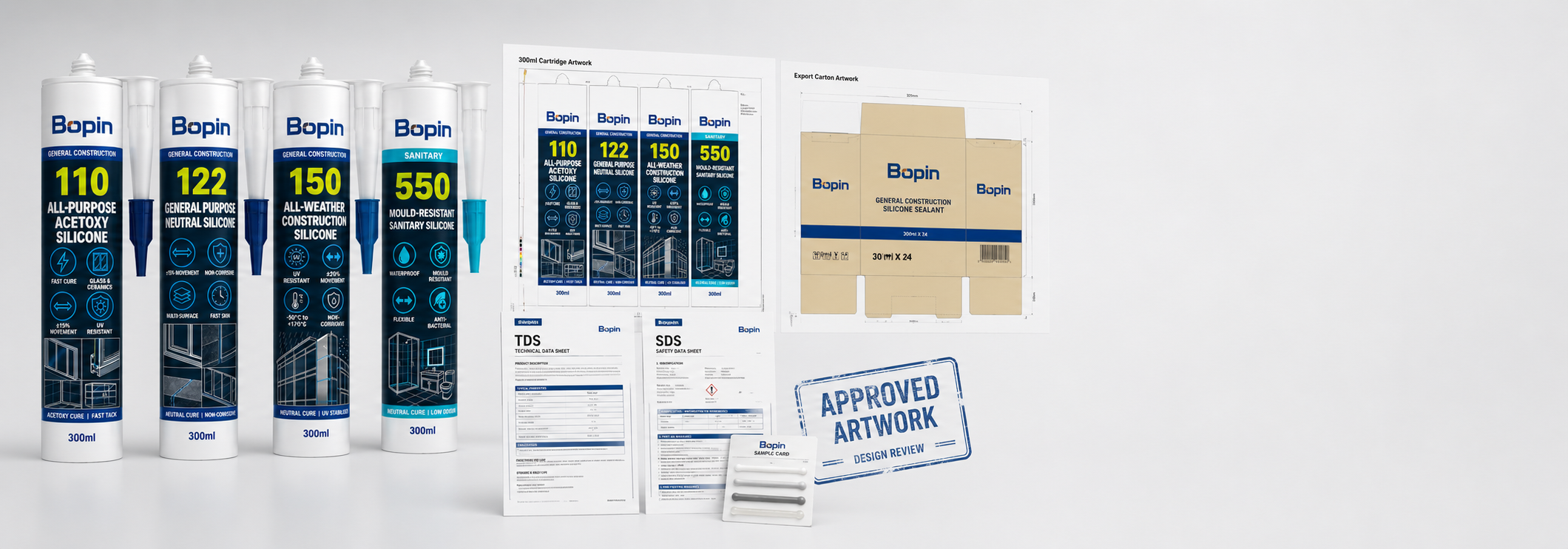
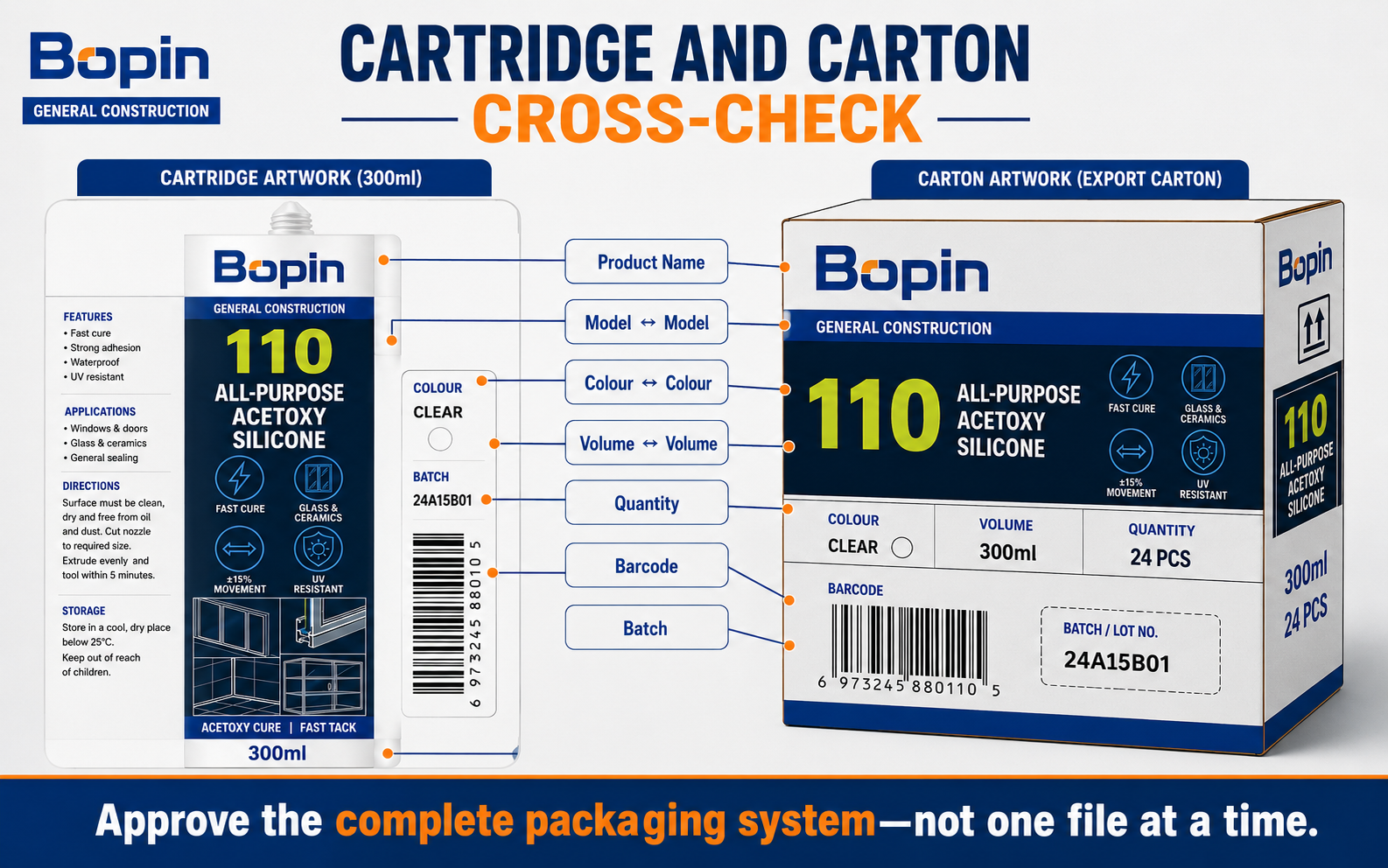
18. Approve Cartridge and Carton Artwork Together
Cartridge artwork and outer carton artwork should not be reviewed separately.
They need to agree on:
- Product name
- Model
- Màu sắc
- Net content
- Quantity
- Batch information
- Barcode
- Storage wording
- Brand
- Manufacturer / importer details
Typical mistake
Cartridge:
BoPin 150 All-Weather Construction Silicone
Carton:
BoPin 122 Neutral Silicone
This type of mismatch can create serious warehouse and customer confusion.
Final cross-check
Before printing, place the cartridge and carton artwork side by side.
Compare every field.
19. Use an Artwork Version-Control System
OEM packaging may go through many revisions:
- V1 initial design
- V2 colour change
- V3 technical wording
- V4 translation correction
- V5 final print version
Without version control, the printer may accidentally use an old file.
A simple naming structure
Brand_Model_Color_Language_Revision_Date
Ví dụ:
BOPIN_150_WHITE_EN_V5_20260817.pdf
The final approval should state clearly:
APPROVED FOR PRINT
along with:
- File name
- Revision
- Date
- Buyer
- Supplier
- Product model
Never approve through vague messages
Avoid:
Looks okay.
Use:
Artwork BOPIN_150_WHITE_EN_V5 dated 17 Aug 2026 is approved for printing.
That creates a traceable record.
20. Perform a Final Pre-Print Review
Before the printer starts mass production, conduct one final review.
Product Identity
- Correct brand
- Correct model
- Correct product name
- Correct chemistry
- Correct application category
Claims
- Benefits supported
- Technical numbers confirmed
- No unsupported certification
- No exaggerated application claims
- Limitations reviewed
Safety
- SDS matches product
- Hazard elements reviewed
- Local requirements reviewed
- Supplier / importer information correct
Commercial Information
- Net volume correct
- Colour correct
- Barcode correct
- SKU correct
- Batch/date area reserved
Artwork
- Correct language
- Spelling checked
- Cartridge and carton match
- Latest revision used
- Final approval recorded
Only after this stage should printing begin.
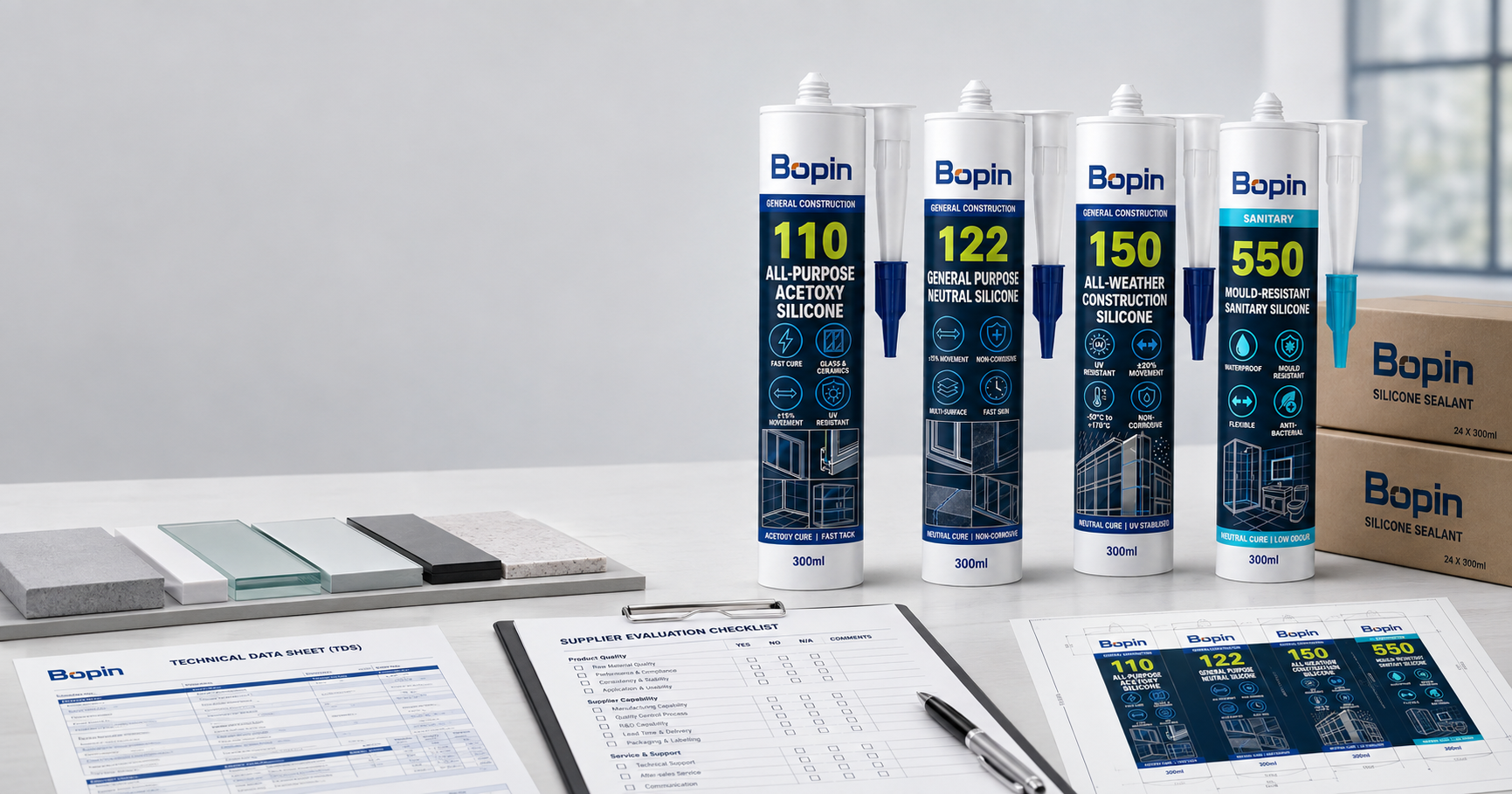
OEM Sealant Packaging Approval Checklist
Use the following checklist before approving private-label sealant packaging.
| Review Item | Confirmed? |
|---|---|
| Final formula selected | |
| Approved sample available | |
| Product name confirmed | |
| Cure system confirmed | |
| Application claims confirmed | |
| Functional claims supported | |
| Technical values supported | |
| Certification marks verified | |
| Fire claims verified | |
| Stone / mould claims verified | |
| Final TDS reviewed | |
| Final SDS reviewed | |
| Net content confirmed | |
| Product colour confirmed | |
| Barcode confirmed | |
| Batch/date area included | |
| Local language approved | |
| Supplier/importer details confirmed | |
| Cartridge/carton data match | |
| Artwork revision locked | |
| Buyer approval recorded |
The objective is not to remove every marketing claim.
It is to make sure that every important statement on the package can be connected to the product actually being manufactured.
Common OEM Packaging Mistakes
Printing before the sample is approved
If the formula changes, technical claims may become incorrect.
Copying another supplier’s cartridge
Besides visual differentiation issues, the copied technical claims may not match your product.
Printing every TDS value on the front
This creates unnecessary technical and inventory risk.
Using certification logos as decoration
Every mark should have a valid basis and permitted use.
Confusing company certification with product certification
A factory’s ISO certificate does not automatically certify the sealant.
Using “fire-rated” too broadly
Material performance and complete firestop-system performance are different.
Calling a product “eco” without defining the claim
Low odour, solvent-free, low VOC and certified environmental performance are different concepts.
Hiding the real net volume
A 300ml cartridge body should not be used to imply 300ml if the declared fill is 280ml.
Ignoring local language requirements
Safety and mandatory information may require local-market adaptation.
Approving cartridge but forgetting the carton
Both must describe the same product.
Losing control of artwork revisions
Always identify the exact print-ready version.
Những câu hỏi thường gặp
Can I design the packaging before choosing the final factory?
You can develop the brand structure, colours, layout and product-family system.
However, final technical claims, cure chemistry, safety information, hard specifications and certification statements should wait until the product source is sufficiently confirmed.
Should movement capability be printed on the cartridge?
Only when it is important to the product positioning and supported by the final formulation.
For many general-purpose OEM products, it may be safer to keep exact movement values in the TDS rather than printing them permanently on the front label.
Can I print “Made in China”?
Country-of-origin wording should reflect the actual product and destination-market requirements.
The buyer and supplier should confirm required origin marking before printing.
Should I put TDS values on the back label?
Selected values can be included when confirmed, but avoid turning packaging into a substitute for the full TDS.
A QR code or technical-data reference can provide more flexibility.
Can I use a supplier’s certificate logo on my private-label cartridge?
Do not assume so.
Confirm whether the certificate applies to the exact product and whether the issuing organisation permits use of the mark on private-label packaging.
Who should approve the local-language label?
The supplier can prepare and place the text, but the importer or an appropriately qualified local party should confirm mandatory local wording.
What happens if the formula changes after the packaging is printed?
Review every formula-dependent claim again.
If the existing packaging no longer accurately describes the product, it should not be used simply to avoid packaging waste.
Final Thoughts
OEM sealant packaging should be treated as part of product control—not only brand design.
Before printing, importers should verify:
- Product identity
- Cure system
- Application positioning
- Functional claims
- Technical values
- Certification references
- Safety information
- Net content
- Màu sắc
- Barcode and SKU
- Local-language requirements
- Manufacturer or importer details
- Cartridge and carton consistency
The strongest private-label packaging is not the package with the largest number of technical icons or certification logos.
It is the package that communicates the product clearly without claiming more than the confirmed formulation and documents can support.
A useful rule is:
Formula first. Documents second. Artwork third. Printing last.
BoPin supports importers and private-label buyers with product selection, sample confirmation, packaging coordination and document alignment. Final packaging claims are reviewed against the confirmed formulation and available technical documentation before production.