Selecting the right sealant supplier proves as critical as choosing the right products – supplier reliability, technical support, consistent quality, and responsive service directly impact project success, costs, and long-term satisfaction. Poor supplier choices lead to product inconsistencies, delayed deliveries, inadequate technical support, and ultimately compromised project outcomes requiring expensive corrections.
Understanding different supplier types, establishing clear evaluation criteria, conducting systematic assessments, and building strategic partnerships ensures access to quality products with reliable delivery and ongoing support. Whether you’re a contractor establishing vendor relationships, a facility manager selecting maintenance suppliers, a developer sourcing materials for major projects, or a distributor building your supply chain, choosing suppliers strategically creates competitive advantages while avoiding costly problems.
Understanding Supplier Types and Business Models
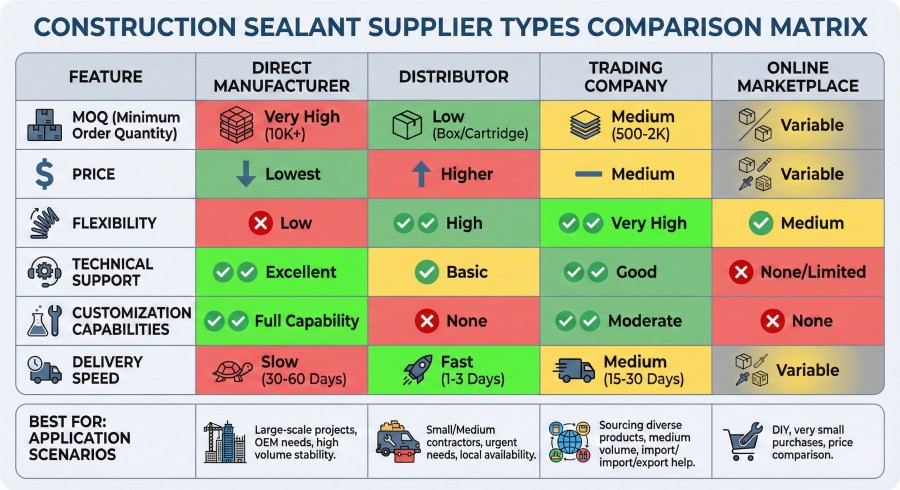
Construction sealant suppliers operate under various business models, each offering distinct advantages and trade-offs. Understanding these fundamental differences guides realistic expectations and appropriate supplier selection for specific needs.
Direct Manufacturers
Manufacturers produce sealants in their own facilities – they control formulation, raw materials, quality systems, and production processes. Buying direct from manufacturers offers certain advantages but isn’t always optimal for every situation.
Advantages of direct manufacturer sourcing:
- Price potential – Eliminating intermediary margins may reduce costs for large volumes
- Technical depth – Access to formulation chemists and R&D capabilities
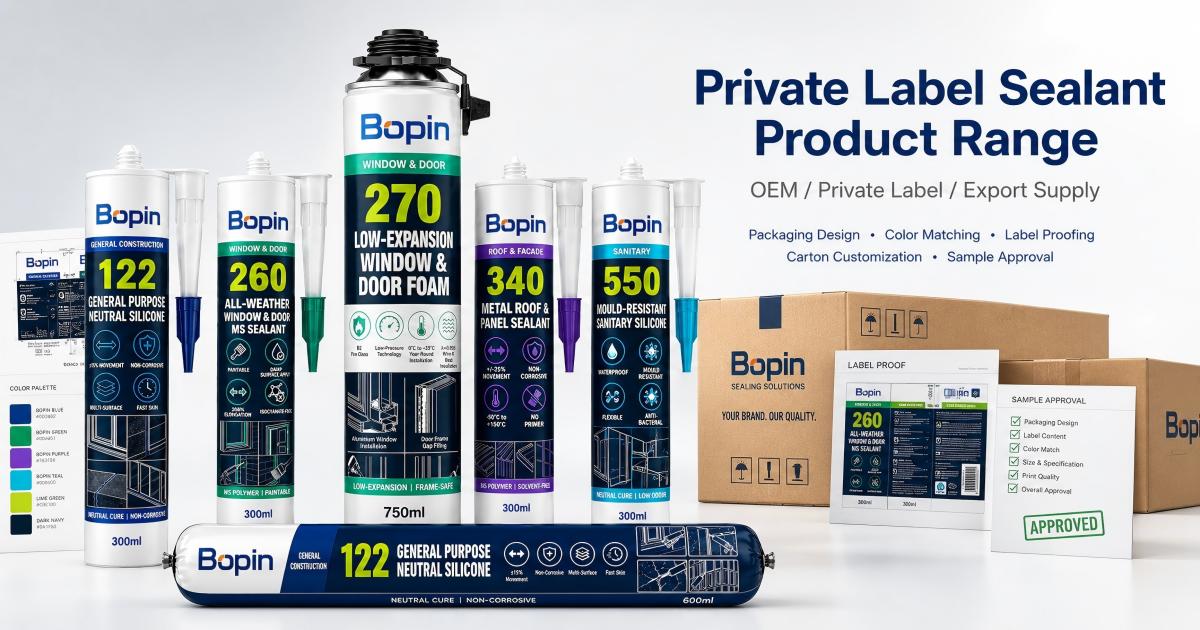
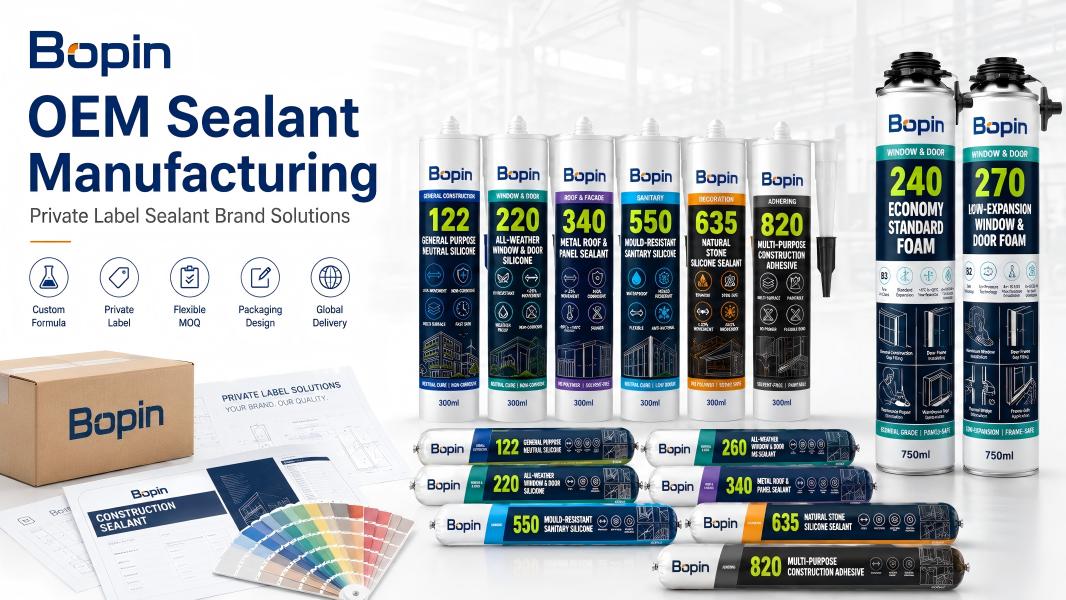
- Customization – OEM private labeling, formula modifications, special packaging
- Quality control – Direct insight into production processes and testing
- Large-scale capacity – Ability to supply major projects or regional distribution
Challenges with direct manufacturers:
- Minimum order quantities – Often require container loads or pallet quantities (10,000+ units typical)
- Limited flexibility – Production schedules, lead times, order minimums designed for efficiency not small orders
- Specialized focus – May produce limited product range requiring multiple manufacturers for complete needs
- Geographic limitations – Manufacturers concentrated in specific regions (many in China, Europe, US) creating logistics challenges
- Language and cultural barriers – International manufacturers may have communication challenges
- Ödeme koşulları – Often require deposits, letters of credit, or less favorable terms for smaller buyers
En iyisi: Large contractors with predictable high-volume needs, distributors building inventory, developers with major projects, buyers seeking OEM customization, those with logistics expertise and working capital.
Distributors and Wholesalers
Distributors purchase from manufacturers and resell to contractors, facilities, and end users. They add value through inventory management, local presence, mixed-brand selection, and smaller order quantities.
Advantages of distributor sourcing:
- Lower minimums – Buy individual cases or even single cartridges
- Immediate availability – Local stock eliminates international shipping delays
- Product variety – Multiple brands and types from one source
- Established logistics – Local delivery, familiar payment terms, responsive service
- Language/cultural ease – Local communication, business practices, legal frameworks
- Credit terms – May offer net-30 or net-60 payment terms vs. prepayment
Challenges with distributors:
- Higher prices – Markup covers their costs and margins
- Technical depth – Sales staff may lack deep technical knowledge of products
- Inventory limitations – May not stock full product range or specialized items
- Manufacturer dependence – Supply disruptions affect distributor availability
- Limited customization – Generally stock products only, no private labeling
En iyisi: Small to medium contractors, maintenance departments, project-based buyers, those valuing convenience and service over minimum pricing, buyers needing mixed product types, those preferring local relationships.
Trading Companies
Trading companies act as intermediaries connecting international manufacturers with buyers – they don’t manufacture products but provide sourcing, logistics, quality control, and support services. SOHO (Small Office/Home Office) trading companies represent a specialized category offering personalized service and flexibility.
Advantages of trading company model:
- Flexible minimums – Often accommodate smaller quantities than direct manufacturer
- Manufacturer access – Leverage relationships with multiple factories providing options
- Quality oversight – Inspect factories, verify certifications, test samples before buyer commitment
- Cultural/language bridge – Navigate international business, language, documentation
- Specialized expertise – Deep knowledge of specific product categories or markets
- Personalized service – SOHO operations provide direct owner involvement and attention
- Competitive pricing – Direct factory sourcing with lower overhead than large distributors
Challenges with trading companies:
- Verification needed – Ensure legitimate operation, actual factory relationships, quality claims
- Variable capabilities – Trading companies range from highly professional to problematic
- Limited local inventory – May require international shipping vs. local distributor stock
- Ödeme koşulları – Typically require deposits though more flexible than direct manufacturers
En iyisi: International buyers sourcing from manufacturing regions (China, Asia), buyers seeking flexibility unavailable from manufacturers or distributors, those valuing personalized service and technical support, markets where direct manufacturers and local distributors have limitations.
Online Marketplaces
B2B platforms like Alibaba, Global Sources, Made-in-China connect buyers with suppliers globally. These platforms aggregate thousands of suppliers offering convenience but requiring careful vetting.
Avantajları:
- Massive selection – Thousands of suppliers and products
- Price transparency – Easy comparison shopping
- Supplier information – Reviews, certifications, transaction history
- Transaction protection – Payment escrow, dispute resolution mechanisms
Risks:
- Quality variability – Suppliers range from excellent to problematic
- Verification challenges – Difficult to confirm capabilities, certifications, actual quality
- Communication barriers – Language, time zones, business practice differences
- Limited technical support – Transactional rather than relationship-based
- Fraud potential – Unscrupulous sellers despite platform protections
En iyisi: Initial supplier identification and research, sourcing commodity products, buyers with strong technical knowledge enabling self-assessment, those willing to invest time in thorough due diligence.
Essential Supplier Evaluation Criteria
Systematic supplier assessment using clear criteria prevents costly mistakes and identifies partners capable of meeting actual needs. The following framework addresses critical factors determining supplier suitability.

Product Quality and Consistency
Quality represents the foundation of supplier value – inconsistent or substandard products create project failures, warranty claims, and reputation damage far exceeding any cost savings.
Quality verification methods:
Certifications and standards compliance:
- ISO 9001 – Quality management system certification demonstrating process consistency
- ISO 14001 – Environmental management showing responsible manufacturing
- Product-specific certifications – ASTM, UL, FM, or regional standards (CE marking, etc.)
- Factory audits – Third-party inspection reports or certificates
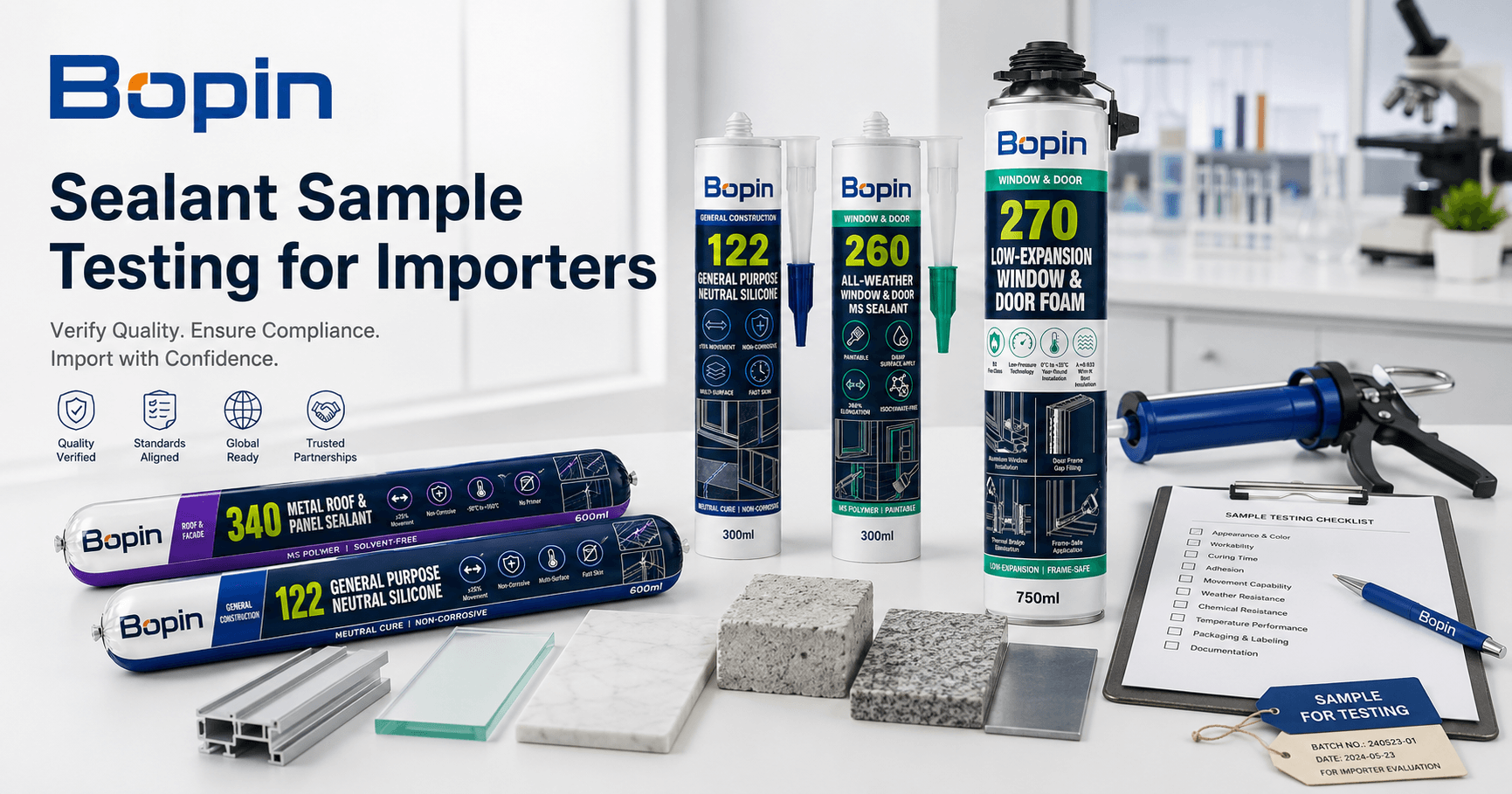
Sample testing:
- Request samples from multiple batches, not just “golden samples”
- Independent testing – Send samples to labs for verification against claimed specifications
- Field testing – Apply samples in actual conditions evaluating cure, adhesion, durability
- Compare to established brands – Benchmark against known quality products
Quality documentation:
- Technical Data Sheets (TDS) – Complete specifications, test results, certifications
- Safety Data Sheets (SDS) – Proper chemical safety information
- Test reports – Actual data from quality control testing
- Lot traceability – Ability to track production batches
Consistency verification:
- Order samples from different production runs – Verify batch-to-batch consistency
- Request manufacturing process documentation – Understand quality controls
- Check complaint history – Quality issues, returns, customer feedback
- Visit facilities if feasible – Firsthand observation of operations
Red flags indicating quality concerns:
- Reluctance to provide samples or test documentation
- Missing or questionable certifications
- Vague specifications or claims without supporting data
- No lot coding or traceability systems
- Extremely low pricing suggesting substandard materials or processes
Technical Support Capability
Technical support separates competent suppliers from mere product vendors – ability to provide specification guidance, troubleshooting assistance, and application support adds substantial value beyond product itself.
Evaluate technical support through:
Staff expertise:
- Qualified personnel – Chemists, engineers, or experienced technicians (not just sales people)
- Response depth – Can they answer detailed technical questions or just quote data sheets?
- Problem-solving ability – Do they help diagnose issues or just recommend products?
- Industry knowledge – Understanding of construction applications, building codes, standards
Support services offered:
- Pre-purchase consultation – Product selection guidance for specific applications
- Specification writing – Assist with project specs and submittals
- Application training – Teach proper installation techniques
- Troubleshooting support – Help diagnose and resolve field problems
- Technical literature – Comprehensive guides, application bulletins, installation instructions
Communication quality:
- Responsiveness – How quickly do they respond to inquiries?
- Accessibility – Multiple contact methods (email, phone, messaging)
- Language capability – Clear communication in your language
- Documentation quality – Well-written, accurate technical materials
Testing questions:
- Before committing, ask specific technical questions and evaluate responses
- Request application guidance for a real scenario
- Assess their proactive suggestions – Do they ask clarifying questions?
- Gauge their honesty – Will they admit when products aren’t suitable?
Value of strong technical support:
- Reduced failures – Correct product selection and application
- Faster problem resolution – Expert troubleshooting saves time and money
- Training and knowledge – Builds your team’s capabilities
- Competitive advantage – Better technical understanding improves your results
Supply Reliability and Lead Times
Consistent, predictable supply enables project planning and prevents costly delays – unreliable suppliers disrupt schedules regardless of product quality or pricing.
Assess supply reliability:
Delivery performance:
- On-time delivery rate – Do they meet promised delivery dates?
- Lead time accuracy – Are quoted lead times realistic and maintained?
- Inventory levels – Do they maintain stock or manufacture to order?
- Emergency capability – Can they expedite urgent orders?
Capacity and scalability:
- Production capacity – Can they handle your volume growth?
- Multiple supply sources – Do they have backup factories or inventory locations?
- Peak period performance – How do they handle busy seasons?
- Allocation policies – How do they handle supply shortages?
Logistics capabilities:
- Shipping methods – Air, sea, truck, courier – what options available?
- Packaging quality – Products arrive undamaged
- Documentation – Proper invoices, packing lists, certificates
- Tracking – Visibility into shipment status
Contingency planning:
- Backup options – What happens if factory has problems?
- Inventory buffer – Do they maintain safety stock?
- Communication – Will they notify you proactively of potential delays?
Reference checks:
- Ask current customers about delivery reliability
- Check how they handled COVID disruptions – Good indicator of crisis management
- Review complaint patterns – Delivery issues recurring theme?
Pricing Structure and Value
Price matters but must be evaluated in context of total value delivered – lowest initial price often proves most expensive when quality issues, delays, or lack of support create problems.
Understand pricing components:
Base pricing:
- Product cost – Price per unit (cartridge, pail, drum)
- Volume discounts – Price breaks at quantity thresholds
- MOQ impact – How does minimum order quantity affect unit pricing?
- Contract pricing – Committed volume discounts vs. spot buying
Additional costs:
- Shipping and freight – Included or additional? Who arranges?
- Duties and taxes – Import costs for international sourcing
- Ödeme koşulları – Cost of prepayment vs. credit terms
- Currency risk – Exchange rate fluctuations for international purchases
- Packaging options – Bulk vs. retail packaging costs
Total cost of ownership:
- Technical support value – Worth paying premium for excellent support
- Inventory carrying costs – Large MOQs tie up capital and space
- Quality costs – Failures, rework, warranty claims from inferior products
- Opportunity costs – Delays impacting project schedules
Price evaluation framework:
Compare suppliers holistically:
Supplier A: Low price, minimal support, quality concerns
= High risk of hidden costs

Supplier B: Moderate price, excellent support, proven quality
= Best total value despite higher unit cost

Supplier C: High price, average support, premium brand
= May not justify cost premium
Pricing red flags:
- Prices dramatically below market suggest quality compromises
- Lack of clear pricing structure or frequent “special” pricing
- Hidden costs discovered after commitment
- Unwillingness to provide firm quotes
- Excessive price volatility
Negotiation opportunities:
- Volume commitments – Better pricing for guaranteed volumes
- Ödeme koşulları – Flexibility on timing vs. pricing adjustments
- Contract duration – Price stability for longer agreements
- Value-added services – Training, technical support, marketing materials
Conducting Supplier Due Diligence
Systematic verification prevents costly mistakes from partnering with unsuitable or unreliable suppliers. The due diligence investment pays back many times over through risk reduction.

Document Verification
Request and verify essential documentation establishing legitimacy and capabilities:
Business registration:
- Business license – Verify legal entity status
- Tax registration – Legitimate tax compliance
- Export license – Required for international suppliers
- Company age and ownership – Established operation or new venture?
Quality certifications:
- ISO certifications – Obtain certificate numbers and verify with issuing body
- Product certifications – ASTM, UL, FM, CE – verify authenticity
- Factory audit reports – Independent third-party assessments
- Test laboratory accreditation – Are their test facilities certified?
Financial stability:
- Bank references – Confirmation of financial standing
- Credit reports – Dun & Bradstreet or local equivalents
- Financial statements – For significant partnerships, review financial health
- Insurance certificates – Product liability, business insurance
Reference documents:
- Customer references – Contact information for current customers
- Project portfolios – Examples of completed projects or supplied customers
- Case studies – Documented successful applications
Red flags:
- Reluctance to provide documentation
- Inconsistencies in provided information
- Cannot verify claimed certifications
- Very new company with limited track record
- Frequent company name changes or restructuring
Factory Audits and Visits
Firsthand factory observation provides insights impossible to obtain remotely – whenever feasible, especially for significant partnerships, visit supplier facilities.
What to observe during factory visits:
Production capabilities:
- Equipment – Modern, well-maintained machinery or outdated equipment?
- Scale – Capacity matching claimed production volumes?
- Automation level – Manual processes or automated lines?
- Cleanliness – Professional manufacturing environment or chaotic?
Quality control systems:
- Testing equipment – Proper instruments for quality verification
- QC procedures – Documented processes, actual implementation
- Sampling and testing frequency – How often do they test?
- Record keeping – Comprehensive documentation systems
Raw material management:
- Supplier quality – Using recognized raw material brands?
- Inventory control – Proper storage, FIFO (first-in-first-out) systems
- Traceability – Can they track raw materials through production?
Environmental and safety:
- Safety equipment – Proper PPE, safety systems, emergency equipment
- Environmental controls – Pollution prevention, waste management
- Regulatory compliance – Meeting local environmental and safety requirements
Workforce:
- Staffing levels – Adequate personnel for claimed capacity
- Training – Employee skill and knowledge levels
- Turnover – Stable or constantly changing workforce?
Questions to ask during visits:
- How do you handle quality issues or defects?
- What percentage of production undergoes testing?
- Show me recent test records.
- How do you maintain batch consistency?
- What happens when raw material quality varies?
- Walk me through your process from raw materials to finished product.
Virtual audits:
- When in-person visits impractical, request detailed video tours
- Live video calls showing production, testing, warehousing
- Time-stamped photos with requested specific details
- Better than nothing but less reliable than physical presence
Sample Testing Protocol
Comprehensive sample testing verifies quality claims before large purchases:
Sample request specifications:
- Multiple batches – Request samples from 3+ different production runs
- Production samples – Not special “golden samples” made for sales
- Labeled – Batch numbers, production dates, expiration dates
- Typical packaging – Same as actual commercial products
- Adequate quantity – Enough for thorough testing (minimum 5-10 units)
Testing program:
Basic verification:
- Görsel inceleme – Color, consistency, packaging quality
- Odor – Appropriate smell, not off-odors suggesting contamination or degradation
- Extrusion – Proper flow from cartridge, consistent texture
- Shelf stability – Store samples at different temperatures checking stability
Performance testing:
- Cure time – Tack-free and full cure timing
- Yapışma – Apply to relevant substrates, cure, test pull-off
- Hareket kabiliyeti – Extend/compress cured samples
- Weather exposure – Outdoor weathering for 30-90 days
- UV direnci – Indoor vs outdoor exposed samples
Comparative testing:
- Benchmark against known products – Compare to established brands
- Blind testing – Multiple samples coded without identification
- User feedback – Have field crews test and provide input
Laboratory testing:
- Independent labs – Send samples for ASTM testing if critical
- Key tests: Tensile strength, elongation, hardness, adhesion, durability
- Verify against TDS claims – Do actual test results match technical data?
Sample testing investment justification:
- Small cost relative to large order quantities
- Identifies quality issues before commitment
- Leverage for negotiation – Demonstrates serious intent
- Builds technical understanding of products
Risk Management and Mitigation Strategies
No supplier selection is risk-free – smart buyers implement strategies reducing exposure to potential problems.

Starting Small and Scaling
Begin relationships with limited risk before major commitments:
Progressive commitment approach:
- Initial trial order – Minimum quantity for limited testing (one pallet or case)
- Project pilot – Use on single small project assessing performance and service
- Limited adoption – Expand to multiple projects while monitoring
- Full integration – Make primary supplier after proven performance
Benefits of progressive approach:
- Limits exposure if problems emerge
- Allows exit without major sunk costs
- Tests full cycle – ordering, shipping, technical support, problem resolution
- Builds relationship gradually rather than betting everything immediately
Patience pays:
- Resist pressure for large initial orders
- Ignore “special pricing” available only for immediate large commitment
- Trust develops through demonstrated reliability over time
Multi-Sourcing Strategy
Avoid excessive dependence on single suppliers:
Primary/secondary model:
- Primary supplier – 60-70% of volume, best pricing, closest relationship
- Secondary supplier – 20-30% of volume, backup capacity, competitive pressure
- Spot suppliers – 10% for specialty items or emergency backup
Advantages of multi-sourcing:
- Supply security – One supplier problem doesn’t stop operations
- Competitive pressure – Suppliers maintain pricing and service knowing alternatives exist
- Esneklik – Options for different products, markets, or applications
- Innovation access – Multiple suppliers may offer different technologies or solutions
Multi-sourcing challenges:
- Complexity – Managing multiple relationships requires effort
- Higher costs – May sacrifice volume discounts splitting purchases
- Consistency – Different suppliers may have slight product variations
- Supplier relations – Primary suppliers may resist if competition too intense
Balance approach:
- Core products from primary supplier (predictable volumes)
- Specialty items from specialized suppliers
- Maintain tested alternatives without unnecessarily fragmenting every purchase
Quality Assurance Programs
Implement systems catching quality issues early:
Incoming inspection:
- Sample every shipment – Test basic characteristics (cure, adhesion, extrusion)
- Verify batch documentation – Match labels to test certificates
- Check for damage – Packaging integrity, expiration dates
- Quarantine until approved – Don’t use untested materials
Field feedback systems:
- Report cards – Systematic collection of user feedback on products
- Problem tracking – Document any issues, patterns, supplier responses
- Performance metrics – Delivery on-time, quality acceptance rate, complaint resolution
Regular audits:
- Periodic reassessment – Don’t assume quality continues without verification
- Annual factory visits for strategic suppliers
- Renewed sample testing periodically
- Certification renewals – Verify continued compliance
Contract Terms and Protection
Formalize agreements protecting your interests:
Essential contract elements:
- Product specifications – Detailed description, standards, acceptable tolerances
- Quality assurance – Testing requirements, rejection criteria, remedies
- Delivery terms – Lead times, shipping responsibilities (Incoterms)
- Pricing – Base pricing, discounts, price adjustment mechanisms, currency
- Ödeme koşulları – Methods, timing, partial payments for large orders
- Warranties – Product defect coverage, remedy procedures
- Liability – Product liability, consequential damages, insurance requirements
- Force majeure – Handling of uncontrollable events
- Dispute resolution – Arbitration, jurisdiction, governing law
- Termination – Conditions allowing contract exit
Letters of credit:
- Inspection rights before payment release
- Proof of quality certifications as required documents
- Professional LC management through banks familiar with trade
Escrow arrangements:
- Hold payment pending product verification
- Particularly useful for new suppliers or large orders
- Third-party platforms offer built-in escrow (Alibaba Trade Assurance, etc.)
Building Strategic Supplier Partnerships
Moving beyond transactional relationships to strategic partnerships creates mutual value and competitive advantages.
Communication and Relationship Management
Invest in relationship quality:
Regular communication:
- Scheduled check-ins – Monthly or quarterly calls beyond order placement
- Share forecasts – Help suppliers plan inventory and production
- Provide feedback – Both positive and constructive about products and service
- Include in planning – Invite input on specifications, new applications, market trends
Transparency:
- Be honest about volumes – Don’t overestimate to get better pricing
- Share challenges – Suppliers may offer creative solutions
- Discuss competition – Professional honesty about alternatives
- Realistic expectations – Don’t demand impossible terms
Mutual respect:
- Value their expertise – Suppliers often have insights you lack
- Reasonable requests – Don’t abuse relationship with unreasonable demands
- Pay on time – Nothing damages relationships faster than payment delays
- Acknowledge good performance – Recognize when they deliver excellently
Collaborative Development
Work together on continuous improvement:
Product optimization:
- Application feedback – Share real-world performance data
- Formula adjustments – Request modifications addressing specific challenges
- Packaging improvements – Suggest user-friendly packaging innovations
- Documentation enhancement – Collaborate on better technical materials
Market development:
- Share market intelligence – Trends, competitor information, opportunities
- Joint marketing – Case studies, project showcases, educational content
- Training programs – Develop installer training benefiting both parties
- New applications – Identify emerging uses expanding market
Process improvements:
- Ordering efficiency – Streamline ordering, invoicing, shipping
- Inventory management – Consignment stock, JIT delivery, VMI programs
- Quality systems – Joint problem-solving on quality issues
- Sustainability – Collaborate on environmental improvements
Long-Term Value Creation
Strategic suppliers become true partners:
Preferred supplier status:
- First consideration for new requirements
- Price protection – Stable pricing vs. spot market volatility
- Priority allocation – During supply shortages
- Flexible terms – Accommodations during cash flow challenges
Exclusive arrangements:
- Territory exclusivity – For distributors in specific regions
- Application exclusivity – Special products for specific uses
- Co-branded products – Joint marketing and product development
- Mutual commitments – Volume guarantees with pricing protections
Integration and efficiency:
- EDI systems – Electronic ordering reducing administrative costs
- Consignment inventory – Supplier-owned stock at your location
- Technical liaison – Dedicated support person familiar with your needs
- Executive access – Direct communication with supplier leadership
Red Flags and Warning Signs

Recognize warning signs suggesting supplier problems before commitment:
Quality and Reliability Concerns
Indicators of potential quality issues:
- ⚠️ Reluctance to provide samples or documentation
- ⚠️ Inconsistent products between samples and deliveries
- ⚠️ Vague specifications – “similar to” rather than actual test data
- ⚠️ Questionable certifications – Cannot verify or obvious forgeries
- ⚠️ Price dramatically below market – Suggests inferior materials or processes
- ⚠️ Frequent formula changes without notification
- ⚠️ Poor packaging – Damaged goods, inadequate labeling
- ⚠️ No lot coding – Cannot trace production batches
Communication and Service Issues
Warning signs in supplier interactions:
- ⚠️ Slow response to inquiries or technical questions
- ⚠️ Vague or evasive answers to direct questions
- ⚠️ Overpromising – Claims that seem too good to be true
- ⚠️ Pressure tactics – Urgency for immediate large orders
- ⚠️ Lack of technical knowledge – Sales people cannot answer basic questions
- ⚠️ Poor English (for international suppliers) creating misunderstandings
- ⚠️ Inconsistent contacts – Different people each interaction, no continuity
- ⚠️ Defensive reactions to legitimate concerns or questions
Business Practice Concerns
Red flags in business dealings:
- ⚠️ Payment terms only – Require full prepayment with no flexibility
- ⚠️ Minimal documentation – Lack of contracts, terms, specifications
- ⚠️ Company instability – Frequent name changes, ownership changes
- ⚠️ Cannot provide references or references are generic/fake
- ⚠️ Unwilling to allow factory visits or provide manufacturing details
- ⚠️ Legal issues – Litigation history, intellectual property disputes
- ⚠️ Poor financial health – Risk of supplier failure mid-relationship
Sıkça Sorulan Sorular
How do I verify a supplier’s claimed certifications are legitimate?
Most certifications can be verified directly through issuing organizations using certificate numbers provided by suppliers. For ISO certifications (9001, 14001, etc.), contact the certification body listed on certificate (SGS, TUV, Bureau Veritas, etc.) providing certificate number and company name for verification. Many certification bodies offer online verification portals where you can check certificate validity, scope, and expiration dates. For product-specific certifications like UL or FM listings, visit certifier websites with searchable databases – enter product model or company name confirming listing exists. ASTM compliance cannot be “certified” by ASTM (they publish standards but don’t certify products) – suppliers claiming “ASTM certification” may be misleading; rather verify they have test reports from accredited labs showing compliance with relevant ASTM standards. Request original certificates not just copies which can be manipulated, and be suspicious of certificates with poor quality, generic language, or missing key details like certificate numbers, scope, or accreditation marks. When verifying international suppliers, time zone and language barriers may require patience but legitimate certifications can always be verified with reasonable effort.
What’s a reasonable minimum order quantity (MOQ) for construction sealants?
MOQ expectations vary dramatically by supplier type and should match your actual needs and capabilities rather than straining your resources. Direct manufacturers typically require container-load quantities (10,000-50,000 cartridges) or at minimum full-pallet orders (typically 1,000-3,000 cartridges per pallet depending on packaging) due to production economies and logistics efficiency. Trading companies and specialized importers often accommodate smaller quantities – perhaps 500-2,000 cartridges for first orders – as they aggregate multiple customers and provide flexibility direct manufacturers cannot. Local distributors typically sell cases (typically 12-30 cartridges per case) or even individual cartridges for immediate needs, though at higher unit pricing reflecting their added value. For new supplier relationships, negotiate trial orders below standard MOQ explaining it’s quality verification before larger commitment – responsible suppliers understand this logic. Consider product variety in MOQ discussions – rather than 5,000 units of single SKU, perhaps 5,000 total units across multiple colors or product types provides needed variety. Your decision factors include: storage capacity (where will you keep inventory?), capital availability (can you pay for and carry large inventory?), usage rate (will product be used before expiration?), and risk tolerance (how much exposure acceptable with unproven supplier?).
Should I buy directly from Chinese manufacturers or use trading companies?
Both approaches have merits depending on your specific situation, capabilities, and requirements – neither is universally “better” than the other. Direct manufacturer sourcing makes sense when you have: large predictable volumes justifying container orders, logistics expertise managing international shipping and customs, quality assurance capabilities verifying products independently, language capabilities or staff navigating Chinese business culture, working capital supporting deposits and large inventory, and time for developing manufacturer relationships which takes months. Trading companies (particularly quality-focused SOHO operations) add value when you: need smaller quantities unavailable directly, lack international logistics experience, value quality pre-screening and factory verification, appreciate cultural and language bridge services, want technical support beyond factory capabilities, need faster response and communication flexibility, or require multiple products from different factories creating complexity managing direct. Costs differ less than expected – while direct manufacturing appears cheaper eliminating intermediary, hidden costs (logistics complexity, quality issues, communication delays, mistakes from inexperience) often exceed trading company margins. Consider starting with trading company establishing supplier relationship, then evaluate direct if volumes grow substantially. Quality trading companies provide value beyond price – their expertise, oversight, and support justify reasonable margins for many buyers, particularly those new to international sourcing or with moderate volumes.
How long should I test a new supplier before making them primary supplier?
Rushing into primary supplier status risks exposure to quality or service problems – establish proven performance through systematic testing before major commitment. Minimum recommended timeline: Initial trial order (month 1-2): Small quantity testing quality and service basics. Pilot project (month 3-4): Use on actual project evaluating full performance cycle. Expanded testing (month 5-6): Multiple projects, variety of applications, experiencing different seasons and conditions. Full evaluation (month 7-9): Assess delivery consistency, technical support responsiveness, problem resolution, documentation quality. Only after 6-9 months minimum with consistent excellent performance should you consider primary supplier status representing 60-70% of volume. Longer evaluation provides more data points – ideally 12+ months covering full annual cycle including busy seasons, supply chain stress periods, weather variations. Warning signs requiring extended evaluation: any quality issues discovered (extend testing until root causes understood and resolved), delivery problems (need consistent on-time performance), communication challenges (must resolve before major dependence), or market reputation concerns (investigate thoroughly). Don’t confuse “primary supplier” with “exclusive supplier” – even with primary supplier relationship, maintain qualified secondary supplier providing backup capacity, competitive pressure, and flexibility for specialty applications. Document performance systematically with scorecards tracking delivery, quality, service, responsiveness enabling data-driven decisions rather than impressions.
What recourse do I have if a supplier delivers defective products?
Your options for defective product remedy depend on contractual terms, supplier responsiveness, order size, and jurisdiction – advance planning through clear purchase agreements provides strongest protection. Immediate steps: Document defects thoroughly (photos, videos, test results, affected quantities) and notify supplier immediately (delays weaken claims) providing detailed evidence. Most reputable suppliers will: investigate promptly, arrange sample return for analysis, and offer remedy (replacement, credit, partial refund) once defect confirmed. Your contract should specify remedy procedures – replacement timelines, who pays shipping, whether partial shipments acceptable, credit vs. refund terms. For international orders, payment method matters greatly – letters of credit or trade assurance programs provide leverage requiring compliance before payment release, while wire transfer prepayments offer limited recourse. Escalation options include: negotiated settlement (most common – partial credit or replacement), mediation (third party facilitating resolution), arbitration (binding decision by arbitrator, often specified in international contracts), or litigation (expensive, time-consuming, particularly challenging internationally). Prevention proves superior to remedy – thorough supplier vetting, sample testing, inspection rights, incremental commitment, and maintaining alternative suppliers limits defect exposure. Small buyers have limited leverage – this reality favors dealing with reputable suppliers valuing long-term reputation over single-transaction profit maximization.
Çözüm
Selecting construction sealant suppliers strategically – evaluating capabilities systematically, verifying quality rigorously, managing risks thoughtfully, and building partnerships deliberately – creates sustainable competitive advantages while avoiding costly mistakes from poor supplier relationships. The supplier decision impacts not just product cost but project success, customer satisfaction, business reputation, and long-term profitability.
Understanding supplier types and business models enables realistic expectations and appropriate matching of supplier capabilities to actual needs. Direct manufacturers offer scale, technical depth, and customization for large buyers with logistics expertise. Distributors provide convenience, immediate availability, and local service for smaller volumes and mixed product needs. Trading companies bridge international manufacturing with buyer markets offering flexibility, quality oversight, and personalized service. Online marketplaces facilitate supplier discovery but require careful vetting. Each model serves different situations – the “best” supplier type depends on your specific circumstances, capabilities, and requirements.
Systematic supplier evaluation using clear criteria prevents mistakes. Product quality and consistency provide performance foundation – verify through certifications, sample testing, and reference checks. Technical support capability adds substantial value beyond product itself – assess expertise, responsiveness, and service breadth. Supply reliability enables predictable operations – evaluate delivery performance, capacity, and contingency planning. Pricing represents only one component of total value – consider technical support worth, quality costs, and opportunity costs from delays or failures. Comprehensive assessment identifies suppliers truly capable of meeting needs rather than simply offering attractive initial pricing.
Thorough due diligence reduces risk. Document verification establishes legitimacy and certifications. Factory visits (or virtual alternatives) provide firsthand insight into operations and quality systems. Sample testing confirms performance claims before commitment. Progressive commitment limits exposure through trial orders, pilot projects, and gradual expansion. Multi-sourcing strategy maintains supply options and competitive pressure. Quality assurance programs catch issues early. Investment in due diligence pays back many times over through prevented problems.
Strategic partnerships create mutual value exceeding transactional relationships. Regular communication, transparency, and respect build relationship quality. Collaborative development on product optimization, market expansion, and process improvements benefits both parties. Long-term value creation through preferred supplier arrangements, integration, and efficiency. Suppliers become partners contributing to competitive success rather than mere vendors providing commodities.
Recognize warning signs before problems escalate. Quality concerns like inconsistent products, vague specifications, or questionable certifications indicate potential issues. Communication problems such as slow response, evasive answers, or pressure tactics suggest operational or ethical issues. Business practice red flags including payment inflexibility, documentation deficits, or financial instability warn of higher risk. Heed warnings early rather than hoping problems resolve themselves – they rarely do without intervention.
Whether you’re establishing first supplier relationships, reconsidering existing partnerships, or expanding into new markets, systematic supplier selection processes create advantages while managing risks. Define your actual needs and constraints clearly. Evaluate supplier types matching your situation. Establish criteria aligned with your priorities. Conduct thorough verification and testing. Start conservatively and prove performance. Build relationships delivering mutual value. Monitor performance continuously. Strategic supplier partnerships represent competitive assets enabling superior project execution, satisfied customers, and sustainable business growth.
Looking to evaluate potential sealant suppliers, need guidance on international sourcing, or want to learn more about our supplier capabilities and quality systems? Contact us directly – we’re happy to discuss your requirements, provide references, arrange factory verification, and demonstrate how our focused SOHO model delivers flexibility, quality, and personalized service for your construction chemical needs.
İlgili Makaleler:
- Sealant Curing Methods Explained: Moisture-Cure, Reactive, UV-Cure
- Complete Guide to Choosing the Right Silicone Sealant
- Sızdırmazlık Malzemesi Sorun Giderme: Sık Karşılaşılan Problemler ve Çözümler
- How to Read Sealant Technical Data Sheets
- Understanding Construction Sealant Certifications and Standards (coming soon)