Green building is no longer a niche trend. It has become the standard expectation in Europe, the Gulf, Southeast Asia and beyond. And yet, when architects and contractors carefully specify low-carbon concrete, recycled insulation and FSC-certified timber, sealants and adhesives are often left as an afterthought.
That’s a costly oversight.
Sealants and foams are applied at critical junctions throughout a building. They affect indoor air quality for decades. They determine whether your building envelope stays airtight and energy-efficient for its entire service life. And they directly influence your score under LEED, BREEAM, HQE and other certification programs.
This guide explains which sealant types align with green building principles, how low-VOC requirements work in practice, and what to look for when sourcing sustainable construction chemicals for certified projects. Whether you’re specifying for a LEED Platinum commercial tower in the Gulf, a BREEAM-rated logistics facility in Eastern Europe, or an HQE-certified residential complex in France, this guide gives you the knowledge to make the right call.
1. Why Sealants Matter for Green Building Certification
Many project teams don’t realize how significantly sealants affect their sustainability score.
Green building rating systems evaluate buildings across multiple categories. Sealants and adhesives contribute to three areas in particular.
Indoor Air Quality: The VOC Problem
VOC stands for Volatile Organic Compound. These are carbon-based chemicals that evaporate at room temperature. Many traditional construction chemicals — sealants, adhesives, paints, coatings — release VOCs as they cure and, in some cases, continue to off-gas for months or years afterward.
Elevated VOC concentrations indoors have been linked to headaches, respiratory irritation, and longer-term health effects. Buildings where occupants spend significant time — offices, schools, hospitals, residential apartments — are held to particularly strict standards.
Under LEED v4 (the current international version), the Indoor Environmental Quality credit EQ Credit: Low-Emitting Materials requires that sealants and adhesives used inside the building’s weatherproofing boundary comply with VOC content limits. The relevant standard is generally SCAQMD Rule 1168 ou Green Seal GS-36, depending on the product category.
BREEAM similarly awards credits under its Health and Wellbeing category for specifying low-VOC materials. The French HQE (Haute Qualité Environnementale) standard addresses this under its Confort & Santé targets.
The practical takeaway: sealants applied inside buildings — around windows, at expansion joints, in wet rooms, at structural junctions — should meet low-VOC requirements if you want to maintain your certification score.
Energy Performance: The Airtightness Connection
A building’s energy rating depends heavily on how airtight its envelope is. Every gap at a window frame, every unsealed penetration through an external wall, every poorly filled joint between precast panels represents heat loss in winter and heat gain in summer.
Sealants and foams are the primary tools for achieving airtight construction. Using the wrong product — one that cracks over time, loses adhesion, or fails to accommodate joint movement — creates air leakage pathways that permanently damage energy performance.
This is why green building programs like LEED and BREEAM emphasize the durability and movement capability of sealing systems, not just their initial installation. A sealant that lasts 30+ years without reapplication outperforms one that needs replacing every 10 years, both environmentally and economically.
Embodied Carbon and Material Health
Beyond VOCs, more advanced green building assessments now examine embodied carbon and material health. Product EPDs (Environmental Product Declarations) quantify the carbon footprint of manufacturing and transportation. Programs like the Living Building Challenge and some BREEAM Excellent assessments go further, screening for hazardous substances in the final product.
For sealants, two chemistry types stand out from a material health perspective.
2. Sealant Chemistry and Sustainability: What Actually Makes a Product “Green”
Not all eco-friendly claims are equal. Understanding the chemistry helps you evaluate products honestly.

The Isocyanate Question in Polyurethane Products
Standard polyurethane (PU) sealants and foams are based on isocyanate chemistry. During manufacture and application, isocyanates present significant occupational health risks. They are a leading cause of occupational asthma worldwide and are classified as sensitizers — once sensitized, even tiny exposures can trigger severe reactions.
Many green building material health frameworks, including DECLARE labels and the Living Building Challenge Red List, flag isocyanates as substances of concern.
However, it’s worth distinguishing between uncured PU products (where isocyanate exposure is a real risk) and fully cured PU materials (where residual isocyanate content is negligible). Professional handling protocols and proper curing significantly reduce actual exposure. Most certified PU foams and sealants remain compliant with standard green building VOC requirements after cure.
For projects where material health screening is particularly rigorous, isocyanate-free alternatives are worth considering.
MS Polymers: The Sustainable Sealant Chemistry
MS polymer sealants — based on silyl-modified polyether technology — have become the preferred choice for green building specifications in Europe and increasingly worldwide. Here’s why.
Isocyanate-free by design. MS polymers cure through moisture-activated silane chemistry. There are no isocyanates in the formulation, eliminating the primary health concern associated with polyurethane products.
Low VOC content. Quality MS polymer sealants typically contain VOC levels well below the thresholds required by LEED EQ credits and BREEAM. Many comply with SCAQMD Rule 1168 for architectural sealants (maximum 250 g/L for certain categories, with some products achieving under 50 g/L).
Excellent durability. MS polymers maintain their elastic properties across temperature extremes, resist UV degradation, and form strong bonds to diverse substrates without primers. Fewer reapplication cycles over a building’s lifetime means less construction waste and lower lifecycle impacts.
Paintable surfaces. Many green building interiors use paint systems for aesthetics and hygiene. MS polymer sealants accept paint without adhesion problems — a practical advantage that silicone cannot match.
No silicone migration. Silicone sealants are notorious for surface contamination. The silicone oils that contribute to their flexibility migrate onto surrounding surfaces, preventing paint adhesion and creating ongoing maintenance challenges. MS polymers don’t exhibit this behavior.
Neutral-Cure Silicone: The Low-VOC Standard-Bearer
Not all silicone sealants are equal from an environmental perspective. Acetoxy-cure silicones — the standard hardware-store type — release acetic acid (vinegar smell) during cure. While not classified as a serious VOC concern, the off-gassing can cause irritation in enclosed spaces and may corrode metal substrates.
Neutral-cure silicones, by contrast, cure through an oxime or alkoxy mechanism that releases minimal off-gas. They carry inherently low VOC content, are suitable for use in occupied or sensitive environments, and comply with the strictest indoor air quality standards.
For external applications — structural glazing, curtain wall sealing, facade joints — neutral-cure silicones remain the standard. Their UV resistance and temperature range (-50°C to +150°C) are unmatched by any alternative chemistry. For green building purposes, neutral-cure formulations should always be preferred over acetoxy types.
Acrylic Sealants: Low VOC but Limited Performance
Water-based acrylic sealants are the lowest-VOC option available. As latex-based products, their VOC content can be near zero. They are safe to handle, paintable, and cost-effective.
Their limitation is performance. Acrylics are not suitable for wet areas, exterior weatherproofing, or joints with significant movement. They are appropriate for interior decorative applications — gap-filling around architraves, skirtings, and static interior joints — where low VOC is a priority and mechanical demands are modest.
3. Green Building Certification Requirements: A Practical Overview
Knowing the specific requirements helps you specify correctly from the start.

LEED v4: Low-Emitting Materials Credit
The LEED v4 Low-Emitting Materials credit applies to multiple product categories. For adhesives and sealants, the requirement is that products used inside the building’s weatherproofing boundary comply with VOC content limits per SCAQMD Rule 1168, or alternatively that the total VOC concentration in the finished space meets the California Department of Public Health (CDPH) standard Method v1.2.
Key thresholds under SCAQMD Rule 1168 for common sealant categories:
- Architectural sealants: 250 g/L maximum
- Fireproofing sealants: 100 g/L maximum
- Sealant primers: 775 g/L maximum (note: eliminating the need for primer, as MS polymers often allow, sidesteps this entirely)
Products used outside the weatherproofing boundary — facade joint sealants, external expansion joint fillers — are not subject to the Low-Emitting Materials credit. However, they may still be evaluated for durability and lifecycle performance under other credits.
BREEAM: Health and Wellbeing Plus Responsible Materials
BREEAM’s approach is slightly different. The Hea 02: Indoor Air Quality credit rewards specifying products that minimize VOC emissions. BREEAM accepts several compliance routes, including third-party product certification under schemes like M1 (Finland), Emicode EC1 (Germany/Europe), or equivalent national standards.
Emicode EC1 certification is particularly relevant for construction chemicals in Europe. It is issued by the GEV (Gemeinschaft Emissionskontrollierte Verlegewerkstoffe) and indicates very low emissions. Many MS polymer sealants from quality manufacturers carry EC1 certification, making BREEAM compliance straightforward.
BREEAM also awards credits under its Mat (Materials) category for products with EPDs, for responsibly sourced materials, and for designs that allow disassembly and material recovery — a consideration that favors sealants which can be removed without destroying adjacent substrates.
HQE (France): Specific to the French Market
The French HQE standard is particularly relevant given increasing European market activity. HQE evaluates buildings across 14 environmental targets (Cibles). Relevant targets for sealant specification include:
- Cible 8: Confort hygrothermique — addresses building envelope performance and by extension the airtightness achieved through quality sealing
- Cible 13: Qualité sanitaire de l’air — directly addresses low-emission materials including sealants
French construction increasingly requires FDES (Fiches de Déclarations Environnementales et Sanitaires) — the French equivalent of EPDs — for materials used in certified projects. When sourcing sealants for French projects, requesting an FDES or a European EPD from your supplier is appropriate due diligence.
4. Airtightness and Energy Performance: Choosing Sealants That Last
The most sustainable sealant is one you never have to replace.
Why Joint Movement Capability Matters for Energy Performance
Building envelopes move. Thermal expansion contracts and expands facade panels. Structural settlement shifts joints. Wind loading cycles stress connections repeatedly over decades.
A sealant that cannot accommodate this movement will eventually crack, debond, or cohesively fail — creating air leakage pathways that progressively worsen. From an energy performance perspective, this is a silent efficiency killer.
Quality sealants for green building applications should offer at minimum Capacidade de movimento ±25% (Class 25 under ISO 11600). Joints subject to significant thermal cycling — metal facade panels, glazed curtain walls, exposed concrete — may require ±50% movement capability (Class 25HM or equivalent).
MS polymers and neutral-cure silicones both achieve Class 25 performance. For high-movement applications, products specifically rated for Class 25HM are the appropriate specification.
PU Foam: Airtightness in Window and Door Installation
Polyurethane installation foam is the primary material used to seal the gap between window/door frames and the surrounding structure. In passive house and low-energy construction, this application is critical.
O RAL seal of quality for window installation (RAL GZ 695) in Germany and the certified window installation guidelines across Europe specify that installation foams should achieve air permeability class 1, 2 or 3 under EN 12207 when properly applied. Low-expansion foams specifically formulated for window installation — rather than standard gap-filling foams — are required for quality airtight construction.
For sustainable construction, look for installation foams with documented low-VOC formulations and, where possible, those that have been tested in conjunction with window profile manufacturers to confirm the complete system performance.
5. Regional Considerations: Green Building Across BoPin’s Target Markets
Sustainable construction is growing globally, but priorities differ by region.
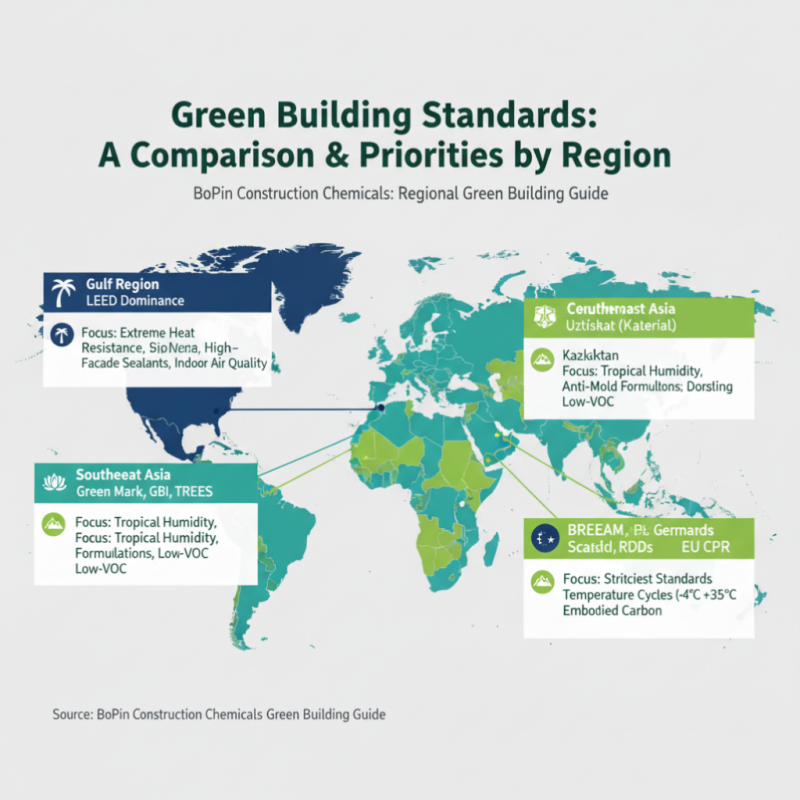
Gulf Region: LEED Dominance and Heat Resistance
The Gulf states — UAE, Saudi Arabia, Qatar, Kuwait — have adopted LEED as their primary green building framework. Abu Dhabi’s Estidama (Pearl Rating System) and the Saudi Green Building Forum operate alongside LEED but share similar material emission principles.
The challenge in the Gulf is extreme heat. Sealants must simultaneously satisfy LEED low-VOC requirements and maintain performance at ambient temperatures regularly exceeding 50°C, with substrate temperatures potentially reaching 70–80°C on exposed south-facing facades.
Neutral-cure silicone sealants remain the workhorses of Gulf facade sealing. Their thermal stability is unmatched. However, for interior applications and joint sealing in air-conditioned spaces, MS polymers offer competitive performance with better overall sustainability credentials.
Southeast Asia: Tropical Humidity and Green Mark
Singapore’s Green Mark scheme, Malaysia’s GBI (Green Building Index), and Thailand’s TREES certification are regional frameworks modeled partly on LEED. All incorporate indoor air quality requirements that align with low-VOC sealant specifications.
In the tropical climate of Southeast Asia, the primary performance challenge is humidity and biological growth. Anti-mold formulations are often a baseline requirement for sanitary and wet area sealants. The good news is that quality anti-mold neutral-cure silicones and MS polymers can simultaneously satisfy low-VOC requirements and provide the fungal resistance essential in high-humidity environments.
Central Asia: Energy Performance Focus
The cold continental climate of Kazakhstan, Uzbekistan, Kyrgyzstan and neighboring countries makes building envelope airtightness a primary energy concern. Poorly sealed windows and facade joints can be responsible for 20–40% of heating energy loss in multi-unit residential buildings.
Green building awareness is growing in this region, driven partly by international financing (World Bank, EBRD) that increasingly conditions loans on green building compliance. For Central Asian projects, the emphasis is practical energy savings rather than formal certification — but the technical requirements are the same: durable, high-movement sealants that maintain airtightness through extreme temperature cycles from -40°C summers to +35°C summers.
Europe: The Strictest Standards, the Highest Bar
European projects — particularly in France, Germany, the Netherlands and Scandinavia — operate under the most demanding sustainability requirements globally. The EU’s revised Construction Products Regulation (CPR), the Taxonomy for Sustainable Finance, and national net-zero building programs have collectively raised the specification bar significantly.
For European projects, suppliers should be prepared to provide:
- EC1 emissions certification or equivalent
- EPD (Environmental Product Declaration) or FDES (for French projects)
- Declaration of Performance (DoP) under the CPR
- Documentation of compliance with REACH regulations (restriction of hazardous substances)
This documentation requirement is one area where sourcing decisions matter. Working with a supplier who understands European regulatory requirements and can provide proper documentation is essential — not just a commercial preference.
6. BoPin Products for Sustainable Construction
Matching the right product to your green building requirements.
MS Polymer Sealants: The Eco-Friendly Workhorse
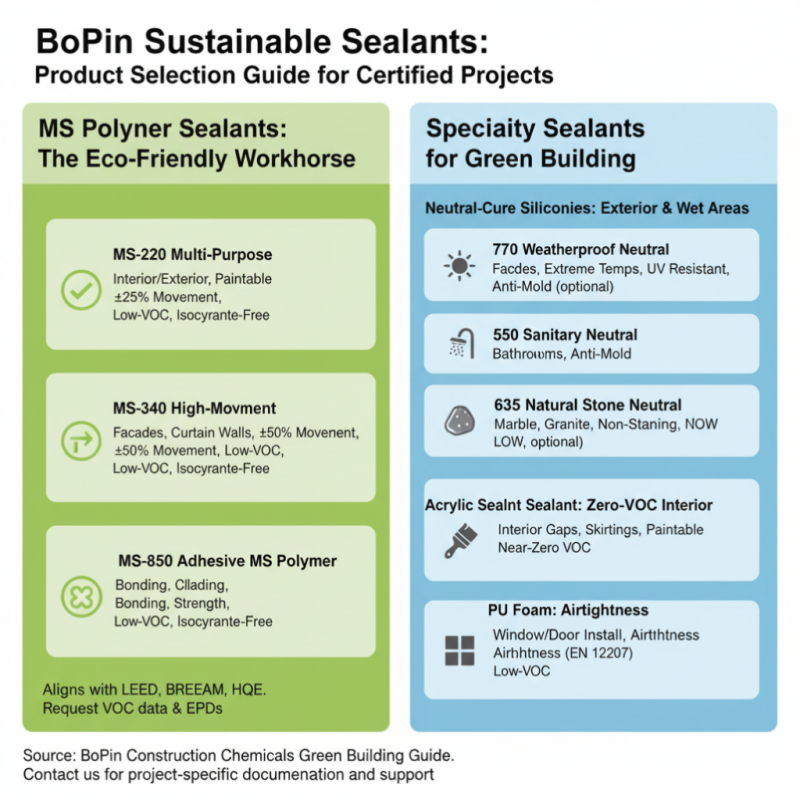
BoPin’s MS polymer sealant line is well suited to sustainable construction requirements. As isocyanate-free, low-VOC products with excellent adhesion to diverse substrates, they align naturally with LEED, BREEAM and HQE specifications.
Polímero MS multiuso BoPin MS-220 is a single-component, moisture-cure sealant suitable for interior and exterior joints in general construction. Its paintability makes it the natural choice for visible interior sealing work in certified projects. With movement accommodation of ±25%, it handles normal building joint movement comfortably.
BoPin MS-340 High-Movement MS Polymer extends movement capability to ±50%, making it appropriate for high-stress facade joints, curtain wall connections, and applications in climates with significant thermal cycling. This product addresses applications where standard silicones are pushed to their limits.
BoPin MS-850 Adhesive MS Polymer functions as both a sealant and a structural adhesive. Its isocyanate-free chemistry and low-VOC profile make it preferred for bonding applications in sensitive environments — facades, stone cladding, composite panels — where occupant health and material compliance are priorities.
For green building documentation, contact us directly for product VOC content data, safety data sheets (SDS), and guidance on compliance with specific certification requirements for your project location.
Neutral-Cure Silicones: Low VOC Exterior Performance
BoPin 770 Silicone Neutro Resistente às Intempéries is formulated without acetoxy cure chemistry, minimizing off-gas during application. With a service temperature range of -50°C to +150°C and Class 25 movement capability, it covers the majority of facade and exterior sealing requirements in certified buildings.
BoPin 550 Silicone Neutro Sanitário combines low-VOC neutral-cure chemistry with anti-mold protection for wet area applications — bathrooms, kitchens, wet rooms — where indoor air quality and hygiene requirements overlap.
BoPin 635 Silicone Neutro de Pedra Natural addresses sealing of premium stone surfaces — marble, granite, travertine — common in high-specification sustainable buildings. Its non-staining neutral cure formula prevents the surface contamination that can compromise both aesthetics and certification documentation.
Acrylic Sealant: Zero-VOC Interior Finishing
BoPin A-180 Acrylic Sealant is a water-based, near-zero-VOC product for interior joint finishing. It is appropriate for static interior gaps — around door frames, skirtings, ceiling junctions — in environments where air quality standards demand the lowest possible emission profile. It is paintable with water-based and solvent-based systems.
7. Specifying Sustainable Sealants: A Practical Checklist
Use this checklist when evaluating sealant products for green building projects.
Before finalizing your sealant specification for a certified project:
Documentation to Request from Your Supplier:
- VOC content (g/L) for each product — compare against LEED/BREEAM threshold for the product category
- Safety Data Sheet (SDS) — check Section 3 for substance declarations and Section 8 for exposure controls
- Emissions certification: EC1 (Emicode), M1, or equivalent
- EPD or FDES if required by your certification program
- REACH compliance declaration
- For French projects: FDES or conformité aux exigences HQE documentation
Performance Requirements to Verify:
- Movement capability class: minimum Class 25 for standard construction joints
- Adhesion testing: verify compatibility with your specific substrates, ideally with manufacturer data or your own trial
- Temperature service range: verify against expected ambient and substrate temperatures in your climate
- Mold resistance: required for sanitary, humid or tropical applications
Application Conditions:
- Confirm suitable temperature and humidity range for application
- Verify substrate preparation requirements — MS polymers often require minimal surface preparation, reducing the use of solvent-based primers
- Confirm compatibility with other materials in the assembly (insulation, membranes, gaskets)
Perguntas mais frequentes
What VOC level do I need to meet LEED low-emitting materials requirements for sealants?
Under LEED v4, architectural sealants must contain no more than 250 g/L VOC. Fireproofing sealants must be below 100 g/L. These limits apply to products used inside the building’s weatherproofing boundary. Many quality MS polymer and neutral-cure silicone sealants fall well below these thresholds. Always request actual VOC content documentation from your supplier — don’t rely on marketing claims alone.
Are polyurethane foams acceptable for LEED-certified projects?
Yes, in most cases. Standard polyurethane installation foams used for window sealing are outside the weatherproofing boundary (between the frame and the rough opening) and are therefore typically not subject to the indoor emissions credit. For interior PU applications, check the VOC content against SCAQMD Rule 1168 thresholds. Cured PU foam typically has very low residual emissions. However, for projects requiring material health screening (Living Building Challenge, Declare labels), isocyanate-based chemistry may need to be addressed.
Is MS polymer sealant better than silicone for sustainable construction?
It depends on the application. For interior applications, visible joints, and surfaces that will be painted, MS polymer sealants generally offer better overall sustainability credentials — no isocyanates, low VOC, and no silicone migration that complicates painting and maintenance. For exterior facade applications with high UV exposure and extreme temperatures, neutral-cure silicone retains performance advantages. The best approach is to match chemistry to application requirements, which sometimes means using both technologies within the same project.
How do I get an EPD for a sealant product?
EPDs (Environmental Product Declarations) are prepared by manufacturers and verified by third-party certifiers. When sourcing products for projects that require EPDs, ask your supplier whether an EPD is available. Some major manufacturers have EPDs for their product families. If a specific product lacks an EPD, a general industry EPD (an average of multiple products in the same category) may be acceptable under certain certification programs. Contact your BoPin representative directly to discuss EPD availability for specific products and markets.
What is the difference between EC1 and EC1+ certification for sealants?
Both are Emicode certifications issued by GEV (Germany). EC1 indicates “very low emissions” and EC1+ indicates “extremely low emissions” — an even stricter classification. Both are accepted under BREEAM’s Health and Wellbeing compliance routes. EC1+ products are appropriate for the most sensitive environments: schools, hospitals, childcare facilities. For standard commercial and residential certified buildings, EC1 is typically sufficient.
Conclusão
Sustainable construction is no longer about achieving a plaque on the lobby wall. It is about building healthier, more durable, more energy-efficient structures that serve occupants and investors over a long service life.
Sealants and construction chemicals play a genuine role in that goal. Low-VOC formulations protect indoor air quality. Durable, high-movement products maintain airtightness over decades. Isocyanate-free chemistries reduce occupational health risk on-site.
MS polymer sealants and neutral-cure silicones represent the current best practice for sustainable sealing. They deliver technical performance without the compromises of legacy chemistries. They align naturally with LEED, BREEAM, HQE and comparable certification programs worldwide.
The key is knowing what to specify, and working with a supplier who can provide the documentation your project requires.
BoPin Construction Chemicals works directly with international project teams — contractors, architects and procurement specialists — to match the right products to certification requirements and regional conditions. If you’re sourcing sealants for a green building project and need technical support or product documentation, contact us directly. You’ll get a straightforward answer, not a sales pitch.
Need product documentation, VOC data, or technical support for a green building project? Contact BoPin directly — we provide personalized guidance without the corporate layers.
Artigos relacionados:
- MS Polymer Sealants vs Silicone: The Complete Professional Guide
- Fire-Rated Sealing Systems: Complete Technical Guide
- Vedação de ar no envelope do edifício para eficiência energética
- Projeto e vedação de juntas de dilatação na construção civil
- How to Choose a Sealant Supplier: The Professional Guide
Product References: