Finding silicone sealant suppliers is relatively easy.
The difficult part is determining whether the product, packaging, documents and service offered during the quotation stage will remain consistent after the order is placed.
Most suppliers can send product photos, catalogs, samples and an attractive price. However, these materials do not automatically answer the questions that matter most to an importer:
- Which exact formulation is being quoted?
- Is it suitable for the intended application?
- Will bulk production match the approved sample?
- Do the TDS and SDS correspond to the same product?
- Can the supplier control fill volume, colour and packaging?
- Are performance claims supported by relevant documents?
- Who will take responsibility if the shipment does not match the agreed specification?
A reliable silicone sealant supplier should be able to connect the application, formulation, sample, packaging, documentation and mass production into one controlled process.
This guide explains 15 checks importers and private-label buyers should complete before placing a bulk silicone sealant order.
Quick Silicone Sealant Supplier Evaluation Checklist
Before reviewing a supplier in detail, use this table to identify the main areas that require confirmation.
| Evaluation Area | Main Question |
|---|---|
| Supplier role | Who actually manufactures the product? |
| Application fit | Is the sealant suitable for the intended substrate and joint? |
| Formula identity | Is the exact product or formulation clearly identified? |
| Product range | Are the products genuinely different or only renamed? |
| Documentos | Do the TDS, SDS and reports match the offered formulation? |
| Performance claims | Are specialised claims supported by relevant evidence? |
| Sample testing | Has the product been tested on actual local substrates? |
| Sample-to-bulk control | How will the approved sample be locked for production? |
| Controle de qualidade | What is inspected during filling, packing and shipment? |
| Fill control | Are net volume, density and approximate weight clearly stated? |
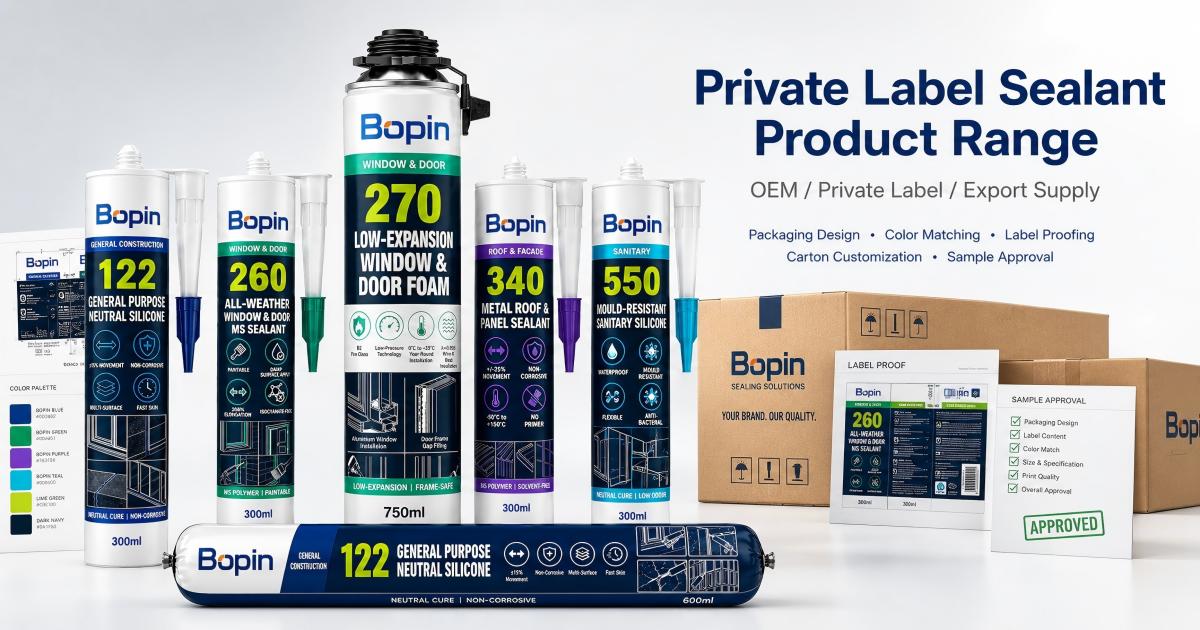
| OEM packaging | Can the supplier manage label claims and artwork accurately? |
| MOQ structure | Is MOQ clear by formula, colour and packaging design? |
| Quotation clarity | Are the inclusions, exclusions and trade term defined? |
| Export support | Can the supplier provide reliable loading and document data? |
| Problem solving | How are quality issues, changes and claims handled? |
A low price should not compensate for missing answers in several of these areas.
1. Identify Whether the Supplier Is a Factory, Exporter or OEM Supply Partner
The first step is understanding who you are dealing with.
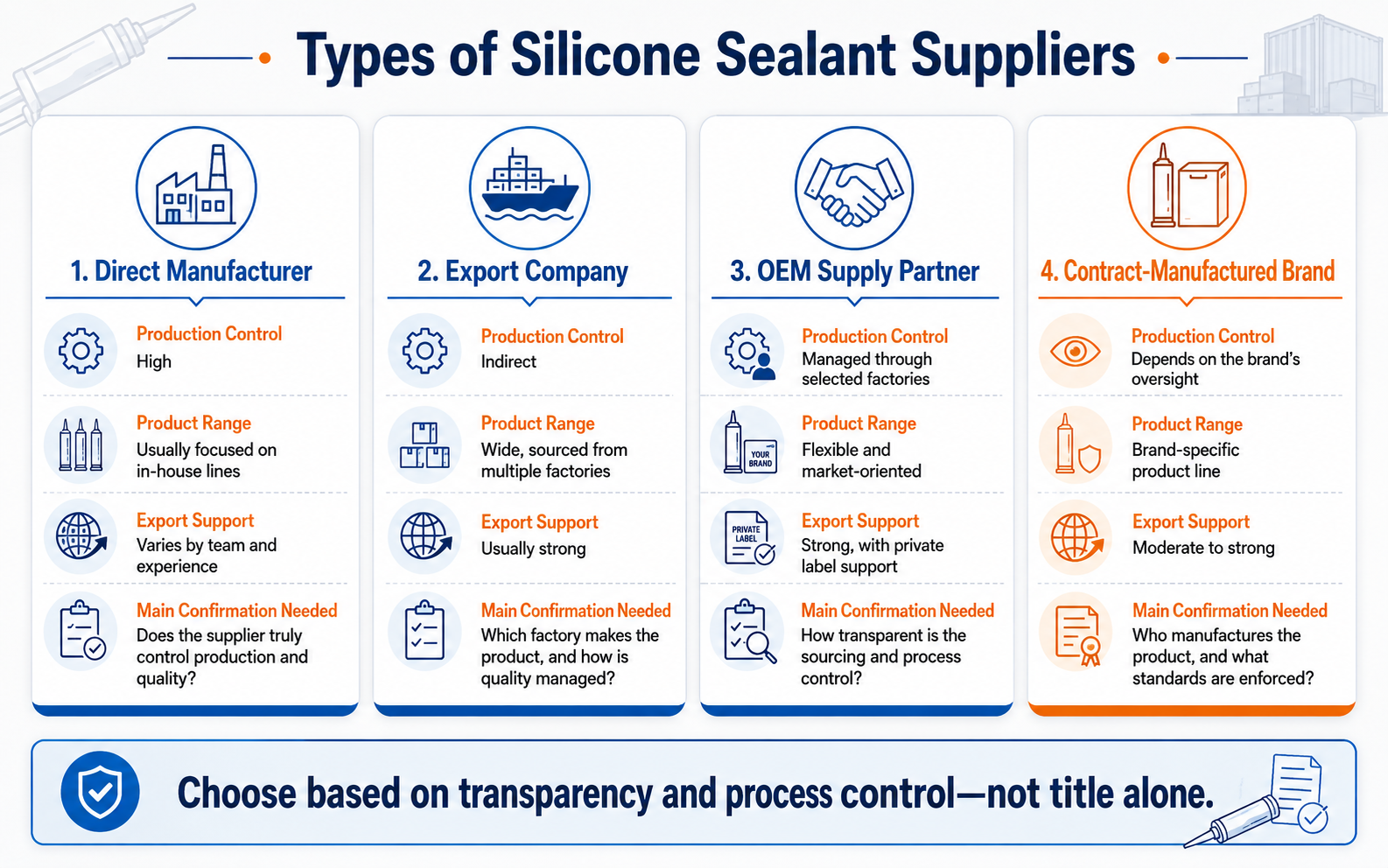
A silicone sealant supplier may operate as:
| Supplier Type | Possible Strengths | Possible Limitations |
|---|---|---|
| Direct manufacturer | Production access, formula control and competitive factory pricing | Product range, overseas communication or export service may be limited |
| Export company | Communication, documentation and shipment coordination | May depend on external factories for technical confirmation |
| OEM supply partner | Can coordinate product selection, packaging and multiple supply sources | Must be transparent about manufacturing control and final formulation |
| Brand owner with contract manufacturing | Clear market positioning and packaging system | Production source and technical-document alignment still need confirmation |
None of these business models is automatically better than the others.
A direct factory can still provide poor export service. An export company or OEM supply partner can provide strong product control if it clearly identifies the manufacturer, formulation and responsibilities.
The important questions are:
- Who manufactures the quoted product?
- Will the same factory produce the bulk order?
- Who selects and approves the formulation?
- Who issues the TDS and SDS?
- Who controls the packaging?
- Who handles a quality complaint?
- Can the manufacturing source be changed without buyer approval?
A supplier should describe its actual role clearly instead of creating the impression that every product is manufactured in one company-owned plant.
What a transparent answer may look like
We coordinate the OEM order and export execution. The final manufacturing partner and formulation will be selected according to your application, target price and approved samples. Final technical documents will correspond to the confirmed product.
This is more useful than simply claiming to be a “leading factory” without explaining how the order will be controlled.
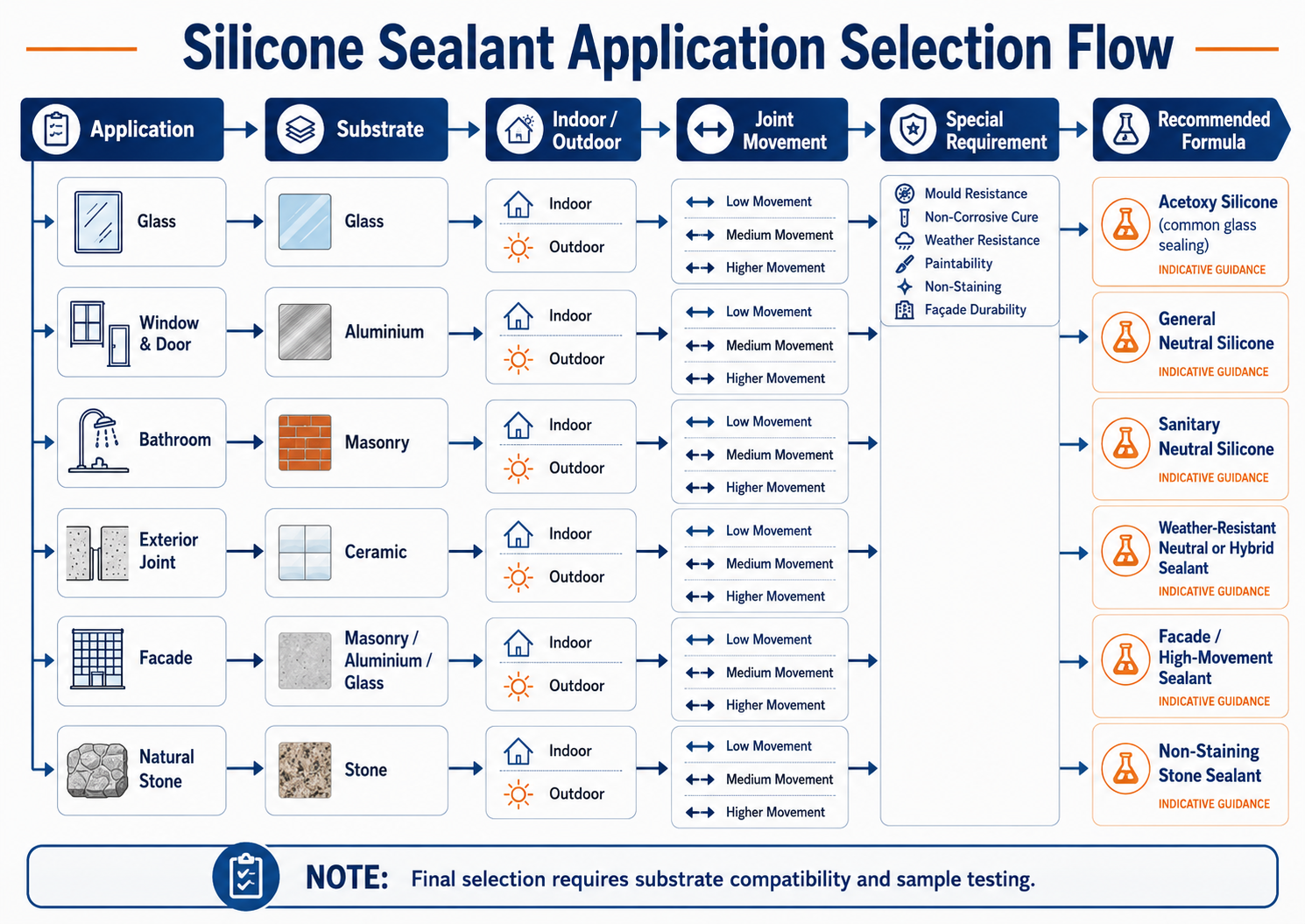
2. Check Whether the Supplier Understands the Application
A professional supplier should not recommend a product after asking only:
Do you need acetoxy or neutral silicone?
The cure system is important, but it is only one part of product selection.
The supplier should also ask:
- What is the intended application?
- Which substrates will be sealed?
- Is the joint indoors or outdoors?
- Will it be exposed to sunlight, rain or temperature cycling?
- Does the joint experience movement?
- Is it a glass, window, sanitary, stone or facade application?
- Will the product contact mirrors, metals, plastics or porous stone?
- Is mould resistance required?
- Are there local project standards?
- What product is currently used in the market?
- What problem is the buyer trying to solve?
Why this matters
A basic acetoxy silicone may be suitable for glass, glazed ceramic or display-cabinet sealing. It may not be appropriate for natural stone, mirror backing or acid-sensitive metals.
A general neutral silicone may work for common construction joints but should not automatically be described as:
- Structural glazing sealant
- Selante para pedra natural
- Facade-grade sealant
- Firestop sealant
- Aquarium silicone
- Permanent immersion sealant
The correct product must be selected according to the actual application.
Example of an application-based product range
| Product | Main Positioning |
|---|---|
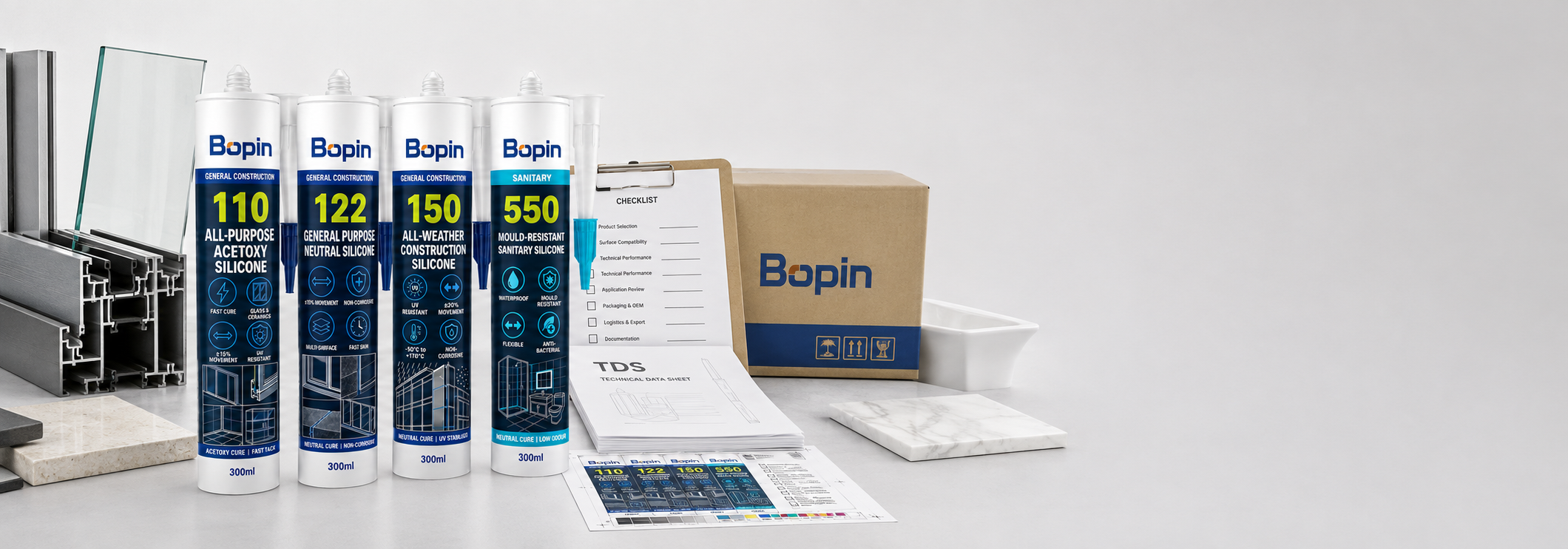
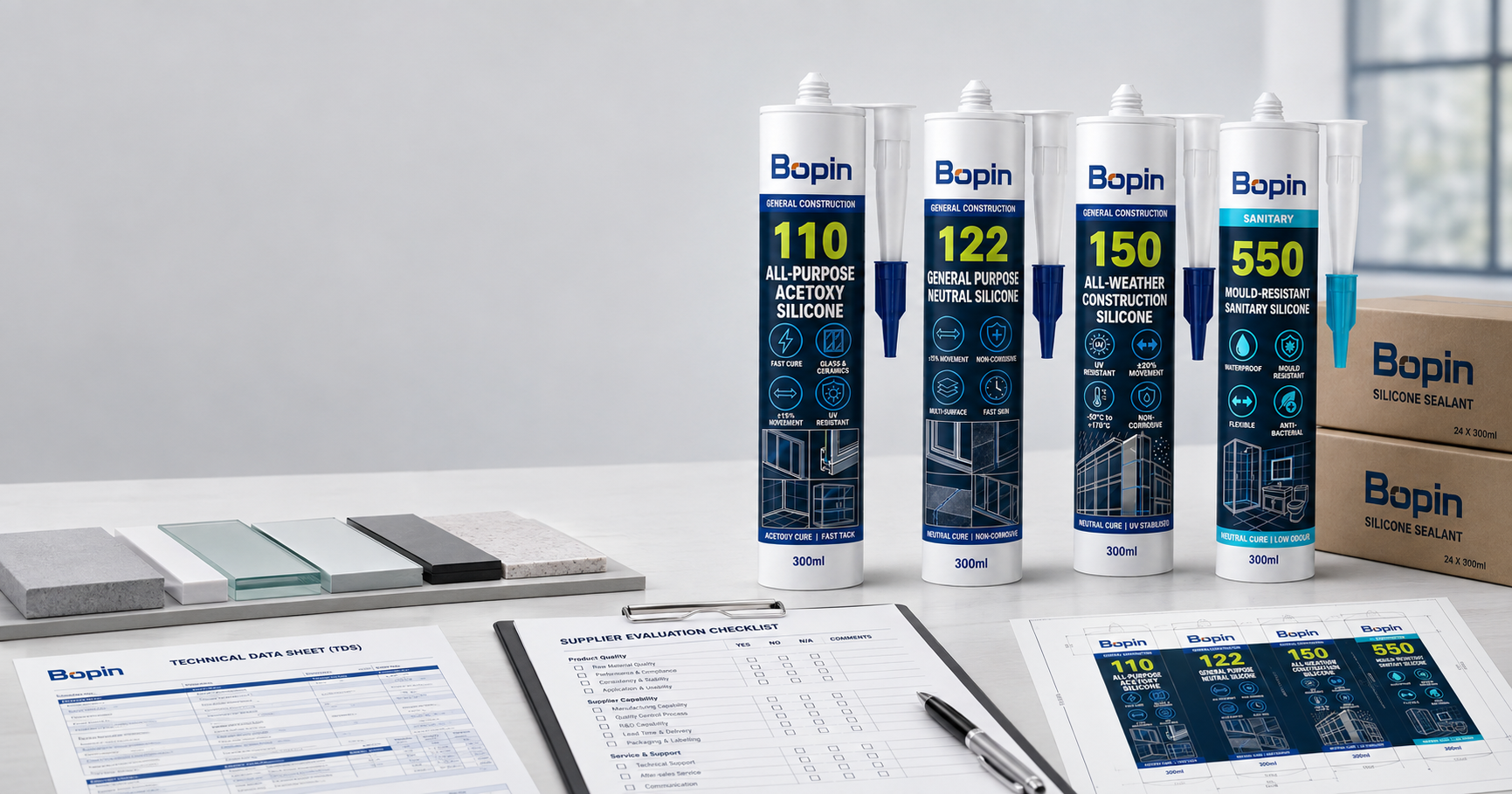
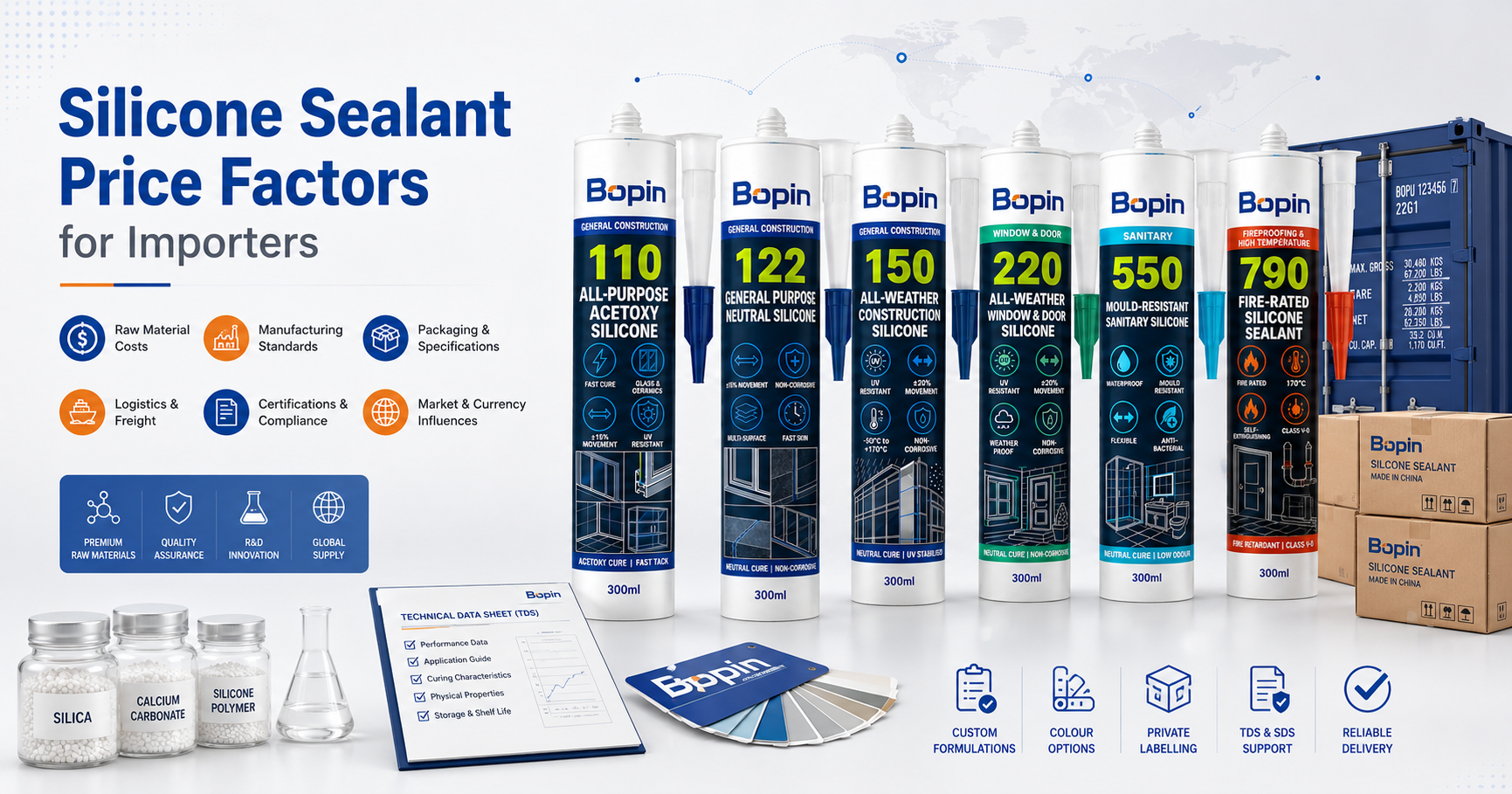
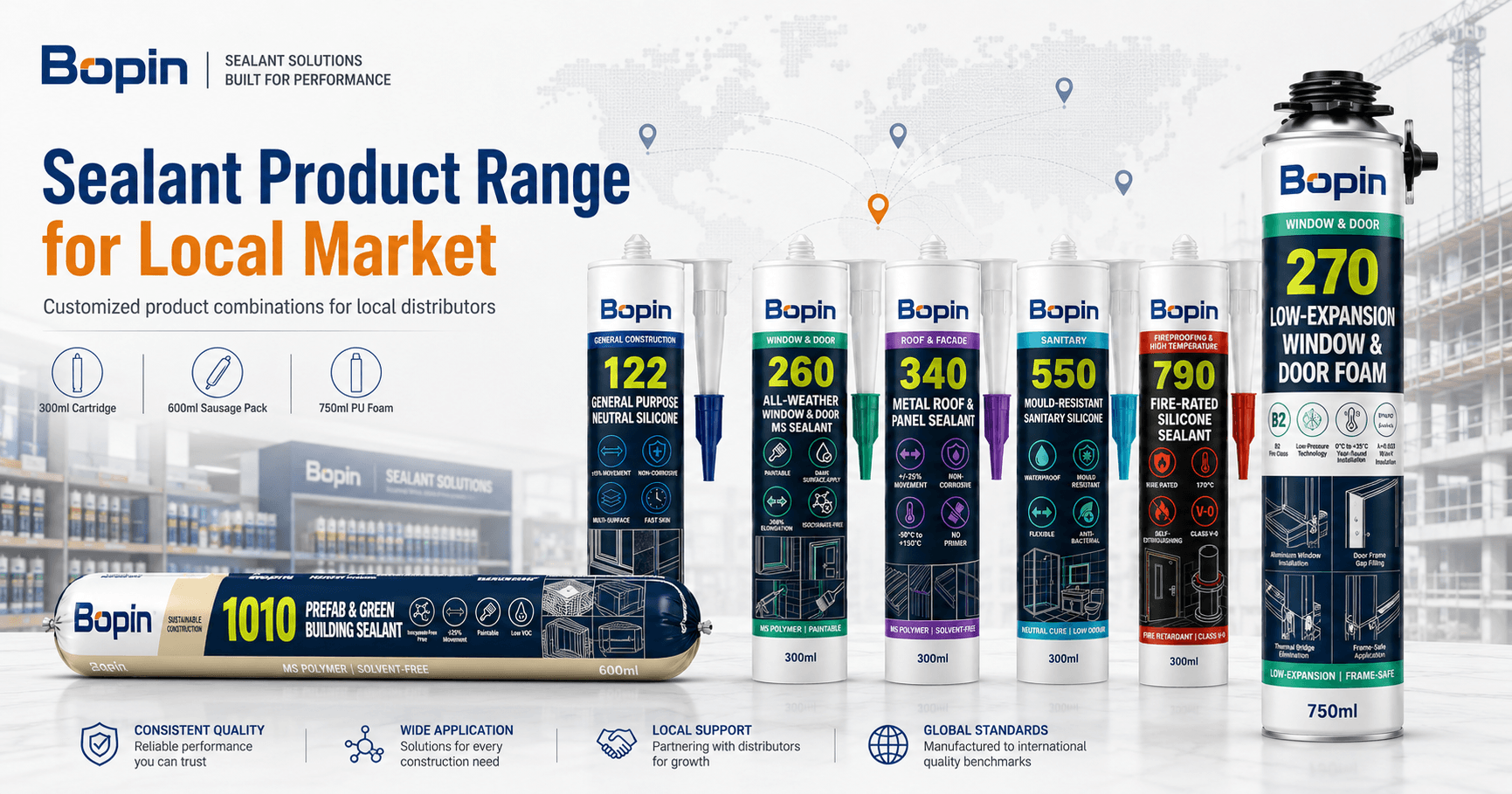
| BoPin 110 | Silicone acetoxi for glass, glazed ceramic and general sealing |
| BoPin 122 | General-purpose neutral silicone for mixed construction substrates |
| BoPin 150 | Weather-resistant neutral silicone for exterior construction joints |
| BoPin 220 | Window and door perimeter sealing |
| BoPin 550 | Kitchens, bathrooms and sanitary joints |
| BoPin 380 | Facade weatherproofing applications |
| BoPin 635 | Pedra natural and decorative stone joints |
The BoPin OEM catalog similarly separates acetoxy, general neutral, weather-resistant neutral and sanitary formulas according to their application and market positioning rather than presenting them as interchangeable products.
3. Ask for the Exact Product or Formulation Behind the Quotation
A commercial description is not the same as a product identity.
The following phrases are commonly used in quotations:
- Standard quality
- Premium quality
- Professional grade
- Export quality
- Sika quality
- Dow quality
- European quality
- High silicone content
These descriptions may help explain positioning, but they are not sufficient to define what will be manufactured.
Before accepting a quotation, ask:
- What is the exact supplier model?
- Is it an existing standard formula or a customised formula?
- Which factory will produce it?
- Is the formula already in regular production?
- Does each colour use the same technical base?
- What batch or sample code identifies the approved product?
- Will the same formulation be used for mass production?
- Can the supplier change the source without buyer approval?
- Which TDS and SDS correspond to the quotation?
- Which performance claims apply to this exact formulation?
Avoid mixing data from several products
A supplier may have:
- One formula with high elongation
- Another with fast skin formation
- Another with high initial strength
- Another with a particular fire test
These values cannot be combined into one “premium” product unless one confirmed formulation genuinely provides all of them.
A supplier should never build a specification by selecting the best parameter from several unrelated models.
Recommended quotation wording
A professional quotation can state:
The final product specification is subject to the confirmed formulation and approved sample. Final TDS and SDS will correspond to the selected OEM product.
This creates a clear link between the sample, product and documents.
4. Review the Product Range—but Do Not Be Impressed by Size Alone
A large catalog can be useful, but product count alone is not proof of supply capability.
Some suppliers list dozens of sealants that may be:
- The same basic formula under different names
- Application-repositioned versions of one product
- Products sourced from several factories
- Concept products without complete documents
- Custom products that have not yet entered regular production
Ask the supplier to explain the difference between similar products.
Por exemplo:
- What is the difference between general neutral silicone and window silicone?
- How is weather-resistant silicone different from basic neutral silicone?
- What makes sanitary silicone suitable for mould-prone areas?
- How is natural stone silicone validated?
- Is facade sealant structural or non-structural?
- Is the fire-related product flame-retardant or part of a tested firestop system?
A strong supplier should also be willing to say:
This product is not suitable for your application.
That is often more valuable than a supplier claiming every product can be used everywhere.
Start with a compact range
For a new private-label project, a focused range may be more practical:
| Range Type | Produtos |
|---|---|
| Price-led starter range | Acetoxy + general neutral |
| Professional range | Acetoxy + weather-resistant neutral |
| Sanitary extension | Add mould-resistant sanitary silicone |
| Project extension | Add window, facade or stone products after validation |
BoPin’s current silicone OEM range follows this compact approach, starting with common acetoxy and neutral formulas before extending into sanitary or application-specific products.
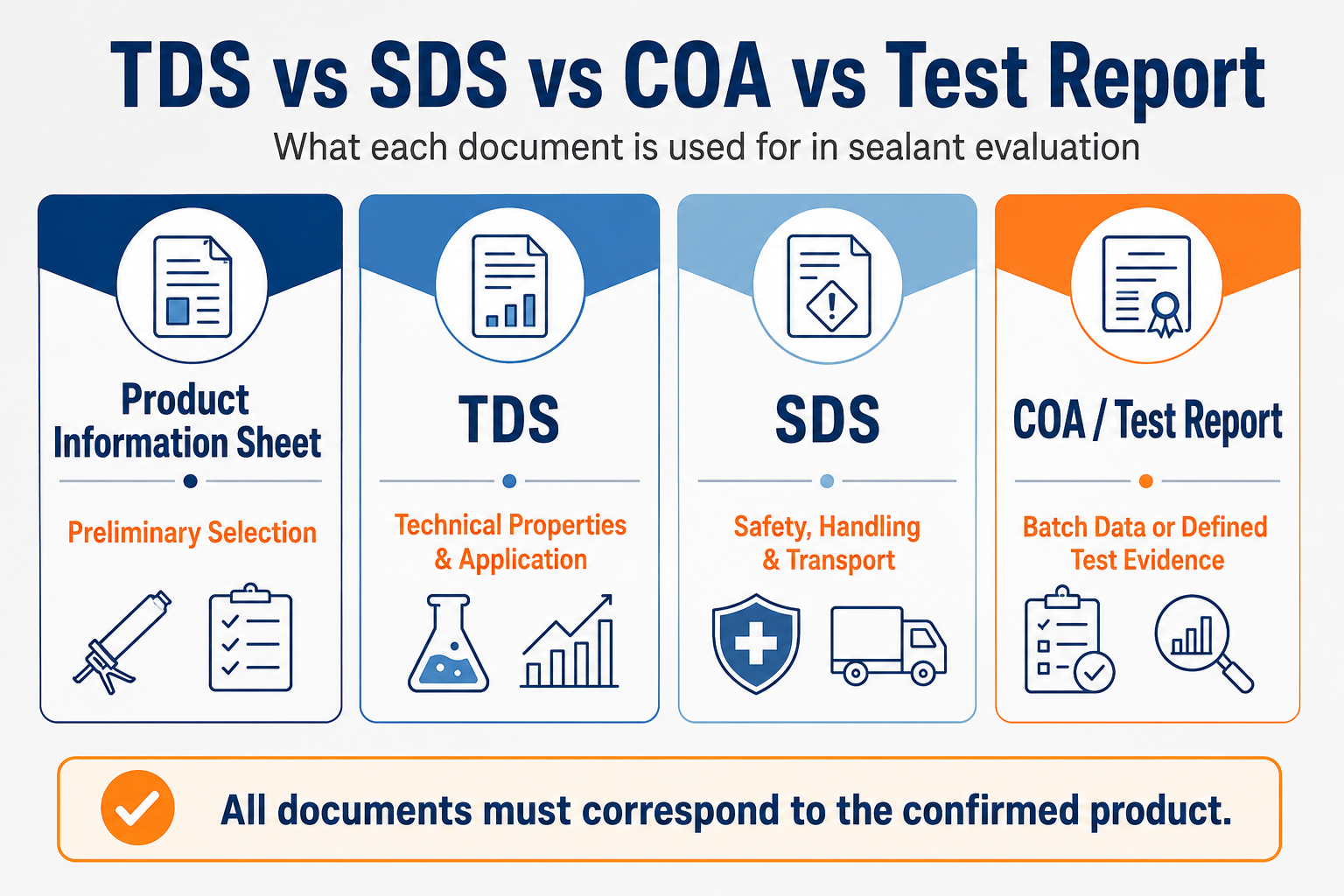
5. Verify That the Technical Documents Match the Quoted Product
Technical documents are essential, but buyers should not treat every document as equivalent.
Product Information Sheet
A Product Information Sheet is useful for:
- Preliminary product selection
- Website presentation
- OEM discussion
- Application positioning
- Packaging planning
It may contain reference information, but it should not automatically be treated as an official final specification.
Technical Data Sheet
A TDS should describe the confirmed product’s:
- Cure system
- Typical physical properties
- Application methods
- Substrate recommendations
- Limitações
- Embalagem
- Condições de armazenamento
- Prazo de validade
- Relevant test references
Safety Data Sheet
An SDS or MSDS should address:
- Composition categories
- Hazard classification
- Handling
- Personal protection
- Storage
- Fire response
- Accidental release
- Transport information
- Disposal
Certificate of Analysis
A COA generally relates to a production batch or shipment and may record agreed inspection results.
Test Report
A test report supports a particular:
- Product
- Specimen
- Batch or sample
- Test method
- Result
- Scope
It does not automatically apply to every similarly named product.
Document consistency checklist
Check whether:
- The product names match.
- The model numbers match.
- The manufacturer names are clear.
- The TDS and SDS describe the same chemistry.
- The documents correspond to the quotation.
- The report refers to the same product.
- The dates and revisions are visible.
- The limitations are included.
- The report scope supports the marketing claim.
- The documents will remain applicable after OEM relabelling or formula changes.
BoPin’s current document framework treats Product Information Sheets as preliminary selection material and requires final technical and safety documents to be confirmed according to the selected supplier, formulation, packaging and target market.
6. Be Careful with Certification and Performance Claims
Specialised product claims can strongly influence both price and purchasing risk.
Claims requiring careful verification include:
- Certified
- Structural
- Fire-rated
- Firestop
- Four-hour rated
- EI-rated
- Stone-safe
- Non-staining
- Antimofo
- Low VOC
- Food-safe
- Aquarium-safe
- Green-building compliant
- REACH compliant
- RoHS compliant
- UL approved
- TÜV approved
- No-primer required
The buyer should ask seven questions:
- What exact standard is referenced?
- Which product was tested?
- Which formulation was tested?
- Which laboratory issued the report?
- What specimen or joint system was used?
- Is the test material-level or system-level?
- Does the result apply to the product being quoted?
Company certificates are not always product certificates
A supplier may have:
- ISO quality-management certification
- Environmental-management certification
- Occupational-health certification
- Factory-audit reports
These may be useful when assessing the company, but they do not automatically prove that every product meets a particular performance standard.
Material performance is not the same as system performance
For example, a silicone may demonstrate flame-retardant behaviour in a material test. That does not automatically mean it is approved as a complete firestop joint or penetration system.
Likewise, a product described as stone-compatible should not be marketed with an absolute non-staining guarantee unless the offered formula has relevant evidence and has been tested with the actual stone.
Your supplier should use the narrowest accurate wording supported by the available documents.
For building joint sealants, buyers may refer to ASTM C920 e ISO 11600 when reviewing product classification, intended use and performance requirements. However, a supplier should only claim compliance when the offered formulation is supported by relevant test evidence.
Fire-related claims require particular care. Buyers should understand the scope and limitations of UL 94 ratings, because a material-level flammability result is not the same as a tested building firestop system. For joint, penetration and perimeter fire-containment applications, the supplier should provide evidence relevant to the complete firestop system testing and its intended construction.
Company-level management certificates should also be separated from product-level performance evidence. Buyers can review the official explanation of ISO certification when checking whether a certificate relates to the company’s management system, the certification body or the specific product.
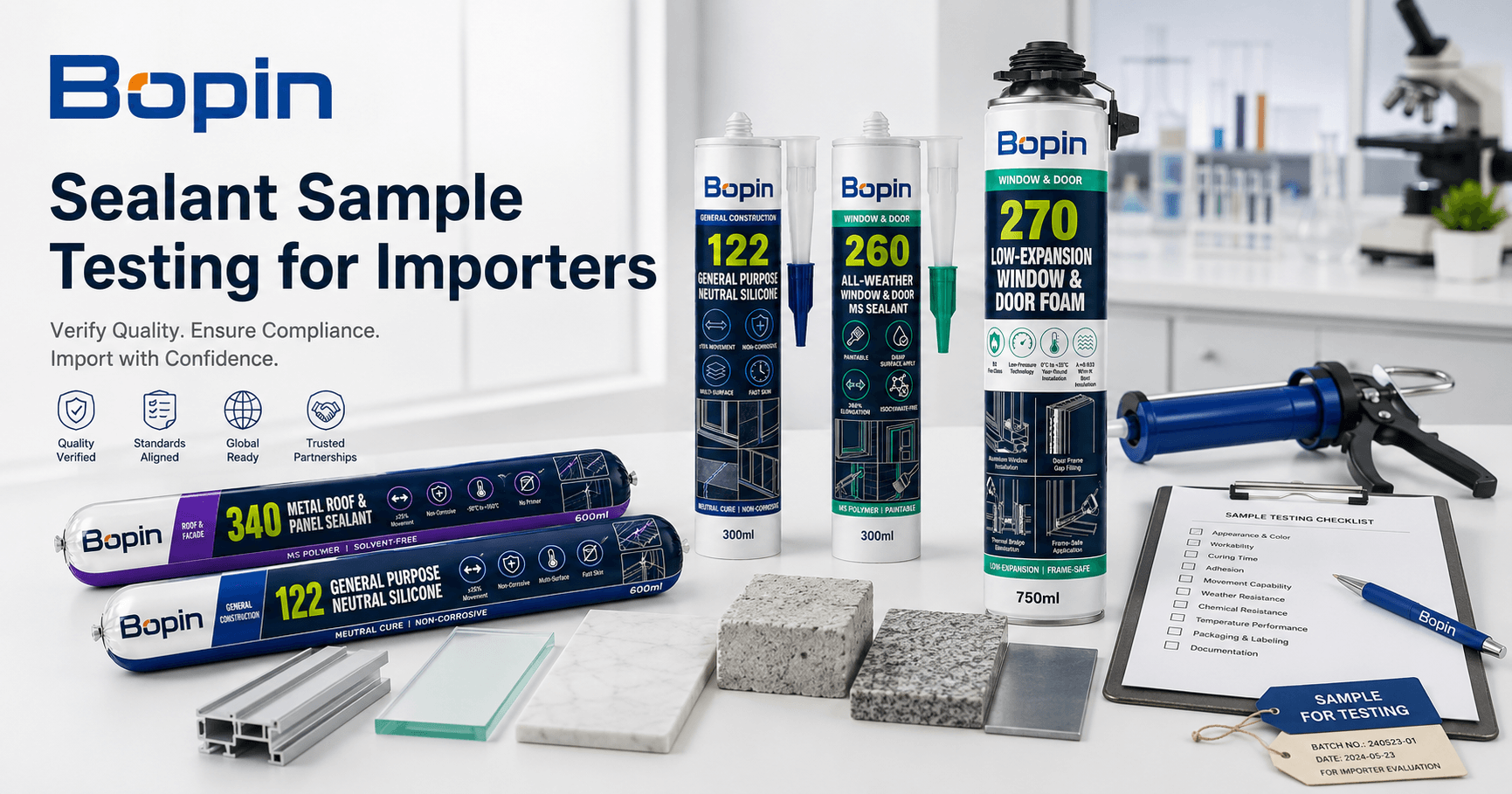
7. Test Samples on Actual Local Substrates
A sample should be tested in conditions that are relevant to the buyer’s market.
A general glass test is not enough if the product will be used on:
- Powder-coated aluminium
- Galvanised metal
- PVC window profiles
- Concreto
- Brick
- Ceramic tile
- Pedra natural
- ACP panels
- Superfícies pintadas
What the supplier should do before sampling
A professional supplier should ask:
- Which substrates will be tested?
- What benchmark product is currently used?
- What colour is required?
- What cure speed is acceptable?
- Is odour important?
- Is the product applied vertically?
- Does the buyer need soft flexibility or higher modulus?
- Are local paints or cleaners involved?
- What application problem must the sample solve?
Sample evaluation should include
- Packaging condition
- Suavidade da extrusão
- Bead consistency
- Formação da pele
- Cure behaviour
- Adhesion
- Resistência à deformação
- Tooling
- Odor
- Colour and appearance
- Compatibility with actual substrates
The supplier should also identify the sample clearly.
A label such as “neutral silicone sample” is not enough. The sample should have a code or model that can later be connected to the approved formulation.
A useful principle
A good supplier does not only send samples. It helps define what the sample is expected to prove.
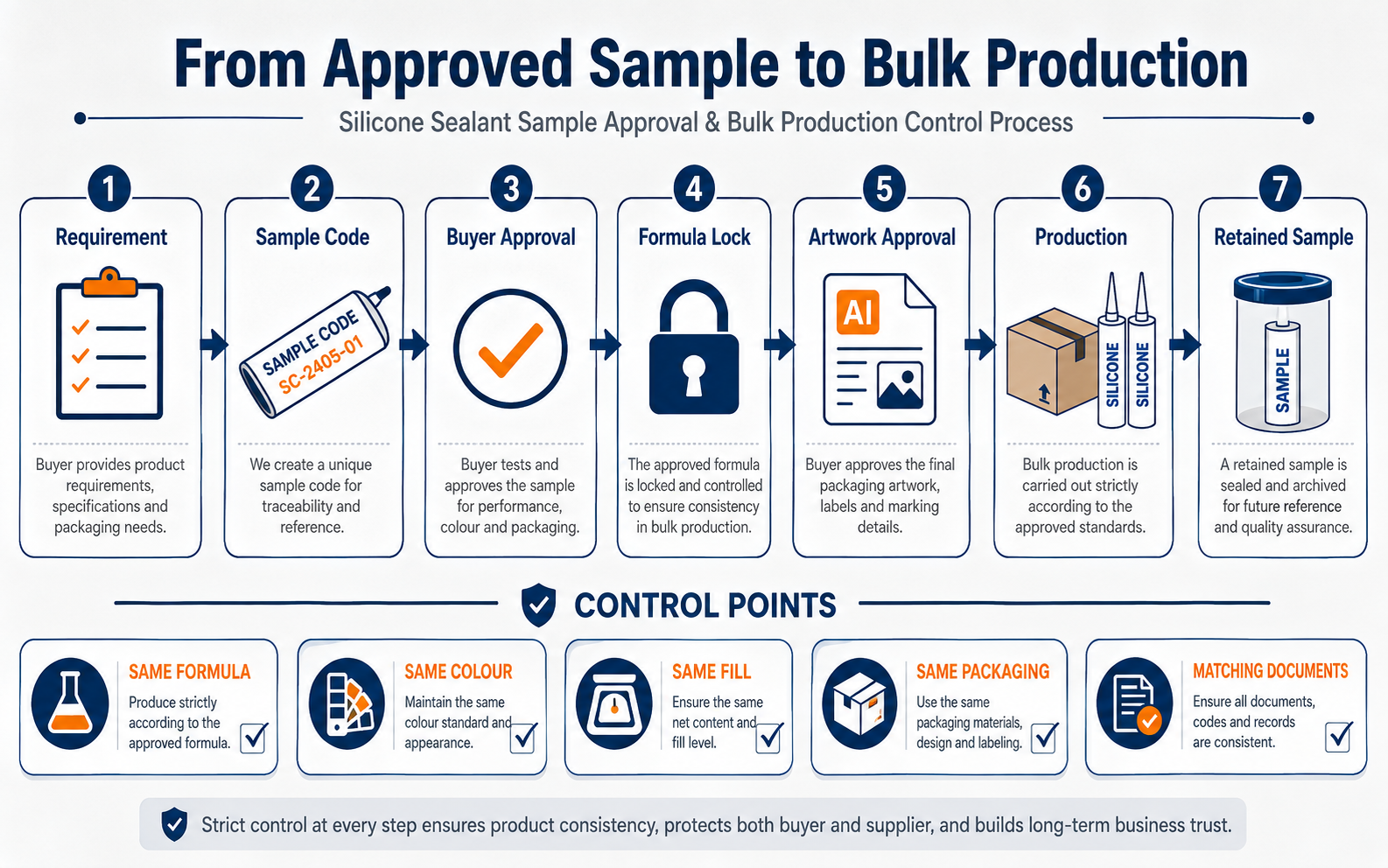
8. Ask How the Approved Sample Will Be Locked for Bulk Production
One of the largest risks in OEM purchasing is the gap between sample approval and mass production.
A buyer may approve a good sample, but the bulk order may later be produced with:
- A different formula
- A different manufacturing partner
- Different raw materials
- A different colour system
- Different fill volume
- A different cartridge
- Modified packaging claims
Before paying a deposit, ask how the sample will be controlled.
Recommended Sample-to-Bulk Process
Step 1: Product requirement
Confirm:
- Aplicação
- Cure system
- Target quality
- Benchmark
- Cor
- Volume
- Embalagem
Step 2: Sample identification
Record:
- Supplier model
- Sample code
- Formula reference
- Cor
- Sample date
- Batch where available
Step 3: Buyer approval
The buyer confirms:
- Product performance
- Appearance
- Cor
- Packaging direction
- Any limitations or required changes
Step 4: Formula lock
The supplier confirms that:
- The approved formula will be used.
- The manufacturing source will not change without approval.
- The technical documents will correspond to the formula.
Step 5: Packaging approval
Approve:
- Cartridge artwork
- Label claims
- Colour marking
- Código de barras
- Carton artwork
- Batch and date areas
Step 6: Mass production
Production follows:
- Approved formulation
- Approved colour
- Approved fill volume
- Approved packaging
- Agreed QC requirements
Step 7: Retained sample
Where practical, the supplier retains production samples for traceability.
The BoPin OEM process similarly moves from requirement and formulation selection to sample validation, artwork approval, production, quality control and shipment preparation.
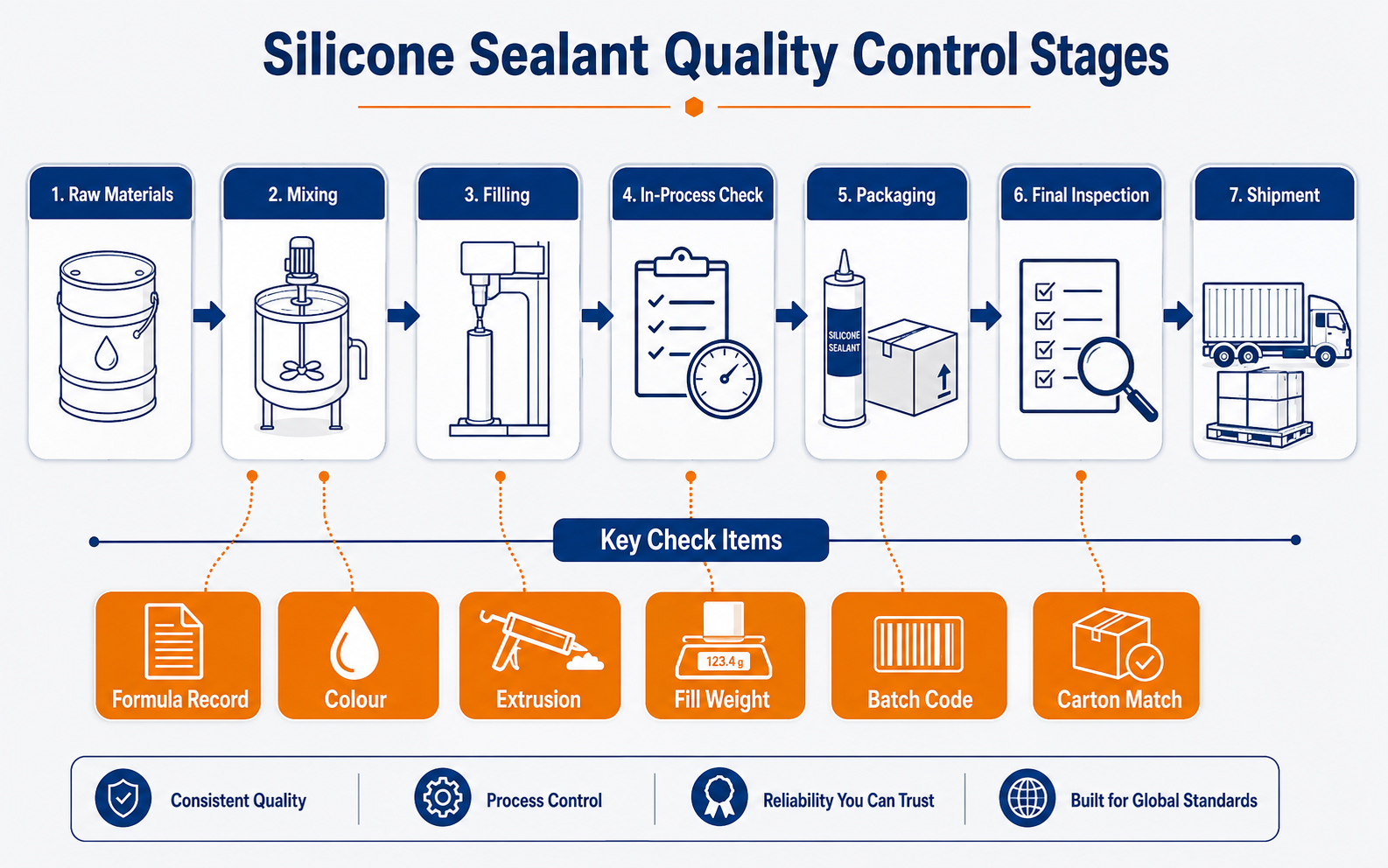
9. Review the Supplier’s Quality-Control Procedures
Buyers do not always need access to confidential formulation details.
They do need evidence that the supplier has a controlled production and inspection process.
Quality-control stages to review
| Stage | Possible Control |
|---|---|
| Raw materials | Identity, source and batch record |
| Mixing | Formula record, mixing conditions and appearance |
| In-process check | Viscosity or consistency, colour and homogeneity |
| Filling | Net content, piston position and cartridge integrity |
| Initial inspection | Extrusion, skin formation and sag observation |
| Embalagem | Product model, label, colour and batch coding |
| Final inspection | Quantity, carton condition and shipment preparation |
| Retained samples | Batch traceability and complaint comparison |
Important questions
- Is there a production batch number?
- How is fill volume checked?
- How often are cartridges weighed?
- Is colour checked against an approved reference?
- Are extrusion and skin time checked?
- Are retained samples kept?
- Is packaging inspected before boxing?
- Who approves release for shipment?
- Can inspection photos or records be provided?
- Can an independent pre-shipment inspection be arranged?
Avoid unrealistic requirements
The supplier may not share:
- Full formulation percentages
- Proprietary processing methods
- Confidential raw-material agreements
That does not automatically mean the supplier lacks control.
The buyer’s objective is to confirm traceability, agreed standards and consistency—not to obtain manufacturing secrets.
10. Confirm Net Volume, Density and Fill-Weight Control
Cartridge size, declared net volume and actual fill are related—but they are not the same thing.
A supplier may offer:
- 260ml
- 280ml
- 300ml
The product may also use a standard 300ml cartridge body even when the declared net content is 280ml.
This can be acceptable when it is clearly stated and accurately labelled.
Information to confirm
- Declared net volume
- Cartridge body size
- Product density
- Approximate net weight
- Filling tolerance
- Units per carton
- Carton gross weight
- Carton net weight
- Carton dimensions
- Loading quantity
Approximate fill weight can be estimated from:
Volume × density
However, density is not a quality score. It should be used to understand fill weight, formulation difference and quotation basis.
Warning signs
Be careful when:
- The supplier says “300ml cartridge” but does not state net content.
- The quotation lists only gross cartridge weight.
- The same weight is quoted for clear and white without formula confirmation.
- The TDS density does not match the offered product.
- The carton weight is inconsistent with the stated fill.
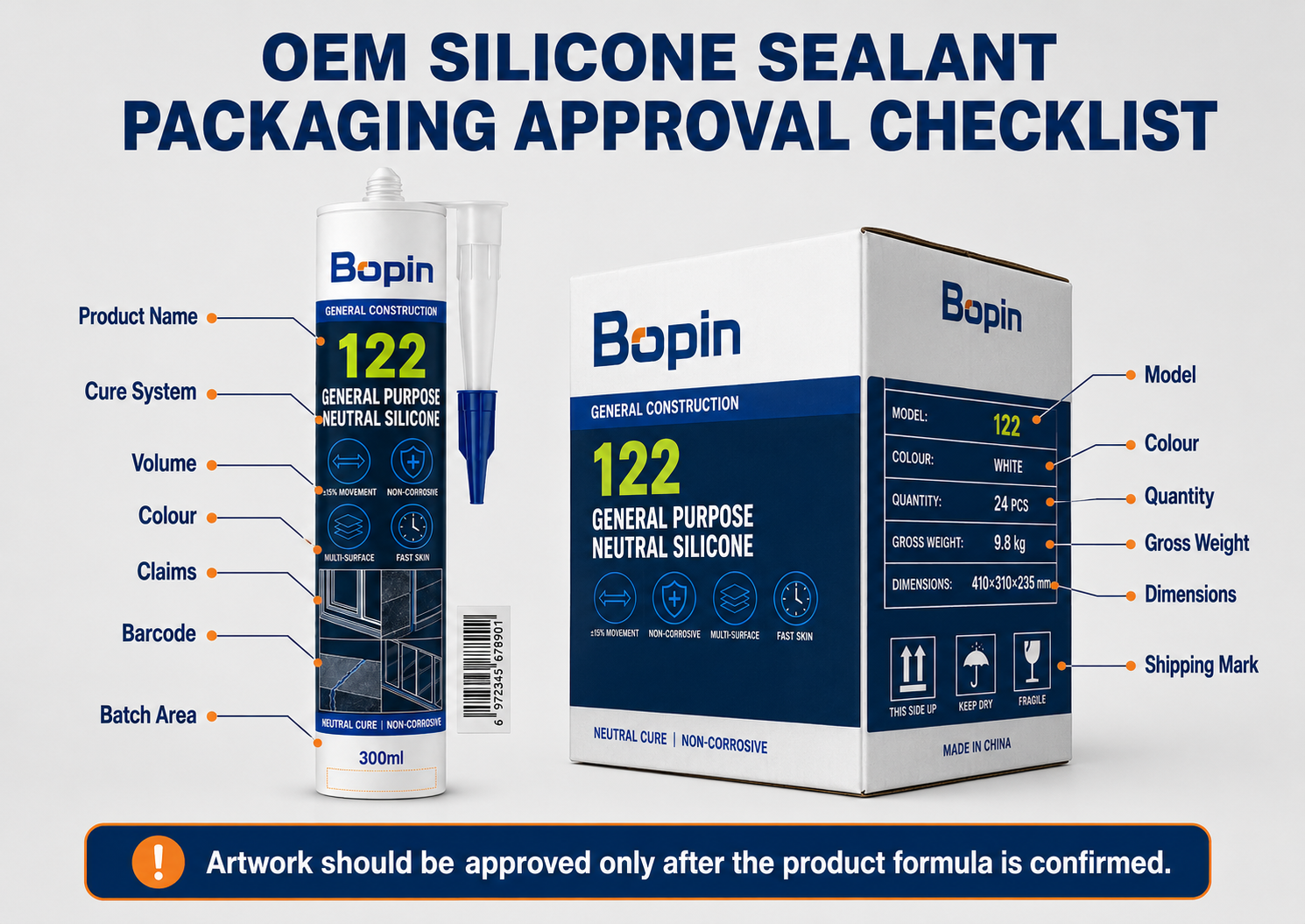
11. Evaluate OEM Packaging Capability
OEM packaging capability is not only graphic design.
The supplier must ensure that packaging claims match the product being supplied.
Cartridge artwork checks
- Nome da marca
- Nome do produto
- Modelo do produto
- Cure system
- Main application
- Volume líquido
- Product colour
- Key benefits
- Ícones de aplicativos
- Safety wording
- Limitation wording
- Storage and shelf-life information
- Batch and date area
- Importer information
- Código de barras
- Country-of-origin requirements
Carton checks
- Nome do produto
- Model
- Cor
- Quantity
- Volume líquido
- Gross and net weight
- Carton dimensions
- Número do lote
- Data de produção
- Marcas de manuseio
- Destination-market text
Questions to ask
- Is the cartridge printed directly or labelled?
- What is the printing MOQ?
- Is a printing plate or cylinder required?
- Can bilingual labels be used?
- Who checks the translated text?
- Can the artwork be changed after approval?
- Are colour marks clear in a warehouse?
- Does the carton match the cartridge?
- Who approves the final print file?
- What happens to unused customised packaging?
BoPin’s packaging control system similarly distinguishes safe application claims from claims that require final supplier and TDS confirmation. It also places unsupported products on hold rather than allowing packaging to proceed.
12. Understand MOQ by Formula, Colour and Packaging Combination
A supplier’s MOQ should not be understood only as one total quantity.
For OEM sealants, MOQ may apply separately to:
- Each formula
- Each colour
- Each cartridge print
- Each label version
- Each carton design
- Each language
- Each packaging size
For example, 12,000 cartridges may include:
- Two formulas
- Three colours
- Two language versions
This can create multiple separate production and packaging combinations.
Example
| Product | Cor | Label | Quantity |
|---|---|---|---|
| Silicone neutro | Limpo | English | 2,000 |
| Silicone neutro | Branco | English | 2,000 |
| Silicone neutro | Preto | English | 2,000 |
| Silicone acetoxi | Limpo | Spanish | 2,000 |
| Silicone acetoxi | Branco | Spanish | 2,000 |
| Silicone acetoxi | Preto | Spanish | 2,000 |
Although the total is 12,000 cartridges, the supplier may treat it as six SKUs.
Each SKU can require:
- Separate mixing or colouring
- Production-line cleaning
- Separate cartridge or label inventory
- Separate cartons
- Separate batch records
- More warehouse handling
A realistic supplier should explain which MOQ comes from:
- Formula production
- Colour preparation
- Packaging printing
- Carton manufacturing
- Production efficiency
A promise of extremely low MOQ for every colour and customised package should be confirmed carefully.
13. Compare Quotations on the Same Basis
A supplier cannot be described as cheaper until the products and terms are comparable.
Use the same requirements for each quotation.
| Comparison Item | Supplier A | Supplier B | Supplier C |
|---|---|---|---|
| Aplicação | |||
| Cure system | |||
| Supplier model | |||
| Net content | |||
| Densidade | |||
| Cor | |||
| Embalagem | |||
| Units per carton | |||
| MOQ by SKU | |||
| TDS / SDS status | |||
| Sample status | |||
| Prazo de entrega da produção | |||
| Condições de pagamento | |||
| Trade term | |||
| Included origin charges | |||
| Freight included | |||
| Quotation validity |
Pay attention to trade terms
The quoted price may be:
- EXW
- FOB
- CFR
- CIF
- DAP
- DDP
Two quotations using different trade terms cannot be compared directly.
Check inclusions and exclusions
Confirm whether the price includes:
- Product filling
- Cartridge
- Nozzle and cap
- Custom printing
- Export carton
- Plate-making
- Domestic transport
- Customs declaration
- Origin port charges
- Pallets
- Ocean freight
- Insurance
- Destination charges
- Testing or certification
A clear quotation should state both what is included and what will be charged separately.
14. Assess Export and Logistics Support
Silicone sealant purchasing does not end when production is complete.
The supplier should be able to support shipment preparation with accurate logistics information.
Basic loading information
Ask for:
- Cartridge quantity per carton
- Carton dimensions
- Carton gross weight
- Carton net weight
- Total cartons
- Total gross weight
- Total volume
- Pallet configuration
- Container-loading estimate
- Product HS code reference
- Country of origin
- Prazo de entrega da produção
Export documents
Depending on the order and market, documents may include:
- Commercial invoice
- Packing list
- Bill of lading
- Certificate of origin
- TDS
- SDS
- COA
- Insurance document
- Relatórios de teste
- Fumigation or pallet declaration
- Market-specific declarations
Freight coordination questions
- Which port will be used?
- Is the quote FOB or CIF?
- Is inland transport included?
- Are origin port charges included?
- Is palletisation included?
- Are destination charges excluded?
- Does the freight quotation have a validity period?
- Is the product treated as dangerous or non-dangerous cargo?
- Is the SDS acceptable to the carrier?
- Will final freight be based on actual weight and volume?
The supplier should avoid presenting an estimated freight cost as permanently fixed when the carrier, shipping schedule or final measurement has not been confirmed.
15. Evaluate Communication and Problem-Solving
Communication quality is one of the strongest indicators of supplier reliability.
A good supplier does not answer every request with “yes”.
Reliable supplier behaviour includes:
- Asking follow-up questions before quotation
- Explaining product limitations
- Separating preliminary information from final specifications
- Confirming uncertain data with the factory
- Avoiding unsupported certification claims
- Recording approved samples and artwork
- Providing written commercial terms
- Warning the buyer about MOQ or packaging risks
- Offering alternatives when a requirement is not practical
- Taking responsibility for corrections
Warning behaviour
Be careful when a supplier:
- Changes technical values repeatedly
- Sends different documents without explanation
- Answers every requirement immediately
- Refuses to identify the final model
- Avoids discussing limitations
- Pressures the buyer to pay before sample confirmation
- Makes verbal promises but will not include them in the quotation
- Blames every problem on the factory, freight forwarder or buyer
A useful principle
A supplier who identifies a limitation before the order is often more reliable than one who agrees with every requirement.
Red Flags When Choosing a Silicone Sealant Supplier
The following signs do not automatically prove that a supplier is unreliable, but they require additional verification.
1. One neutral silicone is recommended for every application
A general neutral silicone should not automatically be used for facade, stone, aquarium, sanitary and fire-related applications.
2. The supplier cannot identify the quoted model
“Premium neutral silicone” is not enough to control an order.
3. The sample, TDS and SDS have different names
The supplier should explain whether they represent the same formulation.
4. The supplier claims equivalence to an international brand
A statement such as “same as Dow” or “same as Sika” requires a defined benchmark and sample comparison. It should not be treated as certified equivalence.
5. Net content is unclear
A standard cartridge body does not prove that the product contains 300ml.
6. Every customised colour has the same extremely low MOQ
Colour and packaging changes normally create production considerations.
7. The quotation excludes important packaging costs
Check labels, cartridges, cartons, plate-making and origin charges.
8. Company certificates are presented as product certification
ISO management certificates do not automatically certify every sealant.
9. Strong claims are made without product-specific evidence
Examples include structural, non-staining, EI-rated, four-hour or permanent waterproof claims.
10. The supplier may change the factory after approval
The manufacturing source and formulation should not change without buyer confirmation.
11. The supplier refuses sample testing
A bulk private-label order should not rely only on a product catalog.
12. Artwork is printed before formula confirmation
Packaging claims may become inaccurate if the formulation later changes.
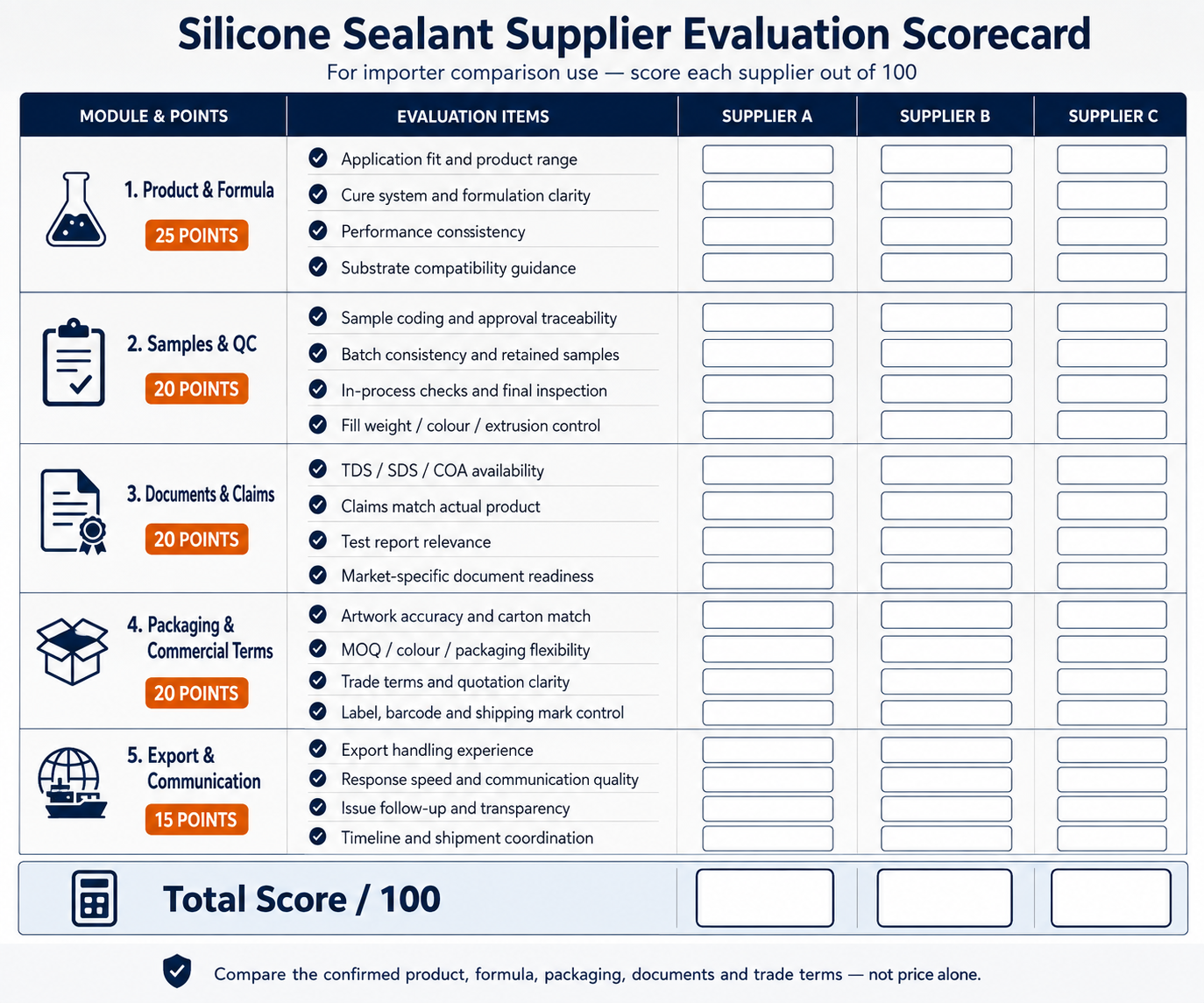
Silicone Sealant Supplier Evaluation Scorecard
Use this scorecard to compare shortlisted suppliers.
| Evaluation Category | Weight | Supplier Score |
|---|---|---|
| Application understanding | 10 | |
| Supplier-role transparency | 5 | |
| Formula identification | 10 | |
| Product-range clarity | 5 | |
| Sample quality | 10 | |
| Sample-to-bulk control | 15 | |
| Technical documents | 10 | |
| Performance-claim evidence | 10 | |
| Quality-control process | 10 | |
| OEM packaging capability | 5 | |
| Quotation clarity | 5 | |
| Export and logistics support | 3 | |
| Communication and problem solving | 2 | |
| Total | 100 |
Suggested Internal Interpretation
| Score | Interpretation |
|---|---|
| 85–100 | Strong candidate |
| 70–84 | Suitable after several confirmations |
| 50–69 | Additional verification required |
| Below 50 | High purchasing risk |
This scorecard is an internal purchasing tool, not an official certification system.
Information to Send Before Requesting a Supplier Evaluation or Quotation
A supplier can provide a more meaningful recommendation when the buyer sends complete information.
| Information | Example |
|---|---|
| Target application | Aluminium window perimeter sealing |
| Main substrates | Powder-coated aluminium and concrete |
| Target market | Bolívia |
| Cure system | Oxima neutra |
| Benchmark | Current local brand or approved reference |
| Volume líquido | 280ml |
| Cartridge | Standard 300ml body |
| Colours | Clear, white and black |
| Quantity | One 20GP container |
| Product mix | 70% neutral and 30% acetoxy |
| Embalagem | Private-label printed cartridge and carton |
| Idioma do rótulo | Spanish |
| Documentos | TDS, SDS and packaging specification |
| Trade term | FOB Shanghai or CIF named port |
| Destination | Named port and final delivery location |
| Special requirements | Barcode, importer information and pallet preference |
A complete enquiry reduces assumptions and makes supplier comparison more accurate.
Perguntas mais frequentes
Is a direct factory always better than an export supplier?
Not necessarily.
A direct factory may offer strong production control, while an export supplier or OEM partner may provide better product-range planning, communication, packaging and shipment coordination.
The better supplier is the one that can transparently control the confirmed product from sample to shipment.
Which documents should I request before placing an order?
For preliminary evaluation, request product information and available reference documents.
Before mass production, confirm that the final TDS and SDS correspond to the selected formulation. COA requirements and test reports should also be agreed where applicable.
How can I confirm that bulk production matches the sample?
Use an identified sample code, record the formula and colour, approve the sample in writing, confirm that the formula is locked, approve packaging separately and request retained production samples where practical.
Should I choose the supplier with the lowest price?
Only after confirming that the quotations use the same application, cure system, net content, formulation level, packaging, documents and trade term.
The lowest cartridge price may not provide the lowest landed cost or lowest cost in use.
Can one neutral silicone be used for all construction applications?
No single product should automatically be assumed suitable for every application.
General construction, windows, sanitary areas, natural stone, facade joints and fire-related uses can require different performance, testing and limitations.
What is a reasonable MOQ for private-label silicone sealant?
MOQ depends on the formulation, colour, cartridge printing method, label, carton design and production setup.
Ask for MOQ by each formula-colour-packaging combination rather than only one total-order MOQ.
Considerações finais
The right silicone sealant supplier is not necessarily the company with the largest factory, the longest catalog, the lowest quotation or the most certificates.
A reliable supplier should be able to connect:
- The target application
- A clearly identified formulation
- An approved sample
- Matching technical documents
- Controlled filling and quality inspection
- Accurate OEM packaging
- Clear commercial terms
- Export-ready shipment preparation
Importers should evaluate not only what a supplier promises before the order, but also how those promises will be recorded, verified and maintained during production.
BoPin supports importers, distributors and private-label buyers with silicone formula selection, sample validation, packaging coordination, document alignment and export preparation. Final product specifications, packaging claims and technical documents are confirmed according to the selected formulation and manufacturing partner.