Silicone sealant prices can vary significantly, even when two products are supplied in the same size cartridge and appear to serve a similar application.
For importers and distributors, this often creates a difficult question:
Are you comparing genuinely equivalent sealants—or only comparing two cartridge prices?
The price of sellador de silicona is affected by more than the cost of the material inside the cartridge. Cure chemistry, formulation, density, fill volume, performance level, colour, packaging, order structure, technical documentation and shipping terms can all change the final quotation.
A lower unit price may be suitable for a basic hardware-store product. It may not be suitable for aluminium windows, exterior joints, sanitary areas, natural stone or facade applications.
This guide explains how silicone sealant pricing works and shows importers how to compare quotations on a like-for-like basis.
The Quick Answer: 12 Factors That Affect Silicone Sealant Price
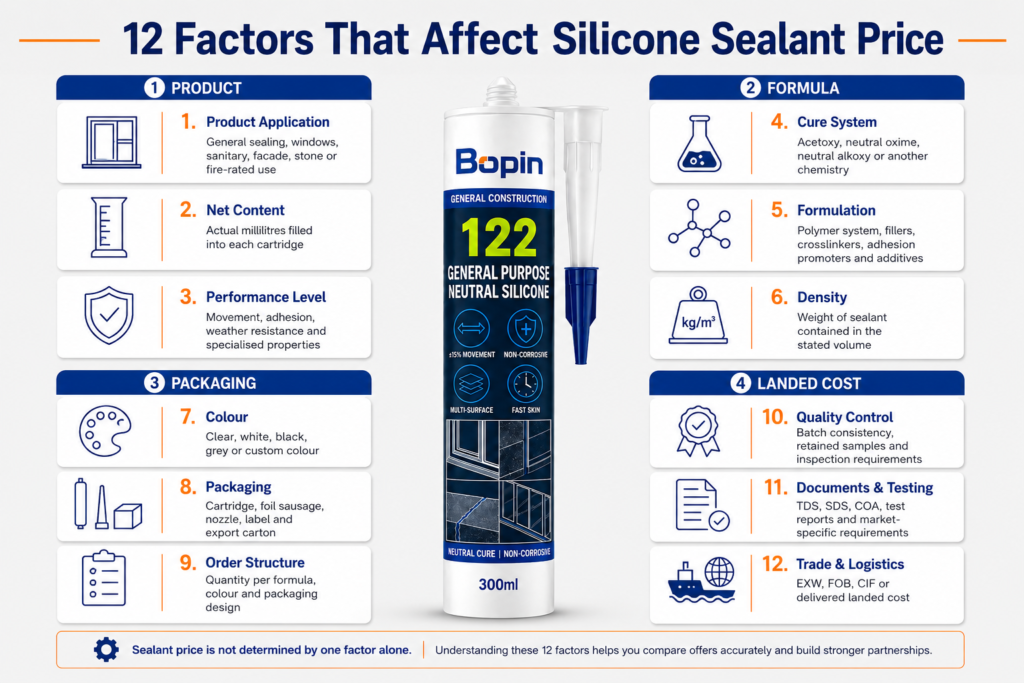
The main cost drivers are:
| Price Factor | What Buyers Should Compare |
|---|---|
| Product application | General sealing, windows, sanitary, facade, stone or fire-retardant use |
| Cure system | Acetoxy, neutral oxime, neutral alkoxy or another chemistry |
| Formulation | Polymer system, fillers, crosslinkers, adhesion promoters and additives |
| Net content | Actual millilitres filled into each cartridge |
| Densidad | Weight of sealant contained in the stated volume |
| Performance level | Movement, adhesion, weather resistance and specialised properties |
| Color | Clear, white, black, grey or custom colour |
| Embalaje | Cartridge, foil sausage, nozzle, label and export carton |
| Order structure | Quantity per formula, colour and packaging design |
| Control de calidad | Batch consistency, retained samples and inspection requirements |
| Documents and testing | TDS, SDS, COA, test reports and market-specific requirements |
| Trade and logistics | EXW, FOB, CIF or delivered landed cost |
A reliable quotation should make these items clear. Without them, two prices may look comparable while representing very different products.
1. Start with the Application, Not the Cartridge Price
The first question should not be:
How much is one cartridge?
The first question should be:
What application is this formulation designed for?
Products sold as “silicone sealant” may have very different intended uses.
| Product Positioning | Aplicación típica | Important Selection Factors |
|---|---|---|
| All-purpose acetoxy silicone | Glass, glazed ceramic and general sealing | Fast cure, glass adhesion, substrate limitations |
| General neutral silicone | Mixed construction substrates | Non-corrosive cure and broad compatibility |
| Window and door silicone | Frame perimeter joints | Weather resistance and joint movement |
| Sanitary silicone | Kitchens and bathrooms | Mould resistance and wet-area compatibility |
| Facade silicone | Exterior building-envelope joints | Movement capability, UV resistance and non-sag behaviour |
| Natural stone silicone | Marble, granite and decorative stone | Staining and compatibility testing |
| Fire-retardant silicone | Selected flame-retardant sealing applications | Verified test method and scope of claim |
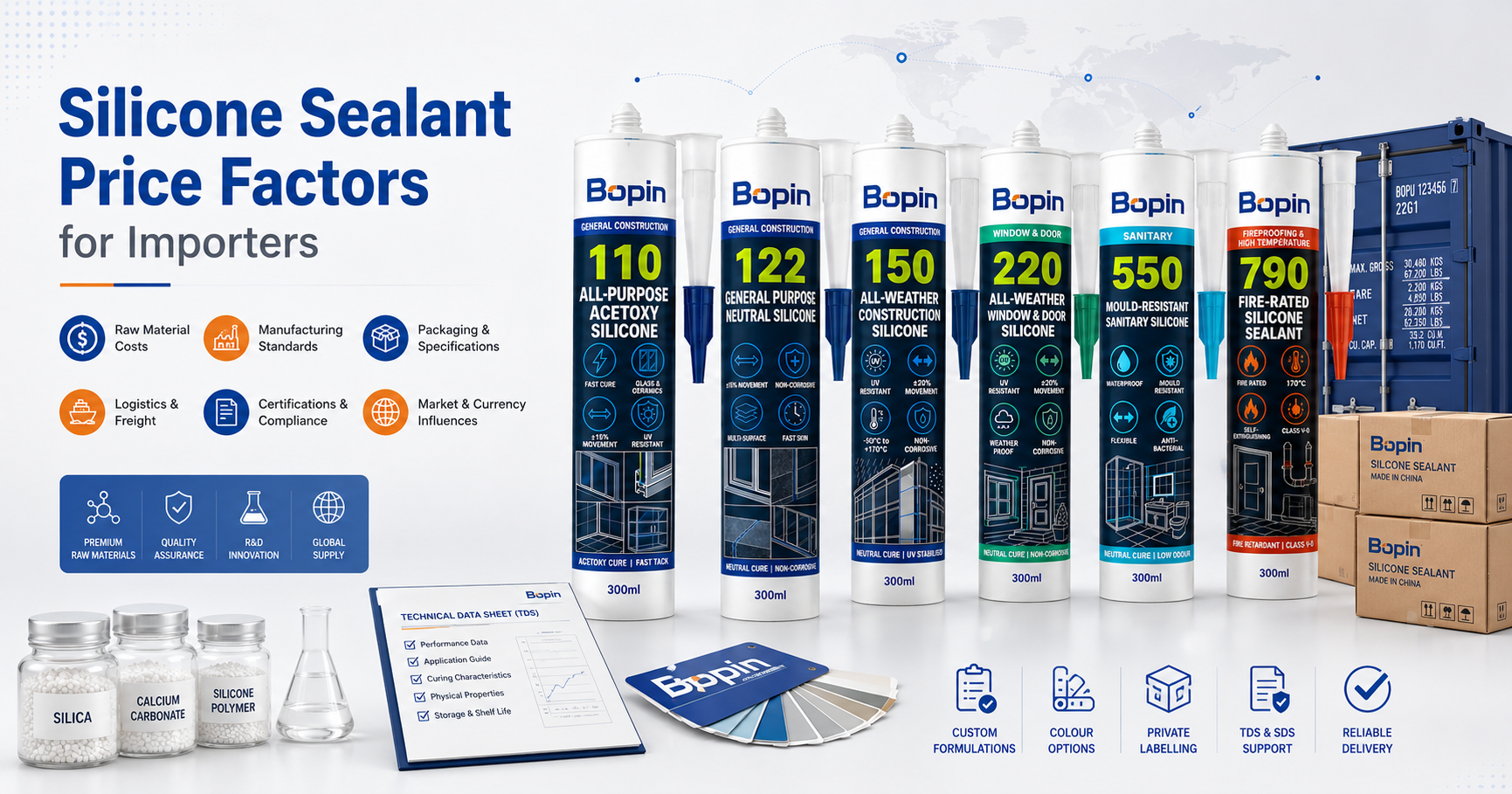
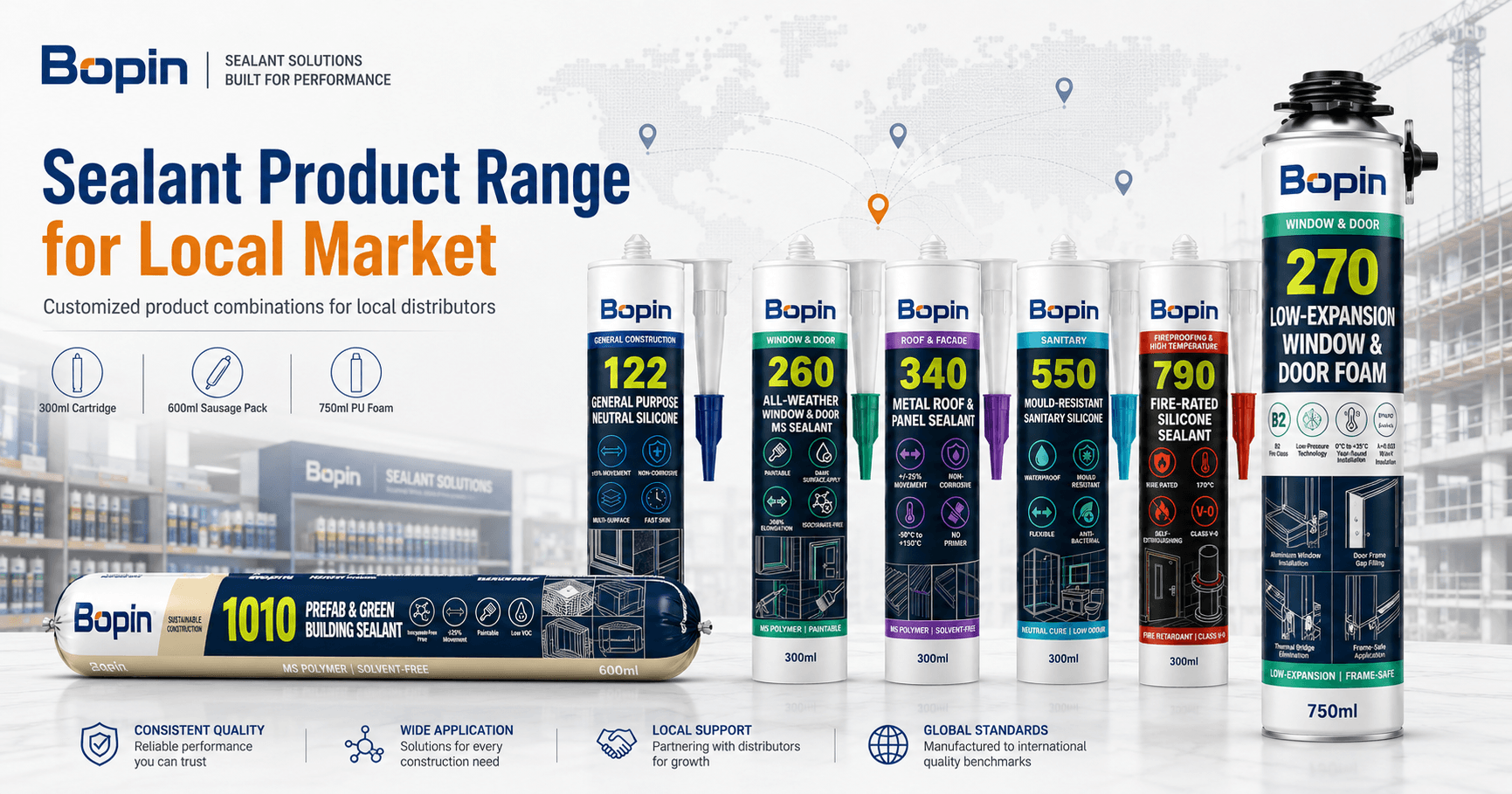
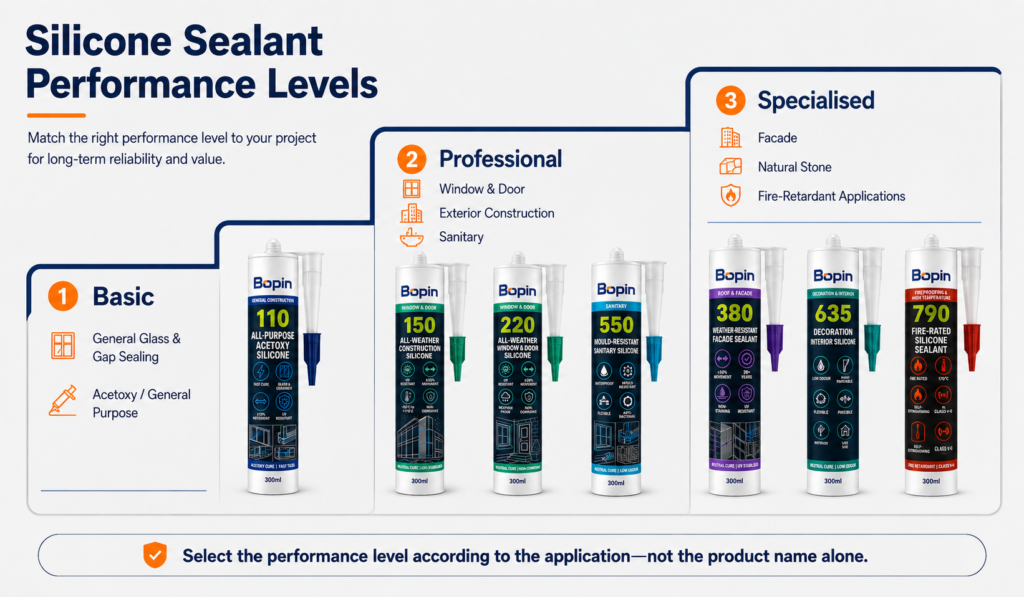
For example, BoPin’s current silicone range positions BoPin 110 as an acetoxy product for glass and general sealing, BoPin 122 as a general neutral silicone, BoPin 150 as a more weather-resistant neutral option, and BoPin 550 as a sanitary extension. The products are not differentiated only by name; they serve different applications and price segments.
Two products with the same 300ml cartridge size are not equivalent if one is intended for basic glazing and the other for high-movement facade joints.
2. Cure System Changes Both Cost and Application Range
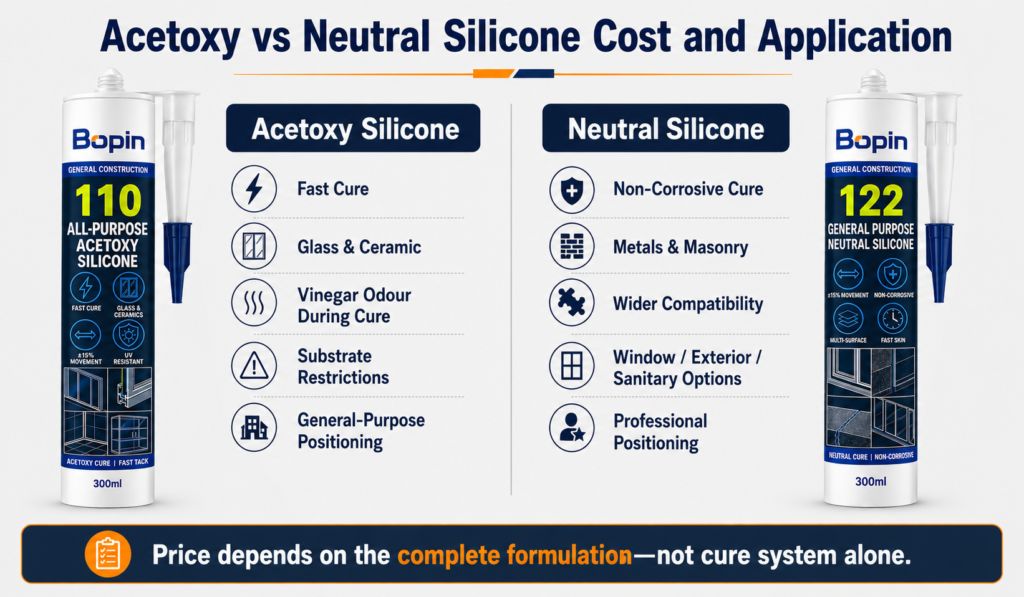
The curing system affects raw-material selection, application suitability, odour, corrosion risk and product positioning.
Acetoxy-Cure Silicone
Acetoxy silicone releases acetic-acid by-products during curing. It is commonly selected for glass, glazed ceramic and other compatible non-porous surfaces.
Its advantages can include:
- Formación rápida de piel
- Good adhesion to glass
- Simple general-purpose positioning
- Competitive cost for suitable applications
However, it may not be appropriate for mirrors, natural stone, copper, brass, zinc or other acid-sensitive substrates.
BoPin 110, for example, is positioned as a fast-curing acetoxy silicone for glass, glazed ceramic and general sealing, with explicit limitations for natural stone, mirror backing and acid-sensitive metals.
Neutral-Cure Silicone
Neutral silicone is generally selected where non-corrosive curing and broader substrate compatibility are required.
Typical applications include:
- Aluminium window frames
- Powder-coated metals
- Concrete and masonry joints
- Exterior construction joints
- Sanitary applications
- Facade weatherproofing
In many OEM ranges, a basic acetoxy formula is positioned below a professional neutral formula. However, cure system alone does not determine the price. A high-volume neutral product may still be more competitively priced than a specialised acetoxy product.
Specialised Neutral Formulations
Sanitary, stone-compatible, facade and fire-retardant products may use additional formulation controls or performance additives.
These products should be priced against the actual application requirement—not against basic general-purpose silicone.
3. The Complete Formula Matters More Than a “Silicone Content” Claim
Buyers sometimes ask for the “silicone percentage” as a simple measure of quality.
In practice, a sealant formulation is more complex.
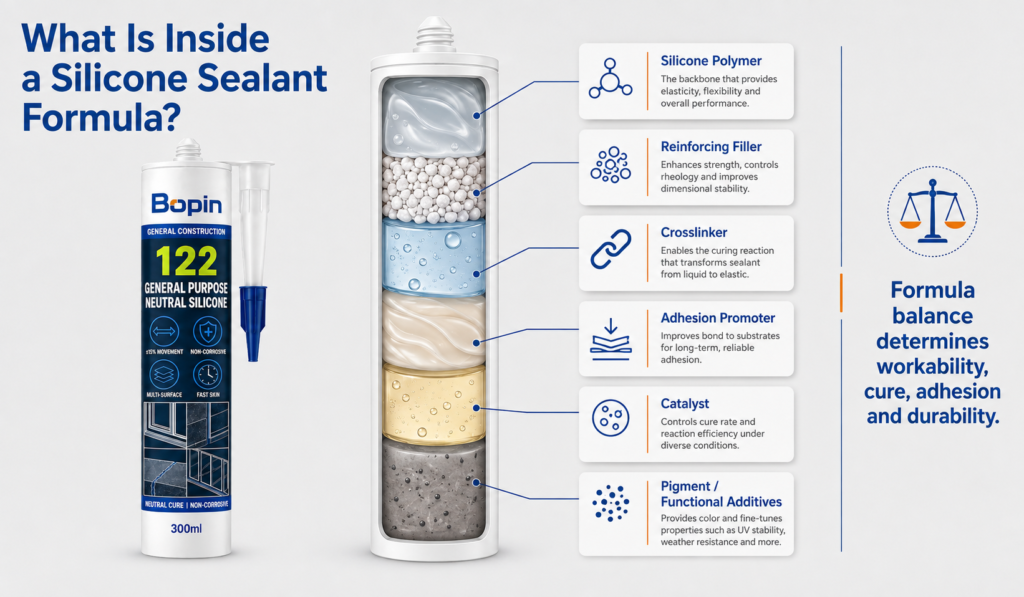
A typical neutral sanitary silicone formulation may contain:
- Silicone polymer
- Silicone fluid or plasticising component
- Reinforcing or rheology-control fillers
- Crosslinking silanes
- Adhesion promoters
- Catalyst
- Pigments
- Mould-resistant additives where required
For example, the available SMT-555 safety document identifies hydroxyl-terminated polydimethylsiloxane, silicone oil, fumed silica, oxime silanes, adhesion-promoting silanes and a catalyst among its formulation components.
The performance and cost depend on how these components work together.
A lower-priced formulation may use a different balance of polymer, filler and processing aids. However, buyers should avoid assuming that every heavier, lighter, softer or harder product automatically contains “more” or “less” silicone.
The practical questions are:
- Does it extrude smoothly?
- Does it cure consistently?
- Does it bond to the required substrates?
- Does it meet the required movement and weathering level?
- Is the batch consistent?
- Is the formulation supported by appropriate documents?
A vague claim such as “100% silicone” does not replace a product specification or sample test.
4. Net Volume, Density and Fill Weight Must Be Compared Together
Density is one of the most misunderstood price factors.
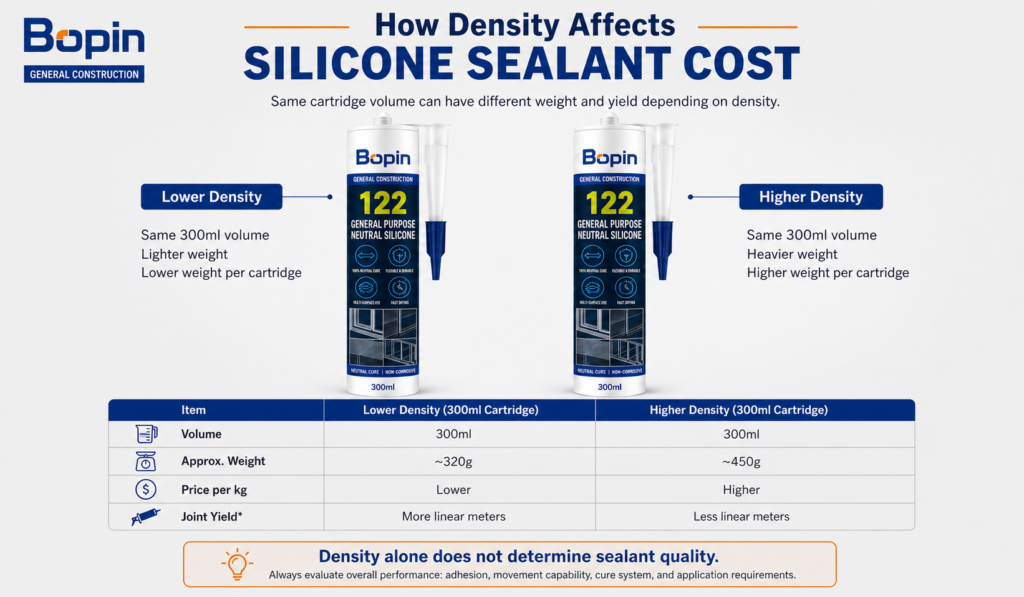
A cartridge is sold by volume—such as 280ml or 300ml—but the amount of material by weight depends on density.
The relationship is approximately:
Fill weight = volume × density
Por ejemplo:
| Cartridge Volume | Formula Density | Approximate Fill Weight |
|---|---|---|
| 300ml | 0.96g/cm³ | 288g |
| 300ml | 1.00g/cm³ | 300g |
| 300ml | 1.40g/cm³ | 420g |
Supplier reference data shows that densities can differ materially between formulations: one acetoxy candidate is listed at approximately 0.96g/cm³, while a high-performance weatherproof candidate is listed at approximately 1.40g/cm³. These are different products and should not be treated as quality equivalents.
This leads to three important conclusions.
Density Is Not a Quality Score
A lower-density product is not automatically better. A higher-density product is not automatically lower quality.
Density must be interpreted together with:
- Formula type
- Color
- Filler system
- Mechanical properties
- Aplicación
- Extrusion performance
- Price basis
Price per Cartridge Is Not Price per Kilogram
Two 300ml cartridges may contain very different fill weights.
A heavier cartridge may use more kilograms of material, but that does not prove that its cost per application is higher or lower.
Price per Kilogram Is Not the Final Answer Either
Contractors usually apply sealant by joint volume, not by kilogram.
A fair comparison may therefore include:
- Price per cartridge
- Price per litre
- Price per kilogram
- Metres of joint per cartridge
- Bead consistency
- Material waste
- Required joint dimensions
5. Performance Level Creates Different Price Tiers
A sealant designed for a low-movement interior joint does not require the same formulation or validation as one intended for an exterior facade.
Relevant performance factors may include:
- Capacidad de movimiento
- Tensile behaviour
- Elongation
- Modulus
- Recuperación elástica
- Sag resistance
- Adhesion after water exposure
- Heat-ageing resistance
- UV and weathering resistance
- Mould resistance
- Stone-staining behaviour
- Flame-retardant performance
BoPin’s current reference range illustrates this progression:
| Product | Posicionamiento | Reference Movement |
|---|---|---|
| BoPin 110 | General acetoxy sealing | ±15% |
| BoPin 122 | General neutral construction | ±15% |
| BoPin 150 | Weather-resistant construction | ±20% |
| BoPin 220 | Window and door perimeter sealing | ±20% |
| BoPin 380 | Facade weatherproofing | Up to ±30% reference positioning |
| BoPin 550 | Sanitary sealing | ±20% supplier reference |
These values must still correspond to the final selected formulation and supporting documents. The BoPin publishing framework specifically warns against presenting preliminary product information as a final TDS or guaranteed shipment specification.
The SMT-555 sanitary reference also includes mould-resistance grade 0, ±20% movement capability and multiple adhesion-related test items under its stated standard.
Specialised performance can raise cost through:
- More demanding formulation requirements
- More controlled raw-material selection
- Additional testing
- Lower production volume
- More complex quality control
- Greater documentation requirements
However, buyers should pay only for performance they actually need. A high-movement facade formulation may be unnecessary for a basic interior glass joint.
6. Colour Can Change Cost—but There Is No Universal Price Order
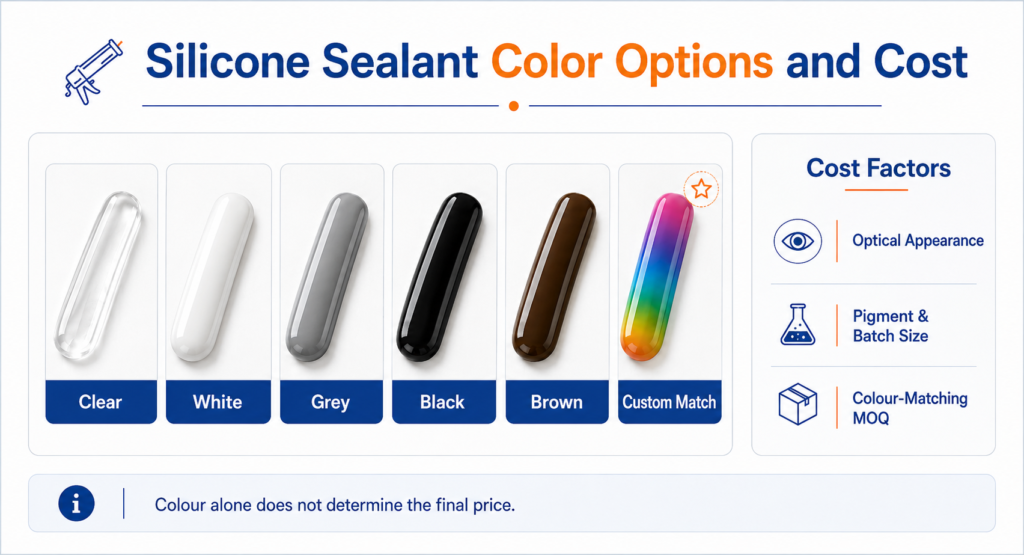
Common silicone colours include:
- Claro
- Blanco
- Negro
- Gris
- Marrón
- Custom-matched colours
Colour can affect price through several mechanisms.
Silicona transparente
A clear product may require controlled optical appearance and good raw-material consistency. However, clear silicone is not automatically the most expensive product in every formulation or market.
White, Black and Grey
Standard colours may benefit from larger production volumes and established pigment systems. Their density and filling weight may differ from clear versions.
Custom Colours
Custom matching may add:
- Colour-development work
- Pigment cost
- Trial batches
- Approval samples
- Production-line cleaning
- Separate packaging identification
- Higher MOQ per colour
The main pricing question is therefore not:
Which colour is always cheaper?
It is:
What is the MOQ, formulation and production requirement for each colour?
For an OEM range containing clear, white and black, each colour should be quoted separately when its formula, fill weight or MOQ differs.
7. Packaging Can Represent a Meaningful Part of an OEM Quotation
For private-label projects, buyers are not paying only for sealant.
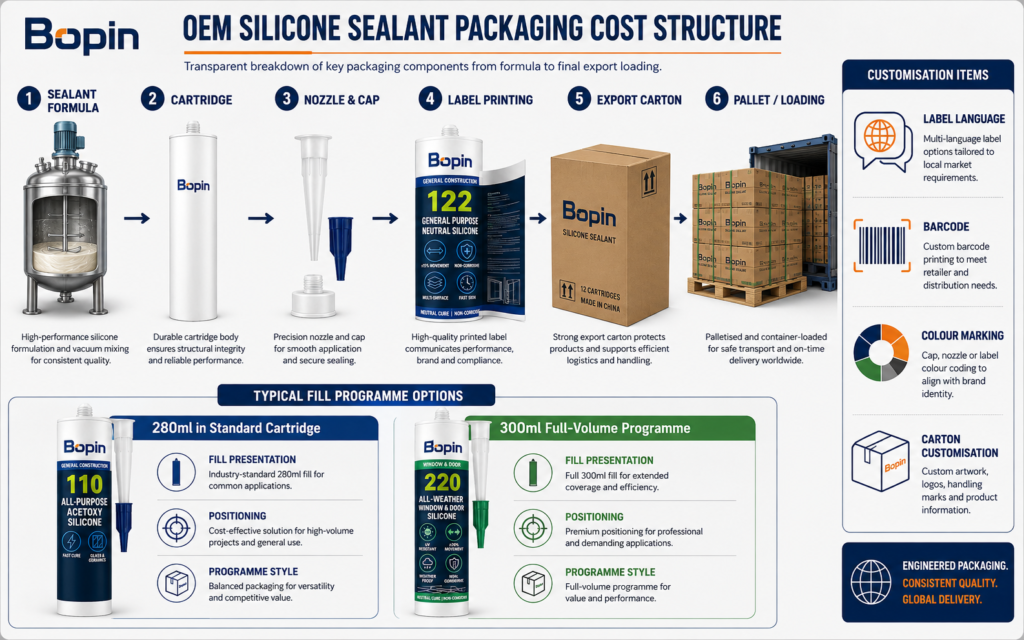
The quotation may also include:
- Plastic cartridge
- Piston
- Nozzle and cap
- Printed label or printed cartridge
- Product-colour identification
- Barcode
- Batch and production-date area
- Export carton
- Carton printing
- Dividers
- Pallet or non-pallet packing
- Artwork preparation
- Printing plates or cylinders
- Packaging samples
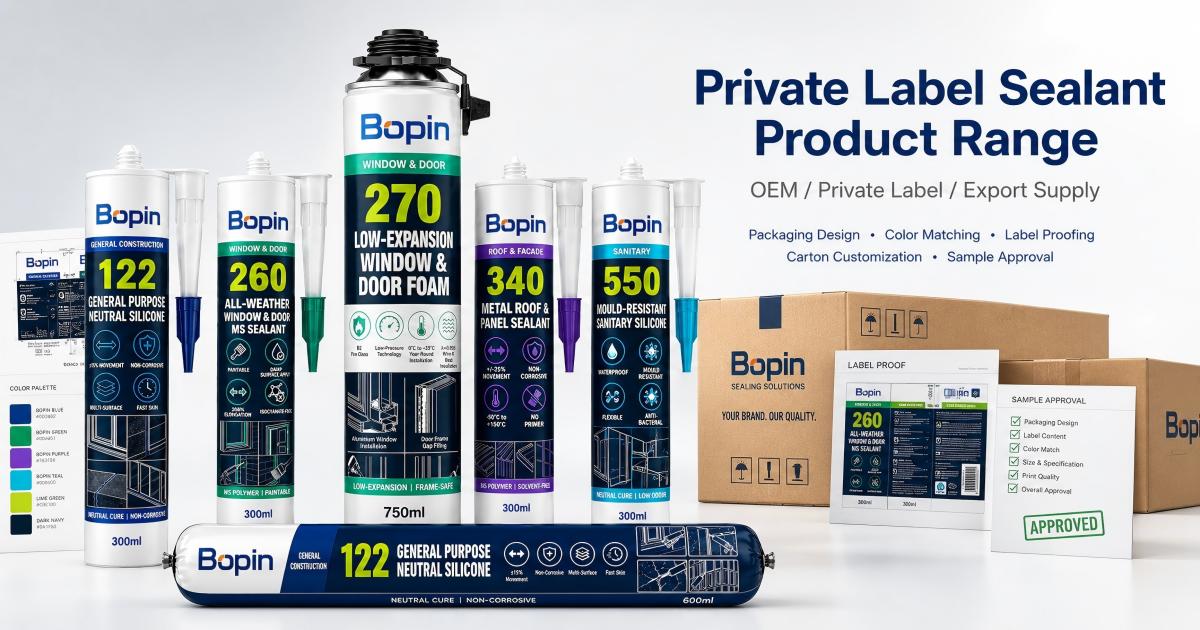
BoPin’s OEM programme currently discusses both 280ml and 300ml cartridge options, together with custom label language, barcode and export-carton design. Final packaging and documentation are aligned with the confirmed formulation and manufacturing partner.
280ml in a 300ml Cartridge
Some markets use a standard 300ml cartridge body filled to 280ml.
This should be stated clearly in the quotation and label. Buyers should confirm:
- Declared net content
- Actual filling tolerance
- Cartridge dimensions
- Gross weight
- Carton quantity
- Container loading quantity
Printed Cartridge vs Applied Label
Direct printing may provide a more integrated appearance but can involve higher setup requirements.
Applied labels may offer more flexibility for smaller runs or multiple languages.
Neither option is universally cheaper. The result depends on quantity, supplier setup and artwork complexity.
Cartridge vs Sausage Pack
Sausage packs may reduce packaging material per litre and suit professional contractors. However, they require different filling equipment, cartons and application guns.
The package should match the sales channel—not only the lowest packing cost.
8. MOQ Is Usually Calculated by Formula, Colour and Packaging Combination
An importer may say:
I want 10,000 cartridges.
But the factory may see:
- Two formulas
- Three colours
- Two label languages
- Two carton designs
That is not one production item. It may be twelve separate SKU combinations.
Every additional combination can create:
- Raw-material preparation
- Colour changeover
- Filling-line cleaning
- Label setup
- Carton setup
- Separate batch control
- Warehouse complexity
- Higher risk of leftover packaging
This is why a focused range usually receives better cost efficiency than a fragmented first order.
For example, a two-product starter range with clear, white and black may be more economical than launching six specialised products in several colours at low quantities.
BoPin’s OEM catalogue similarly recommends starting with a compact range and expanding into sanitary or application-specific products after the core formulas are established.
A Better Way to Request a Quote
Instead of asking only for a total quantity, provide a SKU allocation:
| Formula | Color | Volume | Quantity | Embalaje |
|---|---|---|---|---|
| Acetoxy | Claro | 280ml | 8,000 pcs | Private label |
| Acetoxy | Blanco | 280ml | 2,000 pcs | Private label |
| Neutral | Claro | 280ml | 12,000 pcs | Private label |
| Neutral | Blanco | 280ml | 8,000 pcs | Private label |
This allows the supplier to calculate production and packaging costs more accurately.
9. Quality-Control Requirements Influence the Real Supply Cost
Two factories may quote similar formulations but offer different levels of process control.
Buyers should ask what is checked before shipment.
Relevant controls may include:
- Raw-material batch identification
- Filling-weight inspection
- Appearance and colour check
- Extrusion test
- Skin-time check
- Sag observation
- Adhesion screening
- Packaging inspection
- Batch coding
- Retained samples
- Pre-shipment inspection
A more controlled programme may cost more than a basic price-led programme, but it can reduce:
- Underfilled cartridges
- Colour inconsistency
- Blocked nozzles
- Weak packaging
- Batch-to-batch variation
- Customer complaints
- Replacement costs
For private-label brands, consistency is often more important than achieving the lowest possible price in one shipment.
The right question is:
What quality controls are included in this quotation, and which tests are available only as additional requirements?
10. Technical Documents and Test Claims Have a Cost and a Scope
Buyers commonly request:
- Product Information Sheet
- Technical Data Sheet
- Safety Data Sheet
- Certificate of Analysis
- Test report
- Fire or mould-resistance report
- VOC information
- Certificate or declaration for a target market
These documents are not interchangeable.
Product Information Sheet
Useful for preliminary selection and marketing discussion.
TDS
Describes the technical properties and application limitations of a confirmed formulation.
SDS
Explains composition categories, hazards, handling, storage, transport and emergency measures.
COA
Usually records agreed batch-specific inspection results.
Third-Party Test Report
Supports a defined test method, specimen, result and scope. It does not automatically certify every future formulation or every construction system.
BoPin’s current publishing framework requires final TDS, SDS and test documents to be confirmed according to the selected supplier, formulation, packaging, destination market and order requirements. It also advises against unsupported claims such as “certified,” “code compliant,” “EI-rated,” or “permanent waterproofing.”
For elastomeric building joint sealants, ASTM C920 covers properties of cured single- and multi-component sealants used in building sealing, caulking and glazing applications. ISO 11600 provides classification and requirements for building-construction sealants. These standards are useful references only when the tested formulation and report actually apply to the product being supplied.
Important Fire-Performance Distinction
A material-level flame-retardant result should not automatically be marketed as a complete firestop system.
UL 94 relates to flammability testing of plastic materials for parts in devices and appliances. It is not, by itself, proof of an EI-rated construction joint or penetration-sealing system.
When comparing fire-related quotations, ask:
- What exact standard was used?
- What product or specimen was tested?
- Is the report material-level or system-level?
- Does it apply to the offered formulation?
- Does it apply to the intended joint design?
11. Commercial Terms Can Make the Same Product Look Cheaper or More Expensive
A quoted price is incomplete without a trade term.
Common terms include:
| Trade Term | Usually Includes |
|---|---|
| EXW | Product available at the factory |
| FOB | Product and agreed origin-port export handling |
| CFR / CIF | Ocean freight, with insurance included under CIF |
| DAP / DDP | Delivery closer to the buyer, with responsibilities depending on the agreed term |
Buyers should also confirm:
- Currency
- Exchange-rate validity
- Condiciones de pago
- Export packing
- Inland transport
- Customs declaration
- Port charges
- Ocean or air freight
- Insurance
- Destination charges
- Import duties
- Local tax
- Final delivery
A factory may appear USD0.05 cheaper per cartridge but become more expensive after local transport, container loading or destination charges are included.
For an accurate comparison, every supplier should quote against the same:
- Product specification
- Embalaje
- Quantity
- Destination
- Trade term
- Payment condition
- Quotation-validity period
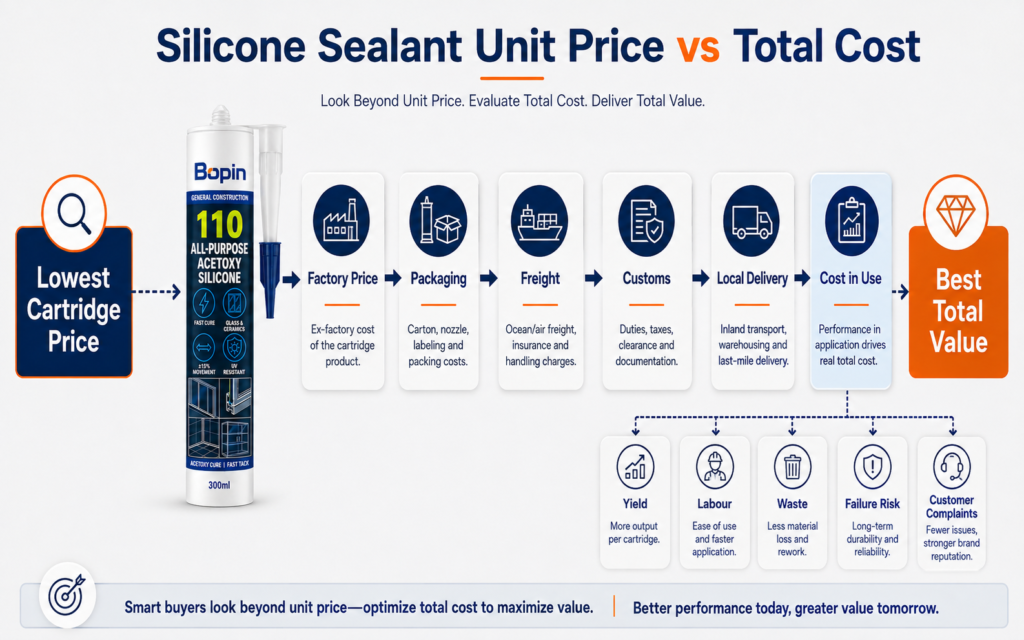
12. The Lowest Unit Price May Not Produce the Lowest Cost in Use
The final buying decision should consider total cost—not only unit price.
Total Landed Cost
This includes:
- Product
- Embalaje
- Origin charges
- Freight
- Insurance
- Destination handling
- Duties
- Tax
- Local delivery
Cost in Use
This can include:
- Metres of joint obtained per cartridge
- Ease of extrusion
- Material waste
- Tiempo de curado
- Labour efficiency
- Fallo de adhesión
- Rework
- Returned goods
- Brand complaints
For example, a cheaper sealant that is difficult to extrude may slow installers and increase waste. A sealant with poor substrate compatibility may create a much larger replacement cost than the original price difference.
The best-value product is therefore the one that meets the required application at a controlled and repeatable total cost.
How to Compare Silicone Sealant Quotations Properly
Use one comparison sheet for every supplier.
| Comparison Item | Supplier A | Supplier B | Supplier C |
|---|---|---|---|
| Intended application | |||
| Cure system | |||
| Final supplier model | |||
| Net content | |||
| Densidad | |||
| Approximate fill weight | |||
| Color | |||
| Skin time | |||
| Capacidad de movimiento | |||
| Key substrate compatibility | |||
| Packaging format | |||
| Units per carton | |||
| MOQ per formula | |||
| MOQ per colour | |||
| TDS and SDS status | |||
| Test reports included | |||
| Production lead time | |||
| Trade term | |||
| Freight included | |||
| Estimated landed cost | |||
| Sample test result |
A supplier should not be marked “cheaper” until the important rows are comparable.
Warning Signs in an Extremely Low Silicone Sealant Quotation
A low quotation is not automatically a problem. It should simply be investigated carefully.
Check whether:
- The quoted volume is 260ml, 280ml or 300ml.
- The price applies only to one colour.
- The quotation is for acetoxy rather than neutral silicone.
- Private-label packaging is excluded.
- The density or fill weight is different.
- The technical values come from another product.
- TDS, SDS and test reports are unavailable.
- The product is being described as facade, stone-safe or fire-rated without supporting documents.
- Cartons, pallets or origin charges are excluded.
- The quotation is based on an unrealistic MOQ or temporary freight assumption.
The correct response is not to reject the price immediately. It is to request a complete specification.
Information to Send When Requesting a Silicone Sealant Quotation
A professional enquiry should contain:
| Required Information | Example |
|---|---|
| Target application | Aluminium window perimeter sealing |
| Cure system | Curado neutro |
| Target market | Chile / Bolivia |
| Benchmark product | Current local brand or tested sample |
| Net content | 280ml |
| Cartridge format | Standard 300ml cartridge |
| Bandera | Clear, white and black |
| Quantity | 1 × 20GP |
| Product mix | 70% neutral / 30% acetoxy |
| Branding | Private label |
| Documents | TDS, SDS and packaging specification |
| Destination | Named port |
| Trade term | FOB or CIF |
| Special requirements | Barcode, Spanish label, pallet preference |
The more complete the enquiry, the more meaningful the quotation will be.
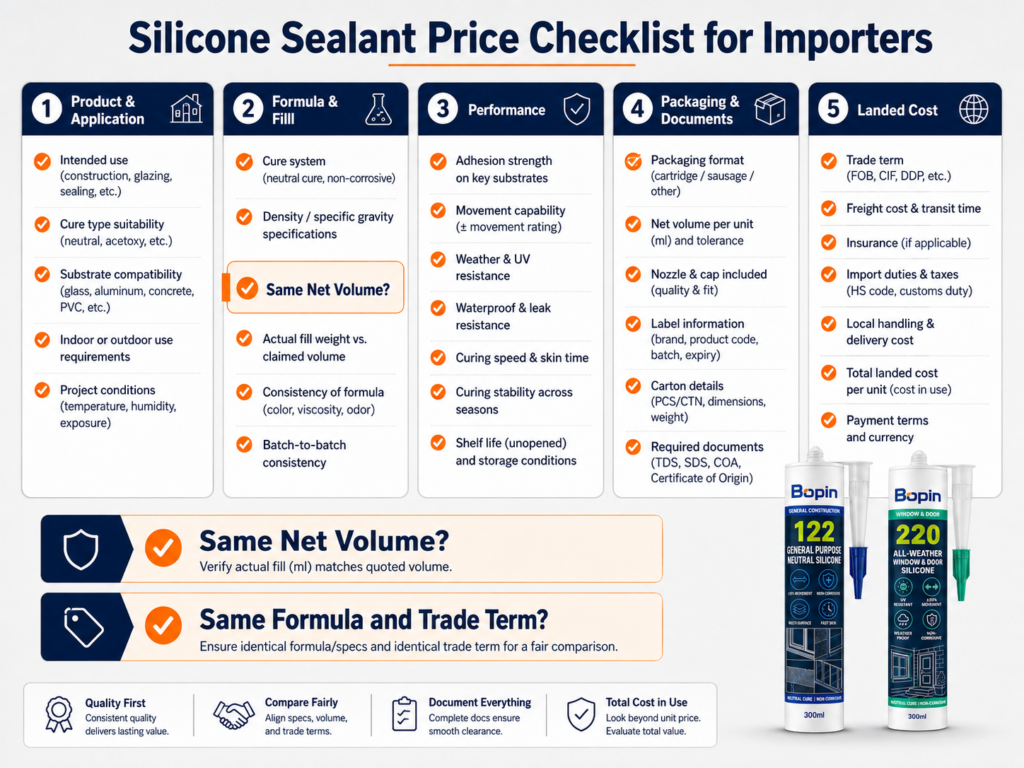
Final Silicone Sealant Price Checklist
Before accepting a quotation, confirm:
Product
- Aplicación
- Cure system
- Final formula or supplier model
- Color
- Net volume
- Density and approximate fill weight
Performance
- Required movement level
- Compatibilidad del sustrato
- Exterior or interior use
- Special sanitary, stone or fire-related requirements
- Sample-test result
Embalaje
- Cartridge or sausage format
- Label or direct printing
- Nozzle and cap
- Units per carton
- Carton dimensions and gross weight
- Pallet and loading arrangement
Documents
- Product Information Sheet
- Final TDS
- Final SDS
- COA requirements
- Applicable test reports
- Market-specific documentation
Commercial Cost
- MOQ by formula
- MOQ by colour
- Lead time
- Condiciones de pago
- Trade term
- Freight
- Destination charges
- Estimated landed cost
Final Thoughts
Silicone sealant price is determined by a combination of product design, manufacturing and supply-chain factors.
The most important variables are not only raw-material cost. Buyers must also compare:
- Aplicación
- Cure system
- Formula
- Net volume
- Densidad
- Performance
- Color
- Embalaje
- MOQ
- Control de calidad
- Documents
- Trade terms
- Landed cost
The lowest cartridge price can be suitable for a basic, price-led product range. It should not be compared directly with a professional window, sanitary, stone or facade formulation without checking the specification.
A professional buyer does not ask only:
What is your lowest price?
A better question is:
What product, packaging, performance and documentation are included in this price?
BoPin supports importers and distributors with formula selection, private-label packaging, sample validation and export quotation coordination. Final technical documentation and product specifications are aligned with the confirmed formulation and manufacturing partner.