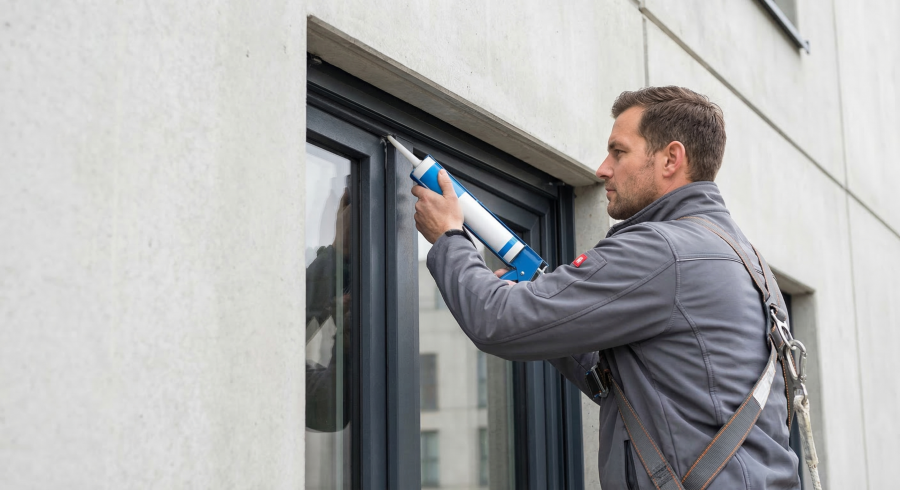
The window is installed. The frame is level. The hardware functions perfectly.
Now comes the step that most directly determines whether that installation performs for 5 years or 25 years: sealing the perimeter joint between the frame and the building structure.
This joint has to do several things simultaneously. It must block water. It must block air. It must accommodate the continuous movement caused by thermal expansion, structural settlement and wind load — without cracking, debonding or losing elasticity. And it must do all of this while remaining visually clean and, in many cases, paintable.
The right sealant makes this straightforward. The wrong one creates callbacks, leaks and warranty disputes.
This guide is written for installation contractors, window fabricators, facade engineers and procurement managers who need to specify and apply perimeter sealants correctly — the first time. It covers sealant selection for every window and door scenario, joint design principles, application technique, and common failure modes to avoid.
1. Why Window and Door Perimeter Sealing Fails
Most window leaks are not caused by the window. They are caused by the sealant joint around it.
Understanding the failure mechanisms helps you avoid them at specification stage.
Thermal Movement: The Primary Cause of Joint Failure
Every window frame moves. The thermal expansion coefficient of aluminium is approximately 23 µm/m·K. A 3-metre aluminium frame experiencing a 60°C temperature range — common in the Gulf, Central Asia and parts of Southeast Asia — moves roughly 4mm across its length.
Multiply that by a typical perimeter joint and you are dealing with cyclic movement of ±1–2mm on every joint, every day, for decades. A sealant that cannot absorb this movement will fatigue and crack. Once the crack propagates, water and air infiltration follow.
This is why the movement capability rating of a sealant — expressed as a percentage of joint width — is the single most important parameter for window and door sealing. A product rated ±25% on a 10mm joint can accommodate 2.5mm of movement. A product rated ±12.5% on the same joint can only handle 1.25mm. The difference is the difference between a 20-year service life and premature failure.
Adhesion Failure: The Wrong Sealant for the Substrate
Window installations involve multiple substrate combinations: aluminium frame against concrete masonry, PVC frame against brick, timber frame against render, UPVC against stone cladding. Not all sealants adhere reliably to all of these without primer.
Acetoxy-cure silicones — identifiable by their acetic acid (vinegar) odour during cure — have limited adhesion to many construction substrates and are corrosive to uncoated metals. They are not suitable for professional window installation, despite their wide availability at retail.
Neutral-cure silicones and MS polymer sealants bond reliably to the substrate combinations found in window and door installation, in most cases without primer. This reduces both installation time and potential adhesion failures caused by improper priming.
Incorrect Joint Geometry: Three-Sided Adhesion
One of the most common professional errors in perimeter sealing is allowing the sealant to bond to three surfaces simultaneously: the frame face, the substrate face, and the back of the joint cavity. This is called three-sided adhesion.
When the joint moves, a three-sided adhesion condition prevents the sealant from stretching freely. The result is cohesive tearing — the sealant splits down the centre of the bead rather than remaining bonded to both surfaces. The joint fails.
The fix is simple: always install a closed-cell polyethylene foam backing rod before applying sealant in any joint deeper than the target sealant depth. The backing rod physically prevents sealant from bonding to the back of the cavity. For joints where a backing rod cannot be inserted, apply bond-breaker tape to the back surface before sealanting.
Using the Wrong Sealant Type for the Exposure Conditions
Not all neutral silicones are equal. A standard general-purpose neutral silicone (Shore A hardness 20, movement capability ±25%) is appropriate for most internal and moderate-exposure perimeter joints. But for exposed south-facing facades in desert climates, for joints on curtain wall systems, or for high-movement joints on large-format aluminium panels, it is not sufficient.
Matching the sealant specification to the actual exposure conditions — UV level, temperature range, joint dimensions, substrate materials — is the foundation of professional specification practice.
2. Sealant Types for Window and Door Applications: A Technical Overview
Choosing the right chemistry starts with understanding what each type can and cannot do.

Neutral-Cure Silicone: The Standard Choice
Neutral-cure silicone is the professional standard for window and door perimeter sealing worldwide. It cures through moisture reaction without releasing acidic or corrosive by-products, making it safe for use on anodised aluminium, powder-coated steel, sensitive stone cladding and other substrates that acetoxy products would attack.
Key technical characteristics for window applications:
- Movement capability: ±25% to ±50% (product-dependent)
- Temperature resistance: -40°C to +120°C or better
- VOC content: typically <40 g/L — compliant with LEED and BREEAM low-emitting materials requirements
- Shore A hardness: 20–30 (softer formulations accommodate movement more effectively)
- Skin formation time: 10–25 minutes
The practical limitation of silicone for some window applications is paintability. Standard silicone sealants do not accept paint, which is a problem for interior jamb joints and trim situations where paint coverage is required for a finished appearance.
High-Movement Neutral Silicone: For Facade and Large-Format Applications
For joints on curtain wall systems, large aluminium composite panel (ACP) facades, or any application involving panels with high thermal expansion, a standard ±25% product is frequently undersized. High-movement silicone sealants — rated ±50% — provide double the movement accommodation.
These products typically carry ISO 11600 classification F 25HM (facade, ±25% high modulus) or equivalent, and are tested to ASTM C920 Type S, Grade NS, Class 50.
The trade-off is that higher-movement silicones are formulated to be softer and more elastic, which means they are more susceptible to dirt pick-up on exposed horizontal surfaces. For vertical facade joints, this is generally not a practical concern.
MS Polymer: The Paintable Professional Alternative
MS polymer sealants (Modified Silane / Silyl-Modified Polymer) are increasingly specified for window and door applications where paintability is a requirement — interior finishes, timber window installations in residential construction, or renovation projects where sealant joints will receive decorative paint.
MS polymers offer adhesion to PVC, aluminium, wood, concrete, brick and render — typically without primer. Their application temperature range is broader than standard silicone (typically -5°C to +40°C versus +5°C to +40°C), which provides practical advantages for winter installation in colder climates.
The chemistry is isocyanate-free and solvent-free, making MS polymer sealants a strong choice for projects with material health requirements under BREEAM, HQE or similar frameworks.
The limitation relative to silicone is temperature resistance. MS polymers are typically rated to +90°C versus +120°C or more for silicone. For direct-sun-exposed joints in hot climates (Gulf region, sub-Saharan Africa), neutral silicone remains the more appropriate chemistry.
Acrylic: For Interior Decorative Finishing Only
Water-based acrylic sealants are appropriate for one specific window and door application: interior decorative trim joints where the primary requirement is paintability and the joint carries no structural or weather-sealing function.
Around interior door casings, window architraves and decorative mouldings, acrylic is the correct choice. It accepts paint immediately after application, has near-zero VOC content, and cleans up easily.
It is not appropriate for any exterior joint, any joint subject to water exposure, or any joint requiring more than ±12.5% movement capability. Using acrylic in these scenarios is a common cause of premature failure.
3. Application Scenarios and Product Selection
Every window type and installation context has different requirements. Here is how to match them.

Scenario 1: Standard Residential Windows — Aluminium or PVC Frame into Masonry
This is the most common window installation scenario globally. The frame material is either aluminium or UPVC. The surrounding structure is concrete block, brick, stone or rendered masonry.
Required performance: Weather sealing, UV resistance, ±25% movement capability, adhesion without primer to both frame material and masonry substrate.
Recommended product: A dedicated window and door neutral silicone formulation. The joint should be designed to a minimum 6mm width. For joints wider than 10mm, maintain a 2:1 width-to-depth ratio and install a backing rod to control depth and prevent three-sided adhesion.
For installations where the interior finish requires paint coverage over the sealant joint, use an MS polymer sealant instead of silicone — the same surface preparation and joint design principles apply.
Coverage reference (300ml cartridge): Approximately 12 linear metres at a 5mm × 5mm joint profile.
Scenario 2: Renovation and Replacement Window Installation
Replacement window installation presents a specific challenge: the old sealant must be removed completely before new sealant is applied. Residues of old silicone are incompatible with fresh sealant and will cause adhesion failure.
Mechanical removal followed by solvent cleaning is the standard protocol. In renovation projects where the substrate has been contaminated by plasticiser migration from old sealant or paint residues, a compatibility primer may be required.
MS polymer sealants have a practical advantage in renovation scenarios because they can be applied to slightly damp surfaces — a common condition when working on older construction where moisture management is imperfect. Standard neutral silicone requires a dry substrate.
Scenario 3: Timber Window Frames
Timber frames require a sealant that bonds to wood without primer and accommodates the higher movement coefficient of timber relative to masonry — particularly relevant in tropical climates where seasonal moisture cycling causes significant wood movement.
MS polymer sealants are the preferred choice for timber frame sealing. Their adhesion to wood is excellent, they accept paint (important for finished timber installations), and their elasticity accommodates wood movement without fatigue.
Neutral silicone can be used on primed timber, but the inability to paint over the finished bead is a significant limitation in most residential applications.
Scenario 4: Curtain Wall and Structural Glazing Systems
Curtain wall perimeter sealing is a separate and more demanding application category. It involves bonding glass directly to aluminium mullion systems — either through a factory-applied structural silicone adhesive (SSG systems) or site-applied weatherseal silicone on four-sided captured systems.
For weatherseal joints on four-sided captured curtain walls, a high-movement neutral silicone rated ±50% (ISO 11600 F 25HM / ASTM C920 Class 50) is required. Joint dimensions must be calculated based on actual panel sizes, thermal expansion coefficients and wind load requirements.
For structural silicone glazing (SSG) — where the silicone is the primary structural connector between glass and frame — a two-component structural silicone tested and certified to ASTM C1184 and ASTM C1401 is mandatory. Single-component silicones are not appropriate for structural glazing applications. All structural silicone work should be carried out by certified applicators following manufacturer-approved procedures and with documented quality control including destructive butterfly test samples.
Scenario 5: Window and Door Frames in Prefabricated Construction
Prefabricated and modular building systems present specific challenges: tighter construction tolerances, larger panel movements, and frequently more demanding installation conditions (winter construction, partially enclosed sites).
MS polymer sealants are well-suited to this scenario. Their broader application temperature range (-5°C to +40°C) accommodates winter installation without the delays associated with standard silicone products. Their adhesion to the diverse substrate combinations found in prefabricated systems — metal composite panels, fibre cement boards, timber frame cladding — is reliable without primer.
4. Joint Design: Getting the Geometry Right
A correctly specified sealant in a poorly designed joint will still fail. Joint geometry is as important as product selection.
The Width-to-Depth Ratio
For joints wider than 10mm, the correct width-to-depth ratio is 2:1. A 20mm wide joint should be sealed to a depth of 10mm. A 15mm wide joint to a depth of 7–8mm.
This ratio ensures the sealant can stretch and compress uniformly when the joint moves. A joint that is too deep relative to its width creates an hourglass stress distribution during movement — the sealant tears from the inside out rather than stretching evenly.
For joints up to 10mm wide, equal width and depth is acceptable.
Minimum and Maximum Joint Dimensions
| Joint Width | Sealant Depth | Backing Rod Required |
|---|---|---|
| 6–10mm | 6–10mm (equal) | Recommended |
| 10–20mm | 5–10mm (2:1 ratio) | Required |
| 20–30mm | 10–15mm (2:1 ratio) | Required |
| >30mm | Contact technical support | Required |
For joints narrower than 6mm, sealant application is impractical and the joint design should be revised. Trying to seal a 3–4mm gap results in insufficient sealant volume to accommodate movement and inadequate adhesion contact area.
Backing Rod Specification
Closed-cell polyethylene foam backing rods are the standard. The rod diameter should be 25–30% larger than the joint width to ensure it compresses and stays in place. A backing rod that is too small for the joint will fall through; one that is too large will be difficult to install without deforming the joint edges.
Backing rods are sized in millimetres: 8mm, 10mm, 12mm, 15mm, 20mm being the most common for window applications. For a 15mm wide joint, use an 18–20mm backing rod.
Designing for Movement Accommodation
The joint must be designed to be at least four times the anticipated movement in width. If thermal movement analysis indicates 2mm of movement on a facade panel joint, the minimum joint width is 8mm (using a ±25% rated sealant). For a ±50% product, the minimum width is 4mm for the same 2mm movement — but a 6mm minimum applies regardless for practical application reasons.
5. Surface Preparation: The Step That Determines Long-Term Performance
Adhesion failures almost always originate in inadequate surface preparation. This step deserves as much attention as product selection.
All surfaces to receive sealant must be:
- Dry — free from surface moisture (neutral silicone) or at least not saturated (MS polymer, which tolerates slight dampness)
- Clean — free from dust, construction debris and form-release agents
- Grease-free — solvent-wiped if contamination from cutting oils, lubricants or handling is possible
- Free from old sealant residues — mechanically removed and solvent-cleaned
Substrate-Specific Notes
Anodised and powder-coated aluminium: Wipe with isopropanol or equivalent solvent. Allow to dry completely before applying sealant. Avoid abrasive cleaning that damages the surface treatment.
Concrete and masonry: Remove laitance, paint or other surface coatings in the joint zone. A dry brush followed by compressed air is typically sufficient for clean masonry. For concrete with form-release agent contamination, solvent wiping is necessary.
PVC/UPVC profiles: Clean with isopropanol. PVC may require adhesion primer for some silicone products — check the sealant manufacturer’s substrate compatibility data. MS polymer sealants generally bond to PVC without primer.
Timber: Ensure the surface in the joint zone is unpainted, clean and dry. Allow any recent preservative treatments to cure fully before applying sealant. For oily or resinous timbers, a dedicated primer may improve adhesion.
Glass: Clean thoroughly with a glass cleaner and allow to dry. Avoid touching the cleaned surface with bare hands — skin oils immediately contaminate the bond surface.
6. BoPin Products for Window and Door Sealing
A complete sealant system for every window and door application in the BoPin product range.
BoPin 220 — Premium Window & Door Silicone
BoPin 220 Premium Window & Door Silicone is the dedicated perimeter sealant for aluminium, PVC and composite window and door installations. Formulated specifically for this application, it combines the elasticity required for thermal movement accommodation with long-term UV and weathering resistance.
Key specifications:
- Movement capability: ±25%
- Shore A hardness: 22±5
- Temperature resistance: -40°C to +120°C
- Application temperature: +5°C to +40°C
- VOC content: <40 g/L
- ISO 11600: F+G 25LM
- Colours: Clear, White, Black, Grey, Brown
The clear version maintains optical clarity after cure — appropriate for frameless glass joints and applications where sealant visibility must be minimised.
BoPin 380 — Facade Silicone for High-Movement Applications
BoPin 380 Weather-Resistant Facade Sealant is specified when standard ±25% movement capability is insufficient — large-format aluminium panel facades, curtain wall weatherseals, and joints subject to extreme thermal cycling.
Key specifications:
- Movement capability: ±50%
- Shore A hardness: 30±5
- Elongation at break: >600%
- Temperature resistance: -50°C to +150°C
- Application temperature: -20°C to +40°C (suitable for cold-climate installation)
- Tensile strength: 1.5 MPa
- ISO 11600: F+G 25LM; ASTM C920
- Colours: Clear, White, Black, Grey, Bronze, Limestone, custom colours available
The -20°C lower application limit makes BoPin 380 the correct choice for installation in Central Asian winters where standard silicones cannot be applied.
BoPin 310 — Structural Curtain Wall Silicone
BoPin 310 Structural Curtain Wall Silicone is a two-component structural glazing product for SSG curtain wall systems. It is not a general perimeter sealant — it is a certified structural adhesive for factory and site structural bonding of glass to metal frames.
Key specifications:
- Two-component, addition-cure system (10:1 mix ratio by volume)
- Tensile strength: 2.2 MPa
- Design stress: 0.14 MPa
- Shore A hardness: 39±5
- Working time: 30–60 minutes
- Full cure to structural strength: 7–14 days
- Complies with ASTM C1184 (Structural Silicone Sealants) and ASTM C1401 (Structural Sealant Glazing)
- Colours: Black, Grey
Note: Structural silicone application requires qualified applicators, project-specific engineering calculations, documented quality control procedures including butterfly test sampling, and in most markets, third-party inspection.
BoPin MS-240 — All-Weather Window & Door MS Polymer
BoPin MS-240 All-Weather Window & Door Sealant is the MS polymer alternative for window and door sealing — the preferred choice where paintability is required or where winter application temperatures fall below +5°C.
Key specifications:
- Movement capability: ±25%
- Base: Modified Silane Polymer (isocyanate-free, solvent-free)
- Shore A hardness: 30±5
- Temperature resistance: -40°C to +90°C
- Application temperature: -5°C to +40°C
- Bonds to PVC, aluminium, wood, concrete, brick without primer
- Accepts all paint systems after full cure
- VOC content: <35 g/L
- ISO 11600: F 25HM
- RAL GZ 695 guidelines compliant
- Colours: White, Grey, Black, Brown, Translucent
The -5°C lower application limit and primer-free adhesion to timber make MS-240 particularly well-suited to renovation projects, timber window installations and cold-climate construction.
BoPin A-630 — Paintable Acrylic for Interior Trim
BoPin A-630 Premium Paintable Acrylic Sealant is the correct product for interior decorative joints around window and door casings — not for weather sealing, but for the finishing bead that will receive paint as part of interior decoration.
Key specifications:
- Movement capability: ±12.5%
- Water-based, low VOC, low odour
- Accepts all paint types including emulsion, alkyd and acrylic
- Dries in 30–60 minutes for overpainting
- Shrinkage: <15%
- Colours: White
Apply A-630 only to dry, interior joints that carry no weather-sealing function. The PU foam cavity fill and the exterior silicone perimeter bead handle the structural sealing — A-630 provides the clean, paintable interior finish line.
7. Step-by-Step Application Guide
Following correct procedure ensures the product performs to its rated specification.
Step 1: Prepare the Joint
Remove all old sealant, dust, concrete splatter, and contaminants from both bonding surfaces. Use a sharp scraper for old sealant removal, followed by solvent wiping. Allow surfaces to dry completely before proceeding.
Install a correctly sized backing rod to the required depth. The sealant depth after application should equal the joint width for joints up to 10mm, and half the joint width for wider joints.
Mask adjacent surfaces with low-tack masking tape if a clean sealant line is required.
Step 2: Apply the Sealant
Load the cartridge into a professional sealant gun. A ratchet gun is adequate for occasional use; a pneumatic or battery-powered gun significantly improves consistency for high-volume application. Use a professional sealant gun calibrated to deliver a consistent bead — inconsistent pressure creates thin spots in the bead that are the first to fail under movement.
Cut the nozzle at 45° to the target bead width. Apply in a single continuous pass, maintaining constant pressure and consistent gun travel speed. Avoid stopping and restarting mid-joint where possible — restarts create potential weak points.
Step 3: Tool the Bead
Tool the sealant within the open time — 10–15 minutes for most neutral silicones, 15 minutes for MS polymer. Use a profiling tool or wetted finger to press the sealant firmly into contact with both substrates and create the correct profile.
A concave (slightly recessed) bead profile is correct for most perimeter joints. It maximises adhesion contact width and ensures water runs off the joint surface rather than pooling against the frame. A convex (proud) bead is a common error — it reduces adhesion contact area and traps water at the sealant edges.
Remove masking tape immediately after tooling, before the sealant skins over.
Step 4: Allow to Cure
Do not disturb the joint during initial cure. Neutral silicone and MS polymer both skin over in 10–25 minutes under standard conditions (23°C, 50% RH). Full cure to the joint depth proceeds at approximately 2–3mm per 24 hours.
For a 10mm deep joint, full cure takes approximately 4–5 days. Do not expose freshly applied sealant to sustained rain within the first 24 hours. Do not apply paint over MS polymer before full cure is complete.
At reduced temperatures or low humidity, cure times extend significantly. At +5°C, expect 50–100% longer cure times. At -5°C (MS-240 minimum application temperature), cure may take two to three times longer — plan joint protection accordingly.
Frequently Asked Questions
What is the best sealant for aluminium window frames?
A neutral-cure silicone is the standard professional choice for aluminium window frame perimeter sealing. BoPin 220 is formulated specifically for this application, with neutral cure chemistry that does not corrode anodised or powder-coated finishes, ±25% movement capability, and UV-stable formulation. Where the joint will be painted, BoPin MS-240 (MS polymer) is the correct alternative — it bonds to aluminium without primer and accepts all paint systems.
Can I use standard silicone for window installation?
General-purpose neutral silicones will perform adequately in standard residential window installations. However, a product specifically formulated for window and door applications — such as BoPin 220 — is optimised for this scenario, with movement accommodation and adhesion characteristics appropriate for typical frame-to-masonry joints. Avoid acetoxy silicones (the type with a vinegar smell): they are corrosive to aluminium and have limited adhesion to many construction substrates.
How wide should the sealant joint be around a window frame?
The minimum width is 6mm. For most residential installations, 8–12mm is the appropriate target range depending on the frame size and anticipated thermal movement. The joint must be at least four times the maximum expected movement — so if thermal analysis indicates 2mm of frame movement, the joint must be at least 8mm wide when using a ±25% rated sealant. Joints wider than 10mm require a 2:1 width-to-depth ratio and a backing rod.
What is the difference between silicone and MS polymer for window sealing?
Both are professional-grade options. Neutral silicone has superior UV and temperature resistance, making it the preferred choice for exposed exterior joints, hot climates, and long-term weathering applications. MS polymer is paintable — silicone is not — and has a broader application temperature range, making it preferred for timber frames, renovation work requiring paint coverage, and cold-climate installation. For a project where both criteria matter, the two products can be used in combination: MS polymer for interior trim joints, silicone for exterior weather-sealing joints.
How long does window sealant last?
Correctly specified and applied neutral silicone sealants in properly designed joints typically achieve 20–25 years of service life before replacement is needed. MS polymer sealants offer 15–20 years in comparable conditions. Premature failure — within 5 years — is almost always the result of one or more of the following: incorrect product specification, inadequate surface preparation, poorly designed joint geometry (particularly three-sided adhesion), or use of acetoxy silicone in an incompatible application. Premium products properly applied last. Cheap or wrongly-specified products fail early regardless of price.
Conclusion
Window and door perimeter sealing is not a finishing step — it is a critical element of the building envelope with direct consequences for energy performance, water management and occupant comfort over the building’s service life.
Getting it right means selecting the correct sealant chemistry for the substrate combination and exposure conditions, designing the joint geometry to the correct dimensions, preparing surfaces properly, and applying with consistent technique.
BoPin’s Window & Door range covers every professional installation scenario: standard perimeter sealing with BoPin 220, high-movement facade and curtain wall applications with BoPin 380, structural glazing with BoPin 310, paintable and cold-climate installation with MS-240, and interior decorative finishing with A-630.
If you are specifying sealants for a window or door installation project and need product recommendations, technical data sheets, or guidance on joint design for a specific application, contact us directly. We work directly with installation contractors, facade engineers and procurement teams — no distributor layers, no waiting.
Sourcing sealants for a window installation project? Contact BoPin for direct technical support, product documentation and competitive pricing on professional volumes.
Related Articles:
- Window & Door Installation Foam: The Professional’s Complete Guide
- MS Polymer Sealants vs Silicone: The Complete Professional Guide
- Building Envelope Air Sealing for Energy Efficiency
- Glass Curtain Wall Sealing: Professional Guide
- Understanding Sealant Movement Capability
Product References:
- BoPin 220 Premium Window & Door Silicone
- BoPin 380 Weather-Resistant Facade Silicone
- BoPin 310 Structural Curtain Wall Silicone
- BoPin MS-240 All-Weather Window & Door Sealant
- BoPin A-630 Paintable Acrylic Sealant