Silicone sealants dominate construction sealing applications – representing 60-70% of the professional sealant market – yet confusion about different silicone types leads to poor product selection, application failures, and substrate damage. Understanding silicone classifications by curing mechanism, chemistry, and performance enables informed choices matching products to actual requirements, substrates, and conditions.
The term “silicone sealant” encompasses dozens of distinct formulations with dramatically different characteristics – acetoxy-cure silicones corrode metals while neutral-cure variants bond safely, structural silicones bear loads while standard grades provide only sealing, specialized formulations resist fire or prevent mold growth. Whether you’re a contractor specifying products, a facility manager purchasing maintenance supplies, or a project designer writing specifications, understanding silicone varieties prevents costly mistakes while optimizing performance and value.
Silicone Basics: What Makes Silicones Special
Silicone sealants base on siloxane polymers – silicon-oxygen backbone chains providing unique combination of properties unavailable from organic polymers like polyurethane or acrylic. This silicon-oxygen structure delivers exceptional durability, temperature stability, and weather resistance.
The Silicone Advantage
Why silicones dominate high-performance sealing:
Extreme temperature range – Typical service range -40°C to +150°C or beyond exceeds organic sealants limited to perhaps -25°C to +80°C. This enables applications from arctic conditions to desert heat, from cold storage to engine compartments.
Outstanding UV resistance – Silicon-oxygen bonds withstand UV degradation where organic materials yellow, crack, or embrittle. Silicones maintain flexibility and appearance decades after organic alternatives fail.
Excellent water resistance – Highly hydrophobic nature repels water rather than absorbing it. Most silicones absorb <1% water by weight even in continuous immersion, maintaining properties where water-absorbing sealants swell or lose strength.
Superior movement capability – ±50% joint movement accommodation (some formulations achieve ±100%) far exceeds typical ±25% for polyurethanes or ±10% for acrylics. This suits expansion joints, seismic applications, or any high-movement situation.
Chemical resistance – Inert silicon-oxygen backbone resists many chemicals, acids, alkalis, oils, and solvents degrading organic polymers. While not universally resistant, silicones handle broader chemical exposure than most alternatives.
Long service life – Properly selected and applied silicones deliver 20-30 years service in demanding exterior applications, 30-50 years in protected conditions. This longevity, while commanding premium pricing, proves economical through reduced maintenance and replacement cycles.
Silicone Limitations
Honest assessment requires acknowledging limitations:
Cannot be painted – Silicone’s low surface energy prevents paint adhesion. If painting required, specify paintable MS polymers or polyurethanes instead.
Higher cost – Premium performance commands premium pricing – typically 2-5× economy sealants. However, longevity and performance often justify investment for critical or long-term applications.
Primer requirements – Some substrates require primers for reliable adhesion – porous concrete, certain plastics, treated wood. This adds complexity versus alternatives bonding without primers.
Limited strength – Standard silicones provide sealing not structural bonding. While structural silicones exist, typical grades offer lower tensile and peel strength than structural adhesives.
Surface preparation critical – Silicones demand clean, dry surfaces for proper adhesion more critically than some alternatives. Contamination tolerance lower than products like polyurethane.
RTV Silicones: Understanding Room Temperature Vulcanization
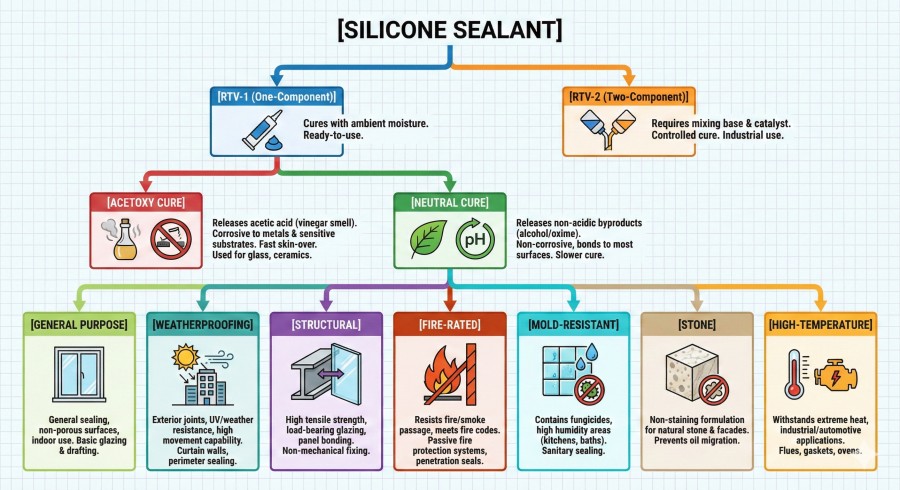
“RTV” stands for Room Temperature Vulcanization – the curing process occurring at ambient temperature without external heat. This distinguishes construction sealants from industrial high-temperature vulcanized (HTV) silicones requiring oven curing.
RTV-1: Single-Component Silicones
RTV-1 products arrive ready-to-use in cartridges, tubes, or bulk containers – no mixing required. These represent essentially all construction silicone sealants including both acetoxy-cure and neutral-cure types.
Characteristics:
- Moisture-cure mechanism – React with atmospheric water vapor
- Shelf life – Typically 12-24 months sealed
- Convenience – Direct application from package
- Cure from outside-in – Surface skins first, interior cures progressively
- Depth limitations – Practical maximum typically 12-15mm due to moisture diffusion limits
Applications: Window and door perimeters, expansion joints, sanitary applications, weatherproofing, general construction sealing – essentially any field-applied sealant work.
For comprehensive curing mechanism explanation, see our Sealant Curing Methods Guide.
RTV-2: Two-Component Silicones
RTV-2 products require mixing base resin (Part A) with catalyst/crosslinker (Part B) before application. These offer specific advantages for industrial, manufacturing, or specialized applications.
Characteristics:
- Reactive cure mechanism – Chemical reaction between components
- Predictable cure – Independent of atmospheric humidity
- Faster cure potential – Minutes to hours vs. days for RTV-1
- Unlimited depth – Exothermic reaction cures thick sections
- Shorter shelf life – Typically 6-12 months for unmixed components
Applications: Gasket manufacturing, mold making, potting and encapsulation, industrial sealing, applications requiring fast cure or very thick sections. Less common in building construction due to mixing complexity and field application challenges.
For typical construction sealing, RTV-1 single-component products dominate due to convenience and suitability for field conditions. References to “silicone sealant” in construction contexts generally mean RTV-1 unless specifically noted otherwise.
Curing Chemistry: Acetoxy vs. Neutral-Cure Systems
The most fundamental silicone classification distinguishes curing chemistry – acetoxy-cure releasing acetic acid versus neutral-cure releasing non-corrosive byproducts. This difference profoundly affects substrate compatibility, odor, and appropriate applications.
Acetoxy-Cure Silicones
Acetoxy systems cure through reaction with moisture releasing acetic acid – creating the familiar “vinegar smell” during cure.
Chemical mechanism: Acetoxy groups on polymer chains react with water molecules, releasing acetic acid (CH₃COOH) while forming cross-links. The acid byproduct provides both advantages and critical limitations.
Advantages of acetoxy-cure:
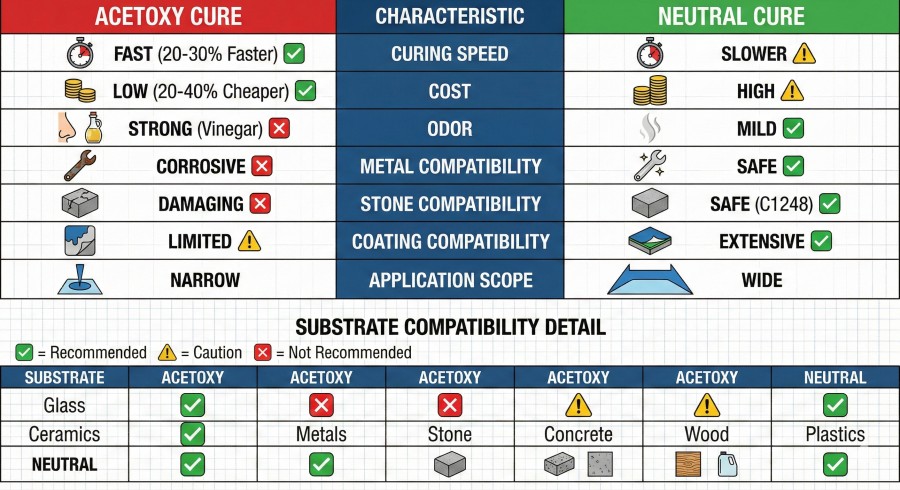
Fast cure – Acetoxy silicones typically cure 20-30% faster than neutral-cure equivalents. Tack-free time often 10-15 minutes versus 20-30 minutes, full cure 24-48 hours versus 3-7 days for thicker beads.
Lower cost – Acetoxy chemistry proves less expensive to manufacture – typically 20-40% lower than neutral-cure alternatives. This makes acetoxy products attractive for budget-conscious applications where limitations acceptable.
Good adhesion to many substrates – Acid byproduct can etch surfaces slightly improving mechanical adhesion to glass, glazed ceramics, and some plastics.
Proven performance – Decades of successful use in appropriate applications demonstrates reliability when properly specified.
Limitations and concerns:
Corrosive to metals – ⚠️ CRITICAL: Acetoxy silicones corrode copper, brass, zinc, and some other metals. Acetic acid attacks metal surfaces causing discoloration, corrosion, and adhesion failure. Never use acetoxy silicones on metal substrates, adjacent to metal, or where corrosion unacceptable.
Damages sensitive stone – Acid can etch or stain marble, limestone, travertine, and other calcareous stones. Even after cure, residual acid may cause discoloration. Avoid acetoxy silicones on natural stone – use stone-safe neutral-cure alternatives.
Strong odor – Vinegar smell during cure (sometimes lingering days) proves objectionable in occupied spaces. While not harmful at sealant application concentrations, odor creates complaints in sensitive environments.
Coating compatibility issues – Acid may affect certain coatings, paints, or finishes. Test compatibility before use on any coated or finished surface.
Appropriate acetoxy applications:
- ✅ Glass-to-glass or glass-to-painted metal (where metal not contacted)
- ✅ Ceramic tile (glazed tiles unaffected by acid)
- ✅ Certain plastics (test compatibility)
- ✅ General glazing where cost critical and metal contact avoided
- ✅ Non-critical applications where fast cure valued
Inappropriate acetoxy applications:
- ❌ Any metal contact (aluminum, steel, copper, brass, zinc)
- ❌ Natural stone (marble, limestone, travertine)
- ❌ Concrete or masonry (alkaline materials, though some formulations acceptable)
- ❌ Aquarium or food contact (acid residue concerns)
- ❌ Sensitive environments (healthcare, food preparation, occupied spaces concerned about odor)
Neutral-Cure Silicones
Neutral-cure systems release non-corrosive byproducts – typically alcohols (methanol or ethanol) or other neutral compounds. This eliminates corrosivity enabling broader substrate compatibility.
Chemical mechanisms: Several neutral-cure chemistries exist:
- Alkoxy (alcohol-cure) – Most common, releases methanol or ethanol
- Oxime-cure – Releases ketoxime compounds
- Acetone-cure – Releases acetone vapor
- Amine-cure – Releases small amine molecules
All share neutral (non-acidic, non-corrosive) byproducts enabling safe use on sensitive substrates.
Advantages of neutral-cure:
Universal substrate compatibility – ✅ Safe for metals (aluminum, steel, stainless steel, copper, brass, zinc), natural stone (marble, limestone, granite, travertine), coated surfaces, concrete, masonry, wood, most plastics. This versatility justifies premium cost for many applications.
No corrosion risk – Neutral byproducts don’t attack metals or sensitive materials. Eliminates corrosion failures plaguing acetoxy applications.
Stone-safe formulations – Properly formulated neutral-cure silicones (meeting ASTM C1248) prevent staining on porous natural stone. Products like BoPin 635 Natural Stone Neutral Silicone specifically designed for stone applications.
Minimal odor – Alcohol or neutral byproducts produce much less objectionable odor than acetic acid. Suitable for occupied or sensitive spaces.
Professional image – Specifying neutral-cure demonstrates quality consciousness and technical awareness. Many architects and engineers default to neutral-cure for liability and performance reasons.
Better long-term adhesion – Some evidence suggests neutral-cure provides more durable adhesion particularly on challenging substrates, though both types perform well when properly applied to compatible substrates.
Limitations of neutral-cure:
Higher cost – Premium chemistry demands premium pricing – typically 30-50% more than acetoxy equivalents. However, substrate damage from wrong acetoxy use costs far more than neutral-cure premium.
Slower cure – Neutral-cure typically requires longer – tack-free 20-30 minutes versus 10-15 for acetoxy, full cure 3-7 days versus 1-3 days. This rarely proves problematic for properly planned applications but may affect tight project schedules.
Primer requirements – Some neutral-cure formulations require primers on difficult substrates more often than acetoxy types. However, this ensures reliable adhesion rather than creating problems.
Appropriate neutral-cure applications:
- ✅ Any metal contact (window frames, curtain walls, cladding, metal roofing)
- ✅ Natural stone (granite, marble, limestone, travertine, slate – use stone-safe formulations)
- ✅ Concrete and masonry
- ✅ Coated or painted surfaces
- ✅ High-value applications where performance and longevity critical
- ✅ Occupied or sensitive environments
- ✅ Professional specifications
Modern best practice strongly favors neutral-cure for most construction applications unless cost absolutely critical and limitations acceptable. The modest price premium proves worthwhile insurance against compatibility issues, corrosion failures, and substrate damage.
Performance-Based Classifications
Beyond curing chemistry, silicones classify by performance characteristics and specialized formulations serving specific application demands.
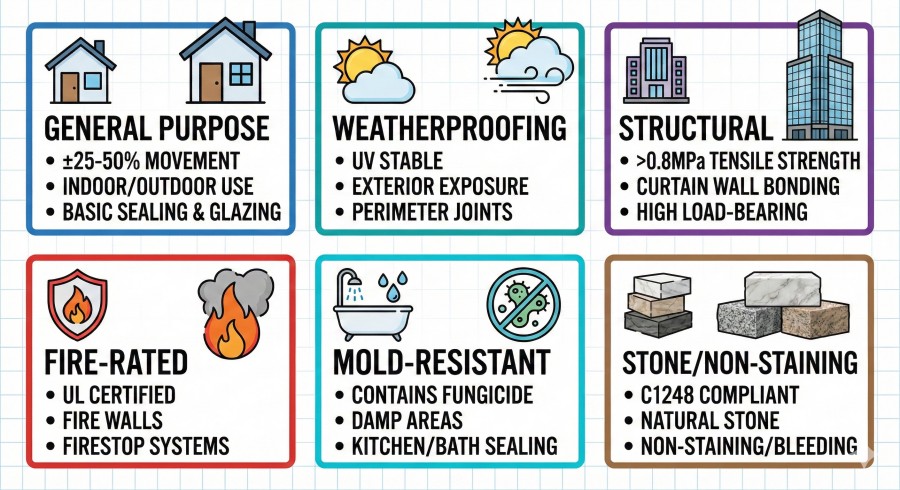
General-Purpose Silicones
Standard formulations balancing cost and performance for routine sealing.
Characteristics:
- ±25% to ±50% movement capability
- Basic weather resistance suitable for most exterior and interior use
- Standard temperature range (-40°C to +150°C)
- Universal formulations not optimized for specific challenges
Applications: General interior sealing, protected exterior joints, non-critical applications, budget-sensitive projects.
Typical products: Entry-level silicones, economy grades, general construction sealants.
Weatherproofing Silicones
Enhanced formulations optimized for exterior exposure and severe weather.
Enhanced characteristics:
- Superior UV stability – Increased UV stabilizers prevent degradation
- Extreme temperature performance – Maintain flexibility at temperature extremes
- Enhanced dirt resistance – Modified surface properties resist soiling
- Improved adhesion – Better bonding to weathered or challenging surfaces
- Extended service life – 20-25+ years in demanding exposure
Applications: Exterior facade joints, curtain wall perimeters, exposed expansion joints, weather-facing sealing, coastal environments, desert conditions.
Example: BoPin 770 Weatherproof Neutral Silicone specifically formulated for demanding weathering and ±50% movement.
For extreme climate applications, see our Desert Climate Sealing Guide.
Structural Silicones
High-strength formulations designed for structural glazing where sealant provides primary structural attachment.
Structural characteristics:
- High tensile strength – Typically >0.8 MPa (compared to ~0.4 MPa for standard)
- Excellent tear resistance – Withstand structural stresses
- Verified adhesion – Specific substrate testing and certification
- ±50% to ±100% movement – Accommodate substantial differential movement
- Long-term load bearing – Maintain strength under sustained loads
- UV and weather stability – Decades of reliable performance
Applications: Structural glazing (glass attached to frames only by silicone), curtain wall structural bonding, insulated glass secondary seal, glass canopies and skylights, architectural glass applications.
Critical requirements:
- Engineering calculations verifying adequate strength for wind loads, dead loads, thermal stresses
- Substrate compatibility testing before project use
- Strict quality control during application
- Professional installation by trained applicators
- Regular inspection of structural silicone installations
Structural silicone requires specialized knowledge and should not be used casually. Consult our Glass Curtain Wall Sealing Guide for comprehensive structural glazing information.
Fire-Rated Silicones
Intumescent formulations expanding when exposed to fire, providing fire and smoke barriers.
Fire-resistance characteristics:
- Intumescent expansion – Swell to many times original volume when heated
- UL or FM listing – Tested and certified for specific fire ratings (1-4 hours)
- Smoke seal capability – Prevent smoke passage in addition to fire
- Maintain flexibility – Accommodate movement before fire exposure
- Temperature stability – Withstand temperatures exceeding 1000°C during fire
Applications: Fire-rated wall penetrations, fire-rated joint systems, head-of-wall joints in fire-rated assemblies, curtain wall perimeter fire seals.
Critical compliance: Must use products specifically tested and listed for fire-rated applications. General-purpose silicones do not provide fire protection.
See our Fire-Rated Sealing Systems Guide for comprehensive fire protection sealing information.
Sanitary and Mold-Resistant Silicones
Formulations containing fungicides preventing mold and mildew growth in damp environments.
Antimicrobial characteristics:
- Fungicide additives – Silver ions, zinc compounds, or organic biocides
- Smooth surface – Non-porous finish resists biological colonization
- Moisture resistance – Doesn’t absorb water supporting organism growth
- Easy cleaning – Surface wipes clean maintaining hygiene
Applications: Bathroom fixtures (tubs, showers, sinks), kitchen backsplashes, wet room sealing, swimming pool areas, any high-humidity environment.
Product example: BoPin 550 Sanitary Anti-Mold Silicone specifically formulated with fungicides for wet area applications.
Limitations: Fungicides eventually deplete through leaching – expect 5-10 years maximum mold resistance even from premium products. Regular cleaning extends effectiveness but all silicones eventually support biological growth in damp conditions.
For comprehensive bathroom sealing guidance, see How to Choose and Apply Bathroom Silicone.
Stone-Safe Silicones
Specialized neutral-cure formulations preventing staining on porous natural stone.
Stone-safe characteristics:
- ASTM C1248 certified – Tested on marble, limestone, granite, travertine
- Non-staining chemistry – No migrating oils, plasticizers, or colorants
- Neutral pH – No acidic or alkaline components attacking stone
- Low extractables – Minimal compounds leaching into porous stone
Applications: Natural stone facades, granite or marble installations, limestone or travertine applications, any high-value porous stone where staining unacceptable.
Critical requirement: Only use products specifically certified stone-safe meeting ASTM C1248. “Neutral-cure” alone doesn’t guarantee stone safety – many neutral-cure products still stain porous stone through plasticizer or oil migration.
Recommended: BoPin 635 Natural Stone Neutral Silicone certified for natural stone applications.
For detailed stone sealing information, see Natural Stone Sealing: Preventing Staining and Damage.
High-Temperature Silicones
Formulations withstanding extreme continuous temperatures beyond standard ranges.
Enhanced temperature capabilities:
- Continuous service – Rated for 200°C, 250°C, or even 300°C+ continuous exposure
- Intermittent peaks – Brief exposure to even higher temperatures
- Thermal cycling – Repeated heating/cooling without degradation
- Red or black colors – High-temp grades typically these colors
Applications: Oven and appliance sealing, automotive/industrial engine compartments, exhaust systems, heating equipment, high-temperature piping, furnace and kiln sealing.
Less common in building construction except specialized applications like boiler rooms, industrial equipment, or architectural features involving heat.
Selecting the Right Silicone Type
Systematic selection process matches silicone characteristics to actual application requirements and constraints.
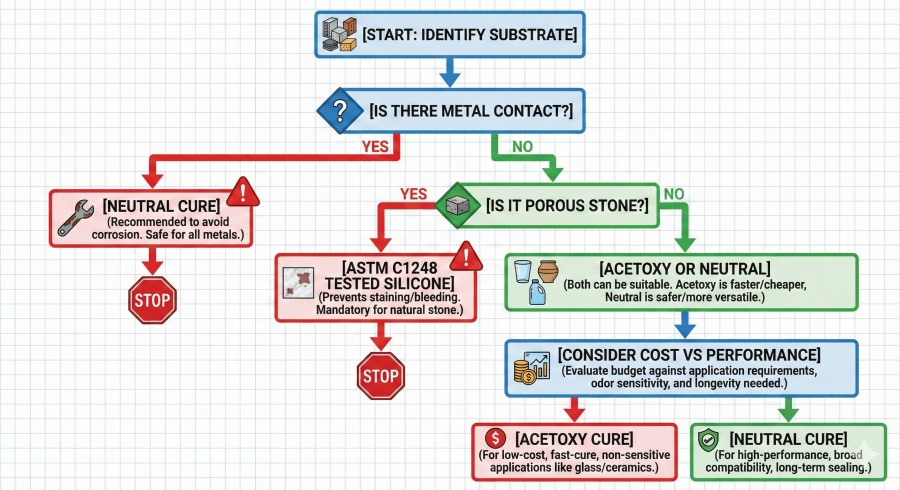
Selection Decision Framework
Start with substrate assessment – the most critical factor:
Question 1: What substrates will sealant contact?
If ANY metal substrates (aluminum, steel, copper, brass, zinc, metal coatings): → MUST use neutral-cure silicone → Acetoxy-cure will corrode metals causing failure → No exceptions – metal contact eliminates acetoxy consideration
If porous natural stone (marble, limestone, travertine, porous granite): → MUST use ASTM C1248 certified stone-safe silicone → Both acetoxy AND many neutral-cure products stain porous stone → Verify specific certification, not just “neutral-cure” claim
If glass, glazed ceramics, or certain plastics only: → Either acetoxy or neutral-cure acceptable → Acetoxy offers cost savings if substrates compatible → Neutral-cure provides safety margin and future flexibility
Question 2: What environmental conditions exist?
Severe exterior exposure (intense UV, extreme temperatures, weather): → Specify weatherproofing-grade silicone → Enhanced UV stabilizers and temperature stability essential → Premium investment worthwhile for demanding exposure
Wet areas or high humidity (bathrooms, kitchens, pools): → Specify sanitary/anti-mold formulations → Fungicides resist biological growth → Smooth finish improves cleanability
High movement joints (expansion joints, seismic, large thermal cycling): → Require ±50% or ±100% movement capability → Verify actual expected movement through calculations → Size joints appropriately for movement magnitude
Fire-rated assemblies (fire walls, floor penetrations, shaft walls): → MUST use UL/FM listed fire-rated products → Standard silicones provide zero fire protection → See Fire-Rated Sealing Systems Guide
Question 3: What project priorities drive selection?
If cost-critical and substrate/environment permit: → Acetoxy-cure offers significant savings → Acceptable for appropriate applications (glass, ceramics, protected interior) → Verify all substrates compatible before specifying
If longevity and performance priority: → Premium neutral-cure formulations → Weatherproofing grades for exposed locations → Higher initial cost yields lower lifecycle cost
If professional specification or liability concern: → Default to neutral-cure → Eliminates corrosion and compatibility risks → Demonstrates professional quality consciousness
Question 4: Are there special requirements?
Structural loads → Structural silicone required Fire rating → Fire-rated silicone required
Food contact → Food-grade certification required Drinking water contact → NSF-certified products Clean room → Low-outgassing formulations Underwater application → Specialty curing systems
Application-Specific Recommendations
Common applications with optimal silicone types:
| Application | Recommended Silicone | Why This Type |
|---|---|---|
| Aluminum window frames | Neutral-cure weatherproofing | Metal-safe, weather exposure, movement |
| Glass-to-glass interior | Acetoxy or neutral-cure | Either acceptable – choose by budget |
| Marble countertop | Stone-safe neutral-cure (ASTM C1248) | Prevents staining, neutral pH |
| Bathroom tub/shower | Neutral-cure sanitary/anti-mold | Metal fixtures, mold resistance needed |
| Kitchen sink | Neutral-cure sanitary | Metal sink, cleanability important |
| Exterior facade expansion joint | Neutral-cure weatherproofing ±50% | Weather exposure, high movement, durability |
| Curtain wall structural glazing | Structural silicone | Load-bearing application requires high strength |
| Concrete expansion joint | Neutral-cure ±50% movement | Alkaline substrate, high movement |
| Swimming pool tile | Neutral-cure chemical-resistant | Chlorine exposure, metal contact possible |
| Fire-rated penetration | Fire-rated intumescent silicone | Code compliance requires listed product |
Common Silicone Selection Mistakes
Learning from typical errors prevents costly failures and re-work.
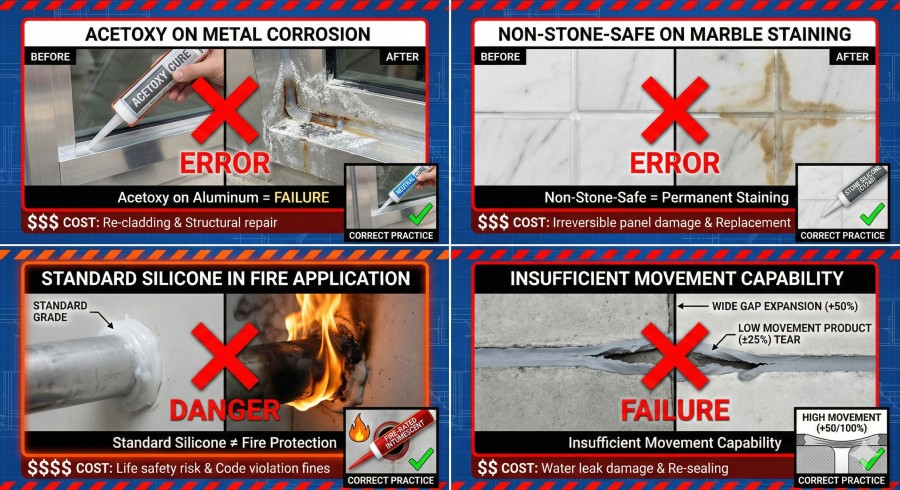
Mistake 1: Using Acetoxy on Metal
Most common error: Applying acetoxy silicone to aluminum window frames, metal roofing, copper plumbing, or any metal substrate.
Consequences: Acid corrodes metal causing green/white corrosion, adhesion failure, aesthetic damage, water infiltration, warranty voids.
Prevention: If any metal contact, use neutral-cure – NO EXCEPTIONS. Cost savings from acetoxy vanish when corrosion requires re-work.
Mistake 2: Non-Stone-Safe Products on Porous Stone
Frequent problem: Using general neutral-cure (or worse, acetoxy) silicone on marble, limestone, or travertine.
Consequences: Permanent yellow or brown staining around joints impossible to remove without stone replacement or professional restoration.
Prevention: Only use ASTM C1248 certified stone-safe products on porous natural stone. Verify certification explicitly – “neutral-cure” insufficient. Test on inconspicuous area before full application.
Mistake 3: Standard Silicone in Fire-Rated Assemblies
Dangerous error: Using general-purpose silicone in fire-rated wall penetrations or joints expecting fire protection.
Consequences: Complete failure during fire – standard silicones provide ZERO fire resistance, violate codes, create life-safety hazards, enormous liability exposure.
Prevention: Fire-rated locations require UL/FM listed fire-rated products installed per tested systems. Never substitute standard silicone – no exceptions for code-required fire protection.
Mistake 4: Insufficient Movement Capability
Design error: Specifying ±25% movement silicone for joints experiencing ±40% actual movement.
Consequences: Cohesive tearing, adhesion failure, joint failure requiring replacement.
Prevention: Calculate expected movement from thermal expansion, seismic loads, settlement. Select silicone movement rating exceeding calculated movement with 25-50% safety factor. When in doubt, specify higher movement capability.
For movement calculation methodology, see Expansion Joint Design and Sealing.
Mistake 5: Painting Silicone
Impossible expectation: Attempting to paint over cured silicone achieving durable coating.
Reality: Paint won’t adhere to silicone’s low-energy surface – peels off immediately or shortly after application.
Prevention: If painting required, do not use silicone. Specify paintable MS polymer or polyurethane sealants instead. Alternatively, match silicone color to finish avoiding painting need.
Frequently Asked Questions
Can I use acetoxy silicone on aluminum window frames?
No – acetoxy silicone will corrode aluminum and should never be used on any metal substrate. The acetic acid released during cure attacks aluminum creating white powdery corrosion, brown or black discoloration, and adhesion failure typically within 6-24 months. This represents the most common silicone application error causing thousands of failures annually. Always use neutral-cure silicone for any metal contact – aluminum window frames, metal cladding, metal roofing, copper pipes, brass fixtures, zinc coatings, or any other metallic substrate. The cost difference between acetoxy and neutral-cure (typically $2-3 per cartridge) proves insignificant compared to labor and materials required removing failed acetoxy silicone and reapplying proper neutral-cure product. For aluminum window and door sealing, products like BoPin 770 Weatherproof Neutral Silicone specifically designed for metal compatibility and exterior weather exposure provide reliable long-term performance.
What’s the difference between “neutral-cure” and “stone-safe” silicone?
While all stone-safe silicones use neutral-cure chemistry, not all neutral-cure silicones qualify as stone-safe – this critical distinction prevents expensive staining mistakes. Neutral-cure refers only to curing chemistry (releasing alcohols rather than acetic acid), but doesn’t guarantee the formulation prevents staining on porous stone. Stone staining typically occurs from plasticizers, oils, or additives migrating into porous stone rather than from curing byproducts. ASTM C1248 certification specifically tests silicones on four stone types – white marble, beige limestone, dark granite, and cream travertine – verifying they cause no staining after 30-day exposure. Only silicones meeting ASTM C1248 qualify as “stone-safe” and manufacturers must state this certification explicitly in technical data. Using general neutral-cure silicone on valuable marble or limestone creates same permanent staining as using acetoxy – only ASTM C1248 certified products like BoPin 635 Natural Stone Neutral Silicone prevent this expensive problem. When in doubt with natural stone, always verify ASTM C1248 certification and test on inconspicuous area before proceeding.
How do I know if my silicone is RTV-1 or RTV-2?
If the product comes in a single cartridge, tube, or container ready to apply without mixing, it’s RTV-1 single-component – this includes essentially all construction silicone sealants. RTV-2 two-component products arrive as two separate containers labeled Part A (base) and Part B (catalyst or crosslinker) requiring mixing before use, typically in 1:1 or 10:1 ratios depending on formulation. For construction applications – window sealing, expansion joints, sanitary sealing, weatherproofing – you’re using RTV-1 unless working in specialized manufacturing or industrial settings. RTV-2 finds use in gasket making, mold fabrication, potting and encapsulation, or specialty industrial applications where rapid cure independent of humidity, unlimited depth capability, or specific properties justify mixing complexity. Product labeling clearly indicates if mixing required – single-component RTV-1 simply states “ready to use” while two-component RTV-2 prominently displays mixing ratio and instructions. Unless you’re specifically seeking two-component systems for specialized applications, standard construction silicone sealants are RTV-1.
Can I speed up silicone cure time?
Silicone cure rate depends primarily on formulation chemistry and environmental conditions – attempting to force acceleration risks problems. For moisture-cure RTV-1 silicones (standard construction sealants), cure rate increases with higher humidity and warmer temperatures within reasonable ranges – maintaining 20-25°C and 50-70% relative humidity optimizes cure without issues. Very light misting with water MAY help in extremely dry conditions (desert climates <20% humidity) but risks skinning-over if excessive – moisture penetrates slowly so patience generally proves wiser. Never apply direct heat (heat guns, hair dryers) – this damages silicone causing bubbling, surface defects, or property degradation. Acetoxy formulations cure somewhat faster than neutral-cure (20-30% reduction in cure time) but substrate compatibility determines selection, not cure speed preference. For applications requiring rapid cure, consider two-component RTV-2 products curing in hours rather than days, though complexity and cost increase substantially. Best practice: plan projects allowing adequate cure time for chosen silicone – typically 24 hours before rain exposure, 3-7 days before full cure achieving rated properties. Rushing chemical reactions rarely succeeds without compromising performance.
Is more expensive silicone always better?
Price generally correlates with performance and specialized capabilities, but “better” depends entirely on application requirements – expensive structural silicone proves overkill for simple bathroom caulking while economy acetoxy fails catastrophically on aluminum windows. Premium silicones typically offer: enhanced UV stability and weather resistance (maintaining flexibility and appearance decades longer), higher movement capability (±50% vs ±25%), broader temperature ranges, better chemical resistance, longer service life (20-25+ years vs 10-15 years), and specialized features (stone-safe, anti-mold, fire-rated, structural strength). However, these benefits matter only if your application demands them – using $15 premium structural silicone for interior glass-to-glass joints wastes money versus $5 general-purpose product performing identically in this non-demanding application. Conversely, “saving” $3 per cartridge using acetoxy on aluminum creates $100+ re-work cost when corrosion causes failure. Match product capabilities to actual requirements: for demanding exterior exposure, high-movement joints, valuable substrates, or long-term critical applications, premium silicones prove economical through superior performance and longevity; for protected interior, low-movement, non-critical applications where substrates permit, economy grades serve adequately at lower cost. Consider total lifecycle cost, not just purchase price.
Conclusion
Understanding silicone sealant types – RTV classifications, curing chemistries, and performance specializations – enables informed selection matching products to actual requirements, substrates, and conditions while avoiding costly compatibility errors. The term “silicone sealant” encompasses dozens of distinct formulations with dramatically different characteristics and appropriate applications.
RTV (Room Temperature Vulcanization) silicones divide into RTV-1 single-component products dominating construction applications and RTV-2 two-component systems serving specialized industrial uses. Construction professionals work almost exclusively with RTV-1 moisture-cure formulations offering convenience and field suitability for building sealing applications.
Curing chemistry – acetoxy versus neutral-cure – fundamentally affects substrate compatibility and represents the most critical selection consideration. Acetoxy-cure releases acetic acid creating corrosivity and odor while offering faster cure and lower cost, suitable only for compatible substrates like glass and glazed ceramics. Neutral-cure releases non-corrosive byproducts enabling safe use on metals, natural stone, and sensitive surfaces – the modest price premium (30-50%) proves worthwhile insurance against compatibility failures and substrate damage. Modern best practice strongly favors neutral-cure for most professional applications unless cost absolutely critical and limitations thoroughly understood and acceptable.
Performance-based classifications – weatherproofing, structural, fire-rated, sanitary, stone-safe, high-temperature – serve specialized requirements demanding capabilities beyond general-purpose formulations. Weatherproofing grades withstand severe exterior exposure through enhanced UV stability and temperature performance. Structural silicones provide high-strength load-bearing capability for structural glazing. Fire-rated formulations meet code requirements for fire-rated assemblies. Sanitary grades resist mold growth in wet areas. Stone-safe products prevent staining on porous natural stone. Matching specialized formulations to demanding applications optimizes performance and longevity.
Systematic selection processes prevent common errors. Substrate assessment identifies compatibility requirements – any metal contact mandates neutral-cure, porous stone demands ASTM C1248 certification. Environmental conditions guide performance specifications – severe weather requires weatherproofing grades, wet areas need sanitary formulations, high-movement joints demand adequate movement capability. Special requirements like fire ratings or structural loads necessitate specifically certified products. The most frequent and costly mistake – using acetoxy on metal – continues plaguing projects despite being entirely preventable through proper specification.
Silicone selection ultimately balances performance requirements, compatibility constraints, and budget realities. Premium formulations deliver superior longevity and capabilities in demanding applications justifying higher initial costs through reduced lifecycle expenses. Economy grades serve adequately in protected, non-critical applications where limitations prove acceptable. The key lies in understanding which factors truly matter for your specific application rather than defaulting to either cheapest available or most expensive assuming “better quality” regardless of need.
Whether specifying sealants for major projects, selecting maintenance supplies for facility management, or making product recommendations to clients, understanding silicone classifications enables confident, informed decisions delivering reliable performance while optimizing value and avoiding expensive compatibility failures.
Need guidance selecting appropriate silicone types for specific applications, substrates, or conditions? Contact our technical team for expert recommendations matching BoPin silicone products to your project requirements ensuring compatibility, performance, and long-term reliability.
Related Articles:
- Sealant Curing Methods Explained: Moisture-Cure, Reactive, UV-Cure
- Complete Guide to Choosing the Right Silicone Sealant
- How to Choose and Apply Bathroom Silicone
- Natural Stone Sealing: Preventing Staining and Damage
- Glass Curtain Wall and Facade Glazing Systems
- Fire-Rated Sealing Systems: Code Compliance Guide
Product References: