Building a sealant product range is one of the most important steps for importers, distributors and private label buyers.
A good product range should not simply include many products. It should match your local market, customer groups, climate conditions, construction habits and sales channels.
For example, a market focused on window installation may need neutral silicone, MS polymer sealant and PU foam. A market focused on interior decoration may need acrylic sealant, sanitary silicone and decorative trim sealant. A market focused on facade and roofing projects may need weather-resistant silicone, metal roof sealant and high-strength construction adhesive.
If your product range is too small, customers may not find what they need. If your product range is too large, you may face inventory pressure and slow-moving products.
This guide explains how importers can build a practical sealant product range for their local market.
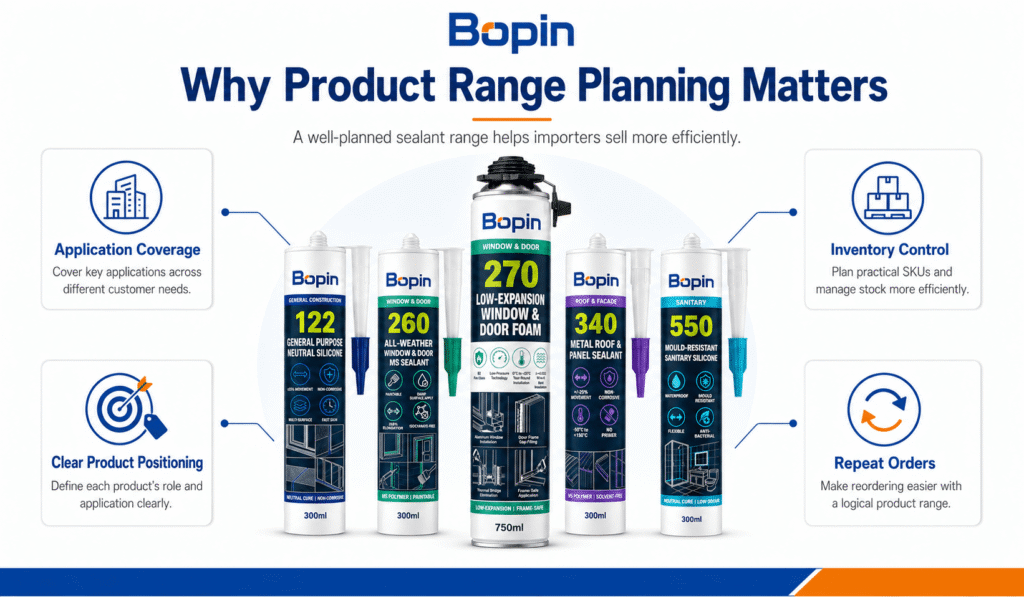
Why Product Range Planning Matters
Many importers make the mistake of selecting products only by price or only by supplier recommendation.
However, sealants are application-based products. Different customers need different solutions.
A hardware store may sell mainly general-purpose silicone, acrylic sealant and sanitary silicone. A contractor supply business may need neutral silicone, PU foam, MS polimeri sealant and construction adhesive. A facade project supplier may need high-movement facade sealant, metal roof sealant and panel bonding adhesive.
Good product range planning helps you:
- Cover the most common applications
- Reduce slow-moving inventory
- Make product selection easier for customers
- Build a clearer brand image
- Improve repeat orders
- Support both retail and project sales
A strong range should be easy to understand. Customers should quickly know which product is for windows, which is for bathrooms, which is for roofing, and which is for bonding.
1. Start with Your Customer Type
Before choosing products, you should first understand who your customers are.
Different customer groups buy sealants for different reasons.
Retail and Hardware Stores
Retail customers usually need easy-to-understand products for daily home improvement and small construction jobs.
Recommended product types:
- General-purpose silicone
- Akrilik sızdırmazlık malzemesi
- Hijyenik silikon
- PU foam
- Basic construction adhesive
This channel needs clear packaging, simple product names and common colors such as white, clear, black and grey.
Contractors and Professional Applicators
Contractors care more about workability, adhesion, curing speed, durability and project performance.
Recommended product types:
- Neutral silicone sealant
- MS polimer dolgu macunu
- Low-expansion PU foam
- Metal çatı yalıtım malzemesi
- Yapı yapıştırıcısı
- Sausage pack sealants
This channel usually prefers larger packaging and stable quality.
Project and Engineering Buyers
Project buyers usually need more technical support, datasheets, standards, sample testing and application recommendations.
Recommended product types:
- Facade sealant
- High-movement sealant
- Fire-rated silicone
- Natural stone sealant
- High-strength MS adhesive
- Prefabricated building joint sealant
For this channel, technical documents and supplier reliability are very important.
2. Choose Products by Application Category
A professional sealant range should be organized by application.
This makes it easier for customers to understand and choose.
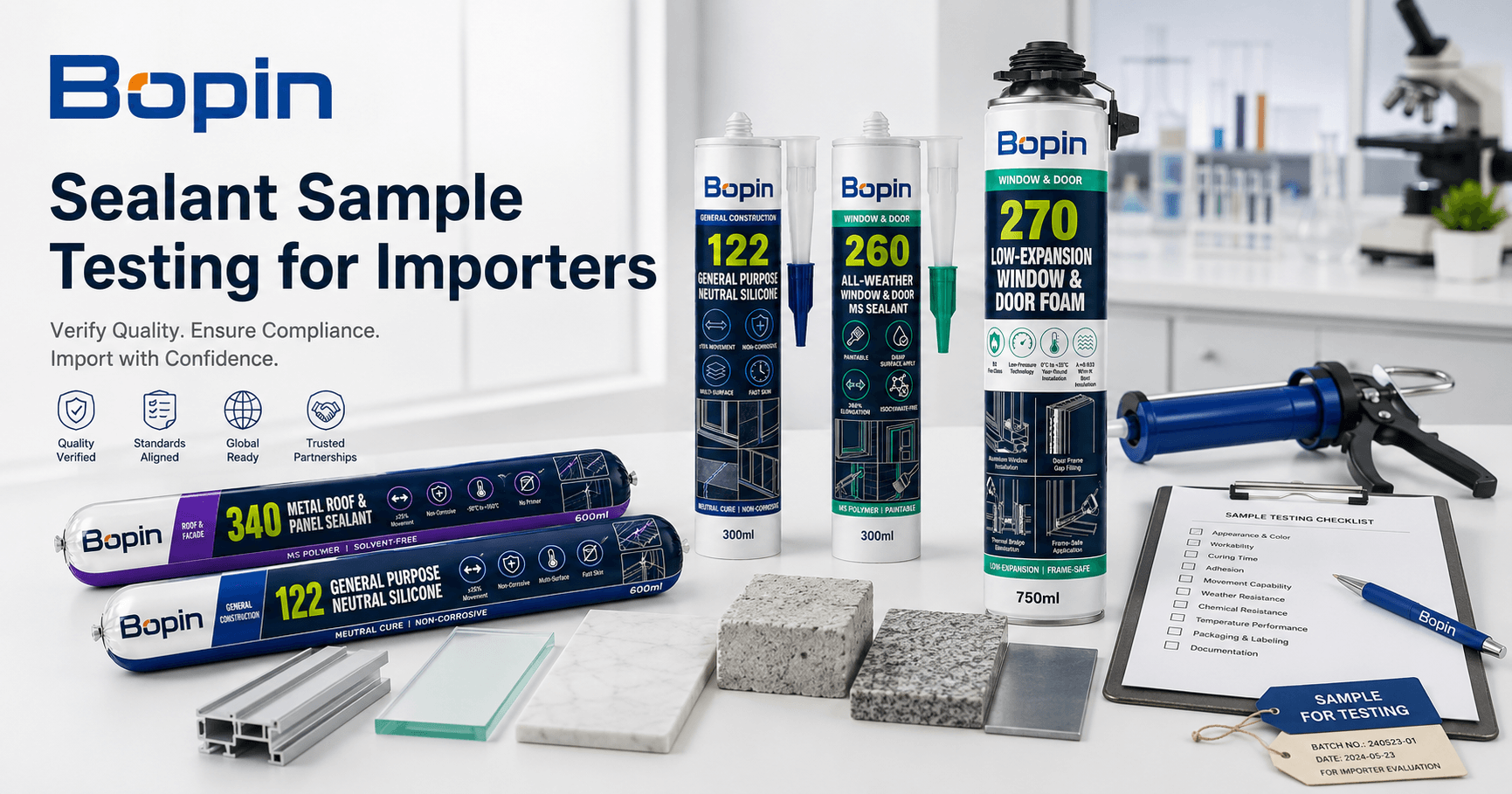
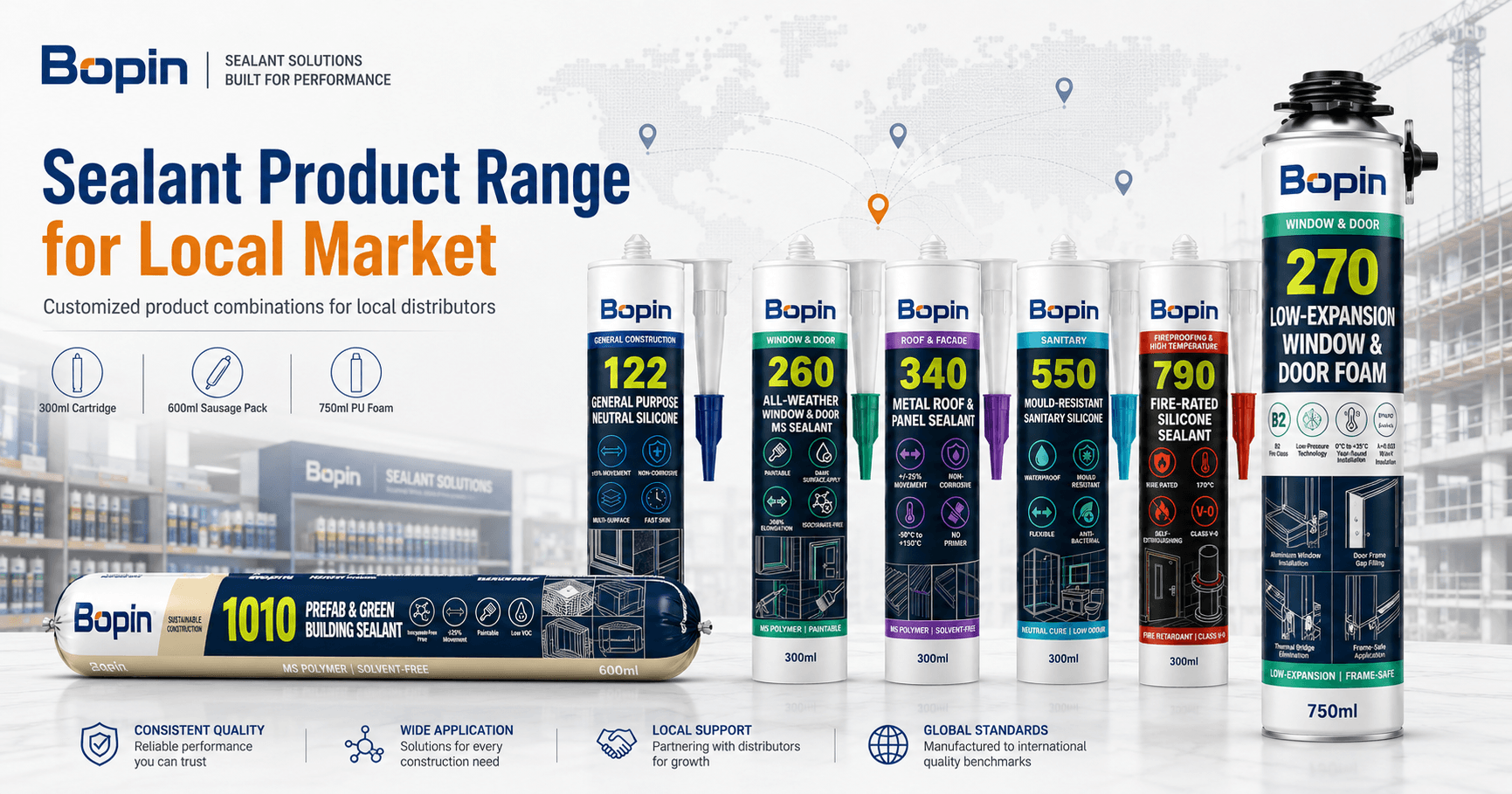
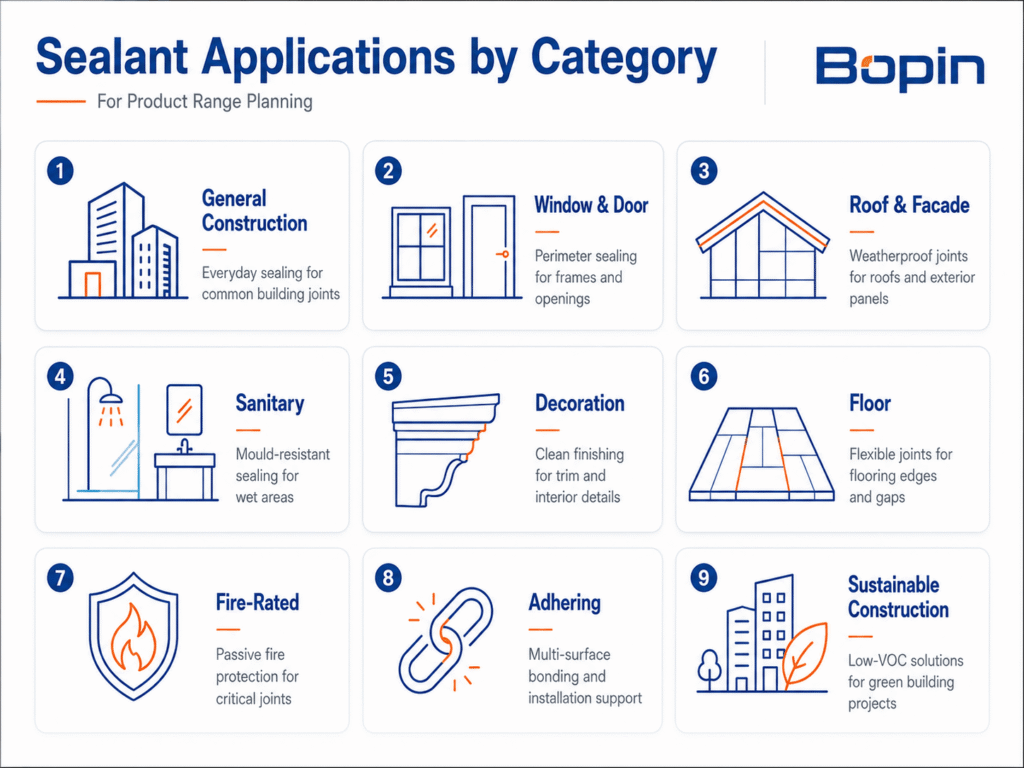
BoPin’s product catalog covers 21 products across 9 application series, including General Construction, Window & Door, Roof & Facade, Floor, Sanitary, Decoration, Fireproofing & High Temp, Adhering and Sustainable Construction. The range includes silicone sealants, MS polymers, PU foam and acrylic sealants.
Common application categories include:
| Application Category | Recommended Product Types |
|---|---|
| Genel İnşaat | All-purpose silicone, neutral silicone |
| Pencere & Kapı | Neutral silicone, MS polymer sealant, PU foam |
| Çatı ve Cephe | Metal roof sealant, facade silicone |
| Sıhhi | Anti-mould sanitary silicone |
| Dekorasyon | Acrylic sealant, decorative trim sealant |
| Zemin | Wood floor joint sealant |
| Bağlılık | Construction adhesive, high-strength MS adhesive |
| Yangın Koruması | Fire-rated silicone |
| Sürdürülebilir İnşaat | Prefab and green building sealant |
This structure is useful because it connects products with real customer needs.
3. Build a Starter Range First
For a new importer or private label buyer, it is usually better to start with a focused range.
A starter range should cover the most common applications and sell through faster.
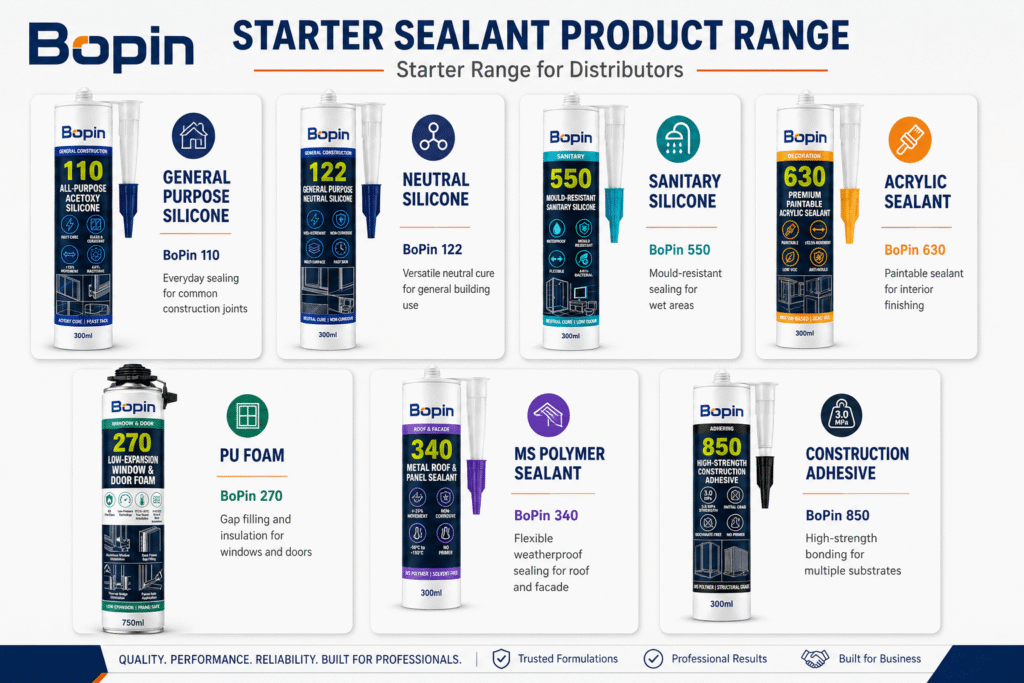
Recommended starter range:
| Product Type | Why It Is Important |
|---|---|
| General-purpose silicone | Basic daily construction sealing |
| Neutral silicone | Safer for metals, frames and masonry |
| Hijyenik silikon | Bathroom and kitchen applications |
| Akrilik sızdırmazlık malzemesi | Interior cracks and paintable joints |
| PU foam | Window, door and gap filling |
| MS polimer dolgu macunu | Paintable, solvent-free, multi-substrate use |
| Yapı yapıştırıcısı | Panel bonding and general fixing |
This range is suitable for many building material distributors because it covers both retail and professional applications.
You do not need to launch every specialized product at the beginning. A smaller but well-positioned range is easier to sell, manage and promote.
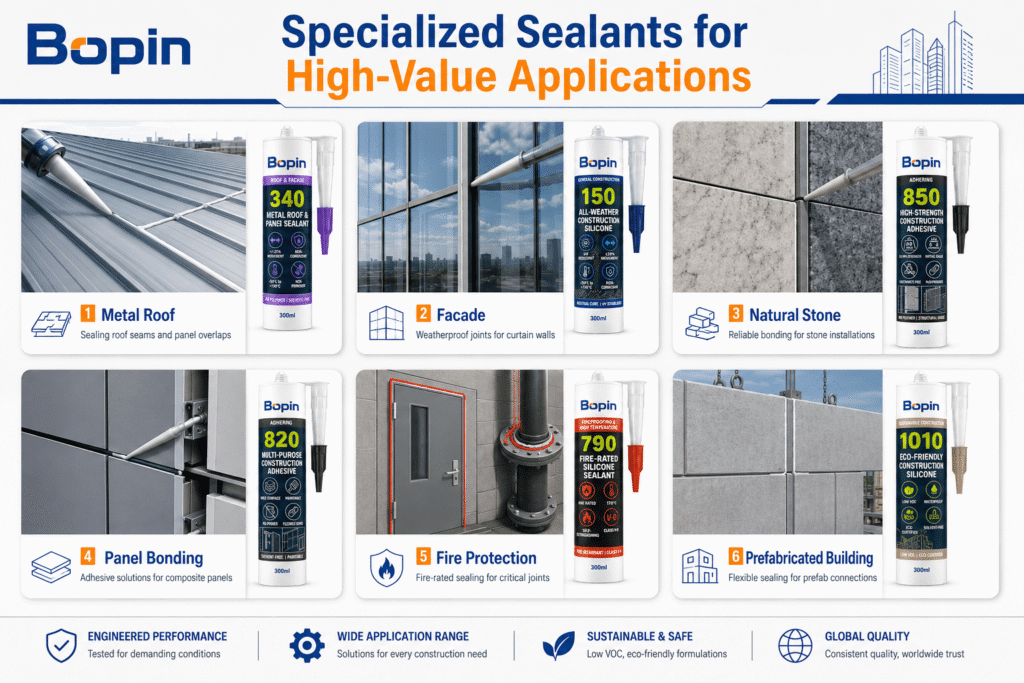
4. Add Specialized Products for Higher-Value Markets
After your basic range is stable, you can add specialized products for higher-value applications.
Specialized products usually have more specific technical requirements, but they can also help your brand stand out.
Examples of specialized products:
| Specialized Application | Recommended Product |
|---|---|
| Metal roofing | Metal roof and panel sealant |
| Curtain wall and facade | Weather-resistant facade sealant |
| Doğal taş | Non-staining natural stone silicone |
| Sintered stone panels | High-strength MS polymer adhesive |
| Fire protection | Yangına dayanıklı silikon mastik |
| Prefabricated buildings | Prefab and green building sealant |
| Wood flooring | Wood floor joint sealant |
These products are especially useful if your customers include contractors, project suppliers, facade installers, roofing installers or stone fabricators.
Specialized products also help you avoid competing only on price.
5. Consider Local Climate Conditions
Climate has a strong influence on sealant selection.
A product range for a hot and humid market may be different from a range for a cold or dry market.
Hot and Humid Markets
Recommended focus:
- Anti-mould sanitary silicone
- Weather-resistant facade sealant
- MS polimer dolgu macunu
- Low-odour interior products
- Proper storage and shelf-life management
Coastal Markets
Recommended focus:
- Non-corrosive neutral silicone
- Metal çatı yalıtım malzemesi
- Products with good adhesion to coated metals
- UV-resistant exterior sealants
Cold Markets
Recommended focus:
- Sealants with wide temperature resistance
- PU foam suitable for local application temperature
- Products with stable curing performance
High-UV Markets
Recommended focus:
- Weather-resistant silicone
- Facade sealant
- Roof and panel sealant
- Exterior-grade MS polymer sealant
When building your product range, do not only ask what products are popular. Ask what problems your climate creates for contractors.
For project-based orders, buyers should also check local building codes Ve climate-related performance requirements before confirming product specifications.
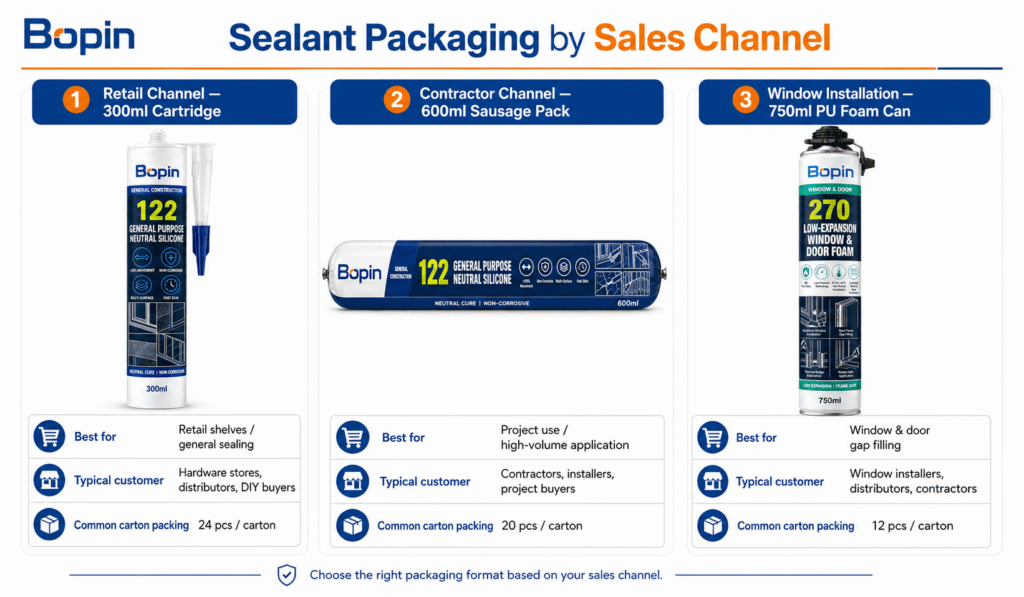
6. Match Products with Packaging Formats
Packaging is another important part of product range planning.
The same product may be suitable for different channels depending on packaging.
Common packaging choices:
| Ambalaj Formatı | En İyisi İçin |
|---|---|
| 300 ml kartuş | Retail, hardware stores, general construction |
| 590 ml / 600 ml sosis paketi | Contractors, project jobs, large-volume application |
| 750 ml aerosol kutusu | PU foam for gap filling and insulation |
For a retail-focused market, 300ml cartridges are usually important. For professional contractors, sausage packs may be more efficient. For window and door installation, PU foam aerosol cans are often necessary.
Your packaging should match how customers actually use and buy the product.
7. Create Good-Better-Best Product Levels
A mature sealant brand often needs different quality levels.
This helps you serve different customers without confusing your product range.
Example structure:
| Level | Positioning | Suitable Channel |
|---|---|---|
| İyi | Economy grade for basic use | Retail and price-sensitive wholesale |
| Better | Standard professional grade | Contractors and general distributors |
| Best | Premium performance grade | Projects and specialized applications |
For example, in silicone sealants:
- Economy general-purpose silicone can serve daily sealing needs.
- Neutral silicone can serve window, door and metal frame applications.
- Facade silicone can serve high-movement exterior joints.
For MS polymer products:
- General MS sealant can be used for paintable sealing.
- Metal roof MS sealant can be used for roofing and cladding.
- High-strength MS adhesive can be used for panel bonding.
This level structure helps sales teams explain products more easily.
8. Avoid Too Many Similar Products
A common mistake is launching too many products with very similar names and functions.
For example, if you have five general-purpose silicone sealants but the packaging does not clearly explain the difference, customers may become confused.
Each product should have a clear reason to exist.
Before adding a new product, ask:
- What application does it serve?
- Which customer group needs it?
- Is it different from existing products?
- Does it solve a specific problem?
- Can sales staff explain it easily?
- Will it create inventory pressure?
A good product range is not the biggest range. It is the clearest and most practical range.
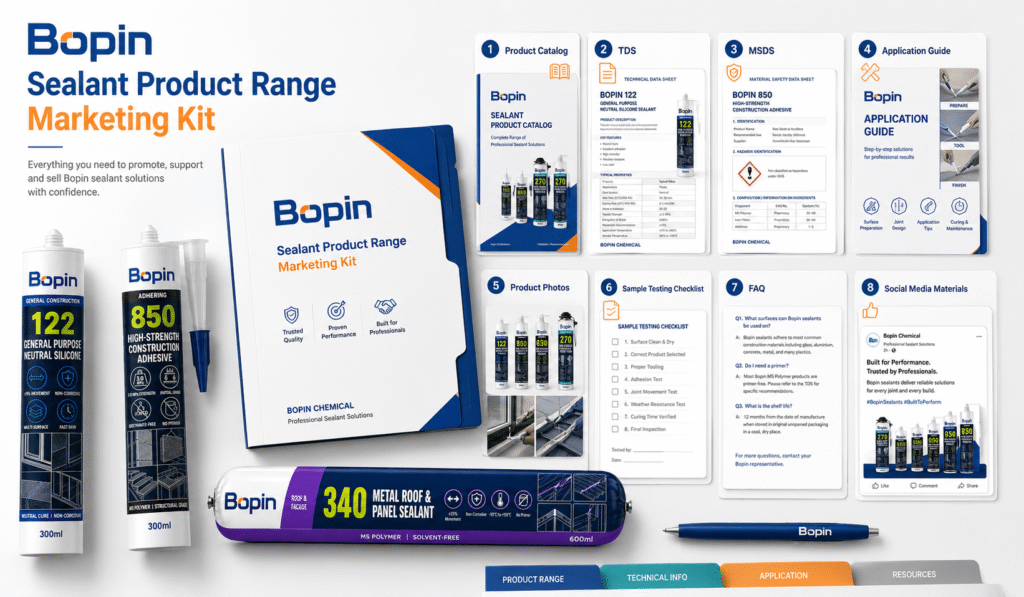
9. Prepare Technical and Marketing Support
A product range is not complete without support materials.
Importers should prepare clear product information for customers, contractors and sales teams.
Faydalı malzemeler şunlardır:
- Ürün kataloğu
- Teknik veri sayfaları
- MSDS
- Ürün karşılaştırma tablosu
- Application guide
- Packaging photos
- Başvuru fotoğrafları
- Sample testing guide
- SSS belgesi
- Social media product content
These materials help customers understand the range and reduce repeated questions.
For project-based buyers, technical documents are especially important. They may need information about curing system, movement capability, tensile strength, elongation, temperature resistance, applicable standards and substrate compatibility.
10. Example Product Range for a Local Distributor
Here is an example structure for a local building material distributor.
| Kategori | Product Example | Target Customer |
|---|---|---|
| Genel İnşaat | General silicone / neutral silicone | Hardware stores, contractors |
| Pencere & Kapı | Window silicone / MS sealant / PU foam | Window installers |
| Sıhhi | Anti-mould sanitary silicone | Retail and bathroom installers |
| Dekorasyon | Acrylic sealant / decorative trim sealant | Interior contractors |
| Çatı ve Cephe | Metal roof sealant / facade sealant | Roofing and facade contractors |
| Bağlılık | Construction adhesive / high-strength adhesive | Panel installers |
| Yangın Koruması | Fire-rated silicone | Ticari projeler |
| Sürdürülebilir İnşaat | Prefab joint sealant | Modular building projects |
This type of range can be adjusted based on your market.
If your customers are mainly retail stores, focus more on cartridge products, simple packaging and common applications. If your customers are project buyers, add more technical products and sausage pack options.
Common Mistakes When Building a Sealant Range
1. Selecting products only by low price
Low price can help with market entry, but unstable quality may hurt your brand.
2. Ignoring local applications
A product range should match real construction needs, not only supplier stock availability.
3. Launching too many SKUs
Too many products can increase inventory pressure and make sales more difficult.
4. Not separating product levels
Without clear economy, standard and premium positioning, customers may not understand the range.
5. Using unclear packaging
Packaging should clearly show product type, application, benefits and limitations.
6. Forgetting technical support
Professional buyers often need TDS, MSDS, samples and application guidance.
7. Not testing products before launch
Always test samples with local substrates before bulk ordering.
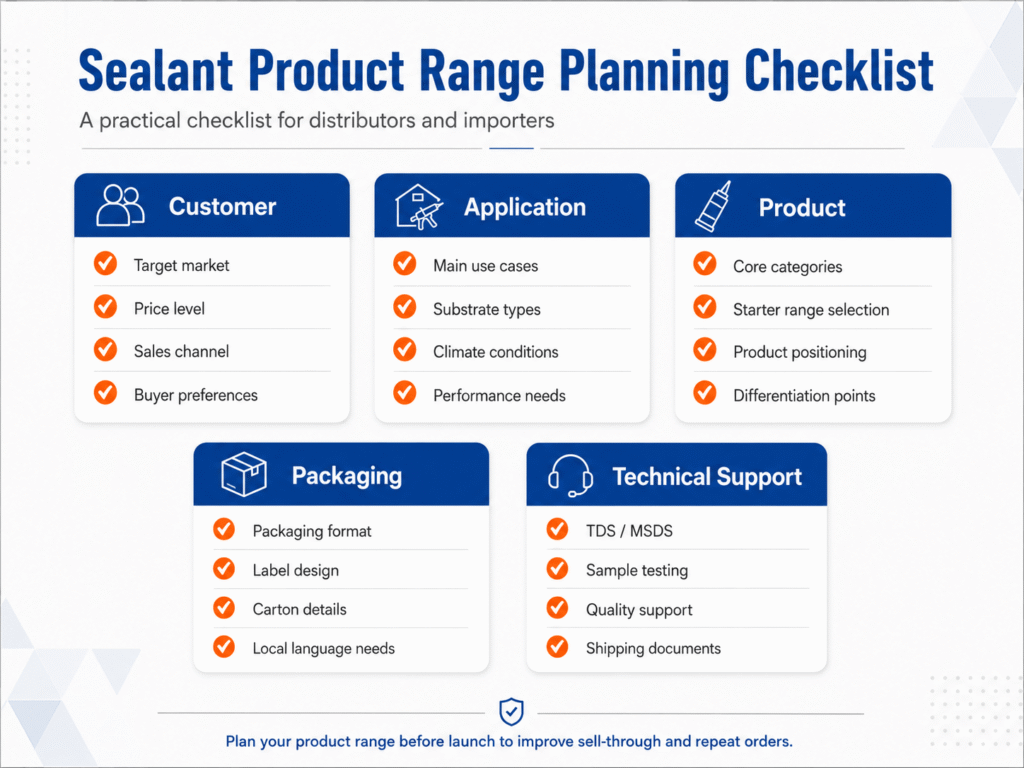
Final Checklist for Product Range Planning
Before confirming your sealant product range, check the following:
| Öğe | Question |
|---|---|
| Customer type | Who will buy the products? |
| Sales channel | Retail, wholesale, contractor or project? |
| Applications | What are the most common uses? |
| Climate | What local conditions affect performance? |
| Ambalajlama | Cartridge, sausage pack or aerosol can? |
| Product levels | Economy, standard or premium? |
| Technical needs | What specifications are required? |
| Documents | Are TDS, MSDS and labels ready? |
| Samples | Have products been tested locally? |
| Inventory | Is the range manageable for the first order? |
This checklist can help importers build a practical and market-focused product range.
Son Düşünceler
Building a sealant product range for your local market requires more than choosing popular products.
You need to understand your customers, applications, climate, sales channels, packaging preferences and technical requirements. A good range should be clear, practical and easy to sell.
For many importers, the best strategy is to start with a focused core range, then gradually add specialized products for higher-value applications such as facade, roofing, natural stone, fire protection and prefabricated buildings.
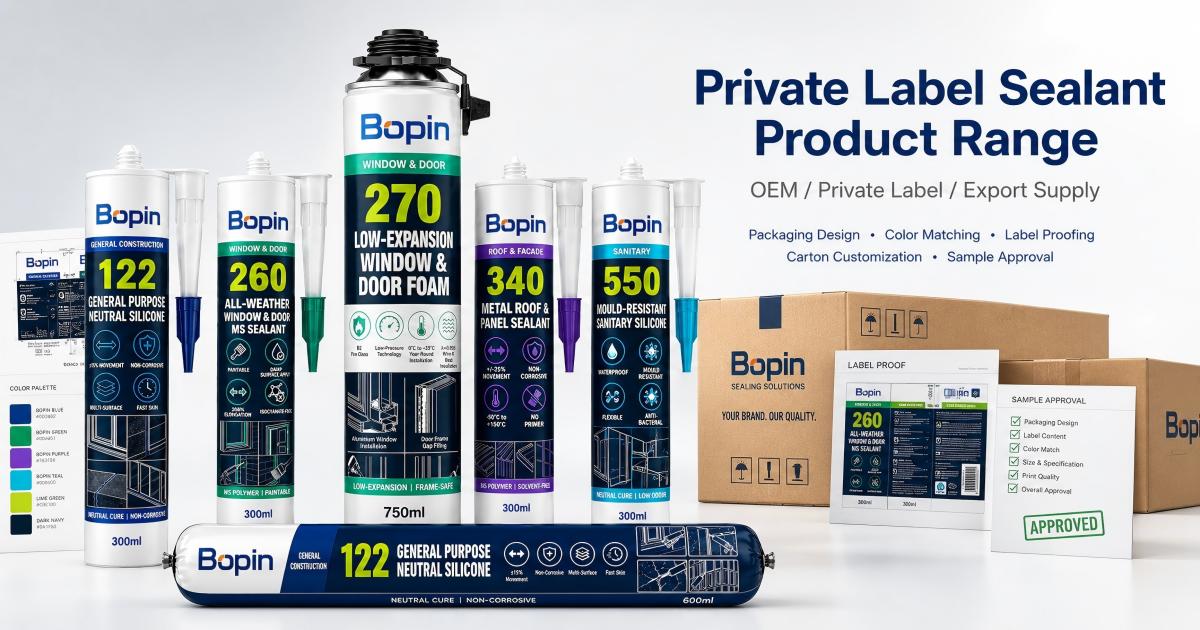
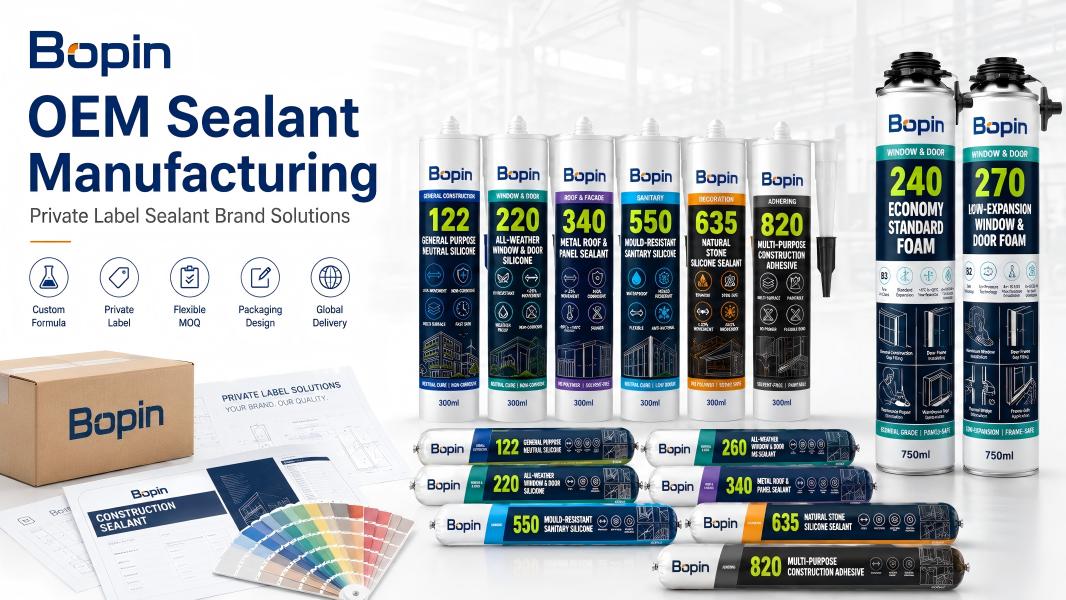
If you are planning to develop a private label sealant range, BoPin size yardımcı olabilir. select suitable products, prepare packaging options, arrange samples and build a product structure for your market.