Swimming pools and decorative water features create unique sealing challenges – continuous water immersion, chemical exposure, thermal cycling, UV radiation, and hydrostatic pressure combine to stress sealants far beyond typical building applications. Pool leaks waste thousands of gallons annually, damage surrounding structures, increase chemical and heating costs, and in severe cases require expensive repairs involving pool drainage and structural work.
Understanding pool construction types, selecting chemically resistant products, implementing proper waterproofing systems, and maintaining effective sealing ensures pools and water features remain watertight throughout decades of service. Whether you’re constructing luxury resort pools, maintaining hotel aquatic facilities, or caring for residential pools and fountains, proper sealing proves essential to performance, longevity, and cost control.
Understanding Pool Construction and Waterproofing Systems
Swimming pools and water features employ various construction methods, each creating specific sealing requirements and waterproofing challenges. The construction type fundamentally determines sealing approach, product selection, and maintenance needs.

Pool Construction Types
Concrete pools (cast-in-place or shotcrete/gunite) represent the most common commercial and high-end residential construction. These monolithic structures offer design flexibility and durability but require comprehensive waterproofing systems addressing concrete’s inherent porosity and tendency to crack.
Construction characteristics:
- Poured concrete or shotcrete creating structural shell
- Reinforcing steel providing structural strength
- Inherently porous – requires waterproof barrier
- Subject to cracking from settlement, thermal movement, ground water pressure
- Chemical reactions with pool water affecting surface over time
Waterproofing approach: Concrete pools require either integral waterproofing during construction (admixtures, crystalline treatments) or applied waterproof membranes (liquid-applied, sheet membranes, cementitious coatings) creating impermeable barriers. Tile or plaster finishes applied over waterproofing provide aesthetic surface and chemical resistance.
Fiberglass pools use factory-molded shells installed in excavated sites. These one-piece units arrive complete requiring minimal on-site sealing work.
Advantages: Factory-controlled quality, smooth non-porous surface, minimal maintenance, excellent chemical resistance, no tile grouting required.
Sealing requirements: Limited to perimeter coping joints where pool shell meets surrounding deck, equipment penetrations (returns, skimmers, drains), and light niches. Most sealing occurs at pool-deck interface rather than within pool itself.
Vinyl-lined pools use flexible vinyl membranes inside structural frames (steel, aluminum, or polymer walls). The vinyl liner provides waterproof barrier requiring replacement every 7-12 years.
Sealing focus: Primarily structural seams in wall panels before liner installation, deck-to-wall joints, and penetration flanges sealed before liner installation. Liner itself provides primary waterproofing – sealing work focuses on supporting structure.
Primary vs. Secondary Waterproofing
Understanding waterproofing hierarchy guides proper sealing approach.
Primary waterproofing represents the main water barrier. In tiled concrete pools, this may be waterproof membrane beneath tiles. In plastered pools, the dense plaster surface itself provides primary barrier. In fiberglass pools, the gel coat forms primary waterproofing.
Secondary waterproofing provides backup protection if primary system fails. For concrete pools, integral waterproofing additives or crystalline treatments in concrete serve as secondary barrier even if surface membrane fails. This redundancy prevents catastrophic leaks requiring complete pool rebuilding.
Tertiary sealing addresses specific vulnerability points. Expansion joints, construction joints, penetrations, and structural cracks receive focused sealing attention as these locations represent highest leak probability. Even with primary and secondary waterproofing, proper joint and penetration sealing proves critical.
The Aquatic Environment Challenge
Pool and water feature environments create extraordinarily demanding conditions for sealants and waterproofing materials. Understanding these challenges guides appropriate product selection and realistic performance expectations.
Continuous Water Immersion
Unlike building envelopes experiencing intermittent moisture, pools maintain continuous water contact. Hydrostatic pressure – water pressure from pool depth – forces water through any available pathway. A pool 2 meters deep creates 20 kPa pressure at bottom – modest by engineering standards but significant for sealant adhesion over time.
Water absorption affects some sealant types. Products that absorb water may swell, lose adhesion, or deteriorate from continuous saturation. Pool applications require sealants with minimal water absorption (typically <1% by weight) maintaining properties despite immersion.
Wet-dry cycling occurs at waterline where waves and water level changes create repeated wetting and drying. This zone experiences accelerated weathering from combined water exposure and atmospheric conditions. Materials must withstand thousands of wet-dry cycles without degradation.
Chemical Exposure Severity
Pool water chemistry creates harsh chemical environment exceeding typical building exposures.
Chlorine represents the primary sanitizer in most pools. Sodium hypochlorite (liquid chlorine) or calcium hypochlorite (granular chlorine) maintains typically 1-3 ppm free chlorine. However, local concentrations near chlorine feeders may reach 10-50 ppm or higher. Some sealants degrade rapidly in chlorine – selection must verify chlorine resistance.
Bromine used in some pools and spas creates similar oxidizing environment. Bromine compatibility should be verified though products resisting chlorine typically handle bromine adequately.
pH variations stress materials. Pool water maintained at pH 7.2-7.8 remains relatively neutral. However, pH can drift – acidic conditions (pH <7.0) from over-chlorination or alkaline conditions (pH >8.0) from calcium buildup. Sealants must tolerate pH range 6.0-9.0 minimum for pool service.
Salt in saltwater pools creates additional challenge. Salt concentrations typically 3,000-4,000 ppm (roughly 1/10 ocean salinity) corrode some materials and affect others’ performance. Saltwater-compatible sealants specifically formulated for this environment prove essential.
Cyanuric acid (stabilizer) at 30-50 ppm, calcium hardness 200-400 ppm, and total alkalinity 80-120 ppm create complex chemical soup. Quality pool sealants resist this combination preventing premature degradation.

Thermal Cycling and UV Exposure
Pool surfaces experience dramatic temperature variations stressing sealants.
Water temperature in heated pools may reach 28-32°C while unheated pools in hot climates approach ambient. However, surface temperatures of dark coping or deck materials in direct sun easily reach 60-70°C creating substantial differential. This temperature gradient between submerged portions (25-30°C) and sun-exposed joints (60-70°C) stresses sealant adhesion.
Thermal cycling magnitude varies by climate. In Middle Eastern environments, nighttime pool water cooling to 20-25°C then daytime deck heating to 65-70°C creates 40-45°C daily cycling. This exceeds typical building envelope cycling demanding exceptional thermal stability.
UV radiation intensity at pool level receives double exposure – direct sunlight plus reflection from water surface. This concentrated UV rapidly degrades UV-sensitive materials. Pool sealants must contain UV stabilizers maintaining properties despite intense exposure.
Structural Movement Considerations
Pools experience various movement sources requiring sealant accommodation.
Thermal expansion from temperature cycling creates most movement. Concrete pools expand/contract with temperature changes. Large pools (Olympic size 50m × 25m) may experience 10-15mm dimensional change from temperature extremes. Properly designed expansion joints accommodate this movement.
Settlement and subsidence particularly affect pools in areas with expansive soils or inadequate compaction. Differential settlement between pool structure and surrounding deck creates joint opening. Sealants must accommodate this gradual movement without failure.
Hydrostatic uplift from rising groundwater can literally lift empty pools out of ground. While structural engineering addresses this risk, sealants must survive any resulting distortion or cracking.
Seismic activity in earthquake zones creates sudden movements. Pools designed for seismic areas include flexible joints that sealants must accommodate during events.
Critical Sealing Locations in Pools
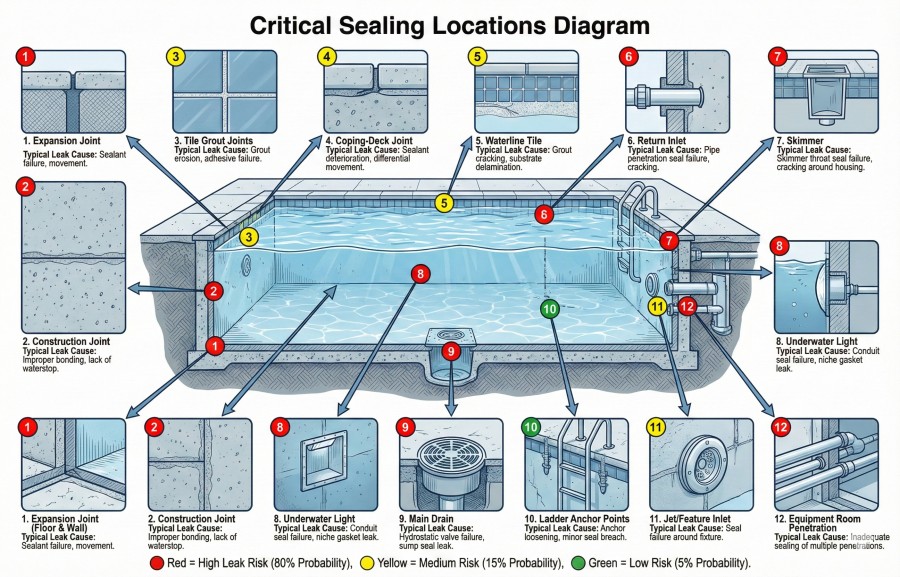
Every pool contains specific locations requiring careful sealing attention. Understanding these critical areas guides systematic waterproofing approach.
Expansion and Construction Joints
Movement joints in pools serve similar function as building expansion joints but operate in more demanding environment.
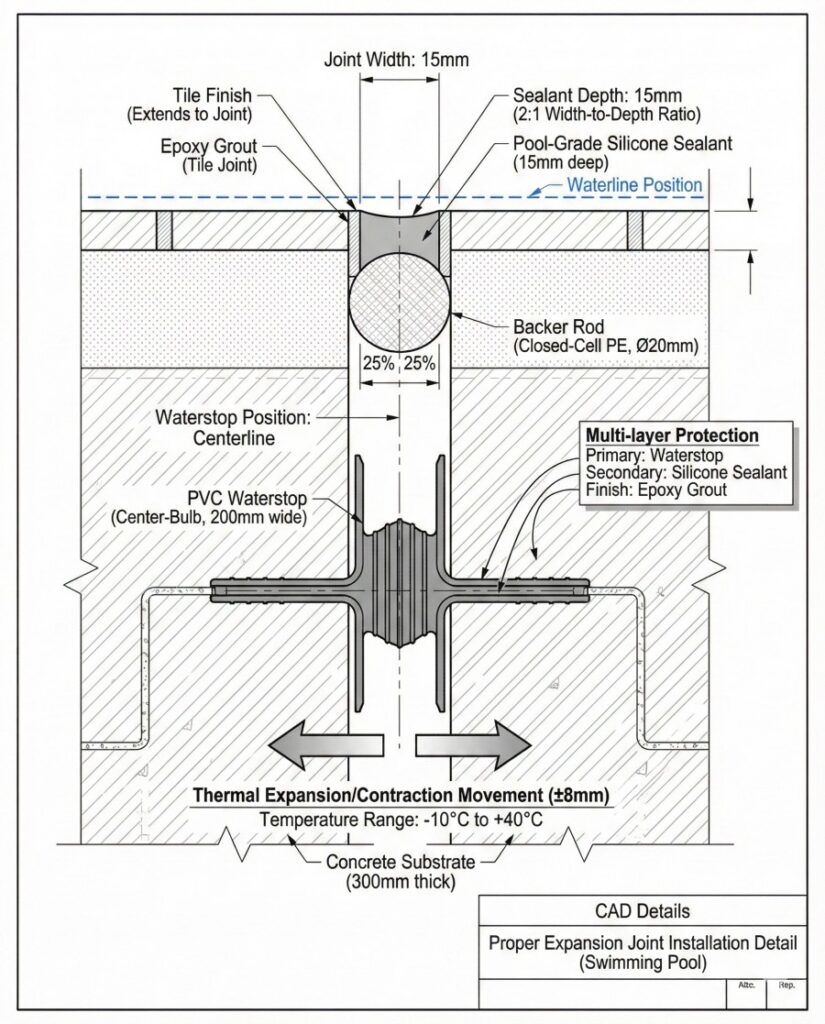
Expansion joints accommodate thermal movement in large pools. Typically placed every 10-15 meters in pool floor and walls, these joints prevent cracking from thermal stress. Joints must remain watertight while allowing ±10-15mm movement.
Typical expansion joint system:
- Backer rod (closed-cell polyethylene sized 25-30% larger than joint width)
- Primary sealant (pool-grade silicone or polyurethane)
- Waterstop (PVC or rubber) cast into concrete providing mechanical water barrier
- Secondary seal from integral waterproofing or applied membrane
Construction joints occur where concrete pours meet. These cold joints between adjacent pours create potential leak paths if not properly detailed. Waterstops installed during construction provide primary protection with surface sealing as backup.
Joint design principles:
- Minimum width: 12-15mm for adequate sealant mass
- Depth control: Backer rod achieving 2:1 width-to-depth ratio
- Clean substrates: Remove laitance, curing compounds, contaminants
- Primer if specified: Particularly for porous concrete or demanding conditions
Tile and Coping Joints
Decorative tile finishes require extensive joint sealing maintaining both waterproofing and aesthetics.
Tile-to-tile grout joints within pool shell serve dual purpose – aesthetic uniformity and waterproofing. Traditional cement grout proves porous and vulnerable to chemical attack. Epoxy grout offers superior water resistance and chemical durability for pool applications.
For optimal tile joint performance:
- Epoxy grout preferred for underwater tile joints
- Cement grout acceptable above waterline if properly sealed
- Joint width typically 3-6mm allows adequate grout filling
- Consistent depth ensures proper grout-to-tile adhesion
- Sealant over grout at movement joints prevents grout cracking
Coping-to-deck joints where pool coping stone meets surrounding deck experience severe exposure – water, chemicals, UV, thermal cycling, and foot traffic. This highly visible joint demands durable, attractive sealing.
Coping joint requirements:
- Pool-grade sealant resisting chemicals and UV
- Color matching to coping or grout for aesthetic continuity
- Proper geometry – typically 6-12mm wide depending on deck material
- Regular inspection – high-traffic location accelerates wear
- Proactive replacement every 8-12 years for premium appearance
Penetrations and Fittings
Every pipe, fitting, light, or accessory penetrating pool shell creates potential leak point.
Return jets and inlets bring filtered water back to pool. Wall fittings must seal around pipe penetration and provide watertight face. Manufacturers supply gaskets and o-rings for primary seal. Additional sealing with pool-grade sealant around fitting flange provides backup protection.
Skimmers and drains handle substantial water flow requiring robust sealing. Face gaskets seal between fitting and pool shell. Penetration sealing around pipe prevents water bypassing fitting. These critical components require periodic inspection as leaks here waste significant water.
Underwater lights create complex sealing challenge – electrical penetration requiring waterproof integrity. Modern LED lights use factory-sealed niches simplifying installation. Older incandescent lights require careful gasket installation and periodic seal inspection.
Ladder and handrail anchors penetrate pool deck and often shell. Decorative water features may include multiple penetrations for pumps, jets, lighting. Each penetration demands proper sealing with products compatible with continuous immersion.
Best practices for penetration sealing:
- Follow manufacturer installation instructions precisely
- Use all supplied gaskets, o-rings, and washers
- Apply pool-grade sealant as backup to mechanical seals
- Pressure test after installation before filling pool
- Document locations for future maintenance reference
Pool-to-Deck Interface
The perimeter joint where pool shell meets surrounding deck represents one of most leak-prone locations.
Why this joint fails frequently:
- Differential movement – pool and deck expand/contract differently
- Settlement – pool and deck founded differently may settle unevenly
- Water concentration – deck drainage directs water toward pool
- Freeze-thaw (in cold climates) – water freezing in joint damages sealant
- Traffic – walking around pool edge stresses joint
- Chemical exposure – pool water splashing onto joint
Proper pool-deck joint design:
- Intentional separation – pool and deck should not be monolithically connected
- Drainage consideration – slope deck away from pool or use drainage channel
- Adequate width – 12-20mm minimum allowing movement accommodation
- Proper depth – backer rod controlling sealant depth
- Premium sealant – pool-grade product with UV, chemical, and traffic resistance
For decorative coping: The visible joint between coping stone and deck requires color-matched sealant maintaining aesthetic appeal. Gray or tan sealants typically blend better than white in these applications.
Sealant Selection for Pool Applications
Not all sealants suit pool service – chemical resistance, water immersion tolerance, UV stability, and movement capability determine suitability. Using inappropriate products guarantees premature failure and expensive repairs.
Pool-Grade Silicone Sealants
Neutral-cure silicone sealants formulated for pool and spa applications provide optimal performance in aquatic environments.
Why silicone excels in pools:
- Excellent chemical resistance – withstands chlorine, bromine, salt, pool chemicals
- Superior water immersion performance – minimal water absorption, maintains properties
- Outstanding UV resistance – decades of exposure without degradation
- Wide temperature range – typically -40°C to +150°C handles all pool conditions
- Good movement capability – ±50% movement accommodates thermal expansion
- Long service life – 15-25 years in pool applications when properly installed
Limitations to acknowledge:
- Higher cost than economy sealants – but justified by longevity
- Cannot be painted – must match color to application
- May not adhere to some plastics without primers
- Requires clean, dry surfaces for optimal adhesion
For pool applications, specify neutral-cure (non-corrosive) formulations rather than acetoxy-cure products. Acetoxy silicones release acetic acid during cure which can corrode metal fittings and etch some tiles.
Products like pool-grade neutral silicones specifically formulated for aquatic service provide reliable performance. Always verify “pool and spa” designation rather than using general-purpose building silicones.
Polyurethane Sealants for Pools
Single-component moisture-cure polyurethane sealants offer alternative for certain pool applications.
Polyurethane advantages:
- Excellent adhesion to concrete, stone, tile, most substrates
- Good chemical resistance to pool chemicals (though inferior to silicone)
- Paintable when cured – useful for applications requiring color matching
- Abrasion resistant – suitable for trafficked areas
- Lower cost than premium silicones
Polyurethane limitations:
- UV sensitivity – requires UV-stable formulations for exposed applications
- Water sensitivity during cure – must protect from rain/moisture first 24 hours
- Shorter service life than silicone in harsh pool conditions (8-15 years typical)
- Less chemical resistance – chlorine may accelerate aging
Best polyurethane applications in pools:
- Above-waterline joints in covered or shaded areas
- Deck expansion joints where paintability desired
- Non-critical locations where economy important
- Temporary sealing during construction before permanent systems
For underwater joints or critical sealing, premium silicone generally preferred despite higher cost.
Epoxy Products for Tile and Structural Sealing
Two-component epoxy products serve specialized pool functions.
Epoxy grout for tile joints provides superior performance to traditional cement grout:
- Impermeable – essentially zero water absorption
- Chemical resistant – unaffected by pool chemicals at any concentration
- Stain resistant – doesn’t discolor or grow mold/algae
- Strong and durable – maintains integrity decades
- Color stable – doesn’t fade under UV or chemical exposure
Application considerations:
- Precise mixing required – wrong ratios prevent proper cure
- Working time limited – must use mixed material within pot life (30-60 minutes)
- Higher cost than cement grout – typically 3-5× price
- Skill required – more difficult than cement grout application
- Cleanup critical – epoxy extremely difficult to remove after cure
Epoxy sealants and coatings address structural sealing:
- Crack injection – epoxy injected into structural cracks creates strong repair
- Underwater repair – specialty epoxies cure underwater for occupied pool repairs
- Coating systems – epoxy coatings waterproof concrete providing chemical barrier
Specialized Pool Repair Products
Various specialized products address specific pool repair and maintenance needs.
Underwater repair putty (epoxy-based) allows temporary or permanent repairs without draining pool. Knead two parts together, apply underwater to cracks or holes, material cures in hours creating watertight seal. Useful for emergency repairs though proper permanent repairs preferable long-term.
Hydraulic cement stops active water leaks through pressure – sets rapidly even underwater. Mix powder with water, apply to leak point, material expands as it sets plugging leak. Typically used during construction or as temporary measure before proper waterproofing.
Pool putty (non-hardening) provides temporary sealing for winterization or testing. Permanently soft putty pressed into joints or around fittings. Remove and reapply as needed. Not suitable for permanent installation but useful for seasonal closure.
Installation Procedures for Pool Sealing
Proper installation proves as critical as product selection – even best products fail if improperly applied. Pool applications often require special techniques addressing continuous water exposure.
Surface Preparation for Underwater Sealing
Achieving proper adhesion in wet environments requires meticulous preparation.
For existing pools requiring re-sealing:
Drain completely when possible – working in dry conditions vastly improves results. Plan draining considering:
- Hydrostatic pressure relief – Install relief valves preventing pool from floating if groundwater high
- Waste water disposal – Treated pool water may require special disposal
- Weather timing – Avoid draining during heavy rain seasons
- Scheduling – Minimize pool closure time for commercial facilities
Surface cleaning critical importance:
- Remove all old sealant completely – new sealant won’t bond over old
- Acid wash or abrasive cleaning – Remove calcium deposits, algae, biofilm
- Rinse thoroughly – Eliminate all cleaning residues
- Allow drying – Concrete requires 48-72 hours minimum, longer in humid climates
- Verify dryness – Moisture meters confirm substrates adequately dry
For underwater repairs when draining impractical:
Some products cure underwater though performance generally inferior to dry installation. If underwater work necessary:
- Lower water level maximizing exposed joint area
- Abrasive cleaning underwater using wire brushes or pads
- Solvent cleaning removing oils and organics
- Use specifically rated products – only materials tested for underwater cure
- Apply generous beads – underwater application less precise
- Allow extended cure – underwater curing typically requires 2-3× normal time
Joint Preparation and Geometry
Proper joint design ensures sealant performs as intended.
Width sizing for pool joints:
- Small joints (6-10mm): Deck-to-coping, tile expansion joints
- Medium joints (10-20mm): Structural expansion joints, pool-deck perimeter
- Large joints (20-40mm): Major structural joints in large commercial pools
Depth control with backer rod:
- Select proper size – backer rod diameter 25-30% larger than joint width
- Closed-cell polyethylene – doesn’t absorb water
- Install at correct depth – achieving 2:1 width-to-depth ratio
- Avoid stretching – stretched backer rod may recoil distorting joint
- Bond breaker tape alternative for very shallow joints
Joint face preparation:
- Clean and dry – no dust, laitance, old sealant, oils
- Prime if specified – porous substrates may require primers
- Mask adjacent surfaces – painter’s tape creates clean lines
- Work in sections – complete manageable areas before material skins
Application Technique for Aquatic Environments
Pool sealing benefits from specific application techniques.
Environmental conditions:
- Temperature – Apply when substrate temp +10°C to +35°C
- Humidity – Moisture-cure products benefit from moderate humidity
- Rain protection – Protect from rain minimum 24-48 hours
- Avoid direct sun – Extreme heat can accelerate skinning making tooling difficult
Application process:
- Consistent bead size – Maintain steady gun speed and pressure
- Fill completely – Eliminate voids and gaps
- Tool immediately – Work while material flowable
- Concave profile – Recessed center sheds water and stresses sealant evenly
- Remove masking – Pull tape while sealant still soft
- Inspect carefully – Verify complete coverage without gaps
Curing requirements:
- Protect from water – Keep dry minimum cure time (24-72 hours product dependent)
- Avoid traffic – Keep foot traffic off joints until fully cured
- Allow complete cure – Full strength develops over 7-14 days typically
- Test before filling – Verify integrity before introducing water
Special Applications: Water Features and Decorative Pools
Decorative fountains, reflecting pools, and architectural water features create unique sealing challenges beyond standard pools.
Fountain and Water Feature Sealing
Decorative water features often incorporate materials and designs challenging to waterproof.
Natural stone features – stacked stone walls, carved fountains, stone basins – require sealing porous stone and ensuring joints remain watertight. Stone selection matters – dense stones like granite seal more easily than porous limestone or sandstone.
Sealing approach for stone features:
- Penetrating sealers on stone surface reduce absorption
- Waterproof membrane beneath stone provides primary barrier
- Joint sealing between stone pieces with flexible sealants
- Concealed catch basins waterproofed independently of decorative stonework
Mosaic tile features create thousands of tiny grout joints requiring careful execution. Glass tile mosaics popular in luxury installations demand:
- Proper thinset selection – Modified thinsets bond glass effectively
- Epoxy grout – Impermeable, stain-resistant, chemical-resistant
- Waterproof substrate – Applied membrane beneath tile
- Movement joints – Even small features require joints preventing cracking
Spillways and waterfalls concentrate water flow creating erosion and weathering. Reinforce these high-stress areas with robust waterproofing and durable sealants. Inspect frequently as damage here accelerates.
Infinity Edge and Vanishing Edge Pools
Infinity pools where water appears to vanish over edge create spectacular effects but demanding sealing requirements.
Critical sealing locations:
Weir edge where water overflows must maintain perfect level and seal against water bypass. Precise construction tolerances (±3mm over entire edge length) require expert workmanship. Sealant at weir-to-wall joint prevents water leaking behind weir wall.
Catch basin collecting overflow water requires comprehensive waterproofing – it’s essentially second smaller pool. Return system pumping water from catch basin back to main pool includes multiple penetrations requiring sealing.
Structural integration between main pool and catch basin/perimeter structures requires expansion joints accommodating differential movement while preventing leaks.
Saltwater Pool Considerations
Saltwater pools using salt chlorine generators create different chemical environment than traditional chlorine pools.
Salt concentration typically 3,000-4,000 ppm (0.3-0.4%) creates:
- Slightly corrosive environment – Affects some metals and materials
- Osmotic stress on certain sealants – Water movement driven by concentration gradient
- Different pH dynamics – Salt systems may drift toward higher pH
Sealant selection for saltwater:
- Verify salt compatibility – Not all pool sealants equally resistant
- Premium silicones generally suitable – Quality products resist salt exposure
- Inspect metal fittings – Salt accelerates corrosion of some metals
- Monitor more frequently – Salt may accelerate some degradation modes
Note: Despite “saltwater” name, these pools still use chlorine (generated from salt) – chlorine resistance remains essential.
Maintenance and Leak Detection
Proactive maintenance prevents small problems becoming expensive repairs, while systematic leak detection identifies issues before extensive damage occurs.
Routine Inspection Schedule
Regular inspections catch developing problems early.
Monthly visual inspection:
- Walk pool perimeter examining all visible joints
- Check coping-to-deck joints for gaps, cracking, or pulling away
- Inspect tile grout for cracks or missing sections
- Look for water staining on deck (indicates leakage)
- Verify equipment seals not dripping
- Check skimmer and return fittings for visible gaps
Seasonal detailed inspection:
- Examine expansion joints for deterioration
- Test sealant adhesion by gently probing with blunt tool
- Inspect penetration seals systematically
- Check underwater lights and fittings
- Assess overall sealant condition planning replacement schedule
Annual professional inspection (commercial pools):
- Comprehensive examination by qualified technician
- Pressure testing of plumbing systems
- Equipment seal verification
- Documentation of conditions and recommendations
- Planning for needed repairs or preventive replacement
Leak Detection Methods
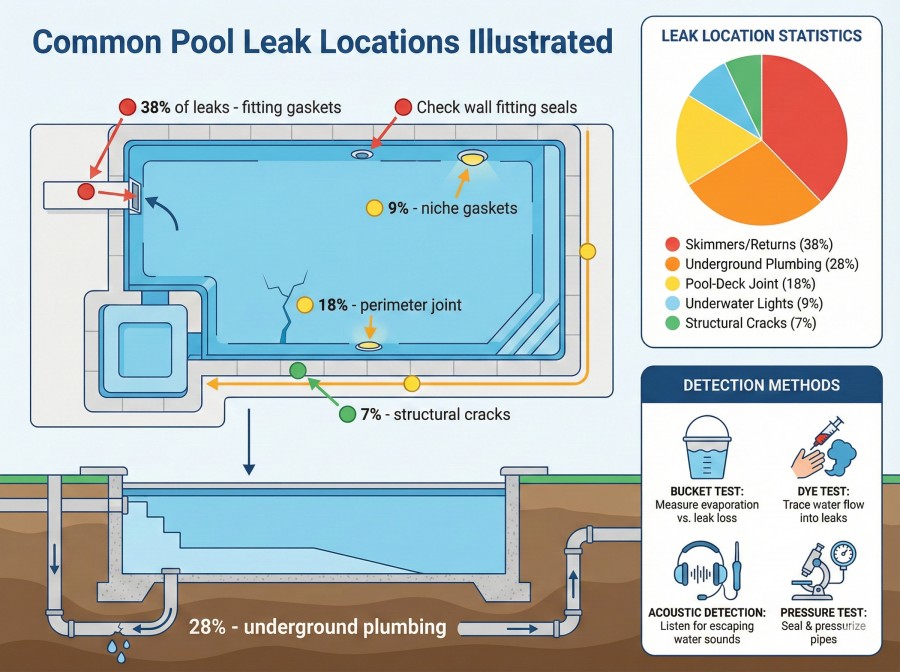
Pools naturally lose water through evaporation – distinguishing evaporation from leaks requires testing.
Bucket test (simple, free, anyone can do):
- Fill bucket with pool water
- Mark water level inside bucket and pool level outside bucket
- Place bucket on pool step (weighted down, water level even with pool)
- Wait 24 hours
- Compare level drop: If pool level dropped more than bucket = leak
Expected evaporation rates:
- Hot dry climates: 6-12mm per day
- Moderate climates: 3-6mm per day
- Humid climates: 1-3mm per day
Dye testing for visible leak identification:
- Use food coloring or specialized leak detection dye
- Inject near suspected leak (cracks, fittings, joints)
- Water movement draws dye toward leak
- Observe dye behavior confirming leak location
Professional leak detection uses specialized equipment:
- Pressure testing of underground plumbing
- Acoustic listening devices detect water flow sounds
- Helium or nitrogen injected into pipes, detector locates gas emerging
- Camera inspection of pipes and drains
- Thermal imaging identifies temperature differences from leaking water
Common leak locations by frequency:
- Skimmer and return fittings (35-40%)
- Underground plumbing (25-30%)
- Pool-deck perimeter joint (15-20%)
- Light niches (8-12%)
- Structural cracks (5-10%)
Repair and Re-Sealing Procedures
When leaks identified or sealants deteriorate, systematic repair restores pool integrity.
For joint re-sealing:
- Drain pool if practical (work quality vastly better)
- Remove old sealant completely – critical for new material adhesion
- Clean joints thoroughly – mechanical and chemical cleaning
- Dry adequately – rush jobs fail from trapped moisture
- Prime if specified – Some substrate/sealant combinations require primers
- Install fresh backer rod – Proper depth control
- Apply new sealant – Compatible products following procedures
- Cure completely – Resist temptation to refill too soon
- Test before filling – Verify repairs before commissioning
For structural crack repair:
- Epoxy injection for active structural cracks
- Routing and sealing for dormant hairline cracks
- Structural evaluation if cracking extensive
- Address underlying causes (settlement, hydrostatic pressure) not just symptoms
For penetration leaks:
- Often requires fitting replacement not just re-sealing
- Test plumbing systems verifying leak at fitting not underground line
- Use correct gaskets and washers – Don’t rely on sealant alone
- Backup seal with sealant after mechanical seals installed
Frequently Asked Questions
What type of sealant should I use around my pool coping and deck?
Use premium neutral-cure silicone sealants specifically rated for pool and spa applications – these provide essential resistance to chlorine, UV exposure, water immersion, and thermal cycling that pool environments demand. General-purpose construction sealants lack the chemical resistance and water immersion durability needed for pool service, typically failing within 2-5 years versus 15-25 years for proper pool-grade products. Look for products labeled “pool and spa,” “aquatic environment,” or “swimming pool approved” and verify specifications include chlorine resistance, UV stability, and ±50% movement capability. Neutral-cure formulations prove critical as acetoxy-cure silicones can corrode metal pool fittings and etch sensitive tile or stone. While pool-grade silicones cost 30-50% more than standard sealants, their longevity makes them far more economical over pool lifetime.
How do I repair a leaking pool without draining all the water?
Minor leaks from fittings, small cracks, or joint deterioration can often be repaired without complete draining using specialized underwater repair products, though drained repairs always provide superior results. Lower water level below repair area when possible – even reducing water level 30-50cm greatly facilitates work. For underwater crack repair, use underwater-cure epoxy putties that bond to wet surfaces and cure while submerged. For leaking fittings, specialized underwater sealants applied around fixture perimeters can stop leaks, though proper repair typically requires draining and fitting replacement with new gaskets. For expansion joint failures, underwater-cure polyurethane or hybrid sealants rated for immersion service provide temporary fixes. However, permanent repairs almost always require draining – underwater repairs should be considered interim measures or used only when draining proves absolutely impractical. Schedule comprehensive re-sealing during planned maintenance closures when pool can be properly drained, cleaned, and repaired under optimal conditions.
Can I use the same sealants for saltwater pools as regular chlorine pools?
Most premium pool-grade silicone sealants perform well in both traditional chlorine and saltwater pools, though always verify specific product ratings confirm salt compatibility. Saltwater pools still use chlorine (generated from salt via electrolysis) so chlorine resistance remains essential. The 3,000-4,000 ppm salt concentration creates additional stress from osmotic pressure and slightly increased corrosivity affecting some materials. Quality neutral-cure silicone sealants generally resist salt exposure adequately – these products handle both chlorine and salt. Avoid economy sealants or products not specifically rated for pool service as salt may accelerate degradation. Also consider metal components – saltwater corrodes some metals faster than traditional pools, affecting fittings and fixtures. When in doubt, contact manufacturers directly providing details of saltwater system for compatibility confirmation – responsible manufacturers maintain technical support helping select appropriate products for specific applications.
How often should pool expansion joints and sealants be replaced?
Pool expansion joints and perimeter sealants typically require replacement every 10-15 years in moderate climates or 8-12 years in harsh conditions (intense UV, extreme heat, heavy chemical use), though annual inspection identifies actual replacement needs based on observed condition. Premium silicone sealants in protected locations may last 20-25 years, while joints exposed to direct sun, heavy traffic, or concentrated chemicals deteriorate faster. Inspection indicators suggesting replacement need include: visible cracking or splitting, sealant pulling away from substrates (adhesion loss), hardening and loss of flexibility, significant discoloration or surface deterioration, gaps or voids developing in joints. Proactive replacement before complete failure prevents water infiltration damaging pool structure or surrounding areas – prevention costs far less than repairing water damage from failed seals. Commercial pools with daily use and constant chemical exposure warrant more frequent inspection (quarterly) and possibly earlier replacement than residential pools with seasonal use. Document installation dates and maintain inspection records enabling data-driven replacement scheduling rather than reactive emergency repairs.
What’s the best way to seal pool tile grout joints to prevent water penetration?
For optimal pool tile joint performance, use epoxy grout for all underwater joints rather than cement-based grout – epoxy provides virtually zero water absorption, complete resistance to pool chemicals, and permanent color stability that cement grouts cannot match. Traditional cement grouts remain porous allowing water penetration and providing pathways for chemical infiltration even when sealed. Epoxy grout costs 3-5 times more than cement grout and requires more skill to install (precise mixing ratios, limited working time, difficult cleanup), but longevity and performance justify the investment for underwater applications. For joints already using cement grout, apply penetrating grout sealers specifically rated for pool immersion and chemical exposure – reapply sealers every 2-3 years as they gradually wear. At movement joints (expansion joints crossing tile fields), use flexible silicone sealant instead of rigid grout – these joints must move so grout would crack. Color-match silicone sealant to grout for aesthetic continuity. For large commercial pools or high-end residential installations, specify epoxy grout from project start – retrofitting from cement to epoxy requires complete grout removal and reinstallation, proving extremely expensive.
Conclusion
Swimming pools and water features create uniquely demanding environments for waterproofing and sealing systems – continuous immersion, aggressive chemical exposure, severe thermal cycling, intense UV radiation, and structural movement combine to test materials far beyond typical building applications. Proper pool sealing requires understanding these challenges, selecting appropriately resistant products, implementing meticulous installation procedures, and maintaining vigilant inspection and maintenance programs.
Pool construction type fundamentally determines waterproofing approach and sealing requirements. Concrete pools require comprehensive waterproofing systems with multiple redundant barriers, extensive expansion joints, and careful attention to penetration and fitting details. Fiberglass pools simplify sealing requirements, focusing primarily on perimeter joints and penetration flanges. Regardless of construction method, certain principles apply universally: use pool-grade products specifically formulated for aquatic service, prepare surfaces meticulously before sealing, install proper joint geometry with backer rod, and protect work during cure periods.
The aquatic environment challenges sealants through mechanisms absent in building applications. Hydrostatic pressure forces water through any available path. Chlorine and other sanitizing chemicals create oxidizing environment degrading many materials. Thermal cycling from heated water and sun-exposed decking stresses adhesion. UV intensity doubles from water reflection. Only products specifically engineered for pool service – premium neutral-cure silicones, specialized polyurethanes, epoxy grouts, and purpose-designed repair compounds – provide reliable long-term performance in these conditions.
Critical sealing locations demand focused attention. Expansion joints accommodating thermal movement require flexible high-movement sealants with robust chemical resistance. Tile grout joints benefit dramatically from epoxy rather than traditional cement formulations. Penetrations for fittings, lights, and accessories need backup sealing beyond mechanical gaskets. Pool-to-deck perimeter joints face concentrated stress from differential movement, drainage, chemicals, and traffic requiring premium sealants and proper geometry. Systematic attention to all these locations prevents the vast majority of pool leaks.
Special applications – infinity edges, decorative water features, mosaic installations, natural stone fountains – create additional complexity. These architectural statements require specialized waterproofing approaches integrating aesthetic requirements with technical performance needs. Saltwater pools using salt chlorine generators demand verification that all sealants resist both chlorine and salt exposure.
Maintenance proves as critical as initial installation. Monthly visual inspections catch developing problems early. Annual professional examinations for commercial facilities identify issues before expensive failures. Leak detection distinguishing actual leaks from normal evaporation guides appropriate responses – bucket tests provide simple screening while professional detection using pressure testing, acoustic methods, or dye injection pinpoints exact leak locations. Proactive sealant replacement every 10-15 years prevents failures that could damage pool structures or surrounding areas.
Whether constructing luxury resort pools, maintaining hotel aquatic facilities, building residential pools, or creating decorative water features, investment in proper sealing products, skilled installation, and diligent maintenance proves economical over facility lifetime. Pool leaks waste water, increase chemical and energy costs, damage structures, and create liability risks far exceeding costs of quality waterproofing. Choosing appropriate products, following proven procedures, and maintaining vigilant oversight ensures pools and water features remain beautiful, functional amenities providing decades of reliable service.
Planning swimming pool construction, experiencing persistent leaks, or need expert guidance on aquatic facility waterproofing? Contact our technical team for professional support on product selection, system design, and installation specifications for pool and water feature applications.
Related Articles:
- Waterproofing Penetrations: Pipes, Cables, and Equipment
- Complete Guide to Choosing the Right Silicone Sealant
- Natural Stone Sealing: Preventing Staining and Damage
- Desert Climate Construction and Sealing Solutions
- Sealant Troubleshooting: Common Problems and Solutions
Industry Resources: