Natural stone installations represent substantial investments in luxury materials where improper sealing causes permanent staining, discoloration, or deterioration that destroys aesthetic value and requires expensive replacement. Standard construction sealants contain compounds that irreversibly stain marble, limestone, and other porous stones, turning premium materials into costly mistakes.
Understanding stone characteristics and selecting specialized non-staining sealants ensures these beautiful materials maintain their appearance for decades. Whether you’re working with marble facades in prestigious developments, granite countertops in luxury residences, or limestone features in heritage restorations, proper sealing protects your investment without compromising the stone’s natural beauty.
Understanding Natural Stone Types and Characteristics
Natural stones vary dramatically in composition, porosity, and sealing requirements. Treating all stone the same leads to problems – what works for granite may damage marble, and products safe for limestone might stain travertine.

Marble: The Luxury Standard
Marble consists primarily of calcium carbonate (CaCO₃) in crystalline form, created through metamorphism of limestone under heat and pressure. This composition makes marble both beautiful and vulnerable – it polishes to brilliant shine but remains sensitive to acids and certain chemicals.
Key marble characteristics:
- Highly porous – readily absorbs liquids and staining compounds
- Acid-sensitive – acids etch surface destroying polish
- Soft relative to granite – scratches more easily, requires gentle cleaning
- Wide color variation – from pure white Carrara to colored varieties
- Veining patterns – distinctive patterns vary dramatically between varieties
Marble’s porosity demands careful sealant selection. Many standard sealants contain compounds that migrate into marble and cause yellowing or discoloration. Only sealants specifically tested and certified as non-staining should contact marble surfaces.
Common marble types and their challenges:
White marbles (Carrara, Calacatta, Statuario) show staining most obviously. Any discoloration becomes immediately visible on pure white backgrounds. These demand the highest-quality non-staining products – no room for error exists.
Colored marbles (Verde, Rosso, Nero) tolerate imperfections better but still require proper products. Staining may be less obvious but remains permanent once it occurs. Don’t assume colored marble forgives inferior products.
Polished vs. honed finishes affect sealing differently. Polished marble has sealed surface from polishing reducing absorbency somewhat, while honed finishes remain more porous requiring greater attention to sealant compatibility.
Granite: Durable but Not Indestructible
Granite consists of quartz, feldspar, and mica in varying proportions, formed from slowly cooled magma deep underground. This composition creates extremely hard, dense stone resistant to scratching, heat, and most chemicals.
Key granite characteristics:
- Low to moderate porosity – denser than marble, less absorbent
- Excellent hardness – resists scratching and wear
- Acid-resistant – unlike marble, granite tolerates acidic cleaners
- Heat-resistant – handles high temperatures without damage
- Стабильность цвета – less prone to discoloration than marble
However, granite isn’t completely impervious. Some granite varieties remain quite porous, particularly lighter colors and those with visible mica content. These porous granites still require careful sealant selection to prevent staining, though requirements aren’t as stringent as marble.
Granite sealing considerations:
Black and dark granites typically have low porosity and may not require sealing for stain resistance. However, sealing still protects against etching from certain chemicals and makes cleaning easier.
Light-colored granites often show greater porosity and definitely benefit from sealing preventing oil and water-based stain absorption. Test absorbency before assuming granite doesn’t need protection.
Granite with visible mica tends toward higher porosity. The mica crystals create weak planes where liquids can penetrate. These granites require more attention than solid, dense varieties.
Limestone and Travertine: Porous and Vulnerable
Limestone consists of calcium carbonate (like marble) but without marble’s metamorphic crystalline structure. This makes limestone even more porous and vulnerable than marble to staining and acid damage.
Key limestone characteristics:
- Very porous – extremely absorbent, readily stains
- Soft and easily scratched – requires gentle maintenance
- Highly acid-sensitive – acids cause rapid etching
- Varied textures – from smooth to rough, affecting sealing
- Natural color variations – creams, tans, grays showing fossil content
Travertine, a variety of limestone formed from hot springs, features distinctive holes and cavities creating additional sealing challenges. These voids may extend deep into the stone requiring careful filling before sealing surface joints.
Limestone sealing demands:
Surface sealing alone may not suffice for very porous limestone. Stone may require impregnating sealers applied before installation, then joint sealing with compatible products during installation.
Filled travertine has resin-filled voids that may react with certain sealants. Проверьте совместимость between void-filling resins and joint sealants to prevent softening or discoloration.
Weathering exposure accelerates limestone deterioration. Exterior limestone absolutely requires sealing preventing water absorption that leads to freeze-thaw damage, efflorescence, or biological growth.
Sandstone and Slate: Variable Properties
Sandstone consists of sand grains cemented together, creating highly variable properties depending on grain size, cementing material, and compaction. Porosity ranges from moderate to extremely high affecting sealing requirements significantly.
Slate forms from metamorphosed shale, creating layered structure with excellent cleavage. While dense in solid areas, slate’s layered nature creates pathways for water penetration along cleavage planes.
These stones’ variable properties demand individual assessment rather than assuming uniform requirements across all sandstone or slate applications.
The Critical Importance of Non-Staining Sealants
The single most important requirement for natural stone sealing is using certified non-staining products. Standard construction sealants cause permanent damage to many stones – damage that cannot be reversed or repaired without replacing the stone.
How Sealants Stain Natural Stone
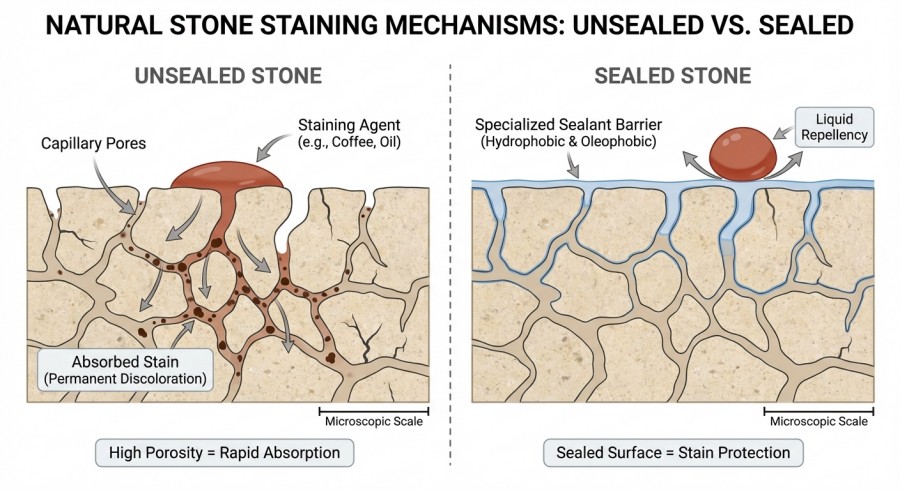
Staining occurs when sealant components migrate into porous stone and cause discoloration. Several mechanisms create this problem:
Plasticizer migration from sealant into stone creates yellowing or brown discoloration. Many standard sealants contain plasticizers maintaining flexibility, but these compounds can leach from sealant into adjacent porous materials. Once in the stone, plasticizers cannot be removed – the discoloration is permanent.
Uncured component migration happens when sealant catalyst or base compounds haven’t fully reacted. These unreacted materials may migrate into stone during the cure period, causing discoloration that appears days or weeks after application.
Fungicide and additive bleeding creates staining when anti-fungal compounds or other additives leach from sealants. While these additives serve important purposes in the sealant, their migration into stone creates problems. Specialized formulations prevent this migration while maintaining necessary product properties.
Oil-based contaminants in some sealants penetrate porous stone rapidly. White marble or limestone can absorb oil stains that spread outward from joint areas creating visible halos around sealed joints.
ASTM C920 and C1248 Compliance
ASTM C920 defines general-purpose construction sealant requirements, but these standards don’t address stone staining. A sealant can fully comply with ASTM C920 yet still catastrophically stain marble or limestone.
ASTM C1248 specifically addresses natural stone staining. This standard tests sealants for staining on marble, limestone, granite, and travertine through accelerated procedures detecting migration problems. Only sealants passing ASTM C1248 testing should be used on stain-vulnerable stone.
The test procedure places sealant samples on stone substrates, subjects them to elevated temperature, then evaluates stone for discoloration. Products causing visible staining fail the test, while products showing no discoloration pass.
However, testing specifics matter. ASTM C1248 allows testing on limited stone types – typically one marble, one limestone, one granite. A product passing on the test stones might still stain on stone varieties not tested. For critical projects with expensive stone, consider additional compatibility testing on actual project materials.
Selecting Certified Non-Staining Products
Product selection for stone sealing requires verification of non-staining certification. Don’t assume or guess – verify certification through technical data sheets or testing documentation.
Такие продукты, как BoPin 635 Natural Stone Neutral Silicone are specifically formulated for stone applications, meeting ASTM C1248 requirements for non-staining performance on marble, granite, limestone, and travertine. These specialized products cost more than standard sealants but protect stone investments worth far more than the sealant price premium.
Key features of quality stone sealants:
- ASTM C1248 certified non-staining – verified through actual testing
- Neutral-cure chemistry – no corrosive byproducts affecting stone or metal
- Excellent flexibility – accommodates stone movement without losing seal
- Устойчивость к ультрафиолетовому излучению – maintains properties through years of sun exposure
- Длительный срок службы – 20+ years protecting stone investments
Avoid products claiming stone-safety without certification. Marketing claims don’t equal actual testing. Insist on documentation showing ASTM C1248 compliance or independent testing verification.
Installation Methods and Sealing Requirements
Natural stone installation methods create different sealing requirements and challenges. Understanding installation systems helps select appropriate products and techniques.

Wet-Set Stone Installation
Wet-set (mortar-set) installation bonds stone directly to substrates using Portland cement-based mortars or adhesives. This traditional method remains common for floors, some wall applications, and certain exterior work.
Sealing considerations for wet-set stone:
Mortar contact with stone back doesn’t typically cause problems, but wet mortar at joint faces must not contact sealant until fully cured and dry. Applying sealant over damp mortar causes adhesion failure or potential staining from mortar moisture extracting sealant components.
Efflorescence potential increases with wet-set installation. Moisture moving through mortar can deposit salts at stone surfaces or joints. Proper cure time before sealing and adequate stone surface sealing reduces efflorescence risk.
Ширина шва in wet-set installations typically remains relatively narrow (3-10mm). These joints experience moderate movement from thermal expansion, requiring quality flexible sealants but not extreme movement capability.
Moisture in substrate affects cure time requirements. Wet-set installations retain moisture longer than dry-set systems. Verify adequate drying before sealing – moisture meters help confirm readiness.
Dry-Set and Mechanical Attachment
Dry-set installations use mechanical anchors, clips, or specialized adhesive systems keeping stone physically separated from substrates by air gaps. This method dominates exterior stone veneer and some high-end interior applications.
Sealing considerations for dry-set stone:
Wider joints (10-25mm) accommodate greater movement from thermal expansion and building deflection. These joints require sealants with higher movement capability (±25% to ±50%) than wet-set applications.
Backer rod installation becomes essential in wider joints preventing three-sided adhesion. Closed-cell backer rod sized 25% larger than joint width provides proper sealant depth control and geometry.
Вопросы дренажа matters more in dry-set systems. Some designs use open joints with drainage cavities behind stone rather than sealed joints. Understanding system design prevents sealing joints that should remain open for drainage.
Metal anchor corrosion from water infiltration through failed sealant joints threatens stone attachment. Proper sealing protects anchors extending system life significantly.
Countertop and Horizontal Applications
Countertops, vanities, and other horizontal stone surfaces face unique challenges from standing water, food/chemical exposure, and direct use contact.
Horizontal sealing challenges:
Standing water exposure tests sealant water resistance continuously. Sinks, cooktops, and wet areas keep sealed joints perpetually damp. Only premium waterproof sealants survive these conditions long-term.
Химическое воздействие from foods, cleaners, and personal care products attacks both stone and sealant. Acid-sensitive stones like marble require protective sealing plus user education about safe cleaning products.
Mechanical stress from use impacts and thermal shock (hot pans on cold stone) creates additional stresses beyond simple weathering. Sealants must remain flexible and maintain adhesion despite these forces.
Sanitary requirements demand easy-cleaning, mold-resistant sealants. Anti-fungal additives in sealants prevent mold growth in wet areas. Такие продукты, как BoPin 550 Санитарный силикон combine non-staining stone safety with anti-fungal protection for wet applications.
Application Best Practices for Stone Sealing
Proper application technique protects stone during sealing and ensures sealant performs as designed. Stone-specific procedures differ from standard construction sealing.

Surface Preparation Without Damage
Stone surface preparation must remove contaminants without damaging the stone itself. Aggressive methods safe for concrete or metal harm natural stone.
Cleaning stone surfaces:
Start with gentlest methods progressing to stronger only if needed. For most installations, clean water and soft cloths remove dust and light contamination adequately. Avoid acidic cleaners on marble, limestone, or travertine – even mild acids etch these stones.
Solvents for oil or adhesive removal must be stone-safe. Isopropyl alcohol works safely on most stone, while harsher solvents may stain or damage certain varieties. Test cleaning methods on inconspicuous areas or sample pieces before applying to visible surfaces.
Mechanical cleaning requires extreme caution. Wire brushing or abrasive scrubbing damages soft stones like marble or limestone. If mechanical cleaning is necessary, use only soft brushes with gentle pressure on vulnerable stones.
Drying thoroughly prevents moisture interfering with sealant adhesion. Allow adequate drying time after any wet cleaning – moisture meters verify readiness better than visual inspection or feel.
Protecting Stone During Application
Preventing sealant contact with stone faces protects against accidental staining or mess. Clean application proves easier than removing cured sealant from stone.
Masking tape protection along joint edges prevents sealant smears on stone faces. Use low-tack tape (painter’s tape) that removes cleanly without leaving adhesive residue. Apply tape carefully to create clean lines while ensuring it doesn’t interfere with sealant adhesion to joint faces.
However, tape removal timing matters. Remove tape shortly after tooling while sealant remains soft enough that tape removal doesn’t pull partially-cured sealant from joints. Waiting too long makes tape difficult to remove and may damage sealant edges.
Immediate cleanup of any sealant contacting stone faces prevents permanent problems. Wipe carefully with appropriate solvents before sealant cures. After cure, removal becomes difficult or impossible without damaging stone surface.
For spills or smears on polished stone, mechanical removal after full cure using razor blades held flat against stone sometimes works. However, prevention beats cleanup – careful application avoids the problem entirely.
Joint Design for Stone Applications
Proper joint geometry ensures sealant performs optimally throughout its service life.
Joint width recommendations vary by installation type and expected movement. Wet-set floors might use 3-6mm joints, while exterior dry-set facades need 12-20mm or wider depending on panel size and movement calculations.
Joint depth control using backer rod prevents three-sided adhesion and ensures proper sealant profile. Ideal depth-to-width ratio is approximately 1:2 – a 10mm wide joint should have 5mm sealant depth. Deeper joints don’t improve performance and waste material.
Выбор уплотнительного шнура for stone requires consideration beyond just size. Avoid closed-cell backer rod impregnated with oils that might stain stone. Standard closed-cell foam generally proves safe, but verify compatibility for critical projects.
Bond-breaker tape alternatives to backer rod work in very shallow joints. Polyethylene tape on joint bottoms prevents bottom adhesion while allowing minimal sealant depth.
Climate Considerations for Stone Sealing
Environmental conditions during application and service affect stone sealing success.
Temperature effects on stone differ from metal or concrete substrates. Stone holds temperature longer – cold stone remains cold despite warming air temperature. Warm substrates to acceptable working temperature before application, especially in cold weather.
Hot desert conditions challenge stone sealing particularly on dark stones. Black granite in summer sun may reach 70-80°C, creating difficult application conditions. Work during morning hours before extreme heat builds, or provide shade during application and initial cure.
High humidity accelerates moisture-cure sealant reactions benefiting cure speed. However, excessive moisture on stone surfaces interferes with adhesion. Balance humidity’s cure benefits against surface moisture problems.
Freeze-thaw exposure affects stone sealing similarly to other substrates – sealed joints must accommodate movement and prevent water infiltration that causes freeze-thaw damage. However, stone itself often suffers freeze-thaw damage if water penetrates through failed seals, justifying extra attention to sealing quality in cold climates.
Maintenance and Long-Term Stone Care
Proper maintenance protects sealed stone investments and extends sealant service life. Stone’s value justifies maintenance effort and cost.
Routine Cleaning Without Damage
Cleaning methods must remove dirt without harming stone or sealant. Many common cleaners damage natural stone despite claims of “safety.”
Safe stone cleaning:
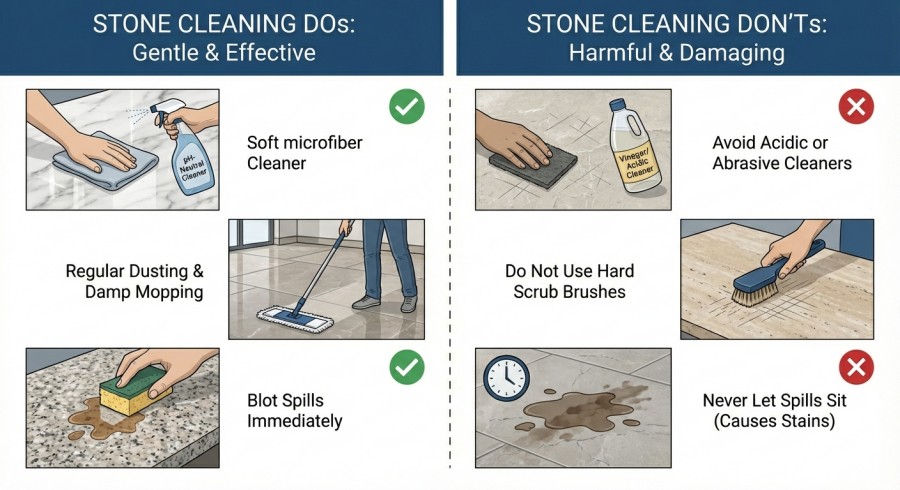
pH-neutral cleaners work safely on all stone types. Avoid acidic cleaners (vinegar, citrus-based products, many bathroom cleaners) on marble, limestone, or travertine – acids etch these stones permanently. Alkaline cleaners in high concentration may also cause problems on some stones.
Soft cloths and gentle scrubbing remove most dirt without abrading surfaces. Microfiber cloths work excellently for routine cleaning. Avoid abrasive scrubbers that might scratch soft stones or wear sealant surfaces.
Water-based cleaning handles most situations. Plain water cleans effectively without chemical risks to stone or sealant. For stubborn dirt, pH-neutral stone soap provides extra cleaning power safely.
Immediate spill cleanup prevents staining on unsealed or inadequately sealed stone. Acidic foods (wine, citrus, tomato), oils, and colored liquids should be wiped immediately rather than left standing on stone surfaces.
Sealant Inspection and Maintenance
Regular inspection catches sealant problems before they damage stone.
Annual visual inspection looks for:
- Gaps between sealant and stone indicating adhesion loss
- Cracks or tears in sealant allowing water infiltration
- Discoloration or staining appearing at joints suggesting problems
- Hardening or loss of flexibility from aging or UV degradation
- Biological growth on sealants in damp conditions
Stone condition around joints provides clues about seal effectiveness. Staining, efflorescence, or deterioration near joints suggests water infiltration through failed seals. Addressing joint problems may require resealing plus stone restoration.
Sealant re-application timing varies by product quality, exposure, and conditions. Premium products may last 20+ years, while standard products in harsh conditions might need replacement in 10-15 years. Base replacement decisions on actual condition rather than arbitrary schedules.
Addressing Stone Staining from Failed Seals
If sealant staining occurs despite precautions, some remediation options may help.
Fresh staining (within days of occurrence) sometimes responds to poultice treatments drawing staining compounds from stone. Specialized stone restoration companies have experience with various stain types and removal methods.
Old, set staining proves much more difficult to remove. In many cases, stained stone requires replacement as staining cannot be reversed. This harsh reality underscores the importance of using proper non-staining products initially.
Professional stone restoration may employ:
- Poultice treatments with absorption materials and solvents
- Chemical treatments targeting specific stain types
- Re-polishing in cases where staining remained shallow
- Replacement when staining has permanently damaged stone
Prevention through proper product selection proves far more economical than restoration attempts.
Regional Market Considerations
Different markets use stone differently, creating regional variations in sealing requirements and challenges.
Middle East: Luxury Marble Applications
Middle Eastern markets feature extensive use of premium marble and granite in both residential and commercial projects. Prestige developments often showcase rare and expensive stone varieties where any sealing errors create unacceptable losses.
Региональные соображения:
Extreme heat exposure requires sealants handling surface temperatures exceeding 70°C on exterior stone. Desert UV intensity demands maximum UV protection preventing premature aging.
Large-scale stone use in facades, flooring, and details creates proportionally large consequences from sealing mistakes. The scale of stone projects justifies investing in premium, certified products rather than risking problems with economy alternatives.
Water sensitivity in this arid climate might seem less critical, but luxury developments often feature water features and irrigation creating moisture exposure despite overall dry climate. Interior wet areas (baths, pools) require full waterproofing attention.
Dust and sand contaminate surfaces and interfere with adhesion if not properly removed. Surface preparation becomes more challenging requiring extra attention despite discomfort in hot conditions.
Southeast Asia: Tropical Stone Challenges
Tropical climates create different stone sealing challenges from constant humidity, biological growth, and sustained moisture exposure.
Региональные соображения:
High humidity accelerates sealant cure benefiting installation but also promotes mold and algae growth on stone and sealant surfaces. Противогрибковая защита becomes essential rather than optional.
Sustained moisture from rain and humidity keeps stone damp much of the year. Sealants must handle continuous moisture exposure without losing adhesion or developing mold.
Biological staining from algae, mold, or organic debris creates appearance problems. While not true stone staining from sealant migration, biological growth discolors stone if prevention measures fail.
Acid rain in some urban/industrial areas accelerates deterioration of marble and limestone. Proper sealing reduces acid penetration though it cannot eliminate surface etching entirely.
Europe: Heritage Restoration
European markets feature significant heritage restoration work on historic buildings where stone preservation demands specialized approaches.
Региональные соображения:
Original materials in heritage projects may include stone varieties no longer quarried or available. Any damage to original stone becomes irreversible loss of heritage fabric, making non-staining products absolutely mandatory.
Reversibility requirements in some conservation standards prefer sealants that could theoretically be removed if future treatments require it. Silicone sealants generally meet reversibility criteria better than some alternatives.
Aesthetic authenticity may require sealant colors matching original joint materials or stone colors. Custom color matching ensures repairs remain visually subtle.
Regulatory requirements for heritage work often exceed standard construction codes. Understanding applicable heritage protection regulations guides appropriate material selection and methods.
Часто задаваемые вопросы
How do I know if my sealant is safe for marble?
Only use sealants with documented ASTM C1248 certification for non-staining performance on marble. Check technical data sheets for specific certification statements – if ASTM C1248 isn’t mentioned, assume the product hasn’t been tested and shouldn’t be used on marble. Don’t rely on general marketing claims of “stone-safe” or similar language without specific testing certification. For high-value projects, consider requesting actual test reports documenting non-staining performance on the specific marble variety you’re using.
Can I use the same sealant for marble and granite?
Yes, sealants certified for marble (ASTM C1248) are safe for granite and most other natural stones. Marble represents the most vulnerable stone to staining, so products passing marble testing typically work safely on less porous or less sensitive stones like granite. However, verify the sealant provides adequate performance for the specific application – granite may need different properties (movement capability, UV resistance, etc.) than marble even if staining isn’t a concern.
What’s the difference between sealing stone joints and sealing the stone surface itself?
Герметизация швов uses flexible sealants filling gaps between stone pieces, preventing water infiltration and accommodating movement. Surface sealing (impregnating sealers) penetrates into stone itself protecting against staining from spills or contamination. These are different products for different purposes – joint sealants shouldn’t be applied to stone surfaces, and impregnating sealers don’t work for joint filling. Many installations require both – surface sealing for stain protection plus joint sealing for waterproofing.
How long does stone sealant last?
Premium non-staining silicone sealants in stone applications typically last 20-30 years when properly applied, though actual lifespan varies by exposure conditions. Exterior stone in harsh climates (desert heat, freeze-thaw cycling) may reduce lifespan to 15-20 years, while protected interior applications may exceed 30 years. Regular inspection every 3-5 years allows assessment of actual condition rather than assuming predetermined replacement schedules. Stone’s value justifies using premium products maximizing service life.
What should I do if sealant has stained my marble?
Contact professional stone restoration specialists immediately – fresh staining sometimes responds to treatment while old staining may be permanent. Poultice treatments, specialized solvents, or chemical treatments may draw staining compounds from stone if caught early. However, deep or long-established staining often cannot be removed, requiring stone replacement. This is why prevention through proper product selection proves so critical – restoration attempts are expensive, often unsuccessful, and never restore stone to original condition completely.
Заключение
Natural stone sealing demands specialized products and techniques far beyond standard construction practices. The permanent nature of stone staining from improper sealants makes correct product selection absolutely critical – mistakes cannot be easily corrected and often require expensive stone replacement.
ASTM C1248 certification provides the only reliable verification of non-staining sealant performance. Don’t trust marketing claims or assumptions – insist on documented certification for marble, limestone, travertine, and other staining-vulnerable stones. The modest premium for certified products proves insignificant compared to stone value and replacement costs.
Different stone types present varied challenges and requirements. Marble’s porosity and acid-sensitivity demands different treatment than granite’s durability, while limestone and travertine require even more careful product selection and application. Understanding stone characteristics guides appropriate sealing approaches.
Installation methods affect sealing requirements significantly. Wet-set installations with narrow joints create different conditions than dry-set facades with wide joints requiring different products and techniques. Matching sealant selection to installation system ensures optimal performance.
Proper application technique protects stone during sealing and ensures long-term success. Gentle cleaning methods, careful masking, proper joint design, and appropriate environmental conditions all contribute to successful stone sealing. Rushing work or cutting corners on premium stone projects proves false economy.
Regular maintenance extends both stone and sealant service life. Gentle cleaning with pH-neutral products, prompt spill cleanup, and periodic sealant inspection preserve stone investments. The value of natural stone justifies maintenance effort and cost.
Whether working with marble facades in prestigious developments, granite countertops in luxury residences, or heritage limestone restorations, proper sealing protects irreplaceable stone investments. Using certified non-staining products and following best practices ensures these beautiful materials maintain their appearance for generations.
Working with natural stone and need expert guidance on non-staining sealant selection? Свяжитесь с нашей технической командой for professional support on product selection and application techniques protecting your stone investments.
Статьи по теме: