Введение
Building materials expand when heated and contract when cooled—a physical reality that creates constant movement in every structure. Without proper accommodation, these movements generate enormous internal stresses that crack concrete, buckle cladding, and tear sealant joints. Understanding movement capability and proper joint design prevents these failures.
Movement capability defines how much expansion and contraction a sealant can handle while maintaining adhesion and seal integrity. It’s expressed as a percentage of the original joint width, such as ±25% or ±50%. This single specification determines whether your sealant succeeds or fails in real-world service.
Proper joint design goes hand-in-hand with movement capability—even the best sealant fails if installed in poorly designed joints. Joint width, depth, geometry, and substrate preparation all interact to determine long-term performance. This guide explains these critical relationships so you can specify and install sealing systems that last decades rather than months.
What is Sealant Movement Capability?
Movement capability measures the maximum joint expansion and contraction a sealant can accommodate without losing adhesion or tearing. It represents the fundamental performance specification that determines suitability for any application.
How Movement Capability Works
When a joint expands, the sealant stretches. When it contracts, the sealant compresses. The movement capability rating tells you the maximum percentage of stretch and compression the product can handle through repeated cycles while maintaining seal integrity.
For example, a sealant rated ±25% movement capability in a 20mm wide joint can handle:
- Expansion to 25mm (20mm + 5mm = 25% increase)
- Contraction to 15mm (20mm – 5mm = 25% decrease)
- Total movement range: 10mm (from 15mm to 25mm)
This expansion and contraction happens continuously as temperatures change, materials expand and contract, and structures respond to wind loads, seismic forces, and settlement.
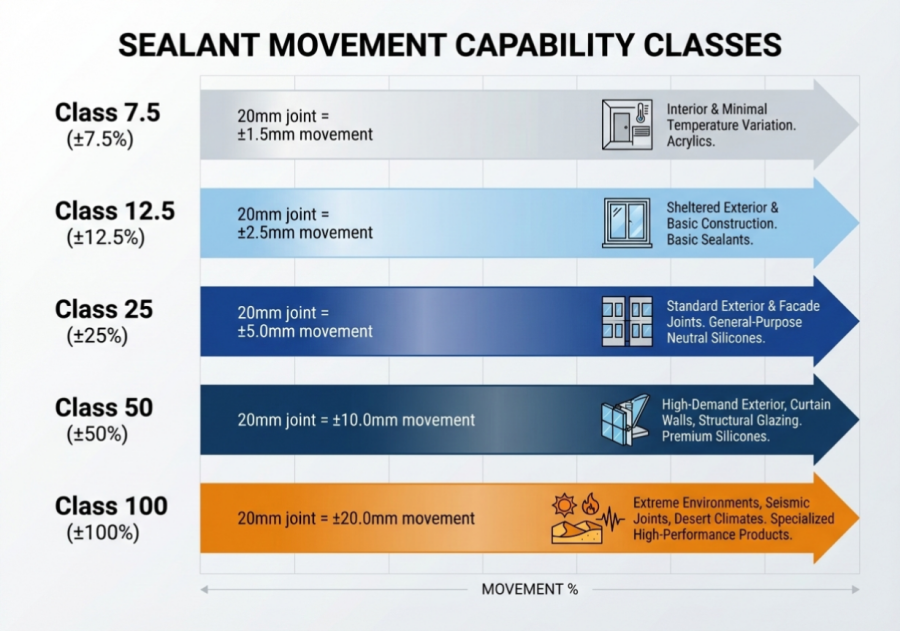
Movement Capability Classes
International standards classify sealants by movement capability:
Class 7.5 (±7.5% movement): Limited movement suitable only for interior applications with minimal temperature variation. Typical for acrylic sealants in climate-controlled spaces. Rarely adequate for exterior applications.
Class 12.5 (±12.5% movement): Low to moderate movement for sheltered exterior locations or interior joints with some temperature exposure. Common for basic construction sealants in temperate climates.
Class 25 (±25% movement): Standard movement capability for most exterior construction applications. Adequate for facade joints, window perimeters, and general weatherproofing in moderate climates. Products like general-purpose neutral silicones typically achieve this rating.
Class 50 (±50% movement): High movement capability for demanding exterior applications. Required for curtain walls, expansion joints, and applications with extreme temperature ranges or structural movement. Premium silicone sealants and specialized MS polymers reach this level.
Class 100 (±100% movement): Maximum movement for extreme applications including seismic joints, desert climate exposure, or situations combining multiple movement sources. Specialized high-performance products only.
Why Movement Capability Matters
Underestimating required movement capability causes the most common sealant failures. When joint movement exceeds sealant capacity, one of three failures occurs:
Adhesive failure: The sealant pulls away from one or both substrates, creating gaps where water, air, and contaminants penetrate. This is the most common failure mode when movement capability is exceeded.
Cohesive failure: The sealant tears internally, creating a split through the material. This typically occurs when the sealant is overstressed beyond its elongation capacity.
Combined failure: Both adhesion loss and internal tearing occur simultaneously, resulting in complete joint failure and the need for expensive remediation.
Proper movement capability selection with adequate safety margin prevents these failures by ensuring the sealant can handle actual service conditions plus reasonable contingency for unexpected stress.
Calculating Required Movement Capability
Accurate calculation of expected joint movement determines the minimum movement capability rating you need. This calculation combines thermal expansion/contraction with structural movement and safety factors.
Расчет теплового движения
Thermal expansion represents the primary movement source in most applications. The calculation follows a straightforward formula:
ΔL = α × L × ΔT
Где:
- ΔL = изменение длины (мм)
- α = коэффициент теплового расширения (на °C)
- L = length between joints (mm)
- ΔT = temperature change range (°C)
Коэффициенты теплового расширения распространенных материалов:
- Concrete: 10-14 × 10⁻⁶ per °C
- Steel: 12 × 10⁻⁶ per °C
- Aluminum: 23 × 10⁻⁶ per °C
- Glass: 8-9 × 10⁻⁶ per °C
- Stone (varies by type): 5-12 × 10⁻⁶ per °C
- Plastics/composites: 30-150 × 10⁻⁶ per °C
Practical Calculation Examples
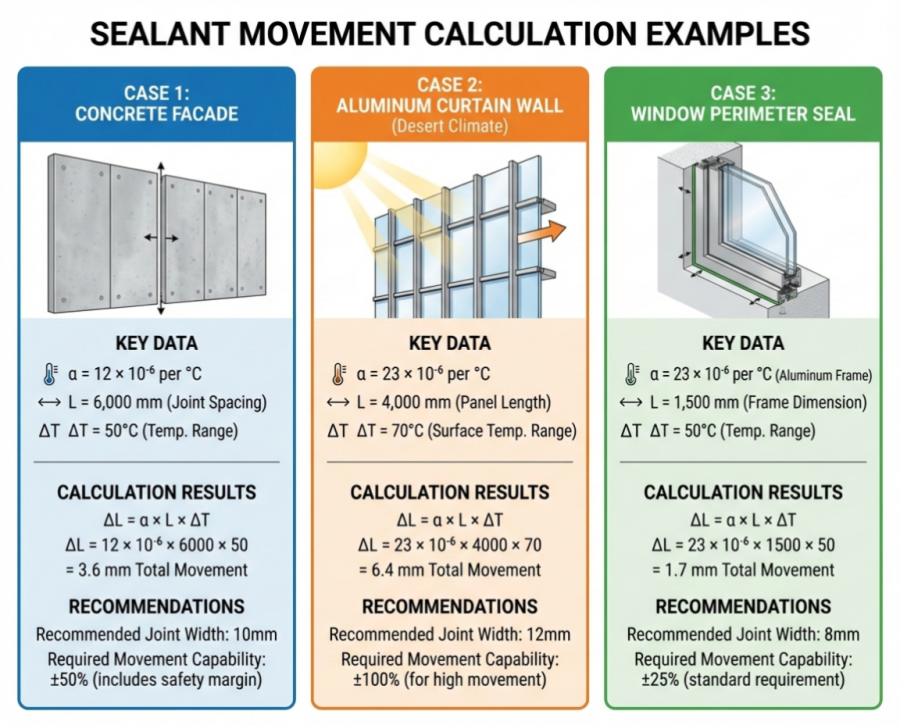
Example 1: Concrete building facade (temperate climate)
Given information:
- Material: Precast concrete panels, α = 12 × 10⁻⁶ per °C
- Joint spacing: 6,000 mm (6 meters between expansion joints)
- Temperature range: -10°C to +40°C (ΔT = 50°C)
Calculation: ΔL = 12 × 10⁻⁶ × 6,000 × 50 = 3.6 mm total movement
Joint sizing:
- Use 10mm joint width (provides comfortable capacity)
- Required movement capability: 3.6 ÷ 10 = 36%
- Select ±50% rated sealant for safety margin
Example 2: Aluminum curtain wall (desert climate)
Given information:
- Material: Aluminum panels, α = 23 × 10⁻⁶ per °C
- Panel length: 4,000 mm between movement joints
- Temperature range: +5°C to +75°C (ΔT = 70°C for dark panels in direct sun)
Calculation: ΔL = 23 × 10⁻⁶ × 4,000 × 70 = 6.4 mm total movement
Joint sizing:
- Use 12mm joint width
- Required movement capability: 6.4 ÷ 12 = 53%
- Select ±100% rated sealant or increase joint width to reduce stress
Example 3: Window perimeter seal
Given information:
- Material: Aluminum window frame, α = 23 × 10⁻⁶ per °C
- Frame dimension: 1,500 mm (one side of window)
- Temperature range: -5°C to +45°C (ΔT = 50°C)
Calculation: ΔL = 23 × 10⁻⁶ × 1,500 × 50 = 1.7 mm
Joint sizing:
- Use 8mm joint width
- Required movement capability: 1.7 ÷ 8 = 21%
- Select ±25% rated sealant minimum (±50% recommended for durability)
Determining Temperature Ranges
Surface temperatures differ significantly from air temperatures, especially for exterior applications. Consider these factors:
Direct sun exposure: Dark surfaces in direct sunlight can reach 40-50°C above ambient air temperature. A black metal panel in 35°C air might reach 75-80°C surface temperature.
Nighttime cooling: Clear night skies allow radiative cooling below ambient temperature by 5-10°C.
Seasonal extremes: Use actual local climate data showing historical minimum and maximum temperatures, not just average values.
Microclimate effects: Urban heat islands, reflective surfaces, and building orientation create local temperature variations.
Climate-specific temperature ranges:
Temperate regions: Typically -20°C to +50°C (ΔT = 70°C for exposed surfaces)
Hot arid climates (Middle East, North Africa): 0°C to +75°C (ΔT = 75°C), sometimes reaching +80°C for dark surfaces
Tropical humid climates: +15°C to +45°C (ΔT = 30°C), but with constant high humidity affecting cure and adhesion
Cold continental climates: -40°C to +40°C (ΔT = 80°C) with severe freeze-thaw cycling
Adding Safety Factors
Real-world conditions always introduce uncertainties requiring safety margin beyond calculated minimum requirements:
Standard safety factor: 25-50% above calculated requirement. If calculations show 30% movement needed, specify ±50% capability (not ±35%).
Reasons for safety margins:
- Construction tolerances create wider or narrower joints than designed
- Material properties vary from nominal values
- Unexpected loads or movements occur
- Temperature extremes exceed historical data
- Multiple simultaneous stress sources combine
- Long-term property changes affect performance
Critical applications (facade sealing, structural glazing, expansion joints) justify larger safety margins of 50-100% above calculated minimums.
Joint Design Principles for Optimal Performance
Even sealants with adequate movement capability fail if installed in poorly designed joints. Proper joint geometry, dimensions, and preparation ensure sealant stress distributes evenly and adhesion remains secure.
Width-to-Depth Ratio
The ratio of joint width to sealant depth critically affects performance. This geometric relationship determines how stress distributes through the sealant during movement.
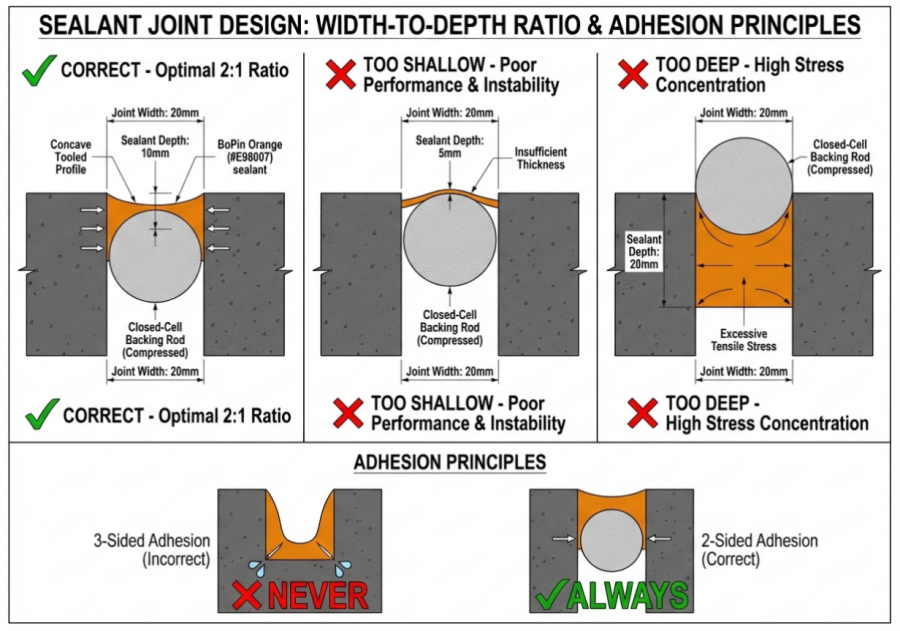
Optimal ratio: 2:1 width-to-depth for most applications
Например:
- 10mm wide joint → 5mm sealant depth
- 20mm wide joint → 10mm sealant depth
- 40mm wide joint → 20mm sealant depth
Why this ratio works:
Too shallow (wider than 2:1): The sealant becomes thin and unstable. Surface tension causes concave profiles that concentrate stress at edges. The sealant may not have sufficient thickness for proper tooling.
Too deep (narrower than 2:1): The sealant stretches excessively during expansion, concentrating stress and potentially exceeding elongation capacity. Compression forces during contraction may cause bulging or adhesion loss.
For narrow joints (less than 10mm wide), use 1:1 ratio: The minimum sealant depth should be 6mm even in narrow joints to ensure adequate material volume and adhesion area.
Three-Sided Adhesion Prevention
Sealants must bond to only two parallel sides of a joint, never the bottom. Three-sided adhesion creates stress concentration that tears the sealant during movement.
Use closed-cell polyethylene foam backing rod to:
- Control sealant depth precisely
- Prevent bottom adhesion
- Support the sealant during tooling
- Create proper surface contour
Backing rod sizing: Use backing rod diameter 25-30% larger than joint width. For a 10mm joint, use 12-13mm diameter backing rod. This ensures proper compression and fit.
Alternative bond breaker: When backing rod cannot be installed (very shallow joints or renovation), use polyethylene tape as a bond breaker on the joint bottom.
Never omit backing rod or bond breaker. This single mistake causes more joint failures than any other installation error.
Joint Width Guidelines
Minimum and maximum joint widths affect both performance and practicality:
Minimum joint width: 6mm for most applications
- Below 6mm, installation becomes difficult
- Tooling cannot create proper profiles
- Adhesion area may be insufficient
- Small variations have large proportional effects
Practical maximum: 40-50mm for single joints
- Above 50mm, consider multiple narrower joints
- Very wide joints require excessive sealant
- Deep applications take very long to cure
- Cost-effectiveness decreases
Typical facade joint widths:
- Window perimeters: 8-12mm
- Panel-to-panel joints: 10-20mm
- Expansion joints: 20-40mm (sometimes wider)
- Structural glazing: 6-12mm depending on system
Joint Spacing Considerations
How far apart should joints be placed? This depends on material properties, temperature range, and movement accommodation strategy.
General guidelines for concrete construction:
- Temperate climates: 30-60 meters maximum spacing
- Hot arid climates: 20-40 meters (more frequent joints)
- Lightweight cladding: 10-20 meters depending on material
Factors affecting joint spacing:
- Material thermal expansion coefficient
- Climate temperature extremes
- Structural system rigidity
- Construction methodology and sequencing
- Aesthetic considerations
More frequent joints with standard-capability sealants often prove more reliable than widely-spaced joints with maximum-capability products pushed to their limits.
Требования к подготовке поверхности
Proper adhesion depends absolutely on surface preparation. Even the best sealant fails on dirty, weak, or contaminated surfaces.
Essential preparation steps:
Уборка: Remove all dust, dirt, grease, oils, form release agents, old sealant residue, frost, and moisture. Use appropriate solvents (isopropyl alcohol for non-porous surfaces) and allow complete drying.
Profile verification: Ensure joint surfaces are sound, not friable or weak. Remove any loose material or weak surface layers.
Moisture removal: Surfaces must be completely dry unless using products specifically designed for damp conditions. Even “wet-surface” sealants perform better on dry substrates.
Primer application: Some substrates (porous concrete, certain plastics, weathered surfaces) benefit from or require primers. Follow manufacturer recommendations.
Proper surface preparation costs pennies but prevents failures costing hundreds or thousands to remediate.
Material-Specific Considerations
Different substrate materials require adapted joint design approaches due to varying thermal expansion rates, surface characteristics, and compatibility concerns.
Concrete and Masonry Joints
Concrete and masonry move relatively slowly with moderate thermal expansion coefficients. However, they present unique challenges:
Porosity: Concrete and masonry absorb moisture affecting cure and potentially weakening adhesion. Consider primers for highly porous substrates.
Alkalinity: Fresh concrete is highly alkaline, requiring neutral-cure sealants. Acetoxy silicones may cause adhesion problems on concrete.
Surface quality: Rough or irregular surfaces make proper sealant tooling difficult. Consider smoothing joint faces or using appropriate sealants for rough surfaces.
For concrete joints, products like BoPin 770 — влагостойкий нейтральный силикон provide excellent long-term performance with ±50% movement capability and proven concrete adhesion.
Metal Cladding Systems
Metal panels expand significantly more than concrete structures creating differential movement requiring careful joint design:
Aluminum cladding: With nearly double the expansion coefficient of concrete, aluminum panels create substantial movement. Joint design must accommodate both panel expansion and differential movement relative to structure.
Steel panels: Moderate expansion similar to concrete, but corrosion prevention requires non-corrosive neutral-cure sealants.
Composite panels: Variable expansion depending on core and facing materials. Verify actual material properties before calculating movement.
Metal substrate considerations:
- Use only neutral-cure sealants (never acetoxy)
- Ensure surfaces are clean and free from oils or protective coatings
- Consider thermal coating effects on adhesion
- Account for panel deflection under wind loads
Glass and Glazing Applications
Glass presents unique challenges combining low thermal expansion with high stiffness and aesthetic requirements:
Low movement: Glass expands less than surrounding frames, creating differential movement at perimeters.
Transparency concerns: Use only non-staining sealants on natural stone surrounds. Products like BoPin 635 Натуральный Каменный Силикон prevent migration-related discoloration.
Bite requirements: Structural glazing systems require minimum sealant bite dimensions for safety. Follow glazing industry standards precisely.
UV exposure: Glass applications receive maximum UV exposure. Use only UV-stable sealants with proven weathering performance.
Dissimilar Material Interfaces
Joints between different materials create additional complexity from differential expansion:
Metal-to-concrete: Aluminum expanding twice as much as concrete creates significant differential movement requiring high-capability sealants.
Glass-to-metal: Moderate differential but high precision requirements for aesthetic appearance.
Stone-to-concrete: Similar expansion rates but porosity differences affect adhesion and primer requirements.
Calculate differential movement separately from absolute movement and ensure joint design accommodates both.
Common Design Mistakes and How to Avoid Them
Understanding typical errors helps you avoid expensive failures that damage buildings and reputations.
Undersizing Joint Width
Attempting to minimize joint width for aesthetic reasons often results in joints too narrow for expected movement.
The mistake: Specifying 8mm joints where calculations show 6mm movement needed, leaving inadequate safety margin.
The consequence: Movement exceeds capability, causing adhesive or cohesive failure within months.
Решение: Use proper safety factors (25-50% minimum) when sizing joints. Remember that narrower joints require higher movement capability sealants, increasing cost. Sometimes wider joints with standard products cost less and perform better than narrow joints with premium materials.
Omitting Backing Rod
Skipping backing rod installation to save time or cost causes three-sided adhesion—the most common installation error.
The mistake: Filling joints completely with sealant or using inadequate bond breakers.
The consequence: Bottom adhesion restrains sealant movement, concentrating stress at edges and causing premature failure. The sealant tears or pulls away from substrates.
Решение: Always use properly sized closed-cell polyethylene foam backing rod. For very shallow joints, use polyethylene bond breaker tape. Never skip this critical step regardless of time pressure.
Ignoring Substrate Compatibility
Assuming all sealants work on all materials leads to adhesion failures on incompatible substrates.
The mistake: Using acetoxy silicones on concrete, mirrors, or metals where corrosion or adhesion problems occur.
The consequence: Adhesion failure, corrosion, or staining damages materials and requires expensive remediation.
Решение: Match sealant chemistry to substrate requirements:
- Concrete/masonry → Neutral-cure sealants only
- Metals → Neutral-cure, never acetoxy
- Natural stone → Non-staining formulations only
- Mirrors → Neutral-cure specifically rated for mirrors
Inadequate Temperature Range Consideration
Using air temperature instead of actual surface temperature severely underestimates movement in exposed applications.
The mistake: Calculating movement based on 40°C maximum air temperature when dark metal surfaces reach 70-75°C.
The consequence: Actual movement exceeds calculated values by 50% or more, overwhelming sealant capability.
Решение: Use realistic surface temperatures accounting for solar heating, especially for dark materials in direct sun. In desert climates, add 30-40°C to maximum air temperature for exposed dark surfaces.
Climate-Specific Design Strategies
Regional climate conditions dramatically affect both movement magnitude and required sealant properties.
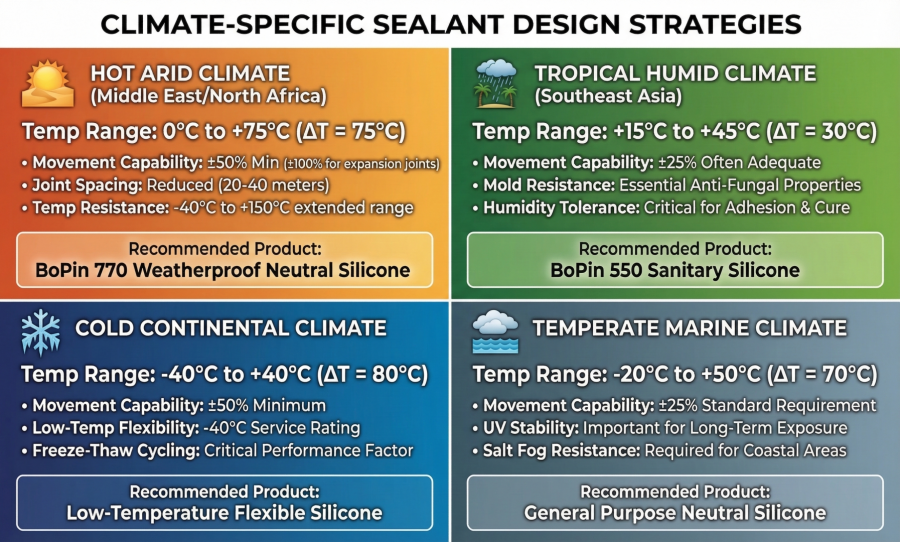
Hot Arid Climates (Middle East, North Africa)
Extreme temperature ranges create severe conditions:
Temperature ranges: Surface temperatures from 0°C at night to 75-80°C in direct sun (ΔT = 75-80°C)
Design strategies:
- Reduce joint spacing by 30-40% compared to temperate climate standards
- Use ±50% minimum movement capability sealants (±100% for expansion joints)
- Specify products with extended temperature resistance (-40°C to +150°C minimum)
- Increase joint widths to reduce stress percentages
Recommended products: High-performance neutral silicones with proven desert climate performance. BoPin 770 — влагостойкий нейтральный силикон provides ±50% movement capability with -50°C to +150°C temperature resistance suitable for extreme conditions.
Tropical Humid Climates (Southeast Asia)
Constant high humidity and moderate temperatures create different challenges:
Conditions: Smaller temperature ranges (ΔT = 30-40°C) but 80-100% relative humidity year-round
Design strategies:
- Movement capability less critical (±25% often adequate)
- Prioritize mold resistance and humidity-tolerant curing
- Ensure excellent adhesion in continuously damp conditions
- Consider increased UV resistance from intense equatorial sun
For sanitary applications in humid climates, specialized products like BoPin 550 Санитарный силикон provide anti-fungal protection critical for preventing mold growth in perpetually damp conditions.
Cold Continental Climates
Severe freeze-thaw cycling and wide temperature ranges demand robust solutions:
Conditions: Temperature ranges from -40°C to +40°C (ΔT = 80°C) with repeated freeze-thaw cycles
Design strategies:
- Specify low-temperature flexibility (minimum -40°C service rating)
- Ensure products maintain adhesion through freeze-thaw cycling
- Use ±50% movement capability minimum for exterior applications
- Consider primer requirements for frozen substrate installation
Temperate Marine Climates
Moderate temperatures but high humidity and UV exposure:
Conditions: Moderate temperature ranges (ΔT = 50-60°C) with high humidity and salt exposure
Design strategies:
- Standard movement capability (±25% minimum) usually adequate
- Prioritize UV stability and water resistance
- Ensure salt water compatibility for coastal applications
- Consider biological growth resistance
Часто задаваемые вопросы
What’s the difference between movement capability and elongation at break?
Movement capability (±%) describes the actual joint expansion and contraction the sealant can handle in service while maintaining adhesion. Elongation at break (%) measures how much the material can stretch in a laboratory test before tearing. Movement capability is always significantly less than elongation at break because it accounts for cyclic loading, adhesion stress, and safety margins. For example, a sealant with 600% elongation at break might be rated for ±25% movement capability.
Can I use a ±25% sealant in a joint that needs only ±15% movement?
Yes, using higher movement capability than required provides additional safety margin and generally improves long-term durability. The sealant won’t fail prematurely from over-specification. However, extremely high-movement products may be softer (lower Shore hardness) than needed, potentially affecting sag resistance in horizontal joints. For most applications, specifying one class higher than calculated minimum represents good practice.
How do I calculate movement for a joint between two different materials?
Calculate thermal expansion for each material separately, then add the absolute values to find total differential movement. For example, a joint between 3-meter aluminum panel (expansion = 4.1mm) and 3-meter concrete panel (expansion = 1.8mm) experiences differential movement of 4.1 + 1.8 = 5.9mm total. Design the joint to accommodate this combined movement.
What happens if I exceed the movement capability rating?
When joint movement exceeds rated capability, the sealant fails through one of three mechanisms: adhesive failure (pulling away from substrate), cohesive failure (tearing internally), or combined failure. The failure may not occur immediately – the sealant might survive a few cycles before failing, but each cycle damages the material until eventual failure. This is why adequate safety margin proves essential.
Should I use 2:1 or 1:1 width-to-depth ratio for my joint?
Use 2:1 ratio for joints wider than 10mm as this provides optimal stress distribution and sealant performance. Use 1:1 ratio for joints 10mm wide or narrower since maintaining 2:1 would create excessively shallow sealant depth. However, never go below 6mm sealant depth even in very narrow joints. For a 6mm wide joint, use 6mm depth (1:1) rather than 3mm depth which would be inadequate.
Заключение
Understanding sealant movement capability and proper joint design forms the foundation of successful building envelope systems that perform reliably for decades. Movement capability defines the expansion and contraction a sealant can handle, while joint design ensures this capability translates into real-world performance.
Accurate movement calculation combining thermal expansion, structural deflection, and appropriate safety factors determines the minimum required movement capability rating. Use the formula ΔL = α × L × ΔT to calculate thermal movement, but remember to account for actual surface temperatures rather than air temperatures. In extreme climates like Middle Eastern deserts, surface temperatures can reach 70-80°C, creating movements 50% larger than temperate regions.
Proper joint geometry—particularly the 2:1 width-to-depth ratio and three-sided adhesion prevention through backing rod use—ensures calculated movement capability actually performs as intended. Even the highest-rated sealant fails if installed in poorly designed joints. The few minutes required for proper backing rod installation prevents expensive failures requiring complete joint remediation.
Material-specific considerations affect both movement calculation and sealant selection. Aluminum’s thermal expansion coefficient nearly double that of concrete creates substantial differential movement at metal-to-concrete interfaces. Natural stone requires non-staining formulations, while concrete and metals demand neutral-cure chemistry for compatibility and durability.
Climate conditions dramatically affect both movement magnitude and required sealant properties. Desert climates with 75-80°C temperature ranges require ±50% minimum movement capability and extended temperature resistance. Tropical humid environments need anti-fungal protection more than maximum movement capability. Match your product selection to actual service conditions, not generic specifications.
Common mistakes—undersized joints, omitted backing rod, incompatible chemistry, and underestimated temperature ranges—cause the majority of field failures. These errors are easily avoided through careful specification and proper installation procedures. The cost of doing it right the first time represents a tiny fraction of failure remediation expenses.
When you combine accurate movement capability specification with proper joint design principles, you create sealing systems that accommodate building movement gracefully throughout their service life. The result is weathertight building envelopes maintaining performance and appearance for 20-30 years or more, protecting occupants and building systems while enhancing property value.
Need help calculating movement requirements or selecting appropriate sealant systems for your project? BoPin Chemicals provides technical support and application guidance to ensure optimal joint design and product selection. Our engineering team can review your specific conditions and recommend proven solutions that match your performance requirements and budget constraints.
Recommended Products for Movement Joint Applications:
- BoPin 770 — влагостойкий нейтральный силикон – ±50% movement, -50°C to +150°C, ideal for extreme climate facade joints
- BoPin 550 Санитарный силикон – ±25% movement with anti-fungal protection for humid climate applications
- BoPin 635 Натуральный Каменный Силикон – Non-staining formulation for natural stone joints
- Многоцелевой полимер MS BoPin MS-220 – ±50% movement, paintable finish for architectural applications
Related Technical Resources:
- How to Read Sealant Technical Data Sheets – Understanding movement capability specifications
- Complete Guide to Choosing the Right Silicone Sealant – Application-specific sealant selection
- Expansion Joint Design and Sealing Guide – Comprehensive movement joint design principles
- Desert Climate Construction Sealing Solutions – Extreme temperature application strategies