Receiving a good sealant sample is an important step in an OEM project.
But it is not the final step.
For importers and private-label buyers, one of the biggest purchasing risks is sample-to-bulk variation: the approved sample performs well, but the mass-produced product later looks, extrudes, cures or performs differently.
This does not always mean that a supplier intentionally changed the product.
Differences can also result from:
- An unclear sample identity
- Different production batches
- Different raw-material lots
- Colour adjustments
- Formula substitutions
- Filling-volume changes
- Packaging changes
- Production-scale processing
- Condições de armazenamento
- Incomplete quality-control requirements
The solution is not simply to ask the supplier:
“Please make the bulk order exactly the same as the sample.”
The buyer and supplier need a documented process that defines what “the same” actually means.
This guide explains how importers can control an OEM sealant order from sample approval through mass production and shipment.
Why an Approved Sample Can Differ from Bulk Production
A sample may be prepared under conditions that are different from full production.
For example, it may be:
- Taken from an existing production batch
- Made specifically for customer evaluation
- Filled manually
- Filled in a different cartridge
- Produced in a small trial batch
- Selected from another colour
- Prepared before the final packaging specification is confirmed
Once the buyer places a bulk order, production may involve:
- Larger raw-material batches
- Different mixing equipment
- A scheduled manufacturing line
- Colour matching at scale
- Automated filling
- Custom cartridges
- Custom labels
- Export cartons
- Multiple production dates
Therefore, the buyer should not treat the sample simply as “a tube of sealant.”
The sample should become a controlled reference.
The key principle is:
Approve the product in measurable terms, not only by visual impression.
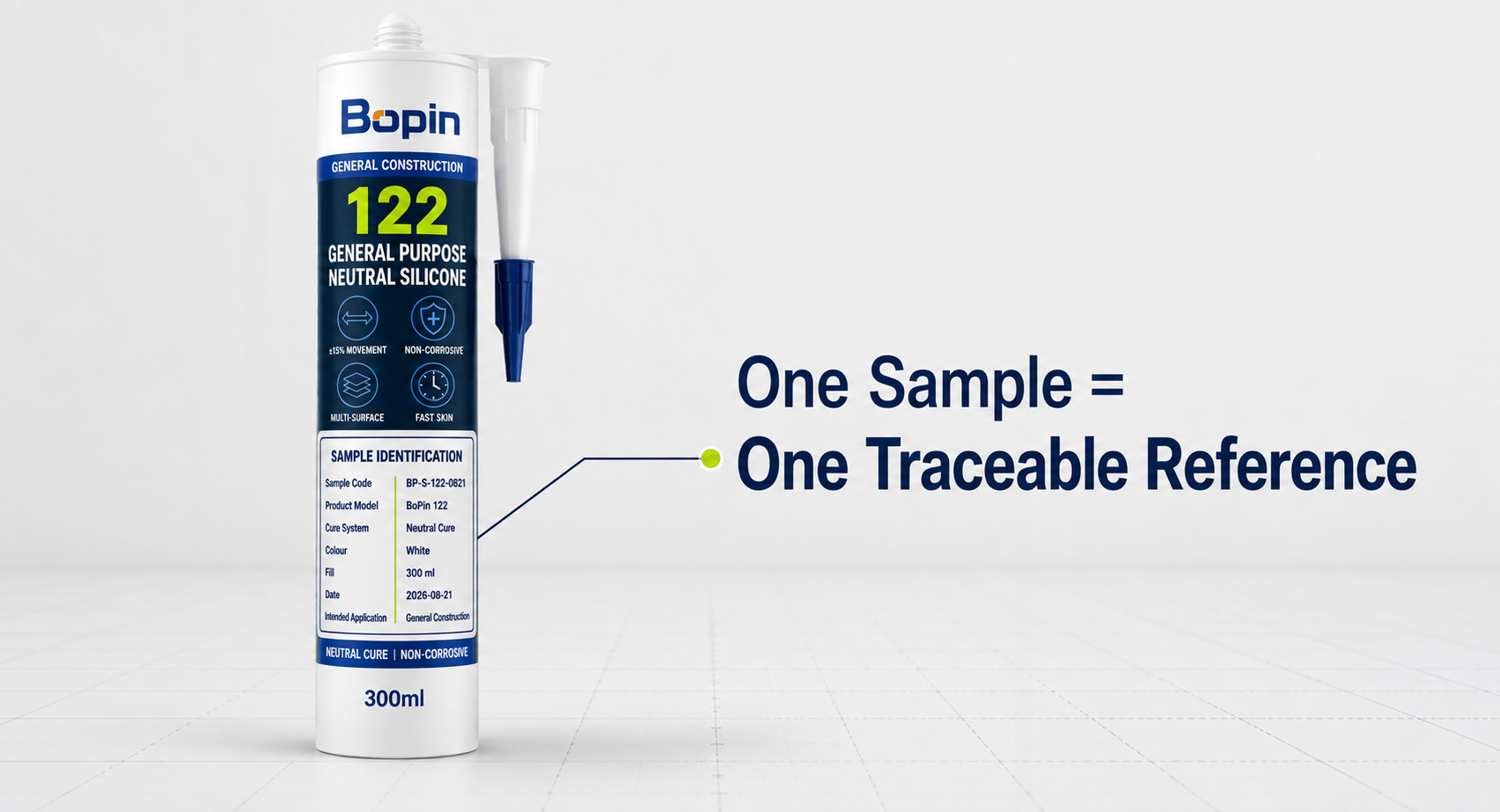
1. Give Every Sample a Clear Identity
The first control starts before sample testing.
Do not accept unidentified samples labelled only as:
- Neutral Silicone
- Premium Silicone
- High Quality
- Sample A
- Best Formula
Instead, every candidate should have enough information to trace it later.
Recommended Sample Identification
| Information | Example |
|---|---|
| Project | Bolivia Private Label Project |
| Sample code | BP-122-N-WH-260801 |
| Product | General Purpose Neutral Silicone |
| Supplier model | Confirmed internal/supplier reference |
| Cure system | Oxima neutra |
| Cor | Branco |
| Fill | 280ml |
| Sample date | 1 Aug 2026 |
| Batch reference | If available |
| Intended application | Aluminium frame to masonry |
| Benchmark | Buyer’s current local product |
A sample code does not need to reveal confidential formulation details.
Its purpose is traceability.
If the customer approves BP-122-N-WH-260801, both parties should later be able to identify exactly which product that code represented.
Why this matters
Without sample identification, a buyer may say:
“Please use the sample you sent last month.”
The supplier may have sent:
- Two neutral formulations
- Two colours
- One economy version
- One premium version
A vague approval can easily create misunderstandings.
2. Define What the Buyer Is Approving
“Sample approved” is too vague.
The buyer may actually be approving several different things:
- Cor
- Odor
- Extrusion
- Skin time
- Cure behaviour
- Adhesion
- Elasticity
- Surface finish
- Embalagem
- Net fill
- Application suitability
Each item should be considered separately.
Example Approval Table
| Evaluation Item | Result | Status |
|---|---|---|
| Cor | Matches target white | Approved |
| Extrusion | Smooth with manual gun | Approved |
| Formação da pele | Acceptable for installer | Approved |
| Adhesion to aluminium | Good after cure | Approved |
| Adhesion to concrete | Good after cure | Approved |
| Odor | Acceptable | Approved |
| Sag | No visible sag in trial | Approved |
| Tooling | Smooth finish | Approved |
| Cartridge artwork | Not yet reviewed | Pending |
| Carton artwork | Not yet reviewed | Pending |
This avoids a situation where a supplier interprets technical approval as packaging approval.
Product Approval and Artwork Approval Should Be Separate
A good process normally includes:
Technical Sample Approval
and later:
Packaging / Artwork Approval
The buyer may approve the formula while still requesting changes to:
- Label colour
- Nome do produto
- Claims
- Código de barras
- Carton
- Language
Do not combine all approvals into one vague message.
3. Create a “Golden Sample” or Approved Reference Sample
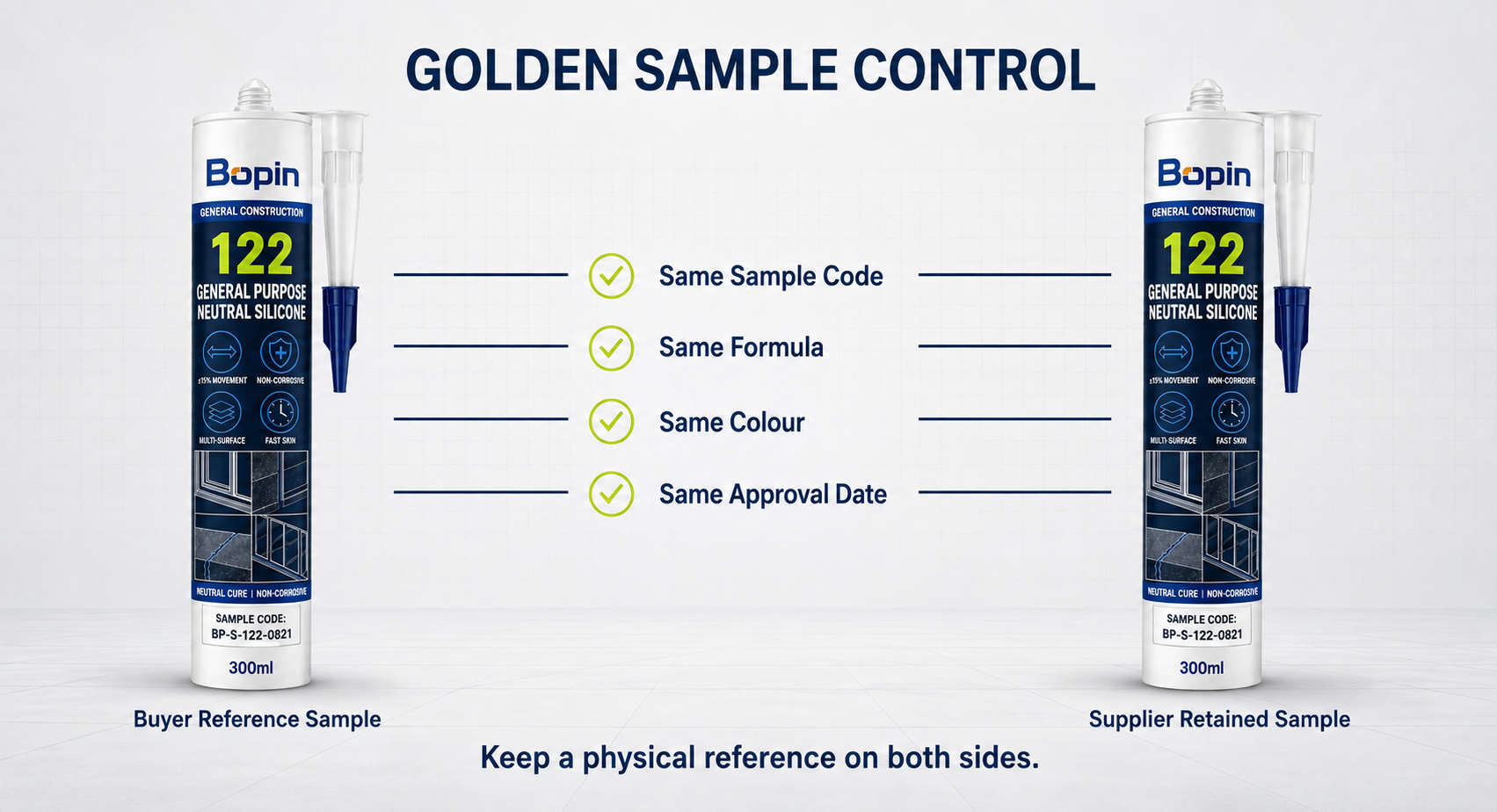
After testing, one physical sample should be treated as the approved reference.
This is often called a:
- Golden sample
- Master sample
- Approved reference sample
- Control sample
The terminology is less important than the process.
The approved sample should record:
- Sample code
- Product
- Formula/model reference
- Cor
- Embalagem
- Approval date
- Buyer
- Supplier
- Test result
- Any agreed deviations
Ideally:
- The buyer keeps one sample.
- The supplier keeps one matching sample.
- Both samples share the same identification.
What the Golden Sample Is Good For
It can help compare:
- Cor
- Odor
- Extrusion feel
- Surface appearance
- Embalagem
- General application behaviour
What It Cannot Replace
A physical sample does not replace:
- TDS
- SDS
- Agreed technical specifications
- Batch QC
- Laboratory testing
- Production records
Sealants also continue curing and ageing after manufacture, so a stored sample should not be treated as an eternal perfect reference for every property.
Use it as one part of the control system.
4. Lock the Formula and Manufacturing Source
This is one of the most important controls in an OEM order.
Before production, the supplier should confirm which formulation will be used.
The confirmation does not need to disclose proprietary percentages.
It should identify the commercial or internal manufacturing reference well enough to prevent uncontrolled substitution.
Buyers should confirm:
- Final supplier or manufacturing partner
- Final product model
- Formula reference
- Cure system
- Product level
- Cor
- Packaging size
- Key agreed properties
- Approved sample code
The supplier should not change the formulation or production source after approval without notifying the buyer.
Why formula substitution happens
Changes can result from:
- Raw-material availability
- Factory scheduling
- Target-price pressure
- Different colour requirements
- MOQ limitations
- Supplier replacement
- Production efficiency
Some changes may be technically acceptable.
The problem is not necessarily that a change occurs.
The problem is when it occurs without buyer review.
Recommended Contract Wording
The production formulation and manufacturing source shall correspond to the approved sample and confirmed product specification. Any material change that may affect product identity, technical performance, colour, cure chemistry or packaging claims requires buyer approval before production.
This does not prevent normal manufacturing tolerances.
It prevents uncontrolled product substitution.
5. Convert the Sample into a Written Product Specification
An approved sample should be supported by written parameters.
Depending on the product, these may include:
- Cure chemistry
- Appearance
- Cor
- Densidade
- Extrudability
- Skin time
- Taxa de cura
- Sag
- Dureza
- Resistência à tracção
- Elongation
- Capacidade de movimento
- Adhesion
- Embalagem
- Prazo de validade
Not every parameter needs to be a batch-release test.
But key characteristics should be documented.
Example
For a general neutral silicone, the practical specification could include:
| Control Item | Agreed Requirement |
|---|---|
| Cure system | Cura neutra |
| Cor | Approved white |
| Appearance | Smooth uniform paste |
| Net fill | 280ml |
| Densidade | According to confirmed TDS/specification |
| Skin time | Within agreed range |
| Extrusion | Smooth and consistent |
| Sag | No unacceptable vertical slump |
| Embalagem | Approved artwork |
| Prazo de validade | Confirmed in final documents |
The goal is to create a specification strong enough to define the product without pretending that every laboratory property is tested on every cartridge.
Typical Data vs Guaranteed Specification
Importers should understand the difference.
A TDS may contain typical values.
A purchase specification may define acceptance limits.
These are not always the same.
Por exemplo:
TDS:
Typical skin time: 20 minutes
Purchase control:
Acceptable skin time: 10–30 minutes under the agreed test condition
The second statement is more practical for production acceptance.
6. Confirm the Final TDS and SDS Before Mass Production
A common mistake is approving one sample while using documents from another product.
Before production, check that the final:
- Nome do produto
- Model
- Cure chemistry
- Technical parameters
- Informações de segurança
- Manufacturing source
are aligned.
The chain should look like:
Approved Sample → Final Formula → TDS → SDS → Packaging Claims
not:
Approved Sample A + TDS from Product B + Packaging Claims from Product C
This is particularly important when the supplier has several similar formulas.
Ask for document revision control
Useful fields include:
- Document title
- Product code
- Revision
- Issue date
If a formula or important technical condition changes, the relevant documents should be reviewed.
BoPin’s current OEM process also treats final technical documents as something to be aligned with the confirmed formulation rather than using preliminary product-selection data as the final shipment specification.
7. Approve Colour Separately
Colour can become a significant sample-to-bulk issue.
A small sample may appear acceptable, while a bulk batch looks slightly different.
Possible causes include:
- Pigment lot
- Base formula
- Production batch
- Curing stage
- Lighting
- Substrate
- Cartridge colour
- Visual perception
For standard colours
Exemplos:
- Limpo
- Branco
- Preto
- Cinzento
The supplier should still confirm the final production colour.
For custom colours
Use:
- Physical reference sample
- Colour code where appropriate
- Buyer-approved cured sample
Do not approve colour only from:
- WhatsApp photo
- Phone screen
- PDF artwork
- Computer monitor
Compare Cured Product
Some sealants may appear slightly different before and after curing.
For important colour-matching projects, compare the fully cured product.
Packaging Colour Is Not Product Colour
Keep these controls separate:
Sealant colour
e
Label / cartridge printing colour
They may have different tolerances and approval methods.
8. Lock Net Content and Fill-Weight Control
Sample-to-bulk consistency is not only about formulation.
The buyer should also confirm the amount of product supplied.
Important fields include:
- Cartridge capacity
- Declared net content
- Densidade
- Approximate net weight
- Filling tolerance
- Quantidade por caixa
For example, a 300ml-style cartridge may be used for a 280ml OEM programme.
That can be commercially acceptable when:
- Net content is clearly declared
- Artwork matches the declared fill
- Filling control is defined
- Carton weight is consistent
Use Density as a Control Tool—Not a Quality Score
If density is approximately known, expected fill weight can help detect abnormal underfilling.
No entanto:
Higher density does not automatically mean worse quality, and lower density does not automatically mean better quality.
Density should be compared only against the confirmed formulation.
What affects silicone sealant price
9. Confirm Packaging Before Production Starts
The product may be technically correct but commercially unusable if the packaging is wrong.
Before printing or filling, approve:
Cartridge
- Brand
- Modelo do produto
- Nome do produto
- Cure chemistry
- Net content
- Cor
- Claims
- Código de barras
- Batch area
- Safety text
Carton
- Modelo do produto
- Cor
- Units per carton
- Net content
- Gross/net weight where required
- Código de barras
- Shipping marks
Packaging Materials
Also confirm:
- Cartridge
- Piston
- Nozzle
- Cap
- Label
- Printed film
- Sausage foil
- Carton
- Divider
A packaging-material change may affect usability.
Por exemplo:
- Poor cartridge rigidity
- Leaking piston
- Blocked nozzle
- Weak carton
- Poor label adhesion
can create customer complaints even when the sealant formula itself is acceptable.
10. Agree on a Practical Production QC Plan
The importer should know what the factory checks during production.
A practical QC process may include:
| Stage | Typical Control |
|---|---|
| Raw materials | Identity and batch control |
| Mixing | Formula/process record |
| Appearance | Uniform paste and colour |
| Filling | Net content / weight control |
| Extrusion | Application consistency |
| Skin time | Cure initiation |
| Sag | Vertical stability |
| Embalagem | Cartridge, label and carton |
| Batch coding | Traceability |
| Final inspection | Quantity and visible defects |
The exact plan depends on:
- Product
- Order size
- Risk level
- Market requirements
- Buyer specification
Not Every Test Belongs on Every Batch
Some properties may require:
- Several days of curing
- Special equipment
- Destructive testing
- Third-party laboratories
Examples may include:
- Full tensile strength
- Elongation
- Long-term weathering
- Stone staining
- Fire performance
These may be controlled through:
- Formula validation
- Periodic testing
- Supplier qualification
- Third-party reports
rather than repeated for every shipment.
The buyer should distinguish between:
Batch-release QC
e
Product qualification testing.
11. Use Sampling Inspection Correctly
A large order may contain thousands or tens of thousands of cartridges.
Inspecting every item manually is often impractical.
Sampling inspection can be useful for visible or countable defects such as:
- Printing error
- Wrong label
- Damaged cartridge
- Missing nozzle
- Incorrect colour marking
- Poor carton
- Barcode error
- Leakage
- Missing batch code
ISO 2859-1:2026 provides acceptance-sampling schemes based on AQL for lot-by-lot inspection by attributes.
However, importers should not misunderstand AQL.
AQL Is Not a Sealant Performance Specification
An AQL plan can help decide how many units to inspect for defined defects.
It does not prove:
- Adhesion
- Capacidade de movimento
- Cure performance
- Weather resistance
- Stone compatibility
- Fire performance
These require appropriate technical controls.
Define Defect Categories
A buyer may classify defects as:
Critical
- Wrong chemical product
- Serious safety-labelling error
- Major leakage
- Incorrect product identity
Major
- Wrong colour
- Incorrect net-content label
- Missing nozzle
- Unreadable barcode
- Serious cartridge deformation
Minor
- Small print variation
- Cosmetic carton mark
- Minor non-functional appearance defect
The exact acceptance criteria should be agreed before inspection.
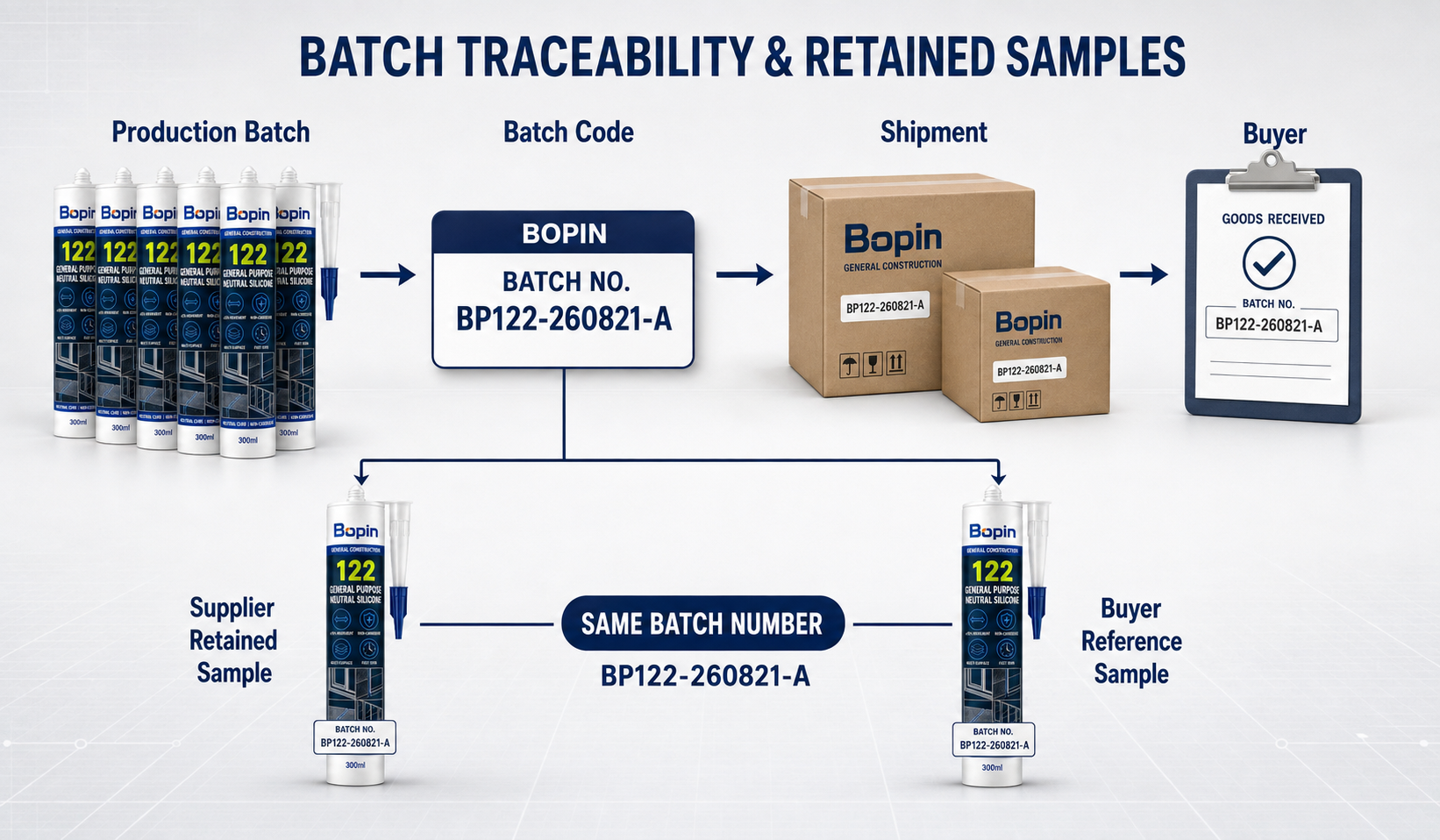
12. Keep Retained Samples from Production
A retained sample is one of the most useful tools when a complaint occurs later.
For each production batch, retain samples can help answer:
- Was the complaint product from this batch?
- Does the retained product extrude normally?
- Is the colour consistent?
- Does it cure normally?
- Is the packaging the same?
- Is the problem related to transport, application or production?
Recommended Retain Information
- Product
- Número do lote
- Cor
- Data de produção
- Quantity produced
- Embalagem
- Formula reference
- Customer/order reference
Where practical, the supplier should retain several units under appropriate storage conditions.
The buyer may also keep shipment samples after receiving the goods.
Retention Period
The appropriate period depends on:
- Prazo de validade
- Warranty structure
- Customer complaint cycle
- Supplier QC policy
At minimum, retained samples should remain useful during the period when a shipment complaint would reasonably arise.
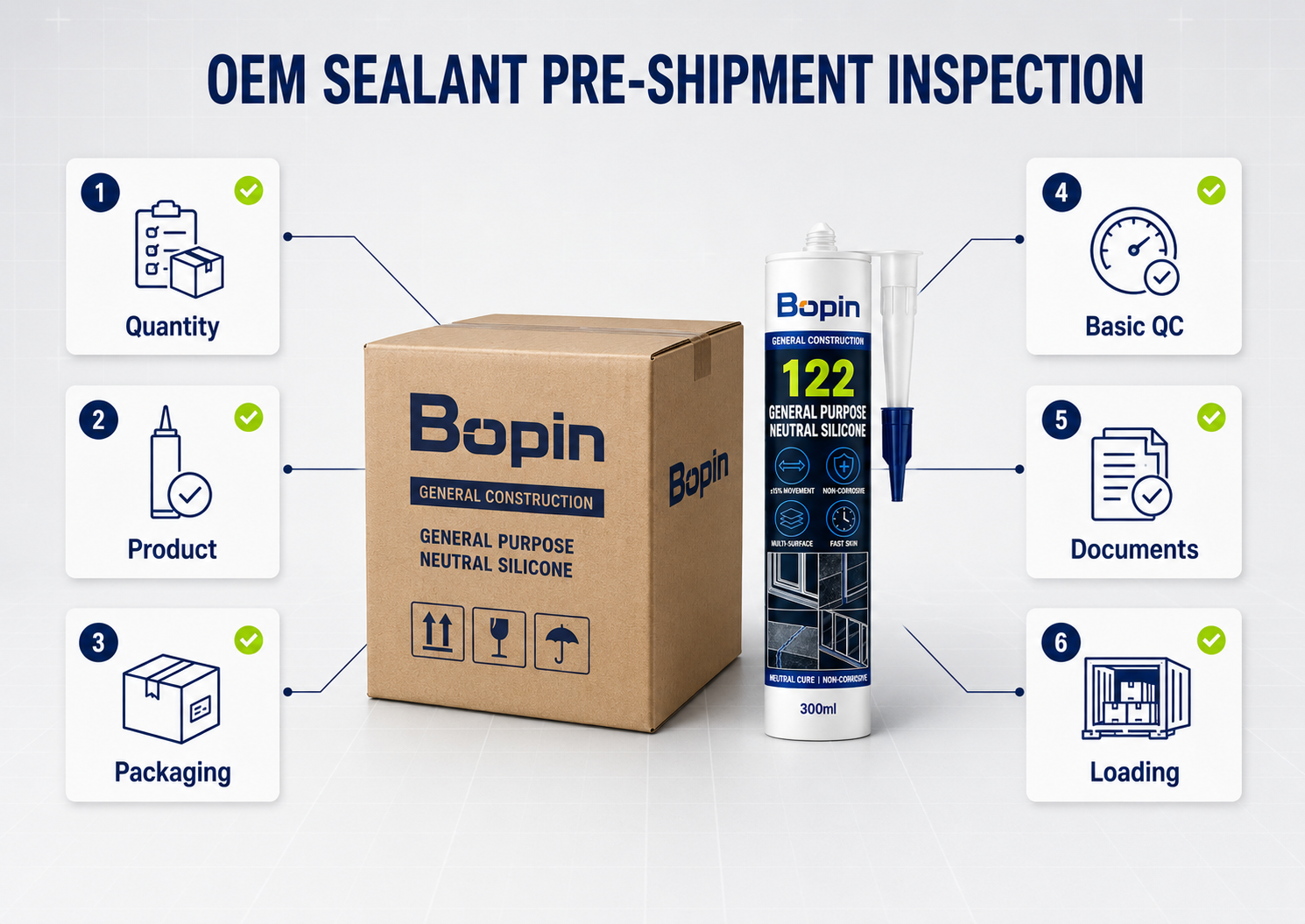
13. Perform a Pre-Shipment Inspection
Before releasing the final balance or shipment—depending on the agreed payment terms—the buyer may perform or request a pre-shipment inspection.
The inspection can be completed by:
- Supplier QC
- Buyer representative
- Sourcing partner
- Independent inspection company
Typical Pre-Shipment Checks
Quantity
- Total cartons
- Units per carton
- Total units
Product Identity
- Correct product
- Correct model
- Correct colour
- Correct batch
Embalagem
- Correct cartridge
- Correct label
- Correct carton
- Código de barras
- Date coding
- Shipping mark
Physical Condition
- No leaking
- No cracked cartridges
- No major deformation
- No damaged cartons
Basic Product Checks
Depending on the agreement:
- Appearance
- Extrusion
- Formação da pele
- Densidade
- Fill weight
- Sag
- Cor
Documentação
- Packing list
- Invoice
- TDS
- SDS
- COA where agreed
- Relevant inspection records
Loading
Record:
- Pallet or loose loading
- Carton condition
- Container number
- Seal number
- Loading photos
14. Introduce Change Control
A long-term importer may buy the same product for several years.
During that time, suppliers may change:
- Raw-material source
- Manufacturing equipment
- Packaging supplier
- Cartridge
- Pigment
- Formulation
- Production site
Not every change is a problem.
But important changes should be controlled.
Changes That May Require Buyer Notification
- Cure chemistry
- Main formulation
- Manufacturing site
- Product density range
- Movement classification
- Cor
- Declared net volume
- Safety classification
- Packaging claim
- Important raw material affecting performance
- Test/certificate status
Recommended Principle
No material change affecting agreed product identity, performance, safety or packaging claims without documented review.
For minor production improvements that do not affect the agreed specification, the supplier may not need individual approval.
The purpose of change control is not to freeze manufacturing forever.
It is to prevent unexpected changes in the product the buyer is selling.
15. Plan What Happens If a Batch Is Out of Specification
Quality control is incomplete if the agreement only explains how good material is accepted.
It should also explain what happens when something is wrong.
Possible issues include:
- Wrong colour
- Skin time outside agreed range
- Packaging error
- Incorrect fill
- Damaged cartons
- Label mismatch
- Abnormal extrusion
- Batch inconsistency
Recommended Process
1. Identify
Record the affected batch.
2. Hold
Do not ship or use affected material until reviewed.
3. Investigate
Determine whether the issue comes from:
- Formula
- Filling
- Embalagem
- Storage
- Testing
- Transport
4. Decide
Possible outcomes:
- Accept
- Rework
- Repack
- Reproduce
- Replace
- Commercial concession
- Reject
5. Correct
Identify how recurrence will be prevented.
Avoid Vague Claims Procedures
Before ordering, clarify:
- Complaint notification period
- Required evidence
- Batch identification
- Photos/videos
- Sample return where necessary
- Responsibility for inspection
- Possible remedies
A structured complaint process protects both buyer and supplier.
16. Do Not Ignore Storage and Transport
Sometimes a product leaves the factory in acceptable condition but arrives with problems.
Potential causes include:
- Excessive heat
- Freezing
- Long storage
- Direct sunlight
- Damaged packaging
- Moisture exposure
- Incorrect PU foam orientation
- Container conditions
Therefore, sample-to-bulk control should also include:
- Prazo de validade
- Storage temperature
- Data de produção
- Shipment timing
- Container loading
- Warehouse conditions
A buyer should not compare a fresh sample with goods that have been stored improperly for months and automatically conclude that the formulation changed.
FIFO Inventory Control
For distributors, use:
First In, First Out
or another suitable stock-rotation system to avoid selling older material after newer batches.
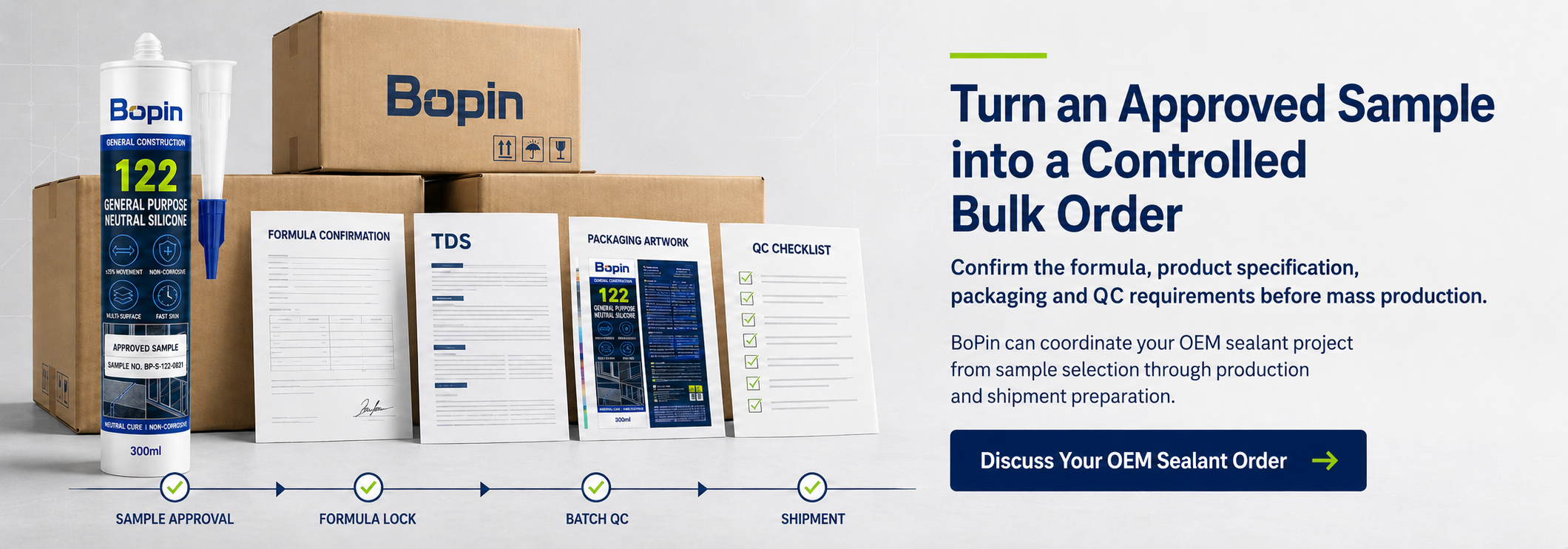
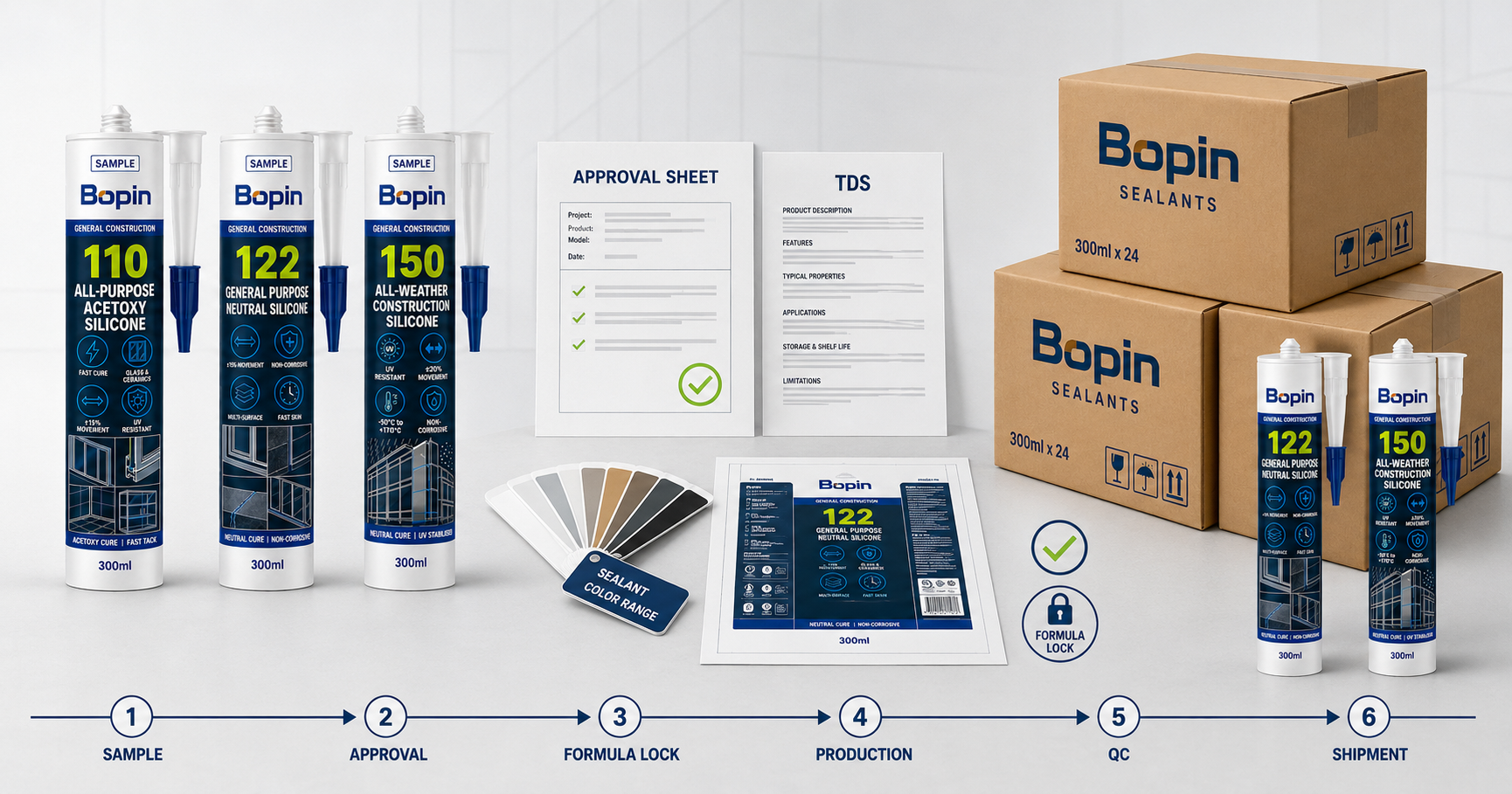
The Complete Sample-to-Bulk Control Process
A robust OEM process can be summarised as:
1. Define Requirement
Application, target quality, market and packaging.
2. Identify Sample
Give each candidate a traceable sample code.
3. Test Sample
Check the product on relevant substrates.
4. Approve Reference
Create a Golden Sample and approval record.
5. Lock Formula
Confirm product model and manufacturing source.
6. Confirm Specification
Define agreed technical and commercial requirements.
7. Align Documents
TDS, SDS and claims must correspond to the product.
8. Approve Packaging
Cartridge and carton artwork are locked.
9. Produce
Use the confirmed formulation and packaging.
10. Perform QC
Check agreed batch-release items.
11. Retain Samples
Keep batch references for traceability.
12. Inspect Before Shipment
Verify goods, packaging and documentation.
13. Record Loading
Quantity, container and shipment data.
14. Maintain Change Control
Review material changes before future orders.
Sample Approval Form for Importers
A simple approval record could contain:
Project Information
- Buyer
- Market
- Product
- Sample code
- Supplier reference
- Aplicação
- Benchmark
- Test date
Technical Approval
- Cor
- Appearance
- Extrusion
- Skin time
- Cure
- Adhesion
- Sag
- Tooling
- Odor
- Special requirement
Commercial Approval
- Net content
- Cartridge
- Cor
- MOQ
- Embalagem
- Carton
Document Status
- Product Information Sheet
- TDS
- SDS
- Test report
- COA requirement
Approval Decision
- Approved
- Approved with conditions
- Revision required
- Rejected
Sign-Off
- Buyer
- Supplier
- Approval date
- Final sample code
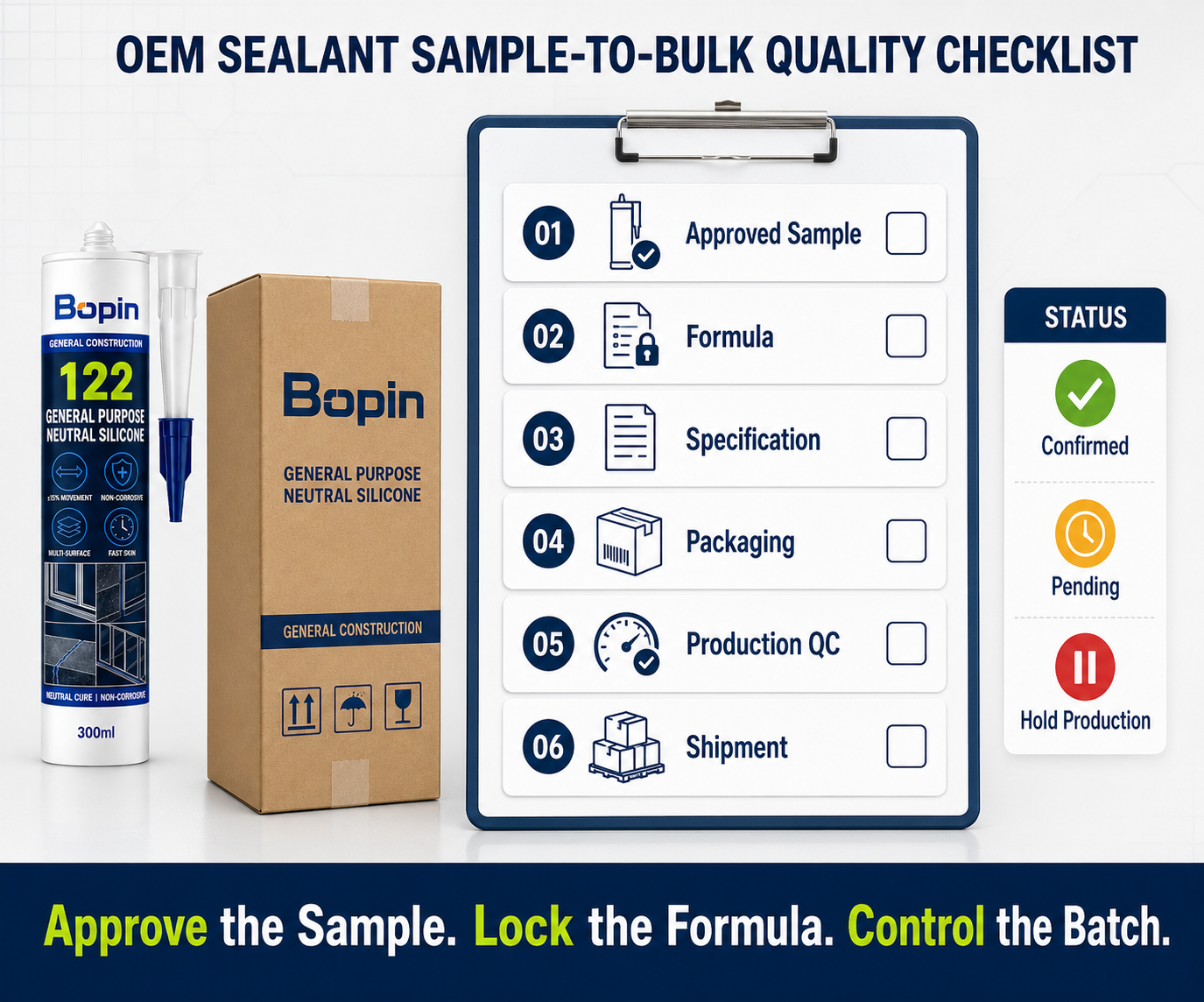
Sample-to-Bulk Quality Control Checklist
Before mass production, confirm:
Product
- Approved sample code recorded
- Golden Sample retained
- Formula identified
- Manufacturing source confirmed
- Colour approved
- Net content approved
Technical
- Product specification agreed
- Key QC limits defined
- Final TDS aligned
- Final SDS aligned
- Special performance claims verified
Embalagem
- Cartridge approved
- Label approved
- Carton approved
- Barcode approved
- Batch/date position approved
Produção
- Production batch traceability available
- Fill control agreed
- Basic QC tests agreed
- Retained samples planned
- Change-control requirement agreed
Shipment
- Pre-shipment inspection plan agreed
- COA requirement confirmed
- Quantity verified
- Loading records planned
- Commercial documents prepared
Common Sample-to-Bulk Mistakes
Approving a sample through WhatsApp only
A message saying “sample good” does not define which properties were approved.
No sample code
Several similar formulations can later become confused.
Accepting a different formula for the same price without review
Price equivalence does not mean product equivalence.
Printing packaging before formula confirmation
Technical claims may no longer match the product.
Assuming the TDS is a batch inspection certificate
Typical technical data and actual production QC serve different purposes.
No colour reference
Custom colours may become subjective.
No fill-control requirement
A cartridge body does not confirm actual net content.
No retained samples
Later complaints become difficult to investigate.
Inspecting only the packaging
The correct carton can still contain a product problem.
Testing only the formula
A good formula can still be supplied in a defective cartridge or carton.
No change-control agreement
Future repeat orders may gradually drift from the original product.
Perguntas mais frequentes
Can bulk sealant ever be exactly identical to the sample?
Manufactured products normally have reasonable batch-to-batch variation.
The goal is not microscopic identity. The goal is consistency within agreed technical, visual and application requirements.
Should every technical parameter be tested on every production batch?
Not necessarily.
Some properties are suitable for routine batch-release testing, while others are better controlled through formulation validation, periodic testing or third-party reports.
Define the QC plan according to product risk and application.
Should I ask the supplier to reveal the full formula?
Usually no.
A buyer needs enough information to control product identity and performance, but manufacturers may legitimately protect proprietary formulations.
A controlled product reference is more useful than demanding confidential percentages.
Can I use the approved sample as the only quality standard?
No.
Use the sample together with:
- Product specification
- TDS
- SDS
- QC limits
- Packaging approval
- Batch traceability
What if the factory needs to change a raw material?
O supplier should assess whether the change could affect:
- Cure
- Cor
- Adhesion
- Safety
- Performance
- Regulatory status
Material changes affecting the agreed product should be reviewed before production.
Do I need a third-party inspection for every order?
Not always.
The decision depends on:
- Order value
- Supplier history
- Product risk
- New packaging
- First order vs repeat order
- Customer requirements
First OEM orders often justify more detailed inspection than mature repeat orders.
What should I do with my own retained samples?
Store them under suitable conditions and label them with:
- Batch
- Date
- Product
- Cor
- Shipment
They can provide useful references if customers later report a problem.
Considerações finais
A successful sealant sample is only the beginning of an OEM quality-control process.
To reduce sample-to-bulk differences, importers should control:
- Sample identity
- Approval criteria
- Golden Sample
- Formula
- Manufacturing source
- Technical specification
- Cor
- Net content
- Embalagem
- Production QC
- Batch traceability
- Retained samples
- Pre-shipment inspection
- Change control
The objective is not to create unnecessary paperwork.
It is to ensure that everyone involved can answer one simple question:
What exactly did the buyer approve, and how do we know the bulk production still matches it?
A useful rule is:
Approve the Sample. Lock the Formula. Control the Batch.
BoPin supports importers and private-label buyers from product selection and sample validation through formula confirmation, packaging coordination, production follow-up and shipment preparation. Final product specifications and documents are aligned with the confirmed formulation and manufacturing source.