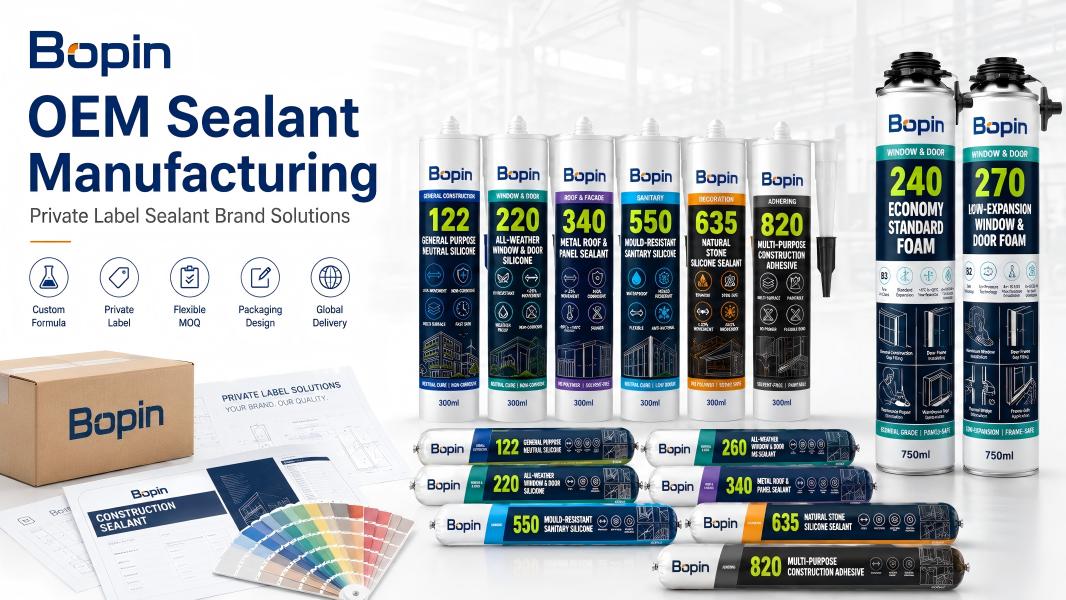
Starting your own sealant brand can be a practical way to enter the construction materials market without building a factory from the beginning.
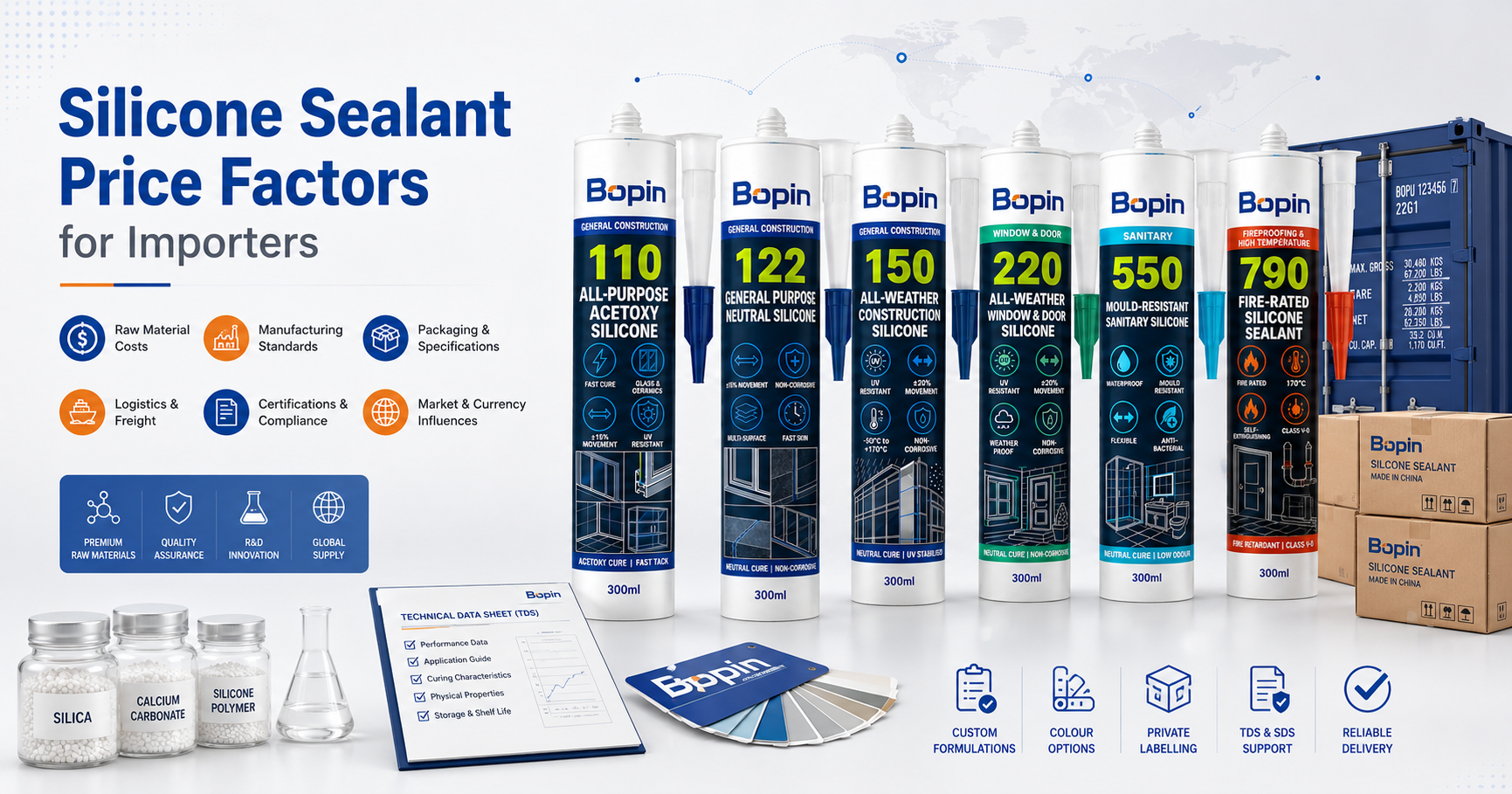
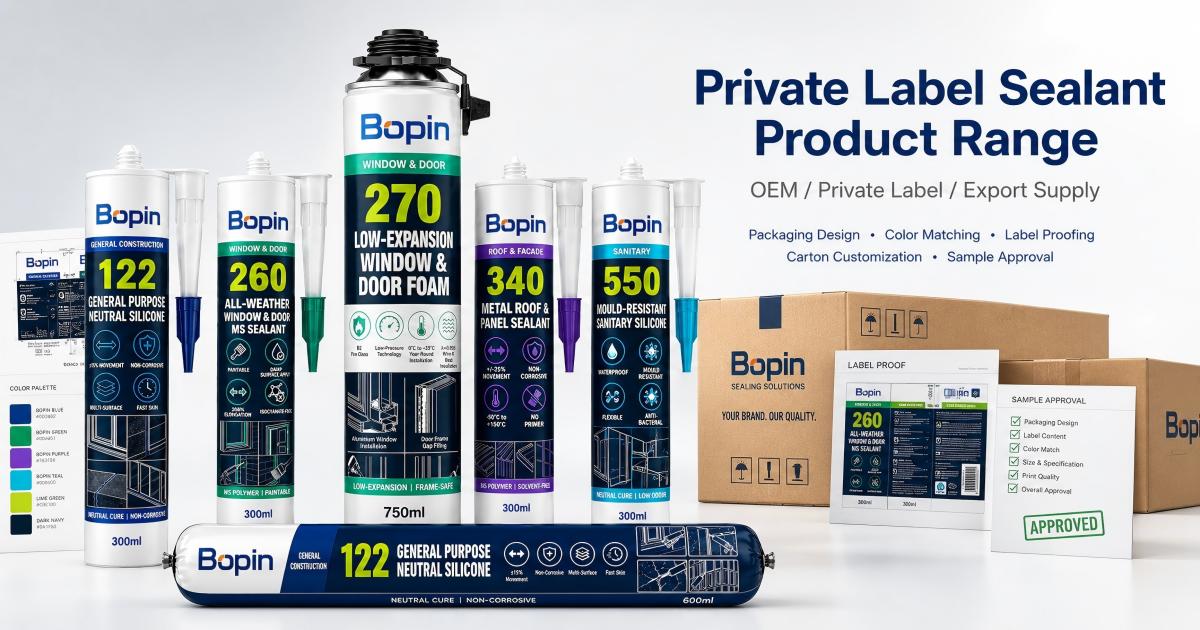
For many importers, distributors, building material wholesalers and project suppliers, OEM manufacturing offers a flexible path to develop a private label sealant range. You can create your own brand, packaging design, product positioning and market strategy, while working with an experienced manufacturer or sourcing partner for production, formulation selection and packaging support.
However, launching a sealant brand is not only about printing your logo on a cartridge. A successful OEM sealant project requires clear product planning, suitable technical specifications, stable quality control and packaging that fits your local market.
This guide explains how to start your own sealant brand with OEM manufacturing, especially for buyers who want to build a professional construction sealant product range.
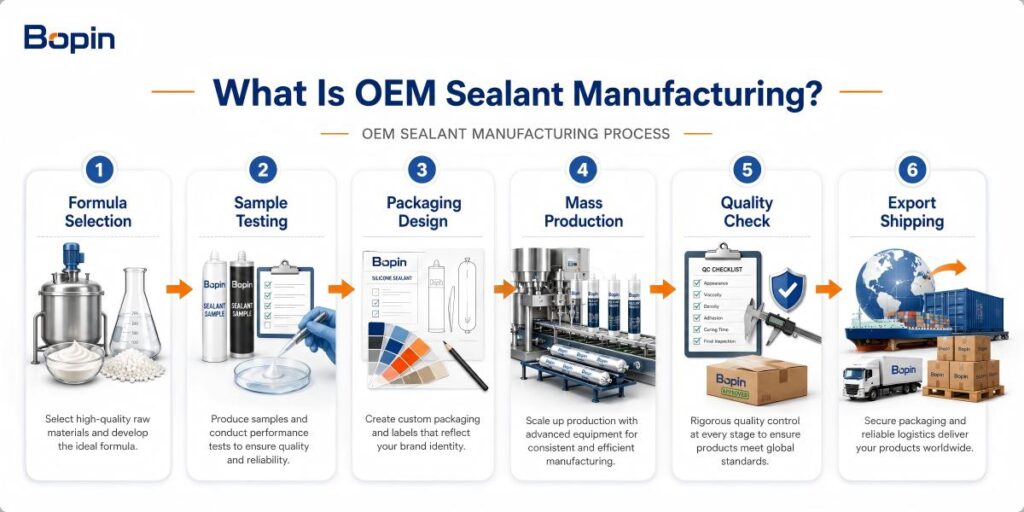
What Is OEM Sealant Manufacturing?
OEM sealant manufacturing means producing sealants under your own brand name with the support of a manufacturer or supply partner.
Depending on your business model, OEM sealants can include:
- Selantes de silicone
- MS polymer sealants and adhesives
- espuma expansiva de PU
- Selantes acrílicos
- Selantes resistentes ao fogo
- Silicone sanitário
- Selantes para fachadas e telhados
- adesivos de construção
The manufacturer provides the production capability, technical support and packaging service. The buyer provides the brand name, target market requirements, packaging direction and sales strategy.
For importers and distributors, OEM manufacturing can help create a unique product line instead of selling only generic products.
Why Start Your Own Sealant Brand?
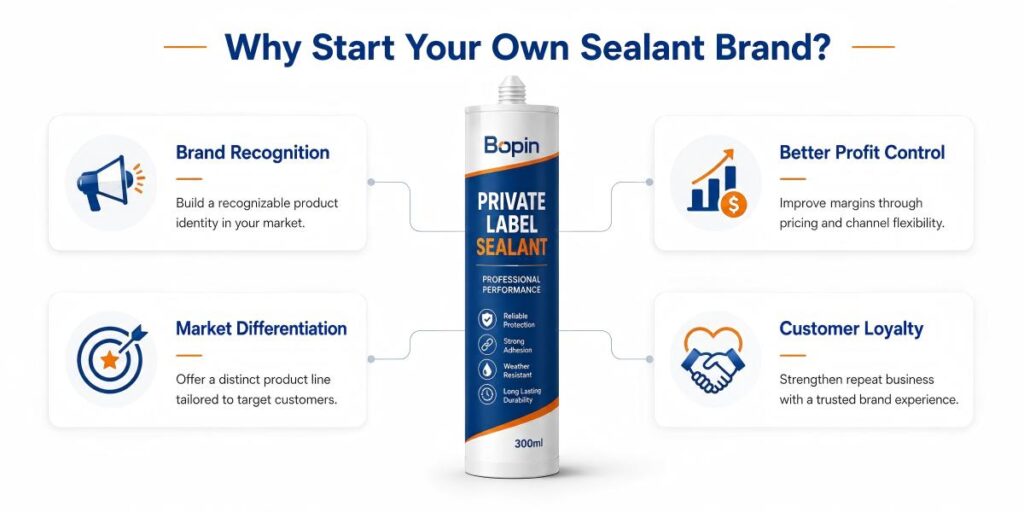
A private label sealant brand gives you more control over your market.
Instead of competing only on price, you can build a product range around your own customers, your local climate, your main application areas and your preferred price level.
Main benefits of starting your own sealant brand include:
- Maior reconhecimento da marca
Your customers remember your brand, not only the product category. - Melhor controle de lucros
Private label products allow you to build your own pricing system. - More flexible product positioning
You can offer economy, standard, professional or premium grades for different customer groups. - Better customer loyalty
Contractors and retailers are more likely to repeat purchase when the product quality and packaging are consistent. - Market differentiation
A well-designed sealant range can help you stand out from generic suppliers.
For building material distributors, OEM sealants can become a long-term category rather than a one-time trading product.
Step 1: Define Your Target Market
Before choosing products, you should first define your target market.
Different markets require different sealant types. A product that sells well in one country may not be the best option for another market.
You should consider:
- Are your customers contractors, retailers, hardware stores or project buyers?
- Is your market mainly residential, commercial or industrial construction?
- Are window and door products your main application?
- Do customers need general-purpose sealants or high-performance products?
- Seu mercado é quente, úmido, litorâneo, frio ou com alta incidência de raios UV?
- Are customers more price-sensitive or quality-focused?
- Do they prefer cartridges, sausage packs or aerosol cans?
For example, a market focused on window installation may need neutral silicone, MS polymer sealant and PU foam. A facade and roofing market may need weather-resistant silicone and metal roof sealants. An interior decoration market may need acrylic sealants, paintable sealants and decorative trim sealants.
Clear market positioning helps you avoid building a random product range.
Step 2: Build a Basic Product Range
For a new sealant brand, it is usually better to start with a focused product range instead of launching too many items at once.
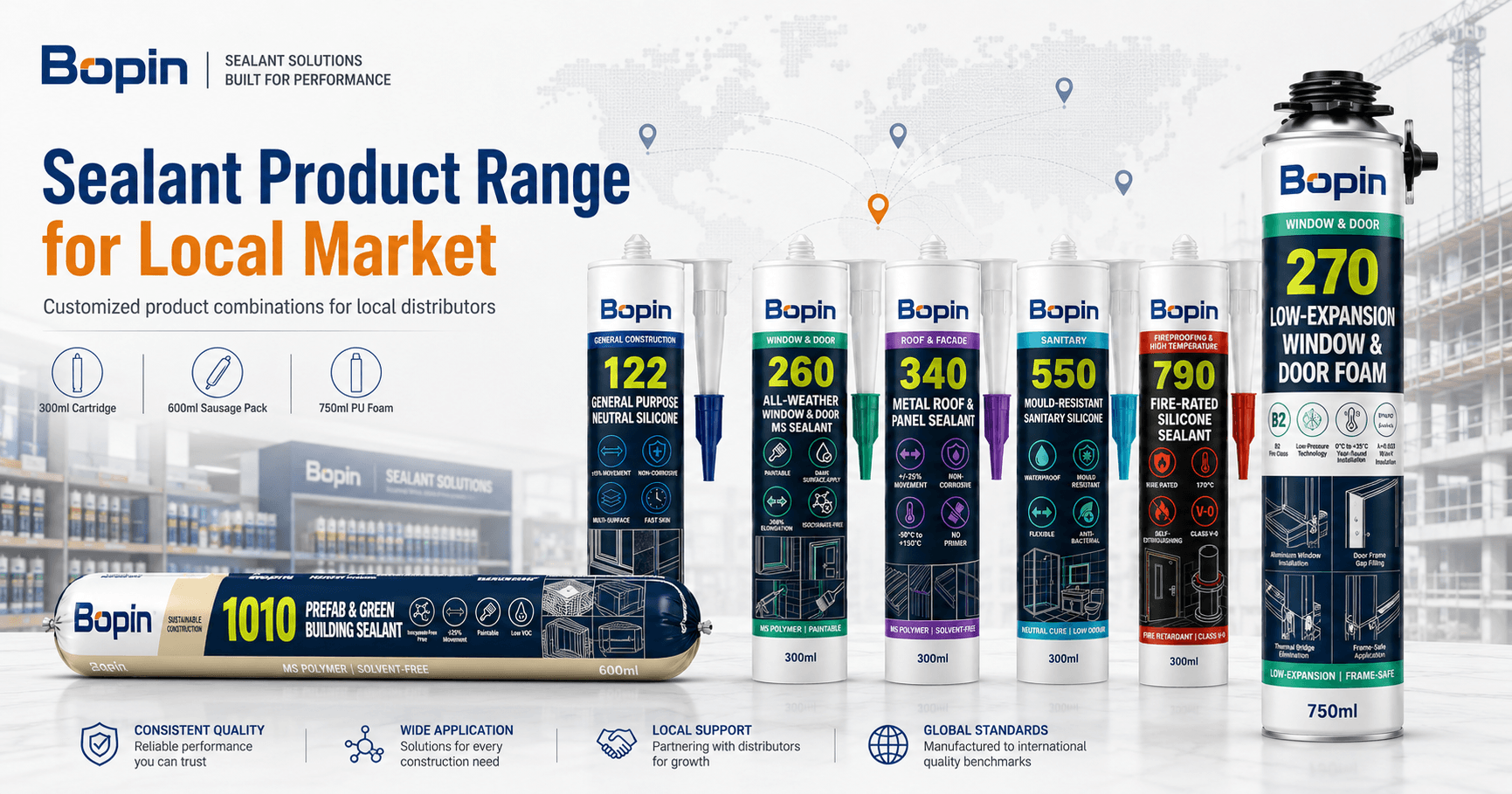
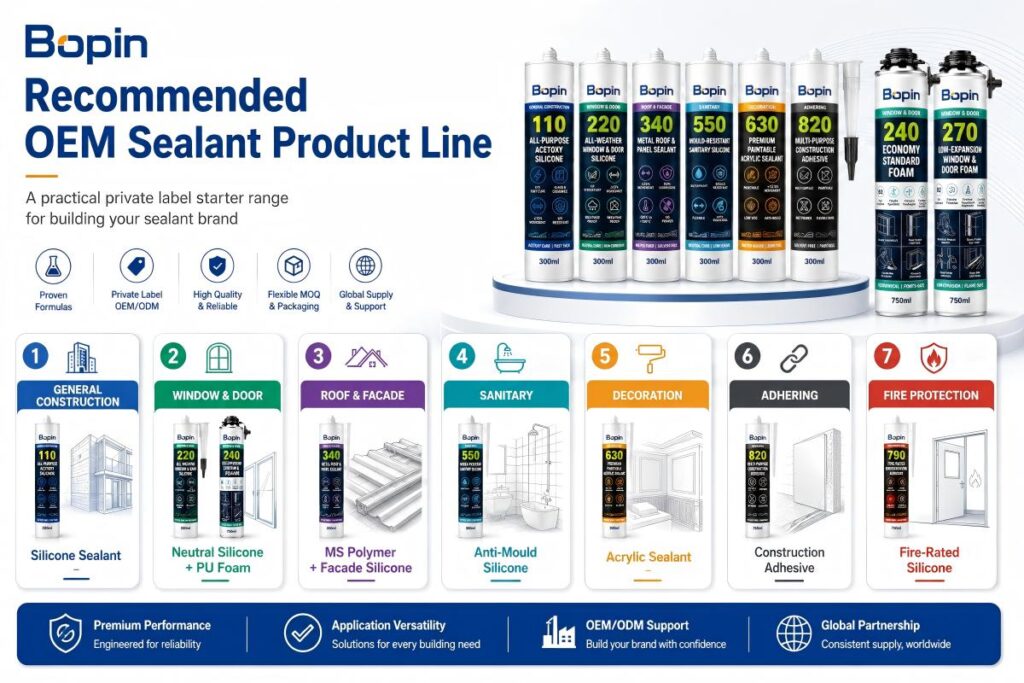
A practical starter range may include:
| Tipo de produto | Main Use |
|---|---|
| General purpose silicone sealant | Daily construction sealing |
| Selante de silicone neutro | Windows, doors, metal frames and masonry |
| Silicone sanitário | Kitchens, bathrooms and wet areas |
| Selante acrílico | Interior cracks, skirting boards and decoration |
| Selante de polímero MS | Paintable, solvent-free and multi-substrate sealing |
| espuma expansiva de PU | Door and window gap filling |
| Adesivo de construção | Panel bonding and general construction fixing |
This type of range gives your brand enough coverage for most common building material sales channels.
If your market is more professional, you can add more specialized products such as facade sealant, metal roof sealant, natural stone sealant, fire-rated silicone or high-strength MS polymer adhesive.
Step 3: Choose Products Based on Application
A good OEM sealant range should be organized by application, not only by chemistry.
Many end users do not search for “neutral oxime silicone”. They search for a sealant for windows, bathrooms, roofs, stone, floors or interior decoration.
That is why your private label range should be easy to understand.
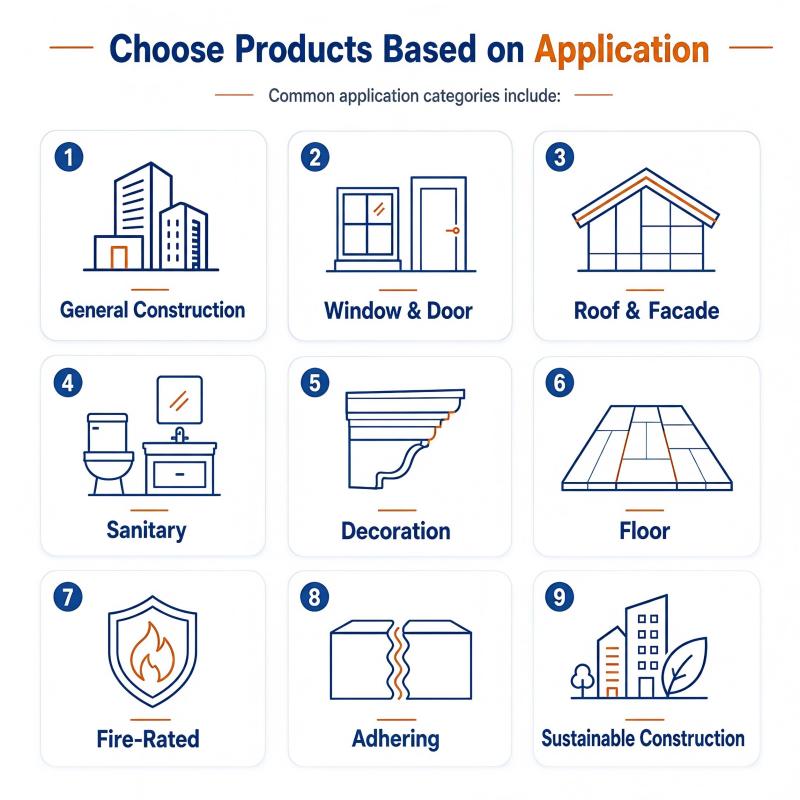
As categorias comuns de aplicativos incluem:
Construção geral
This category usually includes all-purpose silicone and neutral silicone sealants for general gap filling, glass sealing, ceramic sealing, aluminium frame sealing and masonry joints.
It is usually the foundation of a sealant brand.
Janelas e portas
Window and door applications often require products that can handle movement, weather exposure and different frame materials.
A professional window range may include neutral silicone, paintable MS polymer sealant and low-expansion PU foam.
Telhado e fachada
Roofing and facade joints require better UV resistance, movement capability and adhesion to metal, coated surfaces, concrete, glass or ACP panels.
This category is suitable for higher-value project customers.
Sanitary & Interior Decoration
Bathroom, kitchen and interior finishing products are important for retail channels.
Sanitary silicone should focus on mould resistance, waterproofing and adhesion to ceramic, glass, acrylic sanitary ware and metal fixtures.
Acrylic sealant and decorative trim sealant should focus on paintability, low odour and clean finishing.
Stone & Panel Bonding
Stone, sintered stone and panel installation require careful product selection.
For natural stone sealing, non-staining performance is important. For panel bonding, high-strength MS polymer adhesive may be more suitable than ordinary sealants.
Step 4: Decide Your Quality Levels
Not every product in your brand needs to be premium. A practical OEM range may include different quality levels.
Por exemplo:
- Economy grade for price-sensitive retail or wholesale channels
- Standard grade for daily construction use
- Professional grade for contractors and project applications
- Premium grade for facade, stone, roofing or high-performance applications
This structure helps you serve more customer groups without confusing the market.
However, each grade should have clear positioning. Avoid making several products that look similar but have no obvious difference.
For example, one neutral silicone can be positioned for general construction, while another can be positioned for window and door perimeter sealing, and a higher-performance version can be positioned for facade weatherproofing.
Step 5: Confirm Technical Requirements
Sealants are functional construction materials. Before confirming an OEM order, buyers should check the main technical parameters.
Important items may include:
- Sistema de cura
- Tempo de formação da pele
- Taxa de cura
- Dureza
- Resistência à tracção
- Alongamento na ruptura
- Capacidade de movimento
- Resistência à deformação
- Resistência à temperatura
- Temperatura de aplicação
- Prazo de validade
- Packaging size
- Normas aplicáveis
- Compatibilidade com o substrato
For example, a window sealant may need good adhesion to aluminium, glass and masonry. A facade sealant may need higher movement capability and UV resistance. A sanitary sealant should focus on mould resistance and wet-area performance.
Do not choose a sealant only by price. The wrong product can lead to cracking, poor adhesion, staining, shrinkage or customer complaints.
Step 6: Plan Your Packaging
Packaging is one of the most important parts of OEM sealant branding.
A professional package helps customers understand the product quickly. It also helps your brand look more reliable in retail stores, warehouses and project supply channels.
Common packaging formats include:
| Embalagem | Uso comum |
|---|---|
| Cartucho de 300 ml | Comércio varejista, lojas de materiais de construção, construção em geral |
| Embalagem de salsicha de 590ml / 600ml | Contractors, project use, larger jobs |
| Lata de aerossol de 750 ml | espuma expansiva de PU |
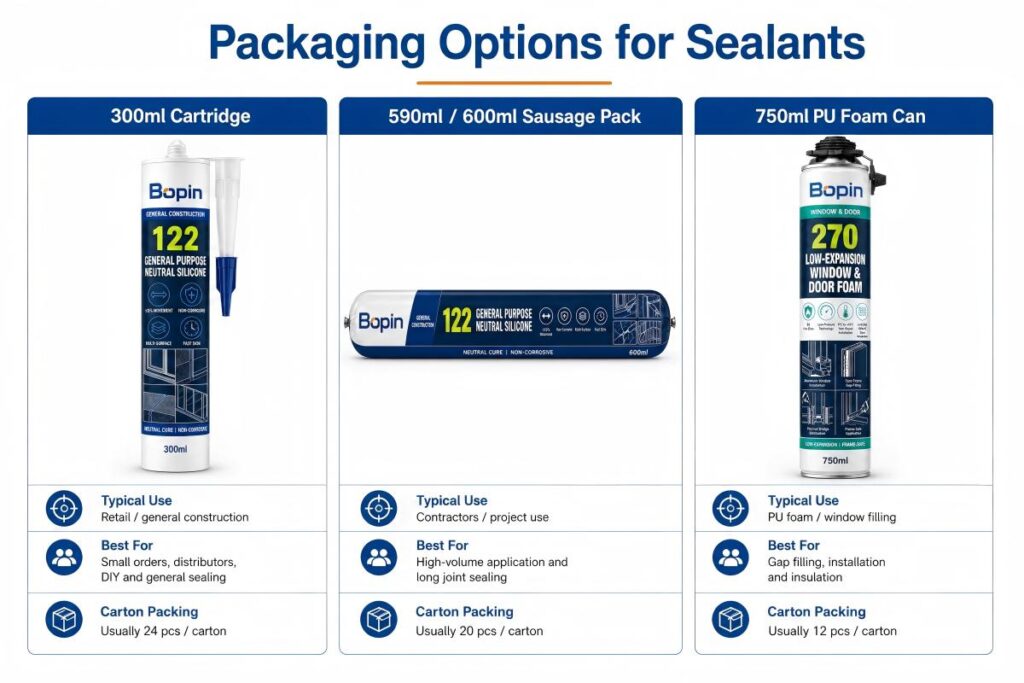
Your packaging should clearly show:
- Nome da marca
- Número do produto
- Nome do produto
- Categoria de aplicação
- Main benefits
- Volume
- Cor
- Tipo de cura
- Informações de segurança
- Ícones de aplicativos
- Carton information
- Production date and shelf life
For OEM projects, packaging design should not only look attractive. It should also make product selection easier for customers.
A good method is to use different colors for different application series, such as general construction, window and door, roof and facade, sanitary, decoration, adhering and fire-rated products.
Step 7: Prepare Your Brand System
Before starting production, you should prepare a basic brand system.
This can include:
- Nome da marca
- Logo
- Brand colors
- Product naming system
- Product number system
- Packaging layout
- Design de caixa
- Product labels
- Fichas técnicas
- Fotos do produto
- Páginas de produtos do site
- Catalog or brochure
A clear brand system makes your product line look more professional and easier to expand in the future.
For example, you can use product numbers to separate different applications. General construction products can use one number range, window and door products another range, and roof and facade products another range.
This makes your catalog easier for distributors and contractors to understand.
Step 8: Request Samples Before Bulk Order
Samples are an important step in OEM sealant manufacturing.
Before placing a bulk order, you should test the product under real conditions.
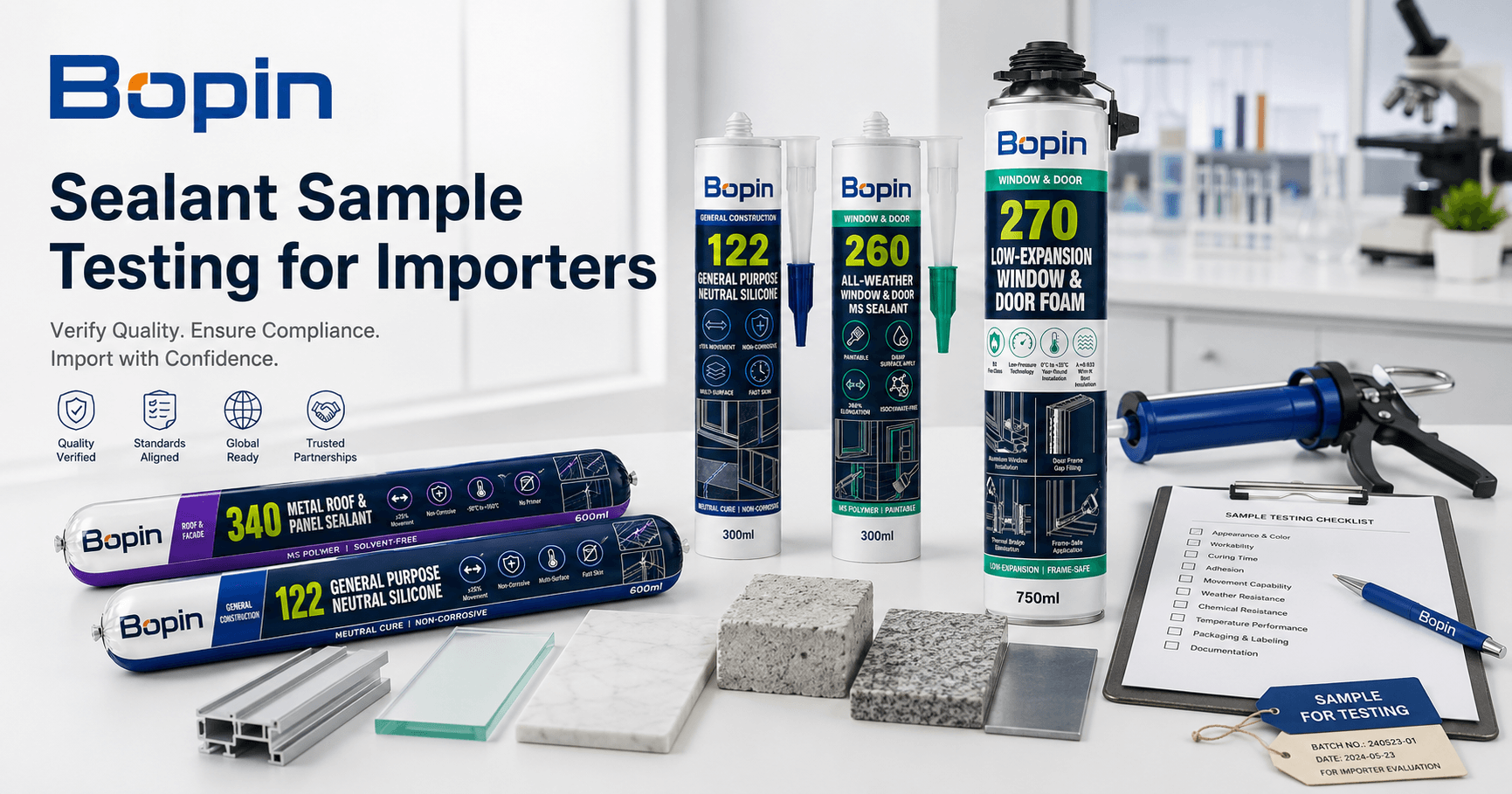
Sample testing can include:
- Suavidade da extrusão
- Tempo de formação da pele
- Initial adhesion
- Velocidade de cura
- Odor
- Resistência à deformação
- Desempenho das ferramentas
- Pintável
- Adhesion to local substrates
- Compatibility with local construction materials
- Aparência da embalagem
- Qualidade do cartucho ou da embalagem de salsichas
For project-based markets, you should test the sealant on actual materials such as aluminium profiles, glass, concrete, ceramic tiles, metal sheets, wood panels or stone samples.
For natural stone, always check whether the sealant causes staining or edge discoloration.
For painted metals or coated aluminium, adhesion tests are also recommended before full application.
Step 9: Confirm MOQ, Lead Time and Shipping Details
OEM orders usually require more planning than regular stock orders.
Before confirming production, you should discuss:
- Quantidade mínima de encomenda
- Available packaging sizes
- Cores do produto
- Private label design requirements
- Quantidade por caixa
- Prazo de entrega da produção
- Sample approval process
- Condições de pagamento
- Shipping method
- Porto de destino
- Documentos necessários
- Shelf life and storage requirements
If you are starting a new brand, it may be better to begin with a smaller, focused range and gradually expand after market feedback.
A complete product line is useful, but slow-moving inventory can increase pressure for new importers. The first goal should be to build reliable sales with the most suitable products.
Step 10: Build Marketing Materials for Your Sealant Brand
After confirming the products and packaging, you also need marketing materials to support sales.
Os materiais úteis incluem:
- Catálogo de produtos
- Fichas técnicas
- Fotos de candidatura
- Tabela de comparação de produtos
- Short product videos
- Páginas de produtos do site
- Social media posts
- Product training materials
- FAQ documents
- Distributor sales sheets
Many sealant buyers need simple and clear information. They want to know where the product can be used, what materials it bonds to, what limitations it has and why it is suitable for their market.
Good marketing materials can help your customers sell the product more easily.
Common Mistakes When Starting a Sealant Brand
Many new buyers make similar mistakes when starting OEM sealant projects.
1. Choosing products only by low price
Low price may help with the first order, but unstable quality can damage your brand quickly.
2. Launching too many products at the beginning
Too many SKUs can create inventory pressure. Start with a practical range and expand later.
3. Ignoring local application conditions
Climate, building materials and contractor habits can strongly affect product selection.
4. Using unclear product names
Product names should tell customers what the product is for. Avoid names that are too technical or too similar.
5. Not testing samples properly
Sample testing helps reduce quality risk before bulk ordering.
6. Poor packaging design
Packaging should look professional, but it should also communicate product use clearly.
7. No technical documents
For B2B buyers, technical datasheets and clear application instructions are important.
Suggested Starter Product Range for a New Sealant Brand
For a new private label sealant brand, the following structure is practical:
| Categoria | Tipo de produto sugerido |
|---|---|
| Construção geral | Silicone multiuso, silicone neutro |
| Janelas e portas | Neutral silicone, MS polymer sealant, low-expansion PU foam |
| Sanitário | Mould-resistant sanitary silicone |
| Decoração | Selante acrílico, selante para acabamento decorativo |
| Telhado e fachada | Metal roof sealant, facade weatherproofing sealant |
| Adhesive | Multi-purpose construction adhesive, high-strength MS adhesive |
| Proteção contra incêndio | Selante de silicone resistente ao fogo |
This type of product range gives your brand a strong starting point for both retail and project customers.
Considerações finais
Starting your own sealant brand with OEM manufacturing is not difficult, but it requires clear planning.
The key is to choose the right products for your market, confirm technical requirements, design professional packaging, test samples carefully and build a product range that customers can understand.
A strong sealant brand is not created by packaging alone. It is built through stable quality, suitable product selection, clear communication and long-term supply support.
If you are planning to develop your own private label sealant range, BoPin can help you select suitable products, prepare packaging options and build a practical OEM product line for your target market.