
Industrial floors and warehouse joints endure punishing conditions that destroy standard construction sealants within months – heavy forklift traffic, chemical spills, thermal cycling, and constant abrasion demand specialized products and installation methods. Inadequate joint sealing causes edge spalling, load transfer failure, and progressive floor deterioration that disrupts operations and requires expensive repairs.
Understanding industrial floor joint requirements and selecting appropriate high-performance sealants ensures these critical surfaces maintain structural integrity and operational efficiency for decades. Whether you’re sealing new warehouse construction, maintaining existing logistics facilities, or upgrading manufacturing floors, proper joint sealing protects your flooring investment and prevents costly downtime.
Understanding Industrial Floor Joint Types and Functions
Industrial floors contain various joint types, each serving specific structural or construction purposes. Recognizing joint types and their functions guides appropriate sealant selection and application methods.

Contraction Joints (Control Joints)
Contraction joints control where concrete cracks from drying shrinkage and thermal contraction. These planned weak points guide cracking to predetermined locations rather than allowing random cracking throughout the slab.
Contraction joint characteristics:
- Sawcut or formed – created during or shortly after concrete placement
- Typically 1/4 to 1/3 slab depth – enough to concentrate stress
- Regular spacing – commonly 24-30 times slab thickness in feet
- Allow horizontal movement but transfer vertical loads through aggregate interlock
- Experience moderate movement – typically 3-6mm depending on slab length and temperature range
These joints represent the most common floor joint type requiring sealing. In industrial applications, sealing prevents debris infiltration, protects joint edges from spalling, and maintains smooth traffic flow across joints.
Construction Joints
Construction joints occur where concrete placement stops and resumes, typically at the end of a pour day or between pours in phased construction. These joints may or may not be designed as movement joints.
Construction joint characteristics:
- Location often determined by practical considerations rather than structural design
- May incorporate dowels or tie bars for load transfer
- Joint face profile varies – butt joints, keyed joints, or doweled joints
- Movement depends on design – some transfer loads without movement, others accommodate thermal expansion
Construction joints in industrial floors require careful sealing as their irregular profiles and potential load transfer make them vulnerable to edge damage if left unsealed.
Isolation Joints (Expansion Joints)
Isolation joints separate floor slabs from columns, walls, equipment foundations, or other restraining elements, allowing independent movement without stress transfer.
Isolation joint characteristics:
- Full-depth separation – completely isolate adjacent elements
- Filled with compressible material – foam, cork, or rubber allow movement
- Accommodate significant movement – thermal expansion, settlement, or structural deflection
- No load transfer – elements move independently
- Wider than contraction joints – typically 12-25mm to accommodate movement
These joints demand sealants with maximum movement capability (±50% or greater) and excellent resilience maintaining seal integrity through countless expansion/contraction cycles.
Sawcut vs. Formed Joints
Joint creation method affects sealant application requirements.
Sawcut joints create clean, straight edges with consistent geometry. These joints provide ideal sealant application conditions – uniform width, proper depth, and minimal surface contamination. Industrial floors typically use sawcut joints for their precision and quality.
Formed joints use inserted strips during concrete placement creating joints as concrete cures. While faster than sawcutting, formed joints may create irregular edges or bonding issues if forms aren’t properly released. Sealant application in formed joints may require additional edge preparation ensuring proper adhesion.
Traffic and Loading Considerations
Industrial floor joints face mechanical stresses far exceeding residential or commercial applications. Understanding these stresses guides sealant selection ensuring adequate durability.
Forklift and Material Handling Equipment
Forklifts represent the most common and most destructive traffic on industrial floors. Their concentrated wheel loads, sudden stops, and tight turning create extreme joint edge stresses.
Forklift impact on joints:
- Concentrated wheel loads – small contact area creates high edge pressure
- Impact loading – sudden stops and starts pound joint edges
- Turning stress – pivoting creates shear and abrasion at joints
- Repetitive traffic – same paths traveled hundreds of times daily
- High-speed operation – faster speeds increase impact forces
Forklift traffic demands sealants with:
- High hardness – resisting abrasion from wheel traffic (Shore A 35-45 typical)
- Excellent resilience – recovering from repeated compression without permanent deformation
- Strong edge adhesion – preventing sealant pull-out from wheel impact
- Abrasion resistance – maintaining integrity despite constant wheel passage
Different forklift types create varying demands:
Electric forklifts with cushion tires create steady, predictable loads with minimal floor damage. These represent the easiest forklift traffic for floor joints to handle.
Gas/diesel forklifts often use pneumatic tires creating higher impact loads. Heavier weight and typically faster operation increase joint stress compared to electric units.
Narrow-aisle forklifts operate in tighter spaces creating more turning stress on joints. Their wire-guided or rail-guided operation creates repetitive traffic in exactly the same paths concentrating wear.

AGVs and Automated Systems
Automated Guided Vehicles (AGVs) create different joint stresses than forklifts. Their predictable paths and consistent speeds generate highly repetitive but controlled loading.
AGV considerations:
- Extremely repetitive paths – same route thousands of times daily
- Consistent speed – less impact variation than manual operation
- Lighter loads than large forklifts but more frequent
- Precise positioning – may cross joints at exact same points repeatedly
AGV facilities require:
- Extremely durable joint sealing handling concentrated repetitive traffic
- Consistent joint surface – even slight irregularities may affect AGV operation
- Long service life – frequent maintenance disrupts automated operations
Pallet Jack and Hand Cart Traffic
Manual pallet jacks and hand carts create lighter but still significant joint loading. While less destructive than forklifts, their abundance and constant use accumulates substantial wear.
Pallet jack characteristics:
- Frequent operation – constant movement throughout facilities
- Small wheel contact – concentrated but lighter loads than forklifts
- Varied paths – less predictable than AGVs, more distributed than narrow-aisle equipment
- Abrasion focus – wheels drag across joints creating wear
Chemical Exposure and Resistance Requirements
Industrial environments expose floor joints to chemicals ranging from mild cleaners to aggressive solvents and acids. Sealant selection must account for actual exposure conditions.
Common Industrial Chemical Exposures
Manufacturing facilities may expose joints to oils, coolants, solvents, or process chemicals specific to the industry. Understanding actual exposure guides appropriate sealant selection.
Petroleum products – oils, greases, fuels – are extremely common in warehouses and manufacturing. Many sealants swell, soften, or degrade from prolonged petroleum contact. Polyurethane sealants generally handle petroleum exposure better than silicones or acrylics.
Acids – battery acid, cleaning acids, process acids – attack many sealant types. Even mild acids may degrade certain sealants over time. Verify sealant acid resistance matching actual exposure pH levels.
Alkalis – strong cleaners, degreasers, some process chemicals – also attack sealants. High-pH environments require specifically resistant formulations.
Solvents – industrial cleaners, degreasers, process solvents – rapidly damage incompatible sealants. Solvent exposure requires careful product selection as few sealants resist aggressive solvents well.
Hot liquids combine chemical and thermal stress. Some processes involve hot oils, water, or chemicals contacting floors. Sealants must resist both the chemical itself and elevated temperatures.

Food Processing and Pharmaceutical Facilities
Food processing and pharmaceutical manufacturing impose additional requirements beyond chemical resistance.
Sanitary requirements:
- FDA compliance – sealants contacting food or pharmaceutical products must meet regulatory standards
- Cleanability – smooth, non-porous surfaces preventing bacterial harboring
- résistance chimique – withstanding aggressive sanitizers and cleaning chemicals
- Temperature resistance – handling steam cleaning or hot water washdowns
- No product contamination – sealants must not leach compounds into products
These demanding applications require specialized food-grade sealants certified for the specific regulatory environment (FDA, USDA, or applicable standards).
Selecting Chemically Resistant Sealants
Matching sealant chemical resistance to actual exposure conditions prevents premature failure.
General chemical resistance by sealant type:
Polyurethane sealants offer good resistance to petroleum products, mild acids and alkalis, and many industrial chemicals. PU represents the most common choice for industrial floors balancing chemical resistance, mechanical properties, and cost.
Epoxy sealants provide excellent chemical resistance to oils, solvents, acids, and alkalis. However, epoxies remain rigid unsuitable for joints experiencing movement. Use epoxies only in joints requiring chemical resistance without movement accommodation.
Polysulfide sealants resist petroleum products and many chemicals excellently. However, polysulfides’ poor UV resistance and slower cure limit their use primarily to interior industrial applications.
Silicone sealants offer excellent temperature resistance but generally poor resistance to petroleum products and solvents. Silicones rarely suit industrial floor applications despite their advantages in other uses.
Sealant Selection for Industrial Floors
Industrial floor sealants must balance multiple performance requirements – abrasion resistance, chemical resistance, movement capability, adhesion, and cost. Understanding these trade-offs guides appropriate selection.
Polyurethane Floor Joint Sealants
Polyurethane (PU) sealants dominate industrial floor applications combining necessary properties more effectively than alternatives.
PU sealant advantages for industrial floors:
- Excellent abrasion resistance – withstands forklift and equipment traffic
- Good chemical resistance – handles common industrial exposures
- Adequate flexibility – accommodates moderate joint movement
- Strong adhesion – bonds reliably to concrete
- Reasonable cost – economical for large floor areas
- Available in various hardnesses – Shore A 25 to 50+ matching different applications
However, PU limitations include:
- UV sensitivity – yellows and degrades in outdoor or high-UV environments
- Limited movement capability – typically ±25%, inadequate for large expansion joints
- Moisture sensitivity during cure – requires proper concrete moisture levels
- Temperature range – typically -25°C to +80°C, less than silicones
For standard industrial floors with typical traffic and moderate chemical exposure, quality PU sealants provide optimal performance. Products specifically formulated for floor applications offer best results versus general-purpose PU products.
Epoxy Floor Joint Sealants
Epoxy sealants provide maximum chemical resistance for floors in aggressive environments. However, epoxies’ rigidity restricts use to non-moving joints.
Epoxy advantages:
- Excellent chemical resistance – superior to PU for acids, solvents, alkalis
- Very high hardness – extreme abrasion resistance
- Strong adhesion – excellent concrete bonding
- Heat resistance – handles elevated temperatures well
- Can be trafficked quickly – rapid cure allows faster return to service
Epoxy limitations:
- No flexibility – completely unsuitable for moving joints
- Brittle under impact – may crack from sharp impacts
- Mixing required – two-component system needs proper ratios
- Limited working time – must apply before pot life expires
- Higher cost – more expensive than PU
Use epoxy sealants only in construction joints or other locations where no movement occurs. For contraction joints experiencing thermal movement, PU sealants prove more appropriate.
Self-Leveling vs. Non-Sag Sealants
Industrial floor sealants come in self-leveling and non-sag formulations, each suited to different applications.
Self-leveling sealants flow to flat, smooth surfaces when dispensed in horizontal joints. These products:
- Create flush finished surfaces – ideal for traffic areas
- Require minimal tooling – flow to proper profile automatically
- Pour quickly – faster application than non-sag products
- Need joint depth control – backer rod or bond breaker prevents excessive depth
- Work only on horizontal surfaces – flow out of vertical or sloped joints
For industrial floor joints, self-leveling sealants provide optimal results creating smooth surfaces that don’t impede traffic or collect debris.
Non-sag sealants maintain profile without flow, suitable for vertical joints or applications requiring tooled profiles. Industrial floors rarely use non-sag products except in unusual joint geometries.
Installation Best Practices
Proper installation ensures industrial floor sealants deliver expected performance and service life. Understanding application requirements prevents expensive failures.
Surface Preparation Requirements
Industrial floor joint preparation demands thorough attention as surface contamination from oils, dirt, or laitance prevents proper adhesion.
Cleaning methods for industrial joints:
Mechanical cleaning – wire brushing, grinding, or shot blasting – removes surface contamination and laitance exposing sound concrete. For new floors, mechanical preparation removes any surface films interfering with adhesion. For existing floors requiring re-sealing, mechanical cleaning removes old sealant residue and surface contamination.
Solvent cleaning removes oils, greases, and chemical residues. After mechanical cleaning, solvent wiping ensures no contamination remains. Isopropyl alcohol or commercial concrete cleaners work effectively.
Sandblasting or grit blasting provides most thorough preparation creating ideal sealant bonding surfaces. However, sandblasting generates substantial dust requiring containment and cleanup. For critical applications in aggressive environments, sandblasting justifies the effort.
Moisture content verification prevents adhesion problems from excessive concrete moisture. Most PU sealants require concrete moisture below 4-5% for reliable bonding. Moisture meters provide quick, reliable testing rather than guessing based on age or appearance.
Joint Depth Control and Geometry
Proper joint geometry ensures sealants perform as designed throughout their service life.
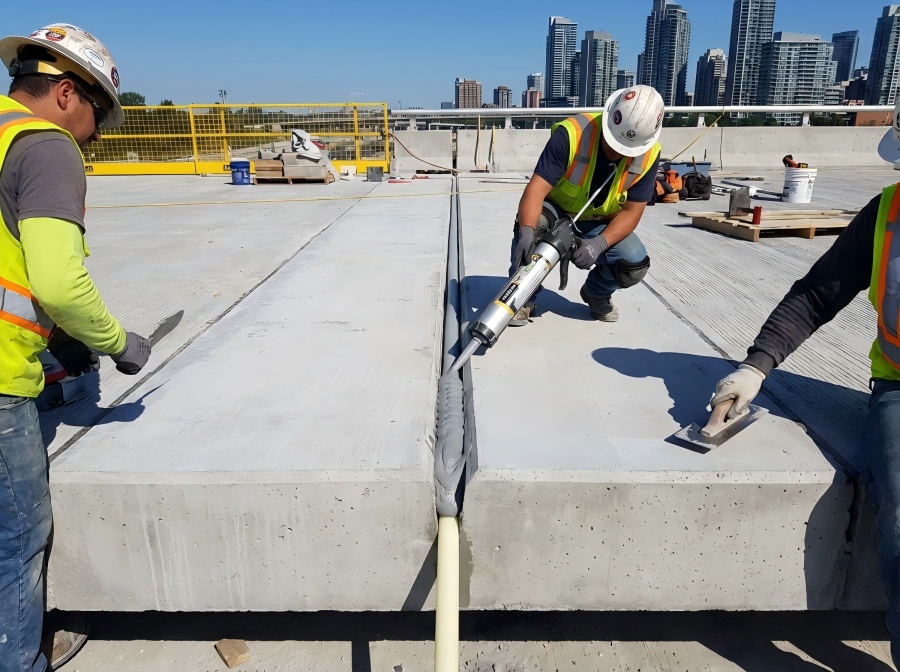
Backer rod installation provides depth control preventing sealant bonding to joint bottoms. For industrial floors, closed-cell polyethylene backer rod resists chemical and moisture exposure while providing proper geometry.
Size backer rod 25% larger than joint width for proper compression fit. Install at depths creating sealant depth approximately half the joint width (2:1 width-to-depth ratio) for optimal performance.
Very shallow joints may use bond-breaker tape instead of backer rod. However, backer rod generally proves more reliable in industrial applications justifying the installation effort.
Joint width considerations balance movement accommodation against practical concerns. Industrial floor joints typically range 6-12mm wide providing adequate sealant reservoir while remaining narrow enough for smooth traffic flow.

Application Timing and Curing
Timing sealant application relative to floor construction and facility occupancy affects success.
New construction timing:
Concrete must cure adequately before joint sealing. Minimum 14-28 days after placement allows sufficient shrinkage and strength development. Sealing too early traps moisture interfering with sealant cure.
However, sealing shouldn’t be delayed indefinitely. Unsealed joints accumulate dirt and debris requiring cleaning before sealing. Seal within 60-90 days of construction when practical.
Facility occupancy during sealing creates challenges. Many industrial facilities cannot shut down for sealant installation. Plan work for low-traffic periods (nights, weekends) and use traffic control protecting fresh sealant.
Cure time before traffic varies by product. Many PU floor sealants allow light foot traffic in 8-24 hours, full forklift traffic in 3-7 days. Verify manufacturer recommendations and allow adequate cure before resuming heavy operations.
Climate and Environmental Conditions
Application environment affects sealant cure and performance.
Temperature requirements vary by product but typically range +5°C to +35°C for application. Very hot or cold concrete affects sealant workability and cure. In extreme climates, warehouse temperature control may be necessary during installation.
Humidity effects on moisture-cure sealants mean high humidity accelerates cure while very low humidity slows it. Industrial facilities often maintain moderate humidity creating acceptable cure conditions.
Ventilation during cure helps remove solvents from some products and prevents accumulation of cure byproducts. However, excessive airflow during self-leveling product application may cause skinning before proper leveling occurs.
Maintenance and Repair
Industrial floor joints require regular inspection and maintenance extending both sealant and floor life while preventing minor problems from escalating.
Inspection Frequency and Priorities
High-traffic areas need more frequent inspection than low-traffic zones.
Inspection frequency recommendations:
- Main traffic aisles – quarterly inspections minimum
- Moderate traffic areas – semi-annual inspections
- Low traffic zones – annual inspections adequate
- After spill incidents – immediate inspection of affected areas
Inspection focus areas:
- Joint edges – check for spalling or chipping
- Sealant surface – look for cracks, tears, or wear-through
- Adhesion – verify sealant remains bonded (probe gently with dull tool)
- Chemical damage – check areas with known chemical exposure
- Traffic damage – examine high-traffic paths for accelerated wear
Common Failure Modes
Understanding typical failures helps diagnose problems and select appropriate repairs.
Adhesion loss – sealant separating from concrete – usually stems from inadequate surface preparation or moisture infiltration. Repairs require complete removal, thorough surface preparation, and new sealant application.
Cohesive failure – sealant tearing internally – indicates movement exceeding capability or material degradation. Repairs may require wider joints or higher-movement sealants depending on cause.
Wear-through from traffic represents normal service life completion in high-traffic areas. Plan periodic re-sealing of main traffic paths before wear exposes joint edges to damage.
Chemical degradation appears as softening, swelling, or discoloration. If original sealant lacked adequate chemical resistance, replacement requires better-suited products. Consider changing warehouse procedures reducing chemical exposure if problems persist.
Edge spalling around joints indicates sealant failure allowed joint edges to deteriorate. Repair requires concrete edge restoration before re-sealing, making prevention through proper initial sealing far more economical.

Repair and Re-sealing Procedures
Proper repair techniques restore joint performance without excessive downtime.
Old sealant removal must be complete. Leaving old material prevents new sealant adhesion. Mechanical grinding or sawcutting removes failed sealant efficiently. Chemical sealant removers help though require adequate dwell time and thorough rinsing.
Edge repair addresses concrete spalling before re-sealing. Epoxy mortars or polyurethane concrete repairs restore damaged edges creating sound substrates for new sealant.
Surface preparation follows same standards as new work – mechanical cleaning exposing sound concrete, solvent cleaning removing residues, and moisture verification.
Sealant application proceeds per manufacturer recommendations using appropriate joint geometry and depth control.
Minimize operational disruption through phased repairs, working during off-shifts, and efficient execution reducing downtime.
Specialized Industrial Applications
Certain industrial environments create unique sealing challenges requiring specialized approaches.
Cold Storage and Freezer Warehouses
Cold storage facilities (-20°C to -30°C or colder) create extreme temperature conditions and thermal cycling.
Cold storage challenges:
- Extreme low temperatures test sealant flexibility limits
- Large temperature differentials when facilities cycle through defrost
- Condensation creating moisture exposure during temperature transitions
- Ice formation in joints if moisture penetrates
Cold storage requirements:
- Extreme low-temperature flexibility – products rated to -40°C minimum
- Grande capacité de mouvement – ±50% accommodating severe thermal cycling
- Excellent adhesion maintained through repeated freeze-thaw
- Moisture resistance preventing ice damage
Specialized low-temperature PU sealants designed for freezer applications provide necessary performance. Standard PU products rated only to -25°C prove inadequate in coldest storage environments.
High-Temperature Manufacturing
Foundries, steel mills, or other high-temperature manufacturing expose floors to elevated temperatures and thermal shock.
High-temperature considerations:
- Sustained elevated temperatures from process heat
- Thermal shock from hot material or liquid contact
- Oxidation from heat accelerating sealant aging
- Softening of inadequate products under heat
High-temperature applications need:
- Extended temperature range – products rated to +80°C minimum, +100°C+ for most demanding
- Thermal stability – maintaining properties through heating cycles
- Heat-resistant formulations – specialized products for extreme conditions
Clean Room and Controlled Environments
Pharmaceutical, electronics, or other clean room facilities require sealants meeting contamination control standards.
Clean room requirements:
- Low VOC emissions – minimal outgassing contaminating controlled environments
- Cleanability – smooth surfaces withstanding aggressive cleaning protocols
- résistance chimique – surviving harsh sanitizers and cleaners
- No particle shedding – sealants must not deteriorate releasing particles
Specialized clean room sealants certified for specific contamination control classifications ensure compliance with facility requirements.
Cost Considerations and Value Analysis
Industrial floor joint sealing represents significant investment justifying careful cost-benefit analysis.
Material Cost Factors
Sealant pricing varies substantially by type and performance:
Economy PU sealants ($3-5 per linear meter installed) provide basic performance adequate for light-duty applications. However, shorter service life (5-10 years) means more frequent replacement.
Quality PU floor sealants ($5-8 per linear meter) deliver better performance and longer service life (10-15 years) in moderate applications. The modest premium proves economical through extended replacement cycles.
Premium PU or specialty products ($8-15+ per linear meter) suit demanding applications in aggressive environments. Higher initial cost delivers superior performance where cheaper alternatives fail quickly.
Epoxy sealants generally cost more than PU ($10-20+ per linear meter) though their specialized use limits direct comparison.
Lifecycle Cost Analysis
Total cost of ownership includes installation, maintenance, and replacement over facility life.
Labor costs often exceed material costs in industrial sealing. Facility downtime during installation or repair creates additional costs through lost productivity.
Premature failures requiring early replacement multiply costs – both materials and another production interruption. Investing in appropriate products pays back through reduced maintenance frequency.
Edge spalling repair from inadequate sealing costs far more than proper initial sealing. Concrete repair plus re-sealing typically costs 3-5x more than doing it right initially.
Questions fréquemment posées
What sealant works best for heavy forklift traffic?
Quality polyurethane floor joint sealants with Shore A hardness 35-45 provide optimal performance under heavy forklift traffic. Look for products specifically formulated for industrial floor applications rather than general-purpose PU sealants. These specialized formulations balance abrasion resistance, resilience, and flexibility ensuring they withstand concentrated wheel loads and constant traffic without wearing through prematurely. Self-leveling products create smoothest surfaces minimizing impact as wheels cross joints.
How do I seal joints exposed to petroleum products?
Polyurethane sealants generally handle petroleum product exposure (oils, greases, fuels) better than silicones or acrylics. Verify specific product chemical resistance data matching your actual exposure conditions – concentrated chemicals versus occasional spills require different resistance levels. For extreme petroleum exposure, consider specialized chemically-resistant PU formulations or polysulfide sealants (interior only). Epoxy sealants provide maximum petroleum resistance though only in non-moving joints due to their rigidity.
Can I seal joints while the warehouse is operational?
Yes, though it requires careful planning and traffic control. Many facilities cannot afford complete shutdowns for maintenance. Work during low-traffic periods (nights, weekends) when possible, and use barriers protecting fresh sealant from premature traffic. Self-leveling PU products allow faster work than gun-applied products reducing disruption. Some products allow light foot traffic in 8-12 hours though forklift traffic typically needs 48-72 hours minimum. Communicate with operations planning work minimizing business impact while allowing adequate cure time.
How long should industrial floor sealants last?
Quality polyurethane floor sealants in properly prepared joints typically last 10-15 years in moderate industrial environments. However, service life varies dramatically based on traffic levels, chemical exposure, and maintenance. Main traffic aisles with constant forklift activity may need re-sealing in 5-7 years, while low-traffic areas may exceed 15 years. Regular inspection identifies problems early allowing proactive maintenance before failures occur. Harsh chemical environments may reduce life significantly regardless of product quality.
What causes sealant to pull out of joints?
Adhesion failure – sealant pulling away from concrete – typically results from inadequate surface preparation, moisture in concrete during application, or incompatible primers/products. Proper surface preparation removing all contamination and laitance remains critical for reliable adhesion. Excessive concrete moisture (above 4-5%) prevents many PU products from bonding properly. Forklift wheel impact can also pull poorly-adhered sealant from joints – proper preparation and appropriate hardness prevent this. If sealant pulls out despite good preparation, consider primers improving adhesion on challenging concrete.
Conclusion
Industrial floor and warehouse joint sealing demands specialized products and professional installation methods far beyond residential or commercial applications. The punishing combination of heavy traffic, chemical exposure, and thermal cycling destroys inadequate sealants within months, creating expensive repairs and operational disruptions that proper initial sealing prevents.
Understanding joint types and their functions guides appropriate treatment approaches. Contraction joints require flexible sealants accommodating thermal movement, while construction joints may need different solutions depending on their design and load transfer mechanisms. Isolation joints demand maximum movement capability handling large displacements without failure.
Forklift traffic creates extreme mechanical stresses requiring sealants with specific properties – hardness for abrasion resistance, resilience for impact recovery, and strong adhesion preventing pull-out. Different equipment types create varying demands that influence optimal product selection.
Chemical resistance requirements vary dramatically by facility type and exposure conditions. Polyurethane sealants provide good general chemical resistance adequate for most warehouses and manufacturing, while aggressive environments may demand epoxy or specialized formulations. Always match sealant chemical resistance to actual exposure rather than guessing or using inadequate products.
Proper installation proves as critical as correct product selection. Thorough surface preparation removing all contamination, proper joint geometry with backer rod depth control, and adequate cure time before traffic all contribute to long-term success. Shortcuts during installation compromise even premium products.
Regular inspection and proactive maintenance extend floor and sealant life significantly. Catching problems early – wear, damage, or developing failures – allows inexpensive repairs rather than waiting for complete failure requiring extensive restoration.
The investment in proper industrial floor joint sealing pays substantial dividends through extended floor life, reduced maintenance costs, and avoided operational disruptions. Whether sealing new construction or maintaining existing facilities, professional-grade products and methods ensure industrial floors perform reliably supporting your operations for decades.
Working on industrial flooring projects and need expert guidance on joint sealing solutions? Contact our technical team for professional support on product selection and application specifications suited to your specific traffic, chemical exposure, and operational requirements.
Related Articles:
- Concrete Crack Repair: Best Sealants and Methods
- Adhésifs et mastics de construction : quand utiliser l’un ou l’autre ?
- Cold Climate Construction Sealing Solutions
- Desert Climate Sealing: Extreme Heat Solutions
Product References:



 English
  العربية
  Español de México
  Português
  Français
  Русский
  Türkçe
  Tiếng Việt