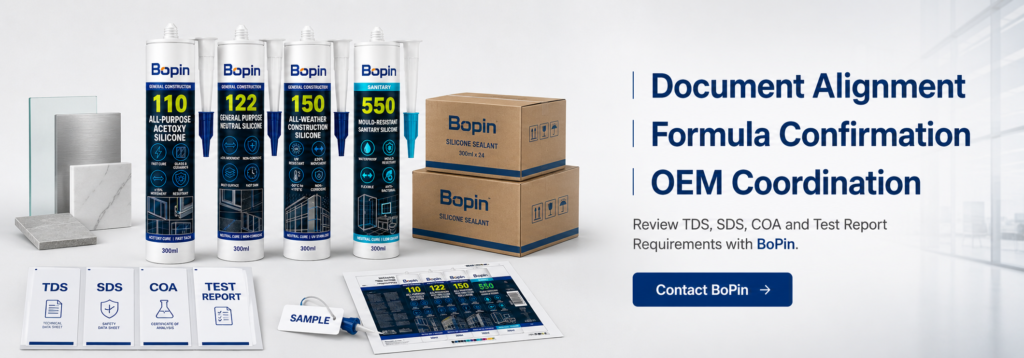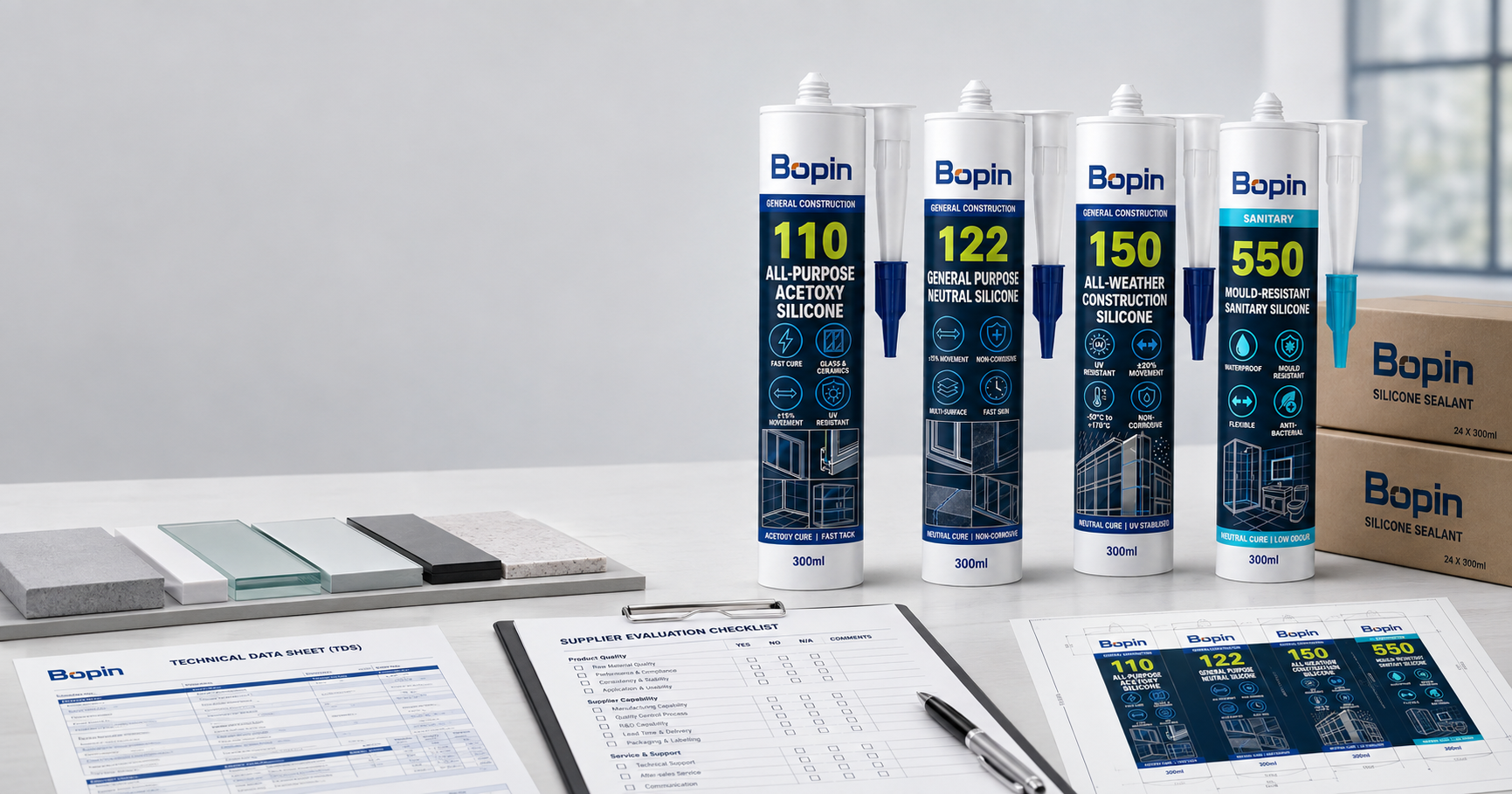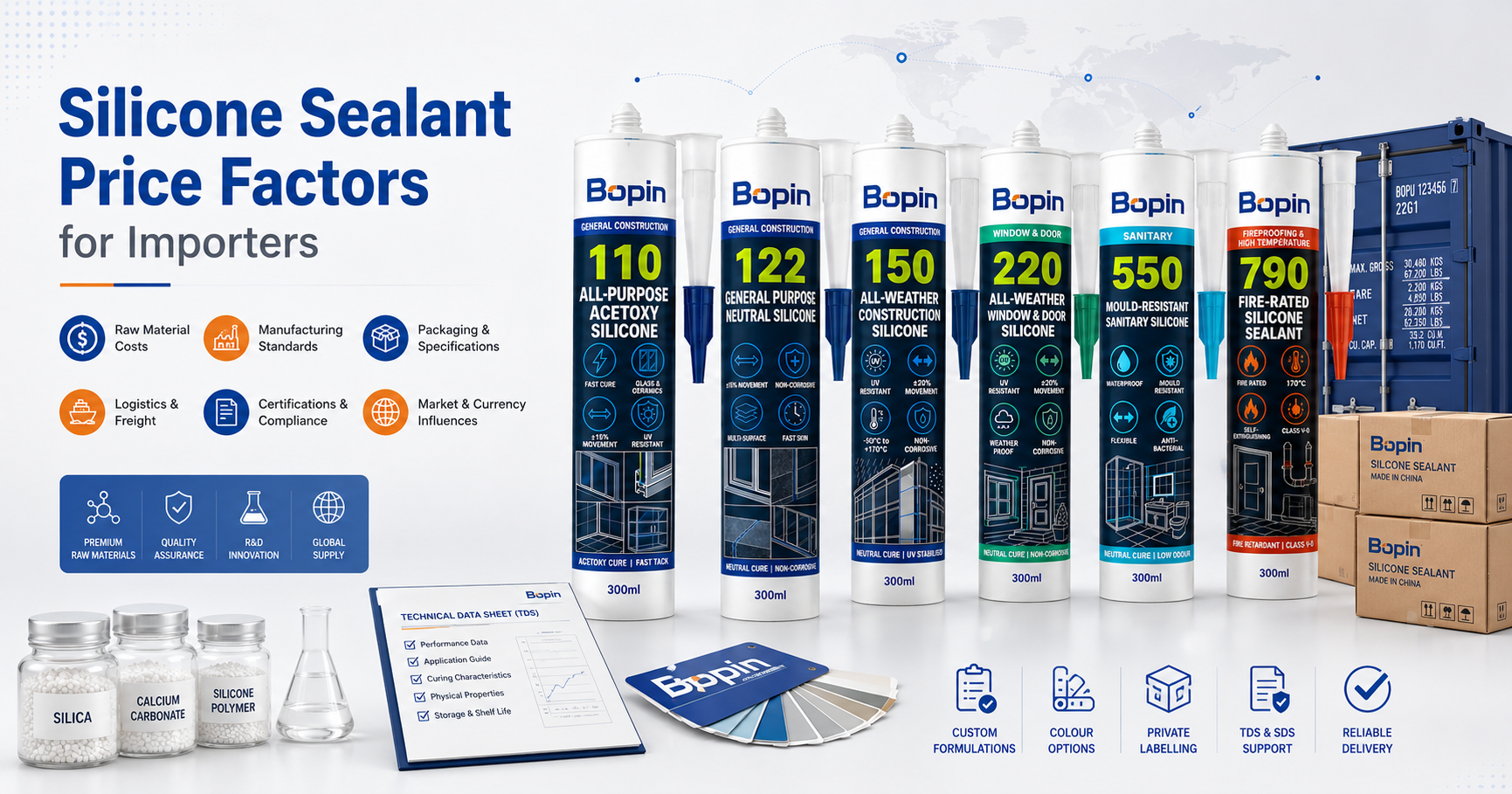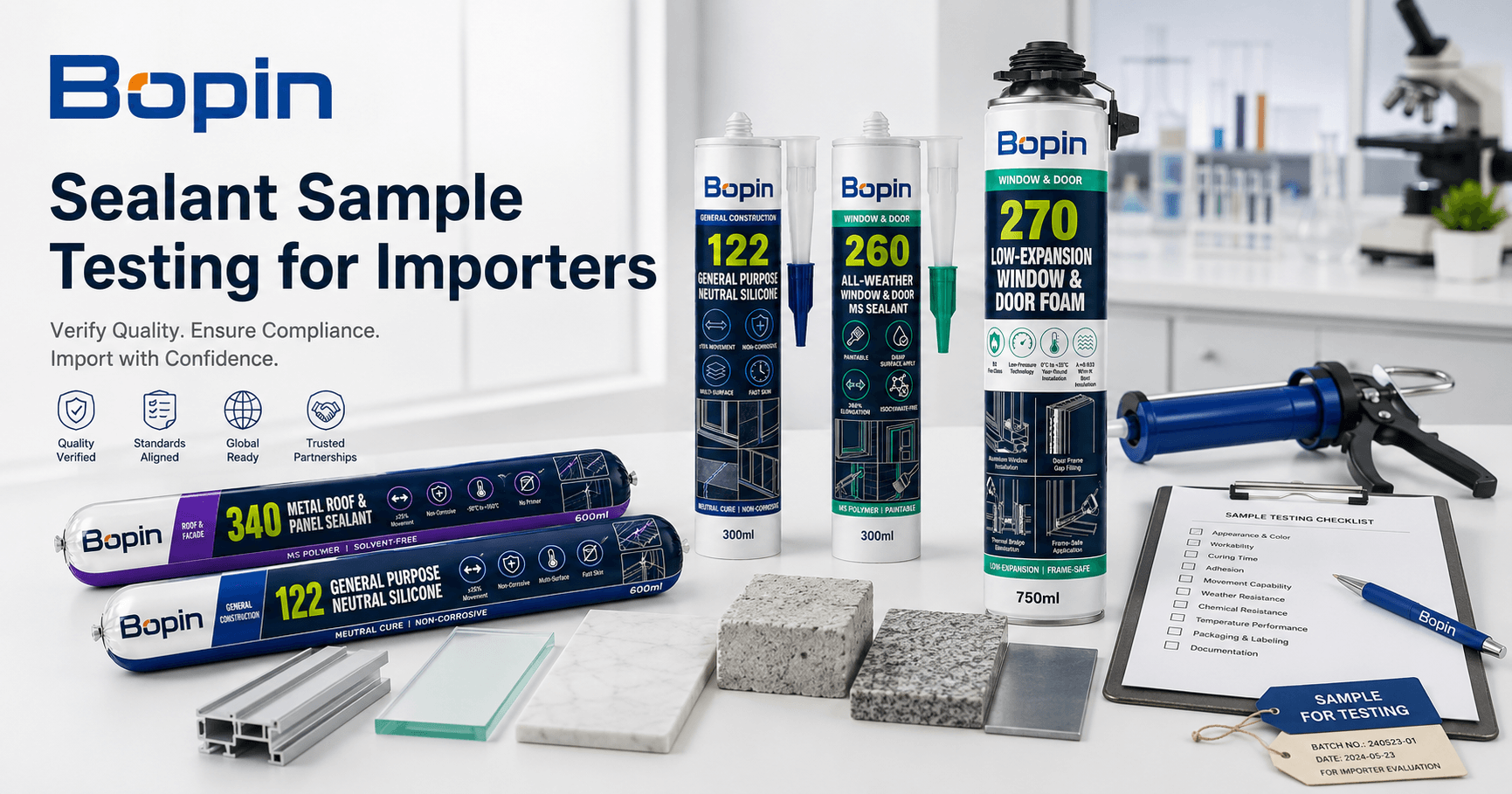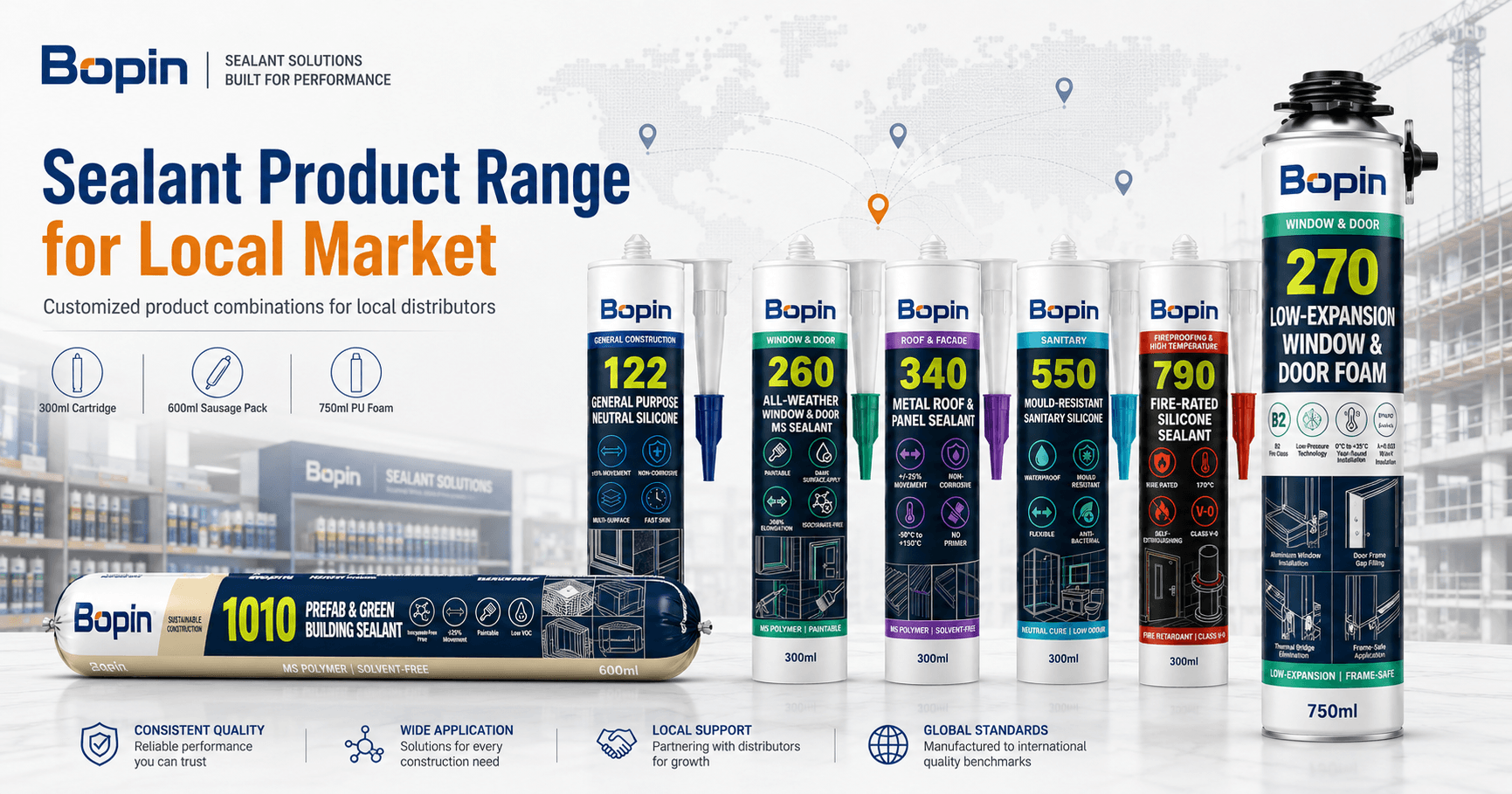
When importing silicone sealants, MS polymer sealants, acrylic sealants, PU foam or construction adhesives, buyers are often asked to review several technical documents.
These may include:
- Product Information Sheet
- Technical Data Sheet
- Safety Data Sheet
- Certificate of Analysis
- Laboratory test report
- Product certificate
- Declaration of conformity
Although these documents may refer to the same product, they do not serve the same purpose.
A TDS explains how a product is intended to perform and be used. An SDS provides safety, handling and transport information. A COA normally records agreed inspection data for a particular production batch. A test report describes what was tested, how it was tested and what result was obtained.
Confusing these documents can create serious purchasing mistakes.
For example:
- An SDS does not prove that a sealant has good movement capability.
- A TDS does not prove that every production batch has been inspected.
- A COA is not automatically a third-party laboratory report.
- A fire-related test report does not automatically certify every joint design.
- A company ISO certificate does not prove that every product meets a particular performance standard.
This guide explains the differences between the main sealant documents and shows importers what to request at each stage of an OEM or bulk-order project.
How to evaluate a silicone sealant supplierSealant sample testingPrivate label sealantOEM sealant manufacturing
Quick Comparison: TDS vs SDS vs COA vs Test Report
| Document | Main Purpose | Usually Relates To | What It Does Not Automatically Prove |
|---|---|---|---|
| Product Information Sheet | Preliminary selection and marketing communication | A proposed product or product family | Final shipment specification |
| TDS | Technical properties, application and limitations | A confirmed product formulation | Batch-specific inspection |
| SDS | Safety, hazards, handling, storage and transport | A chemical product or mixture | Adhesion, durability or project suitability |
| COA | Agreed inspection results | A production batch or shipment | Independent third-party certification |
| Test Report | Result from a defined test method and specimen | The product or system actually tested | Every future batch or every application |
| Certificate | Confirms a defined certification scope | Company, product or system named on the certificate | Claims outside that scope |
The most important purchasing rule is:
Every document should be connected to the exact product, formulation, sample or batch being supplied.
1. What Is a Product Information Sheet?
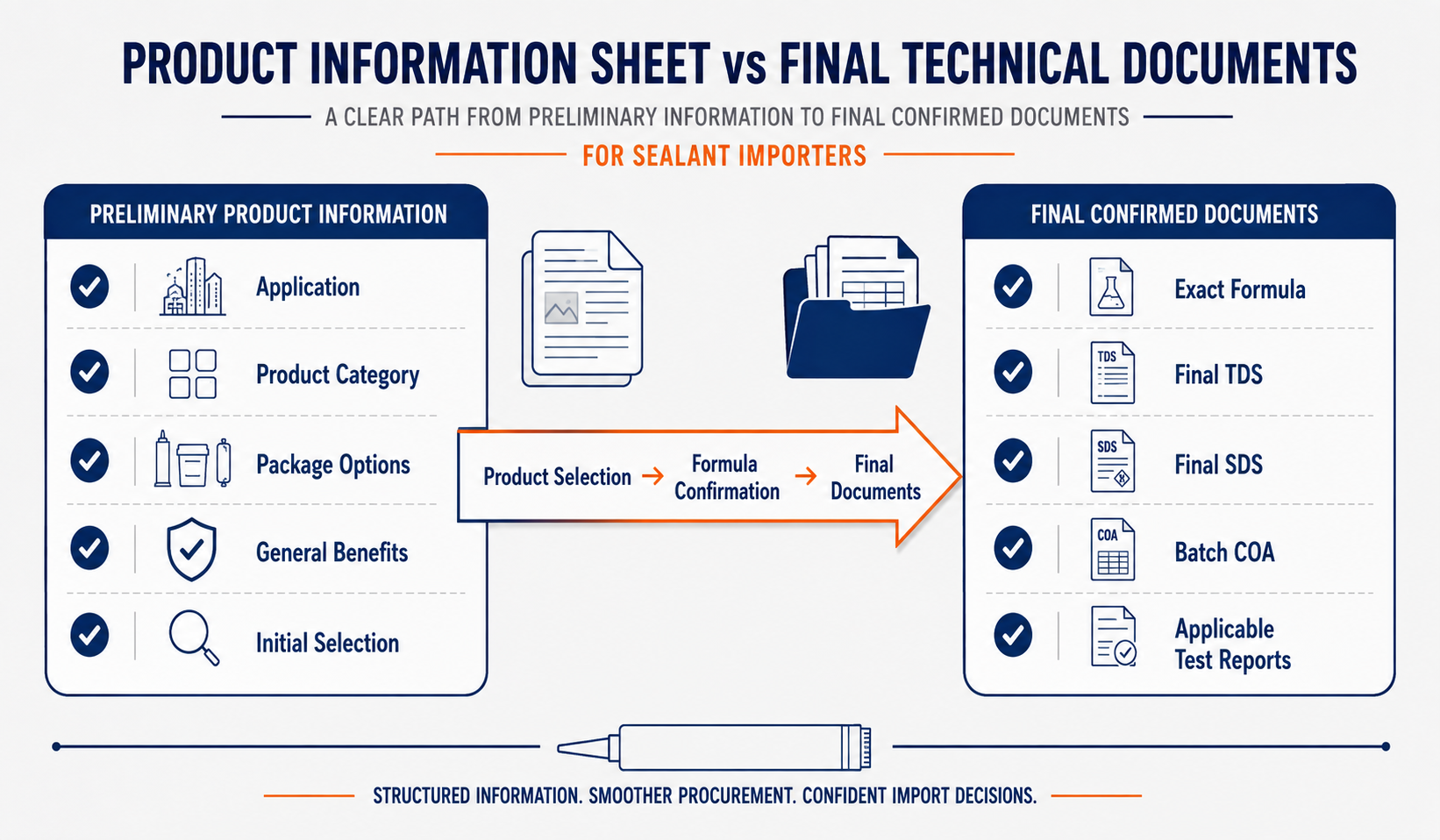
A Product Information Sheet, sometimes called a product profile or preliminary product sheet, is commonly used during the early selection stage.
It may include:
- Product positioning
- Main applications
- General benefits
- Applicable substrates
- Packaging options
- Preliminary technical values
- Basic limitations
- OEM availability
It is useful when the buyer has not yet confirmed:
- The final supplier
- The exact formulation
- The packaging size
- The colour
- The destination-market requirements
- The final test or document package
Why a Product Information Sheet Is Useful
An importer may first need to decide whether to use:
- Acetoxy or neutral silicone
- General-purpose or weather-resistant silicone
- Silicone or MS polymer
- Cartridge or sausage packaging
- Standard or professional product positioning
A Product Information Sheet can support this discussion without implying that every listed value has already become a final shipment specification.
What It Should Clearly State
A responsible Product Information Sheet should explain that:
- It is intended for preliminary selection.
- Final data depend on the confirmed formulation.
- Compatibility testing may be required.
- Strong technical or certification claims need supporting documents.
- Final TDS and SDS will be aligned with the selected product.
BoPin’s current publishing framework uses this approach. Its Product Information Sheets are explicitly described as preliminary materials for website publishing, product selection and OEM discussion—not official TDS, SDS, certificates, test reports, warranties or final shipment specifications.
What It Should Not Be Used For
A preliminary information sheet should not be used as:
- A guaranteed specification
- A batch inspection certificate
- A fire-system approval
- A customs safety document
- A project warranty
- Proof of third-party certification
2. What Is a Technical Data Sheet?
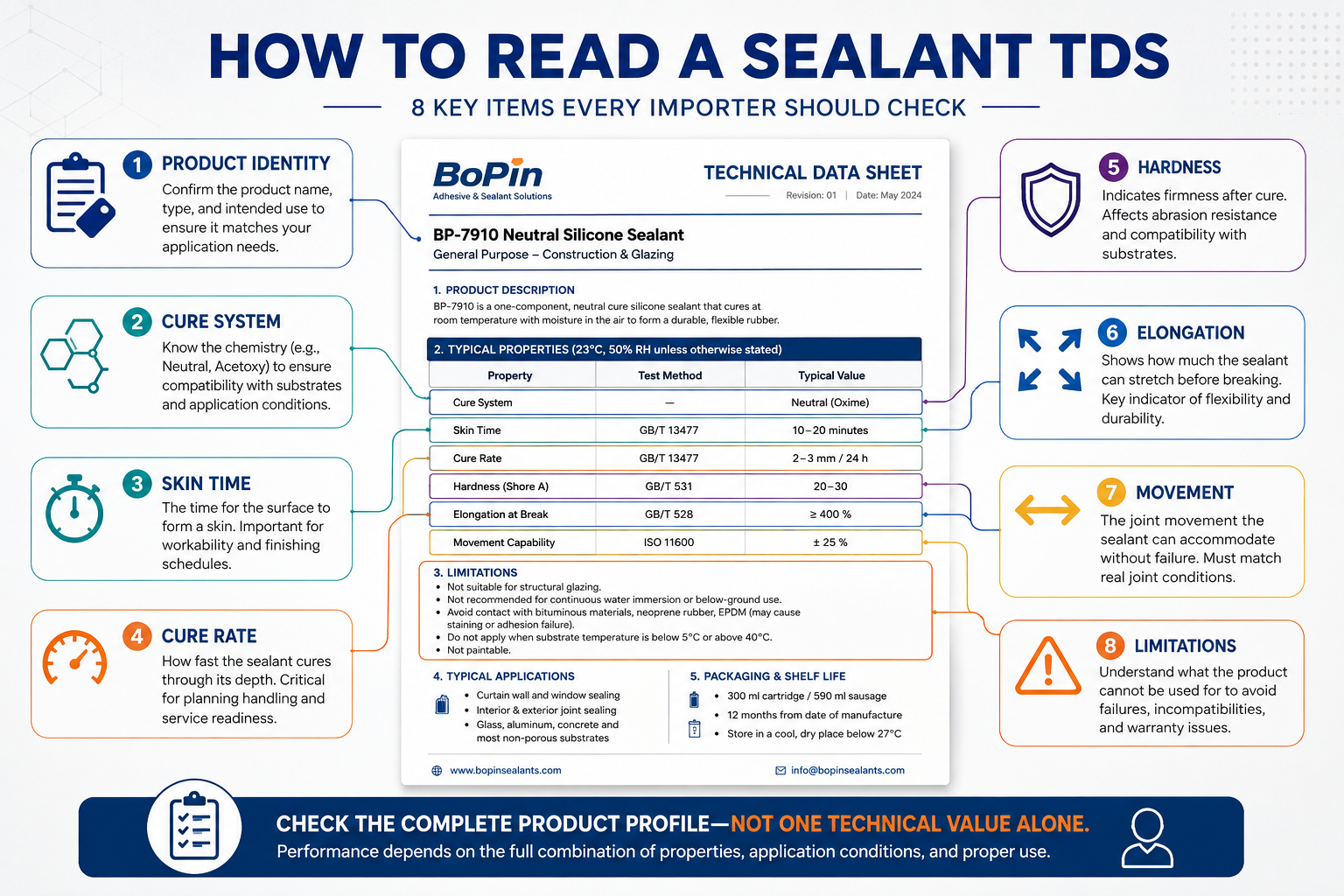
A Technical Data Sheet, or TDS, explains the technical characteristics, recommended applications and limitations of a product.
A sealant TDS may include:
- Product description
- Curing system
- Densité
- Skin formation time
- Cure rate
- Hardness
- Tensile strength
- Elongation
- Capacité de mouvement
- Sag resistance
- Application temperature
- Service temperature
- Packaging
- Shelf life
- Préparation de surface
- Usage instructions
- Limites
- Referenced test standards
What Importers Should Use a TDS For
A TDS helps buyers evaluate whether the product may be suitable for:
- Windows and doors
- General construction
- Kitchens and bathrooms
- Metal roofing
- Facades
- Natural stone
- Interior decoration
- Panel bonding
It also helps buyers compare products on a more meaningful basis than product name or cartridge price alone.
What a TDS Does Not Automatically Prove
A TDS is normally written for a product formulation or commercial model.
It does not automatically prove that:
- Every batch was individually tested
- The product passed an independent third-party test
- The product is suitable for every substrate
- The product meets every local building code
- The product is certified in the destination country
- The product will perform correctly with poor joint design or surface preparation
A TDS should be combined with sample testing and application review.
What to Check on a TDS
Before accepting it, confirm:
- Product name
- Model number
- Manufacturer or responsible supplier
- Cure chemistry
- Revision date
- Test conditions
- Packaging size
- Shelf life
- Application limitations
- Referenced standard
- Whether values are typical or guaranteed
- Whether it matches the quoted product
Do Not Compare One Parameter Alone
A product with higher tensile strength is not automatically better.
The correct balance depends on the application. A high-modulus adhesive and a flexible movement-joint sealant may need very different properties.
Compare the complete performance profile:
- Hardness
- Elongation
- Modulus
- Capacité de mouvement
- Adhésion
- Cure behaviour
- Application conditions
3. What Is a Safety Data Sheet?
A Safety Data Sheet, or SDS, provides information about the hazards, handling, storage, emergency response and transport of a chemical product.
It is not primarily a product-performance document.
Under the OSHA Hazard Communication framework, an SDS follows a 16-section format covering identification, hazards, composition, first aid, firefighting, accidental release, handling, exposure controls, physical properties, stability, toxicology and other regulatory or transport information.
Typical SDS Sections
| Section | Main Content |
|---|---|
| 1 | Product and supplier identification |
| 2 | Hazard identification |
| 3 | Composition and ingredient information |
| 4 | First-aid measures |
| 5 | Firefighting measures |
| 6 | Accidental-release measures |
| 7 | Handling and storage |
| 8 | Exposure controls and personal protection |
| 9 | Physical and chemical properties |
| 10 | Stability and reactivity |
| 11 | Toxicological information |
| 12 | Ecological information |
| 13 | Disposal considerations |
| 14 | Transport information |
| 15 | Regulatory information |
| 16 | Other information and revision date |
Safety Data Sheets used in the European Union are also tied to REACH requirements and include product hazards and guidance for handling, disposal, transport, first aid, fire response and exposure control.
What an SDS Helps Importers Confirm
An SDS may help answer:
- Is the product classified as hazardous?
- What personal protective equipment is recommended?
- How should it be stored?
- What should workers do after skin or eye contact?
- Is the uncured product flammable?
- Is it regulated for road, sea or air transport?
- What substances or ingredient categories are disclosed?
- What disposal precautions apply?
- Who is responsible for the document?
What an SDS Does Not Prove
An SDS does not normally prove:
- Capacité de mouvement
- Tensile strength
- Adhesion to aluminium or concrete
- Mould-resistance performance
- Stone-staining resistance
- Firestop-system performance
- Long-term weather durability
- Structural suitability
A product can have a complete SDS and still be unsuitable for the buyer’s application.
A Practical BoPin 550 Example
The available SMT-555 SDS includes composition ranges, first-aid information, firefighting measures, handling, storage, personal protection, physical properties, toxicological information, disposal and transport classification.
The corresponding SMT-555 TDS focuses instead on sanitary applications, curing type, adhesion, mould resistance, movement capability, application limitations and packaging.
Together, the documents provide a much more complete picture than either document alone.
U.S. Market Note
OSHA states that importers may have responsibility for ensuring that an SDS and label meet U.S. Hazard Communication requirements, including responsible-party information. Overseas buyers should therefore not assume that a foreign supplier’s original SDS automatically satisfies every destination-market requirement.
4. What Is a Certificate of Analysis?
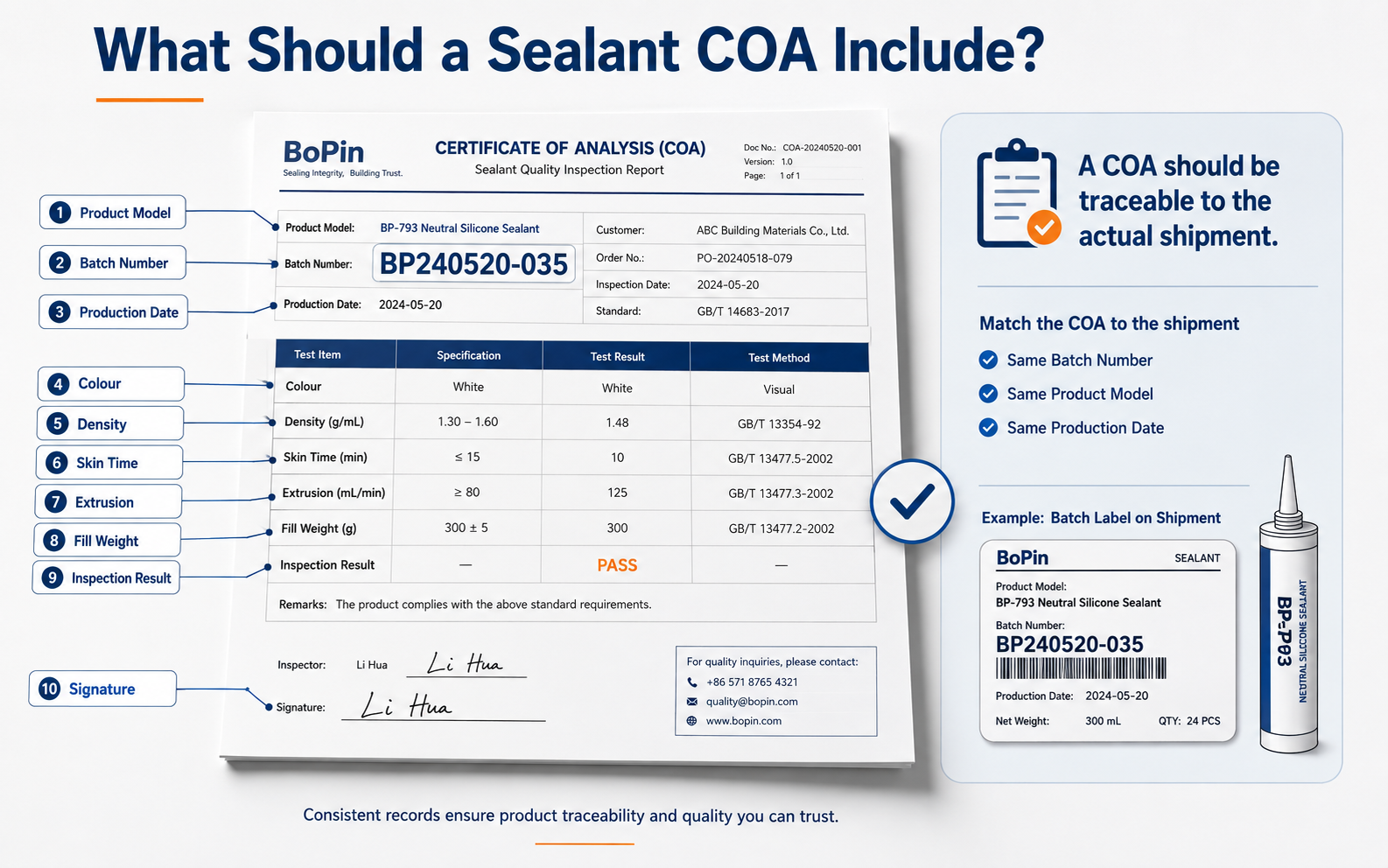
A Certificate of Analysis, or COA, is usually associated with a particular production batch, lot or shipment.
Its purpose is to record agreed inspection results.
Depending on the product and purchasing agreement, a sealant COA may include:
- Product name
- Batch number
- Production date
- Couleur
- Appearance
- Densité
- Skin time
- Extrusion result
- Sag result
- Hardness
- Net content
- Inspection date
- Pass or fail result
- Authorised signature
A COA Should Be Connected to a Batch
A useful COA should allow the buyer to connect the document to:
- The product model
- The production lot
- The shipment
- The carton or cartridge batch code
- The agreed inspection specification
A generic COA without a batch number provides limited traceability.
COA Values Must Be Agreed in Advance
Not every TDS parameter must appear on every COA.
Some properties require longer curing periods or specialised laboratory equipment. Buyers and suppliers should agree before production which items will be checked for release.
A practical shipment COA may focus on:
- Appearance
- Couleur
- Densité
- Extrusion
- Skin time
- Sag
- Fill weight
More complex properties may be verified through periodic testing rather than every production batch.
What a COA Does Not Automatically Mean
A COA is not automatically:
- A third-party test report
- A product certificate
- Proof of compliance with all standards
- A warranty
- Proof that every technical claim was tested on that batch
BoPin’s OEM documentation approach similarly treats COA as a document to be aligned with the confirmed formulation and order rather than a generic certificate issued before the product is selected.
5. What Is a Laboratory Test Report?
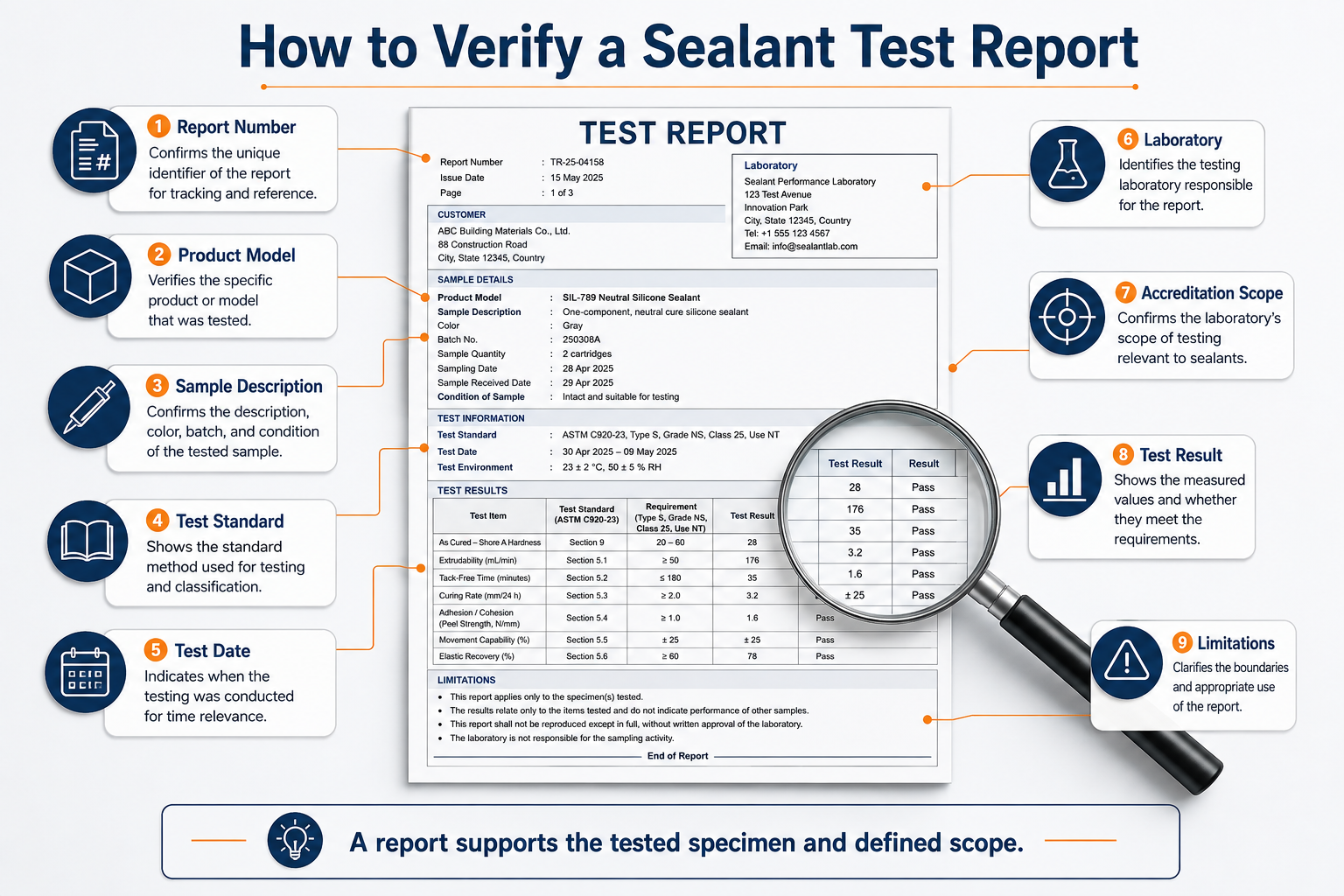
A test report records the result of a defined test.
It should identify:
- The applicant
- The testing laboratory
- The tested product
- The submitted specimen
- The sample identification
- The test method
- The test conditions
- The test result
- The report date
- The report number
- Any limitations or comments
The Report Applies to What Was Actually Tested
A report should not automatically be extended to:
- Another product model
- Another formulation
- Another factory
- Another colour
- Another joint design
- Another substrate
- A complete system that was not tested
- Future batches after the formulation changes
For example, a flame-retardant material test is not automatically a complete firestop-joint-system report.
A stone-staining test on one marble type does not guarantee compatibility with every natural stone.
Check the Laboratory and Accreditation Scope
ISO/IEC 17025 is the international standard used for the competence, impartiality and consistent operation of testing and calibration laboratories. It helps laboratories demonstrate that they can generate valid results.
However, seeing an ISO/IEC 17025 logo is not enough.
Check whether:
- The laboratory is genuinely accredited.
- The accreditation was valid on the test date.
- The test method falls within the laboratory’s accredited scope.
- The report number can be verified.
- The report has not been altered.
- The tested model matches the offered product.
ILAC provides information about accreditation bodies and links to directories that can be used to locate accredited laboratories and inspection bodies.
Test Report vs Product Certificate
A test report records a result.
A product certificate may involve a wider conformity-assessment process, potentially including:
- Product evaluation
- Factory assessment
- Surveillance
- Defined certification rules
- Ongoing control
Do not describe a test report as a product certificate unless the issuing body and document explicitly support that description.
6. Company Certificate, Product Certificate and System Report Are Different
Importers may receive many certificates during supplier evaluation.
These documents may relate to different subjects.
| Document Type | What It May Cover |
|---|---|
| ISO 9001 certificate | Company quality-management system |
| ISO 14001 certificate | Company environmental-management system |
| Laboratory accreditation | Laboratory competence within an accredited scope |
| Product certificate | A defined product and certification programme |
| Test report | One tested specimen and method |
| Fire-system report | A defined joint or penetration system |
| Declaration | A statement made by the manufacturer or responsible party |
Company Certification Does Not Certify Every Product
A factory’s ISO 9001 certificate may be useful when evaluating management processes.
It does not automatically prove that:
- Every sealant meets ASTM C920
- Every product is fire-rated
- Every product is stone-safe
- Every batch has passed independent testing
- Every product is approved in the buyer’s country
Product Name Matching Is Essential
Check whether the certificate or report identifies:
- The same product name
- The same model number
- The same manufacturer
- The same production site
- The same formulation or product family
- The same intended application
A supplier should not use a certificate from one premium model to support a lower-cost product unless the document explicitly covers both.
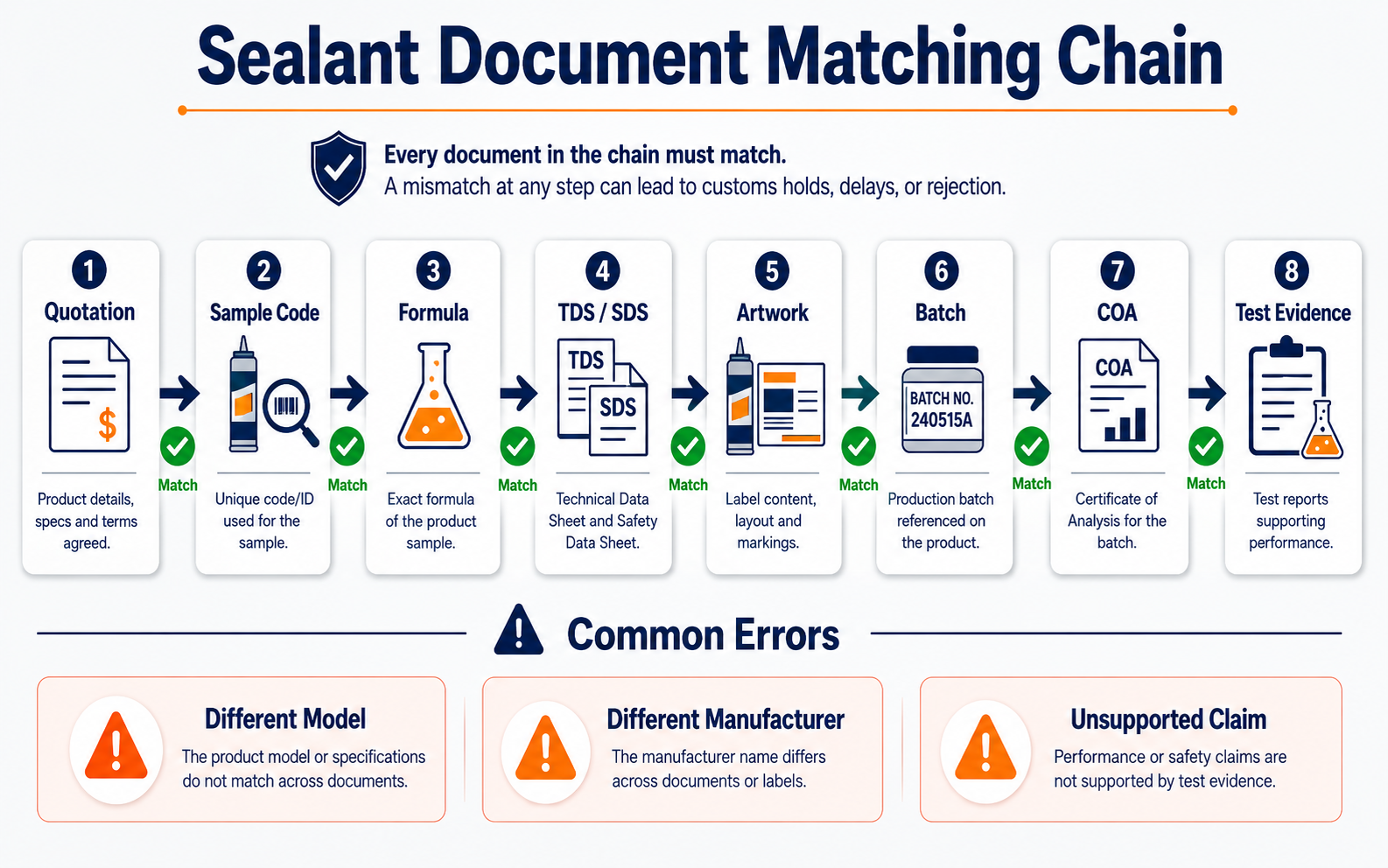
7. How the Documents Should Connect
The strongest document package is not the package with the largest number of PDF files.
It is the package in which all documents refer to the same controlled product.
Recommended Document Chain
Quotation → Sample → Product Model → TDS → SDS → Packaging → Production Batch → COA → Applicable Test Report
Each stage should be connected.
Quotation
Should identify:
- Product type
- Cure system
- Supplier model or formulation
- Net volume
- Couleur
- Packaging
- Documents included
Sample
Should have:
- Sample code
- Product model
- Couleur
- Date or batch reference
TDS and SDS
Should correspond to:
- The selected formula
- The quoted chemistry
- The correct manufacturer or responsible party
Packaging
Should use claims supported by the selected product documents.
COA
Should correspond to the actual production batch.
Test Report
Should support the specific claim for which it is being used.
8. What Documents Should Importers Request at Each Stage?
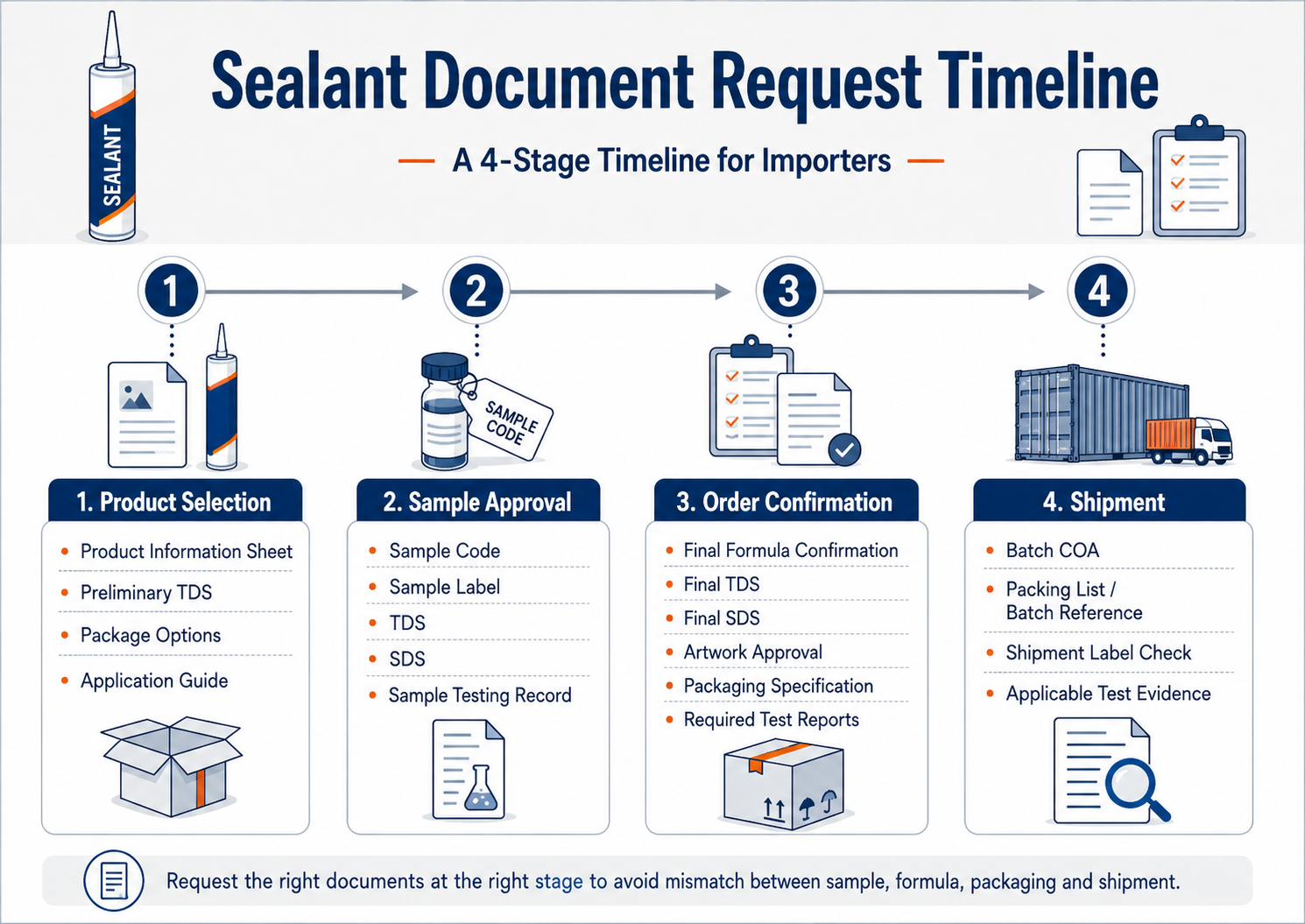
Requesting every possible document before product selection can create confusion.
A staged approach is more efficient.
Stage 1: Preliminary Product Selection
Request:
- Product Information Sheet
- Product catalog
- Available packaging
- Basic application limitations
- Reference TDS or SDS where available
Goal:
Confirm the product category and shortlist suitable options.
Stage 2: Sample Evaluation
Request:
- Sample identification
- Reference TDS
- Reference SDS
- Sample testing guidance
- Available colours
- Packaging specification
Goal:
Confirm that the sample is suitable for the application.
Stage 3: Before Order Confirmation
Request:
- Final supplier model
- Confirmed formulation identity
- Final or agreed TDS
- Final or agreed SDS
- Relevant test reports
- Artwork claim review
- Agreed COA inspection items
Goal:
Lock the product, documents and packaging before production.
Stage 4: Before Shipment
Request:
- Final invoice
- Packing list
- Final SDS
- Batch COA where agreed
- Production or inspection photos
- Carton and loading data
- Applicable certificate or test-report copies
- Certificate of origin where required
Goal:
Confirm that shipment documents correspond to the goods being dispatched.
9. Different Products Need Different Document Packages
Not every sealant needs the same level of documentation.
| Product Type | Basic Documents | Additional Evidence When Claimed |
|---|---|---|
| General acetoxy silicone | TDS + SDS | Application or standard test report where required |
| General neutral silicone | TDS + SDS | Movement or adhesion evidence for project claims |
| Sanitary silicone | TDS + SDS | Mould-resistance test when promoted |
| Natural stone silicone | TDS + SDS | Staining and compatibility test |
| Facade sealant | TDS + SDS | Movement, adhesion, weathering or project reports |
| Fire-retardant silicone | TDS + SDS | Exact flame or fire test report |
| Firestop system | Product documents | Complete tested-system evidence |
| PU foam | TDS + SDS | Yield, fire class, acoustic or insulation report when claimed |
| MS polymer adhesive | TDS + SDS | Strength, initial-grab or substrate test when claimed |
BoPin’s own product matrix applies this principle. BoPin 550 is regarded as the strongest-supported launch product because supplier TDS and MSDS are available, although final BoPin-branded documents still require order confirmation. BoPin 635 requires stone-staining and compatibility verification, while BoPin 730 and 770 remain on hold until appropriate technical and test documents are confirmed.
The same matrix permits cautious fire-retardant wording for BoPin 790 but specifically warns against claiming an EI rating, four-hour resistance or complete firestop-system compliance without corresponding system reports.
This is a better approach than requesting one generic “certificate package” for every product.
10. Common Document Red Flags
1. The TDS and SDS use different product names
Ask whether they relate to the same formulation.
2. The supplier name changes between documents
The supplier should explain the manufacturer, exporter and responsible party.
3. The quotation does not identify a model
“Premium neutral silicone” is not enough.
4. A TDS contains only benefits and no limitations
A professional technical document should also explain where the product should not be used.
5. The SDS is extremely short or missing sections
Confirm whether it follows the destination market’s required format.
6. The COA has no batch number
It cannot be reliably connected to the shipment.
7. The test report covers another model
Similar names do not prove technical equivalence.
8. The report tests only one colour
Ask whether colour changes affect the formula or result.
9. A company certificate is presented as product certification
Check the certificate scope.
10. The report logo is visible but the accreditation scope is not
Verify the laboratory and test method.
11. The test report has been cropped
Request the complete report, including cover, sample details, method, results and signatures.
12. The document dates are inconsistent
An old report may not apply after a formula or factory change.
13. Strong packaging claims appear before document confirmation
Artwork should not be printed until supporting documents are aligned.
14. The supplier refuses to explain document limitations
Reliable suppliers should be able to distinguish reference information from confirmed evidence.
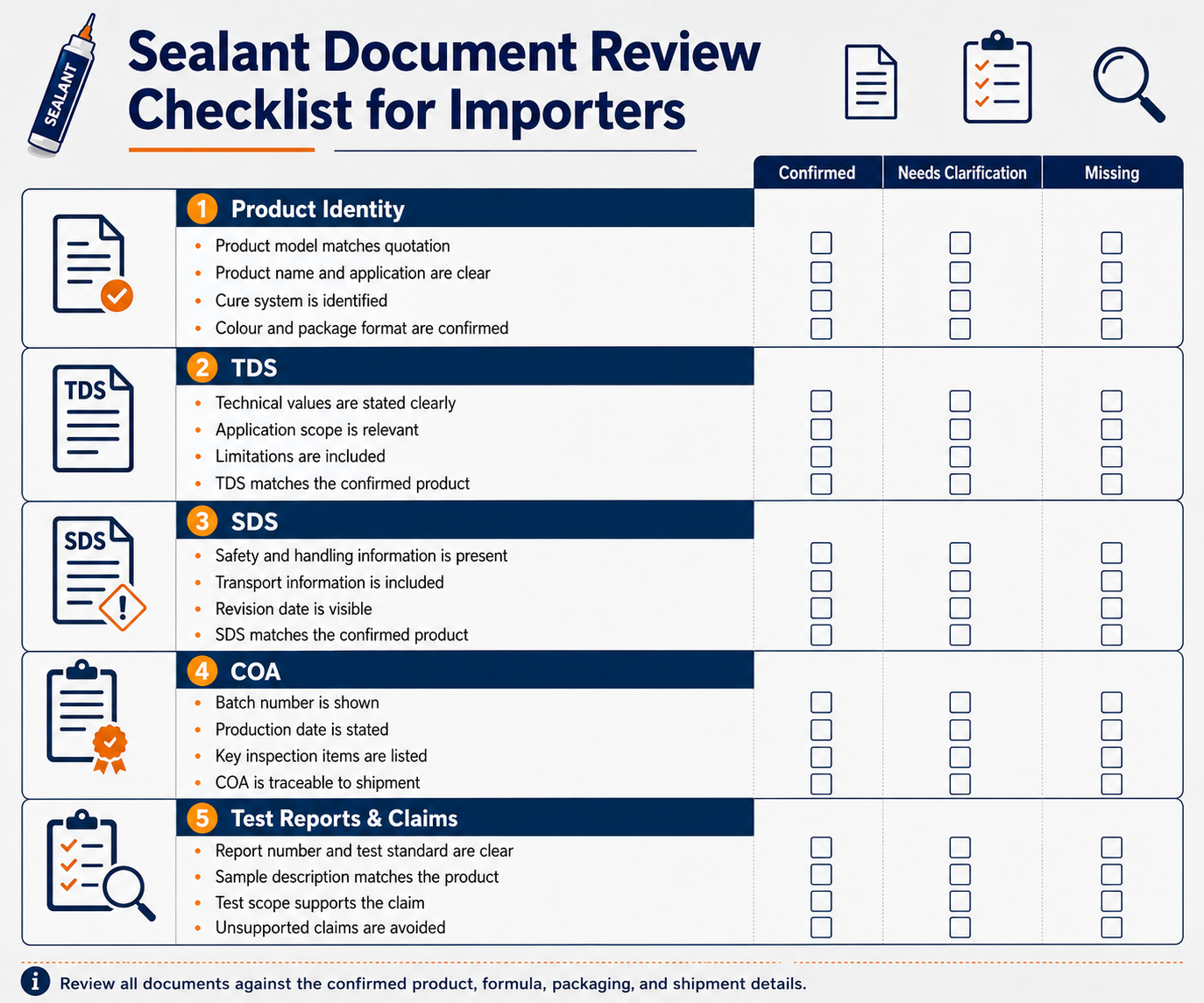
Sealant Document Review Checklist
Before approving a product, confirm:
Product Identity
- Product name matches
- Model number matches
- Manufacturer is clear
- Cure system matches
- Colour and package match
- Formula has not changed
TDS
- Revision date shown
- Technical values included
- Test conditions stated
- Applications explained
- Limitations included
- Shelf life and storage included
SDS
- Correct product identity
- Supplier contact included
- Hazard classification included
- 16-section structure where applicable
- Storage and transport information included
- Revision date shown
COA
- Batch number included
- Production date included
- Agreed inspection items included
- Results clearly shown
- Connected to shipment
Test Report
- Complete report supplied
- Test model matches
- Specimen described
- Standard identified
- Laboratory identified
- Accreditation checked
- Result and limitations reviewed
Packaging
- Claims match the documents
- No unsupported certification icons
- Net volume is correct
- Safety information is correct
- Batch coding area is included
Questions fréquemment posées
Is an SDS the same as an MSDS?
MSDS is an older term that is still commonly used in international trade.
SDS is now the more standard term under modern GHS-aligned systems. Buyers should focus on whether the document contains the required information and is suitable for the destination market.
Can I use a supplier’s original TDS for my private-label product?
It may be used as a technical reference during selection.
For a final private-label order, the document should correspond to the confirmed formulation, responsible supplier and product name. Buyers should not simply replace the supplier logo while leaving unclear product or company information.
Does every shipment need a COA?
That depends on the purchase agreement, product risk and customer requirements.
For routine general products, buyers may agree on a simplified batch inspection record. Project or specialised products may require a more detailed COA.
Is a third-party test report always required?
No.
It depends on the product, claim, market and project requirement. General-purpose sealants may not require the same reports as fire-related, structural, facade or natural-stone products.
Can one test report support several private-label brands?
Possibly, but only when the certification or report owner permits it and the products genuinely use the tested formulation and manufacturing source.
The buyer should request written clarification rather than assuming that changing the brand name has no effect.
Does an ISO 9001 certificate prove product quality?
It provides information about a company’s quality-management system.
It does not by itself prove the performance of a particular sealant formulation or production batch.
What should I do when the supplier cannot provide every document immediately?
First determine which stage the project is in.
During preliminary selection, a Product Information Sheet and available reference documents may be sufficient. Before production, the final formulation, required TDS, SDS, test evidence and packaging claims should be confirmed in writing.
Final Thoughts
TDS, SDS, COA and test reports are connected, but they are not interchangeable.
A professional sealant-document package should answer four different questions:
- TDS: What is the product designed to do?
- SDS: How should the product be handled safely?
- COA: What was checked for this production batch?
- Test report: What specimen was tested, by which method, and with what result?
Importers should not judge document quality by the number of PDFs received.
The more important question is:
Do all the documents correspond to the exact formulation, approved sample, packaging and shipment being purchased?
BoPin supports importers and private-label buyers with preliminary product information, formula selection, sample coordination, packaging review and final document alignment. Final TDS, SDS, COA and applicable test reports are confirmed according to the selected product, manufacturing partner and order requirements.