Le pouvoir d'un sceau invisible
Une étanchéité parfaite n'a pas besoin d'être visible. Le silicone transparent offre une finition propre, moderne et sans joint. qui permet à vos belles surfaces de ressortir sans lignes blanches gênantes ni joints visibles. Mais quand est-ce le bon choix par rapport au mastic blanc traditionnel ?
Cette question intrigue de nombreux propriétaires et entrepreneurs. Vous souhaitez que votre projet ait une apparence professionnelle et soignée. Cependant, choisir le mauvais type de mastic peut donner des résultats décevants. – des bulles et imperfections visibles au jaunissement redouté qui gâche une finition par ailleurs parfaite.
Le choix entre le silicone transparent et le silicone blanc ne relève pas uniquement d'une préférence personnelle. Chacune a des applications spécifiques où elle excelle. et les situations où cela devient un mauvais choix. Il est crucial de comprendre ces différences pour atteindre les résultats que vous envisagez.
Ce guide complet répondra à toutes vos questions sur le mastic silicone transparent. Nous verrons où l'utiliser, où l'éviter et comment choisir un produit de haute qualité qui restera parfaitement transparent pendant des années. À la fin, vous aurez la confiance nécessaire pour faire le bon choix. pour votre projet spécifique et obtenez des résultats de qualité professionnelle qui durent.
Commençons par aborder la question fondamentale qui détermine le succès de votre projet.
1. La grande question : silicone transparent ou mastic blanc ?
Avant de vous plonger dans les applications et les techniques, vous devez comprendre les principales différences. entre les mastics silicone transparents et blancs. Ce savoir guide chacune de nos décisions de la sélection du produit à la technique d'application.
| Fonctionnalité | Mastic silicone transparent | Mastic silicone blanc |
| Esthétique | Laisse apparaître le substrat, un aspect invisible moderne | Fournit une bordure nette et précise qui définit les contours. |
| Idéal pour | Comptoirs en granit, surfaces en verre, douches carrelées, éviers en métal | Plinthes, moulures, robinetterie en porcelaine blanche, applications traditionnelles |
| Pardon des erreurs | Moins tolérant – les bulles, les interstices et les imperfections sont clairement visibles. | Plus tolérant – masque les petits défauts d'application |
| Entretien | La saleté et les résidus de savon sont plus visibles sur une surface propre. | Aspect plus facile à maintenir propre, présente moins d'usure quotidienne |
| Risque de jaunissement | Problème potentiel lié aux produits de mauvaise qualité | Peut se salir avec le temps, mais ne “jaunit” pas.” |
Comprendre ces compromis est essentiel pour faire le bon choix. Le silicone transparent crée une apparence plus sophistiquée et moderne. lorsqu'il est appliqué correctement sur les surfaces appropriées. Cependant, elle exige des normes d'application plus élevées et des produits de qualité pour obtenir ces résultats.
L'idée clé : Le silicone transparent n'est pas simplement du “ silicone blanc sans couleur ”.” C'est un produit spécialisé qui nécessite des considérations différentes pour une application réussie.
2. Les principaux atouts du silicone transparent : ses applications phares
Le mastic silicone transparent excelle dans des applications spécifiques où son caractère invisible rehausse l'attrait esthétique global. Comprendre ces applications idéales vous aide à identifier les situations où le silicone transparent mérite les soins supplémentaires qu'il requiert.
Dans la cuisine et la salle de bain
Le silicone transparent est idéal pour l'étanchéité autour des luminaires haut de gamme. là où vous souhaitez que la beauté du matériau ne soit pas interrompue par des lignes de mastic visibles.
Applications idéales en cuisine :
- Éviers en acier inoxydable – Le mastic transparent disparaît contre la surface métallique.
- Comptoirs en granit ou en quartz – Laissez les motifs naturels de la pierre s'exprimer sans interruption.
- Crédences en carreaux de verre – Préserve l’aspect propre et uniforme des surfaces vitrées
- Zones d'éclairage sous les armoires – Les joints invisibles ne créent ni ombres ni ruptures visuelles.
Utilisations idéales dans la salle de bain :
- Douches carrelées avec motifs décoratifs – Laissez le motif des carreaux être la vedette
- installations en pierre naturelle – Préserve l’aspect continu du marbre ou du travertin
- cabines de douche en verre – Crée des joints véritablement invisibles sur les surfaces transparentes
- lavabos modernes – Préserver la qualité sculpturale des luminaires design
Pour fenêtres et portes
L'étanchéité des fenêtres et des portes extérieures bénéficie grandement du silicone transparent lorsque vous souhaitez préserver l'intégrité architecturale de la façade de votre maison.
Quand le silicone transparent est idéal :
- Maisons en briques ou en pierre – Les lignes blanches créeraient des interruptions visuelles choquantes.
- maisons historiques – Conserver l’aspect d’époque sans ajouts modernes visibles
- Designs contemporains – Soutient l'esthétique épurée et minimaliste
- Grandes installations vitrées – Préserve l'effet de transparence ininterrompu
Sur verre et métal
Le silicone transparent est souvent le seul choix approprié. pour certaines applications sur verre et métal où tout mastic visible compromettrait l'objectif du design.
Applications essentielles :
- Cloisons vitrées – Maintenir la transparence et la fluidité spatiale
- Aquariums – Fournir des joints d'étanchéité robustes sans distraction visuelle des expositions aquatiques
- garnitures et accessoires métalliques – Permet de préserver la finition du matériau sans interruption
- Puits de lumière – Préserve une transmission lumineuse maximale et un aspect impeccable
Applications extérieures
Les applications extérieures bénéficient souvent d'un scellement invisible qui ne dénature ni les caractéristiques architecturales ni les matériaux naturels.
Excellentes utilisations en extérieur :
- Raccordements de gouttières – Aucune ligne blanche visible ne perturbe l'esthétique de la ligne de toit
- Solins autour des cheminées – Préserve la pureté des lignes de l'architecture de la toiture
- pénétrations de ventilation – Un joint invisible qui ne met pas en évidence les éléments mécaniques
- installations en pierre naturelle – Préserve l’aspect continu des ouvrages en pierre
Maintenant que vous comprenez les points forts du silicone transparent, abordons le problème le plus important. ce qui empêche beaucoup de gens de le choisir.
3. Le sujet tabou : le silicone transparent va-t-il jaunir ?
Abordons ce problème honnêtement et directement. C’est cette crainte qui empêche beaucoup de gens d’utiliser du silicone transparent. même lorsque c'est le meilleur choix pour leur application. Comprendre les faits réels vous aide à prendre des décisions éclairées.
La réponse honnête
Oui, les silicones transparentes de mauvaise qualité peuvent jaunir, et jauniront., notamment lorsqu'il est exposé aux rayons UV et à certaines conditions environnementales. Ce jaunissement est dû à la dégradation des polymères dans les formulations de qualité inférieure. lorsqu'elles sont soumises au stress thermique, aux rayons UV et à l'exposition à des produits chimiques.
Cependant, ce problème est parfaitement évitable. avec une sélection de produits appropriée et des techniques d'application adéquates.
La science derrière le jaunissement
Le jaunissement se produit lorsque les chaînes polymères se décomposent sous l'effet du stress. Les formulations de silicone moins chères utilisent des systèmes polymères moins stables. qui se dégradent lorsqu'ils sont exposés à :
- Rayonnement UV direct – Une lumière du soleil particulièrement intense à travers les fenêtres
- températures élevées La chaleur accélère les processus de décomposition chimique
- exposition chimique – Les produits de nettoyage et les polluants peuvent déclencher une dégradation
- mauvaises conditions de séchage – Un durcissement incomplet laisse des structures moléculaires instables
Selon recherche en science des polymères, La dégradation induite par les UV est une cause majeure de décoloration des polymères de silicone, en particulier dans les produits ne bénéficiant pas d'une stabilisation UV adéquate.
La solution : la qualité compte
C’est pourquoi le choix d’une formule haut de gamme qui ne jaunit pas est absolument essentiel. Les silicones transparentes de qualité professionnelle utilisent une technologie polymère avancée qui résiste à la dégradation même dans des conditions exigeantes.
Critères de choix d'un produit qui ne jaunit pas :
- Allégations explicites “ non jaunissantes ” avec garantie
- Formulations polymères stables aux UV conçu pour une exposition à long terme
- Chimie à durcissement neutre qui réduit la contrainte sur les chaînes polymères
- Spécifications de qualité professionnelle qui dépassent les normes de construction de base
En résumé : Le jaunissement est un problème de qualité du produit, et non un problème inhérent au silicone transparent. Choisissez des produits de qualité, et vous éliminerez ce souci.
4. Notre recommandation : Mastic silicone transparent pour fenêtres et portes BoPin 220
La solution limpide et non jaunissante
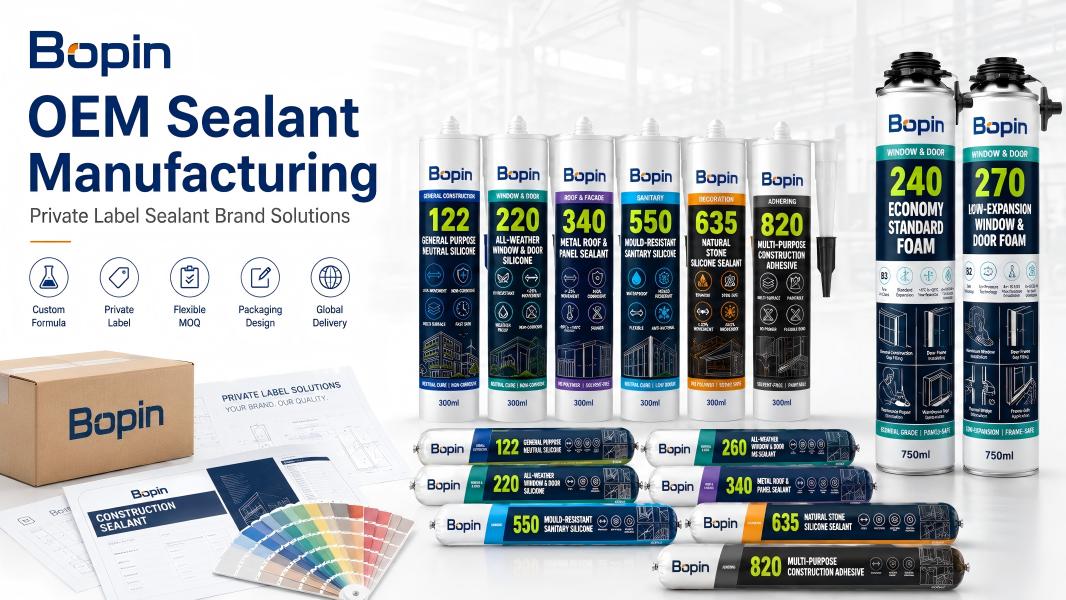
Après des tests approfondis dans des environnements UV difficiles à travers le monde, nous recommandons en toute confiance Mastic silicone pour fenêtres et portes BoPin 220 en clair comme choix optimal pour les applications exigeant une transparence et des performances à long terme.
Pourquoi BoPin 220 Clear offre des résultats supérieurs :
- Transparence cristalline – Sa formule avancée à séchage neutre conserve une transparence parfaite pendant des décennies, même sous une forte exposition aux UV.
- Garantie anti-jaunissement – Technologie polymère stable aux UV, spécialement conçue pour résister à la dégradation et aux changements de couleur.
- Étanchéité aux intempéries de qualité professionnelle – Résistance exceptionnelle à la pluie, à la neige, aux températures extrêmes et aux polluants environnementaux
- Capacité de mouvement ±25% – Supporte les mouvements importants du bâtiment sans se fissurer ni perdre sa transparence
- Durée de vie prolongée – Conserve ses propriétés et son apparence pendant plus de 20 ans dans des applications correctement conçues.
- Technologie sans MEKO – Une formule plus respectueuse de l'environnement sans compromettre la performance ni la clarté
- Formule sans rétention – Utilisation sans danger sur la pierre naturelle et les surfaces sensibles, sans risque de décoloration
Avantages techniques :
- Stabilité UV supérieure prévient la dégradation et le jaunissement des polymères
- Excellente adhérence sur des surfaces en verre, en métal, en béton et en maçonnerie
- caractéristiques de durcissement professionnel pour des résultats cohérents et fiables
- faible teneur en COV est sans danger pour les applications intérieures
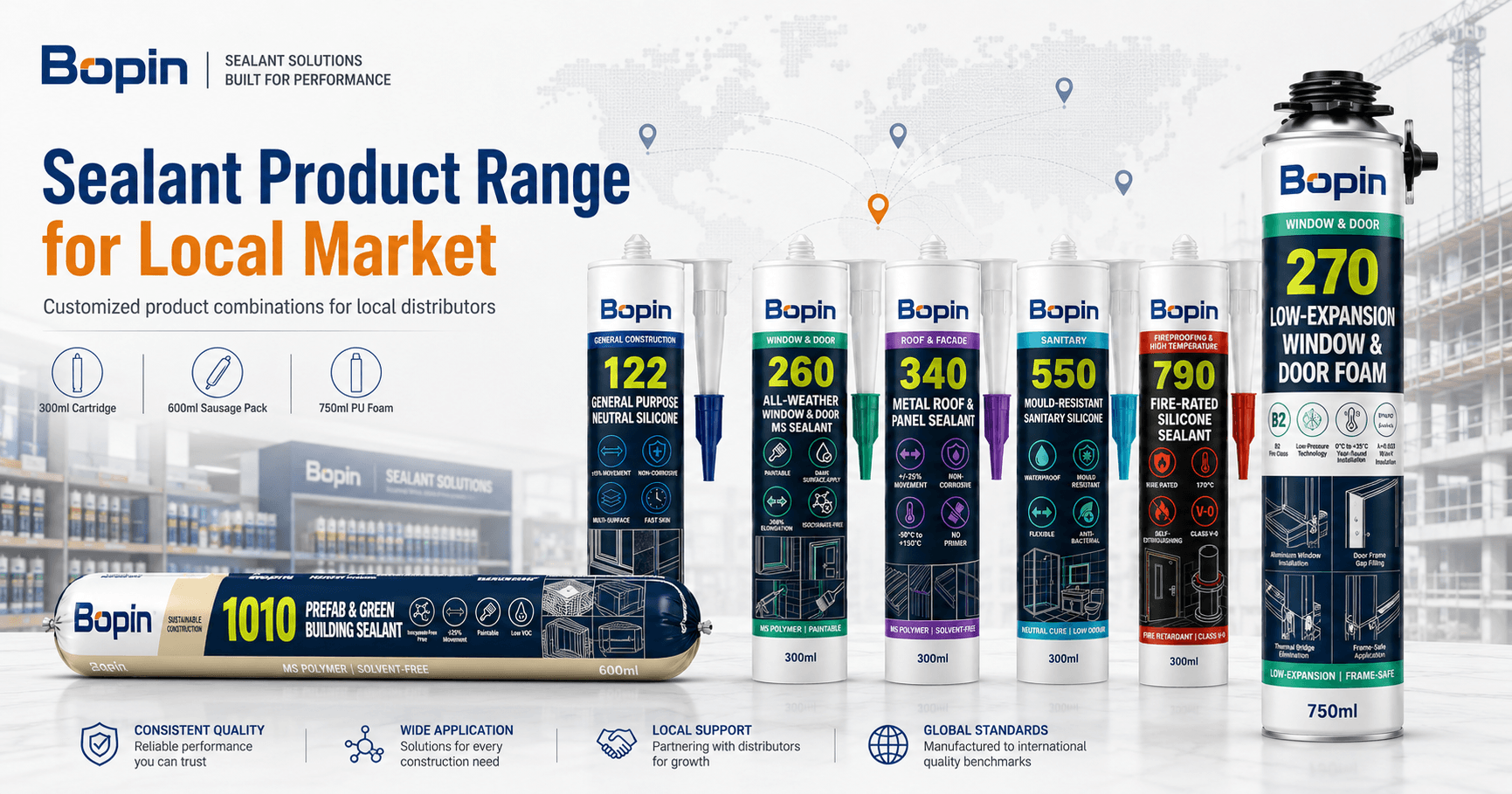
Disponible en cartouches de 300 ml et en emballages aluminium de 600 ml pour des projets de toute envergure.
Les entrepreneurs professionnels choisissent BoPin 220 Clear car elle garantit la transparence et la durabilité dont dépend leur réputation. Vous pouvez désormais obtenir les mêmes résultats de qualité professionnelle. dans vos projets.
5. Comment obtenir une application parfaite et sans bulles
Le silicone transparent exige des normes d'application plus élevées car chaque imperfection est visible à travers le matériau transparent. Suivez ces techniques professionnelles pour des joints impeccables et invisibles qui mettent en valeur vos surfaces au lieu de les dénaturer.
Étape 1 : La surface doit être impeccable
Cette étape est absolument cruciale pour la réussite de la pose de silicone transparente. Toute poussière, débris ou contamination sera amplifiée et clairement visible. à travers le mastic transparent après application.
Processus de nettoyage professionnel :
- Enlever tous les matériaux non adhérents utiliser un aspirateur avec un embout brosse
- Nettoyer avec de l'alcool isopropylique pour éliminer les huiles, les empreintes digitales et les résidus
- Laisser sécher complètement à l'air libre. – même une légère humidité peut provoquer un voile.
- Inspecter sous un bon éclairage – Vérifier la présence de particules restantes ou de contamination
- Nettoyer à nouveau si nécessaire – Ne faites aucun compromis sur cette étape cruciale
Conseil de pro : Utilisez une lampe de poche ou une lampe LED puissante pour inspecter les surfaces. Toute contamination visible sera perceptible sur le scellage final.
Étape 2 : Appliquer en un seul cordon continu
Les arrêts et les redémarrages pendant l'application créent des lignes visibles et des bulles d'air potentielles. qui ruinent l'effet invisible que vous essayez d'obtenir.
Technique d'application professionnelle :
- Planifiez votre itinéraire Avant de commencer – Sachez précisément où vous commencerez et où vous terminerez.
- Déplacez-vous à une vitesse constante. – Environ 25 à 30 cm toutes les 10 secondes
- Maintenir une pression constante – Un flux constant empêche les variations d'épaisseur
- Ne vous arrêtez pas en plein milieu d'une articulation – Prévoir une application continue sur l'ensemble des étendues
Si vous devez vous arrêter : Prévoir des points de pause aux endroits naturels comme les angles ou les transitions de matériaux où de légères variations ne seront pas visibles.
Étape 3 : Utiliser l’outil avec une pression légère et constante
Le sur-outillage est l'erreur la plus courante qui introduit des bulles d'air et crée des surfaces irrégulières visibles à travers le mastic transparent.
Technique d'outillage parfaite :
- Outil en 5 à 10 minutes application – Avant le début de la formation de la peau
- Utilisez une pression légère et constante. – Juste assez pour lisser la surface
- Travaillez en un seul mouvement continu – Ne repassez pas plusieurs fois au même endroit.
- Maintenir le doigt outilleur légèrement humide – Empêche le frottement et les irrégularités de surface
- Vérifiez votre travail – Recherchez les bulles d'air ou les imperfections de surface.
Secret de professionnel : Moins d'outillage est préférable avec le silicone transparent. Des passages délicats et uniques permettent d'obtenir les résultats les plus lisses et les plus invisibles.
Étape 4 : Nettoyer avec des solvants appropriés
Le nettoyage du silicone transparent nécessite des techniques différentes que les produits à base d'eau.
Procédure de nettoyage appropriée :
- Enlever immédiatement l'excédent tant que le mastic est encore utilisable
- Utilisez du white spirit ou un dissolvant pour silicone. pour le nettoyage – L'eau ne sera pas efficace
- Nettoyez immédiatement les outils – Ne laissez pas le silicone durcir sur les outils d'application.
- Protéger les surfaces environnantes Les solvants à base de silicone peuvent endommager certaines finitions.
Note de sécurité : Assurer une ventilation adéquate lors de l'utilisation de nettoyants à base de solvants dans des espaces confinés.
Les pratiques professionnelles de nettoyage et de sécurité sont respectées directives établies dans le secteur du bâtiment pour la manipulation en toute sécurité des produits chimiques et solvants de construction.
6. FAQ sur le silicone transparent
Le silicone transparent peut-il être peint ?
Non, les mastics silicones 100% (y compris les versions transparentes) n'acceptent pas la peinture. Il s'agit d'une des propriétés fondamentales de la chimie du silicone – ses propriétés antiadhésives, qui en font un excellent produit d'étanchéité, empêchent également l'adhérence de la peinture.
Si vous avez besoin d'un vernis transparent pouvant être peint, Envisagez les mastics acryliques transparents pour les applications intérieures. où les exigences de flexibilité sont minimales. Cependant, elles n'offrent pas la même durabilité et la même résistance aux intempéries. des véritables mastics silicones.
Combien de temps faut-il pour que le silicone transparent sèche ?
BoPin 220 Silicone Transparent forme une peau en 10 à 20 minutes dans des conditions normales (23°C, 50% HR). La polymérisation complète s'effectue à raison de 2 à 3 mm par 24 heures.
Calendrier des demandes types :
- Surface sèche : 10 à 20 minutes – Ne fonctionne plus
- Manipulation légère : 2 à 4 heures – Résiste à un contact léger
- Exposition à l'eau : 12 à 24 heures – Selon les conditions et l'épaisseur
- Guérison complète : 24 à 48 heures pour les tailles de perles standard
Facteurs influençant le temps de séchage :
- Température – Des températures plus élevées accélèrent le durcissement
- Humidité – Une humidité plus élevée accélère le processus
- Épaisseur – Les applications plus épaisses mettent plus de temps à sécher.
Quelle est la meilleure façon d'enlever le silicone transparent ?
L'élimination du silicone transparent durci nécessite des méthodes mécaniques car il ne peut être dissous avec des solvants courants.
Processus de retrait professionnel :
- Marquer le long des deux bords avec un couteau utilitaire bien aiguisé
- Retirer ou gratter le matériau en bandes continues lorsque possible
- Utilisez des outils de retrait de silicone Pour les zones difficiles à nettoyer, les grattoirs spécialisés sont les plus efficaces.
- Nettoyer les résidus avec des solvants – L’essence minérale élimine toute trace restante
- Préparer la surface pour la nouvelle application – S’assurer du retrait complet avant de refermer
Conseil de pro : Les pistolets thermiques peuvent ramollir le silicone pour faciliter leur retrait, mais utilisez-les avec précaution pour éviter d'endommager les supports.
Puis-je utiliser du silicone transparent sur de la pierre naturelle ?
BoPin 220 Clear possède une formule qui ne tache pas Spécialement conçu pour être utilisé en toute sécurité avec la pierre naturelle, le marbre et le granit. Cependant, il faut toujours faire un test préalable sur une zone peu visible. pour vérifier la compatibilité avec votre type de pierre et sa finition spécifiques.
Meilleures pratiques pour les applications de pierre :
- Assurez-vous que la pierre soit parfaitement propre et sèche.
- Test de compatibilité d'abord dans les zones cachées
- Utiliser un minimum de mastic – L’application de pierres nécessite souvent des perles très fines
- Outil soigneusement – Les surfaces en pierre peuvent être facilement rayées lors de l'usinage
Comment éviter les bulles dans le silicone transparent ?
Les bulles sont le problème le plus courant avec des applications en silicone transparent, car elles sont très visibles dans le matériau transparent.
Techniques de prévention des bulles :
- Exercer une pression régulière et constante – Évitez les fluctuations de la pression de l'arme.
- Déplacez-vous à une vitesse appropriée – Une vitesse trop élevée crée un emprisonnement d'air
- N'utilisez pas trop d'outils – Un outillage excessif introduit de l'air
- Utilisez la taille de perle appropriée – Les perles surdimensionnées sont plus sujettes à l'emprisonnement d'air.
- Vérifier les conditions environnementales – Une humidité élevée et des températures modérées aident
Conclusion : Choisissez la clarté, choisissez la qualité
Le mastic silicone transparent offre des avantages esthétiques inégalés pour les applications où vous souhaitez que les joints disparaissent complètement dans votre design. Cependant, le succès dépend entièrement du choix d'une formule de haute qualité qui ne jaunit pas. et en l'appliquant avec des techniques professionnelles.
N'oubliez pas ces points clés pour réussir la pose de silicone transparente :
1) La qualité du produit détermine son apparence à long terme. Choisissez des formules éprouvées qui ne jaunissent pas, comme BoPin 220 Clear. qui maintiennent la transparence pendant des décennies.
2) La technique d'application est plus importante avec un mastic transparent. Chaque imperfection est visible, alors redoublez de prudence. avec les méthodes de préparation de surface et d'application.
3) Savoir quand la transparence est appropriée. Choisissez le silicone transparent lorsque la transparence met en valeur votre design. – et pas seulement parce que cela paraît plus “ moderne ”.”
4) Prévoir des normes plus élevées. Le silicone transparent exige une application plus soignée mais offre des résultats esthétiques supérieurs lorsqu'elle est réalisée correctement.
L'investissement dans du silicone transparent de qualité est rentable. sous forme de joints invisibles qui mettent en valeur les belles surfaces au lieu de les dénaturer. Vos projets auront une apparence soignée et professionnelle. ce qui distingue un travail exceptionnel de résultats simplement acceptables.
Ne prenez pas le risque d'un joint jauni et défectueux qui ruinerait vos belles surfaces. Investissez dans une qualité cristalline et durable. Choisissez le silicone transparent BoPin 220 pour votre prochain projet. et constatez la différence qu'apporte une transparence de qualité professionnelle.
BoPin Chemical – Produits chimiques professionnels pour la construction, destinés aux marchés mondiaux. Reconnus par les entrepreneurs et les concepteurs d'Asie centrale, du Moyen-Orient, d'Asie du Sud-Est et d'Afrique, nos produits d'étanchéité transparents garantissent une transparence parfaite, même dans les climats les plus exigeants.